
Contents
- Why 48V VRM Boards Fail — and How to Prevent It
- What Is a 48V VRM Board and Why Does It Matter
- How to Select Materials and Stackup for 48V VRM PCB
- 48V VRM Board Layout Rules and Critical Specifications
- Step-by-Step 48V VRM Board Layout Process
- Common 48V VRM Board Failures and How to Fix Them
- How to Qualify a Manufacturer for 48V VRM Boards
- 48V VRM Board Design Cheat Sheet (6 Rules)
- Glossary of 48V VRM Board Terms
- FAQ
- Request a 48V VRM Board Quote and DFM Review
Data centers running AI accelerators, EV powertrains pushing 800V battery packs, and 5G telecom racks are all converging on one architecture change: moving from 12V to 48V bus distribution. The physics is compelling — quadrupling the bus voltage cuts current by 4× and reduces I²R distribution losses by 16×. But this shift puts immense pressure on the Voltage Regulator Module (VRM) board, which must step down 48V to sub-1V processor rails while handling current densities that turn the PCB itself into a primary thermal management component.
At APTPCB, we manufacture hundreds of 48V VRM boards annually for hyperscale data center OEMs and automotive Tier 1 suppliers. This guide distills the layout rules, material choices, and manufacturing verification steps that separate boards that survive qualification from those that fail in thermal cycling.
Why 48V VRM Boards Fail — and How to Prevent It
Most 48V VRM board failures trace back to five root causes that are preventable at the design stage. Before diving into specifications, here is the executive summary:
- Copper weight: Standard 1oz copper cannot carry the current densities in a 48V VRM. Use 2oz to 4oz heavy copper on power layers. Calculate trace width per IPC-2152 for your target ΔT < 10°C.
- Thermal via neglect: The number-one field failure cause. MOSFETs and inductors generate concentrated heat that must transfer vertically through the board to a heatsink or chassis — without a dense thermal via array, the junction temperature exceeds the absolute maximum rating within minutes.
- Switching loop area: A large loop between the input capacitors, high-side FET, and low-side FET generates voltage spikes proportional to L·di/dt. At 48V input with fast GaN or SiC switches, this kills MOSFETs.
- Material Tg too low: Standard FR-4 (Tg 130–140°C) will undergo glass transition and Z-axis expansion during reflow, cracking via barrels. Use High-Tg material (≥170°C) — Isola 370HR or equivalent.
- No IR drop simulation: Voltage drop across the power plane must be verified with DC Drop Analysis before fabrication. Target < 1% of output voltage across the entire PDN path.
What Is a 48V VRM Board and Why Does It Matter
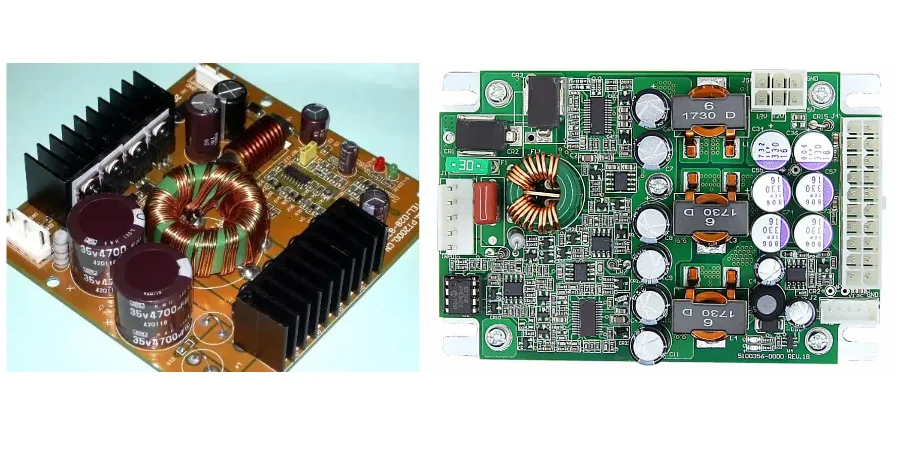
A 48V VRM board is a printed circuit board carrying a voltage regulator module that converts a 48V DC bus to the low voltages (typically 0.8V–1.8V at 100A+ per phase) required by processors, memory, and ASICs. The VRM topology may be a single-stage multiphase buck (common in sub-5V outputs with GaN FETs), a two-stage LLC + buck architecture (popular for 48V-to-1V conversions in data centers), or a hybrid switched-capacitor design (emerging in vertically integrated packaging).
What makes this board category unique from a PCB perspective is that the board is simultaneously a high-current conductor, a heatsink, and a precision analog platform. The power stage carries tens of amps through copper planes, the board must dissipate several watts per square centimeter through its stackup, and the feedback loop and gate drive signals demand controlled impedance to prevent false switching and oscillation.
The transition from 12V to 48V was driven by Google's Open Rack architecture announcement and later adopted across the OCP (Open Compute Project) ecosystem. Today, virtually every new hyperscale rack design specifies a 48V bus. This means the demand for VRM boards that can handle 48V input with extreme current density is growing rapidly — and so is the failure rate among designs that treat these as standard power boards.
Design Decision Matrix: How Fabrication Choices Impact 48V VRM Performance
| Design Decision | Impact on Performance and Yield | Cost Implication |
|---|---|---|
| Copper Weight (2oz vs. 4oz+) | Heavier copper reduces DC resistance and thermal resistance but widens minimum trace/space (typically 8–10 mil for 3oz), making mixed-signal routing harder. | +30–50% per layer vs. 1oz |
| Laminate Tg (150°C vs. 180°C) | High-Tg (≥170°C) prevents Z-axis CTE runaway above Tg, protecting via barrels during lead-free reflow (260°C peak) and continuous operation above 100°C. | +10–15% on material |
| Via Technology (Mechanical vs. Laser Microvia) | Mechanical vias (0.3mm drill) are robust thermal paths but consume routing space. Laser microvias (0.1mm) enable high-density controller fan-out but add lamination cycles. | +20–40% for HDI stack |
| Surface Finish (ENIG vs. Immersion Ag vs. OSP) | ENIG: flat pads for fine-pitch QFN controllers. Immersion Silver: lowest contact resistance for power pads but tarnishes within weeks without N₂ packaging. OSP: cheapest but limited reflow cycles. | ENIG ≈ 2× OSP |
How to Select Materials and Stackup for 48V VRM PCB
Material selection for a 48V VRM board is not about picking the "best" material — it is about matching the material properties to the thermal and mechanical stresses the board will experience over its service life. Here is how to approach the decision.
Laminate selection starts with the glass transition temperature (Tg). For any board that will see continuous operating temperatures above 100°C at the copper surface (which includes most VRM boards under load), you need a Tg of at least 170°C. Isola 370HR (Tg 180°C, Td 340°C) is the industry workhorse for this class of design. If your thermal simulations show hotspots above 130°C, consider IS680 or Panasonic Megtron 4 for their lower Z-axis CTE below Tg.
Copper weight is determined by the current-carrying requirement. Use IPC-2152 (not the outdated IPC-2221 charts) to calculate the required cross-sectional area for your maximum continuous current at an acceptable temperature rise. For most 48V VRM boards, 2oz copper on inner layers is the starting point, with 3oz or 4oz on dedicated power layers. Remember that heavy copper changes the etch factor — a 3oz copper trace specified at 10 mil in the artwork will etch to roughly 6–7 mil at the top due to the trapezoidal etch profile. Your CAM engineer must apply compensation.
Stackup symmetry is critical and often overlooked. If your top two layers are 3oz copper and your bottom two are 1oz, the board will warp like a potato chip during reflow. Mirror the copper weight distribution around the center of the stackup. A typical 6-layer VRM stackup might look like: 3oz / 1oz / 2oz / 2oz / 1oz / 3oz, with controlled-impedance signal layers at positions 2 and 5.

48V VRM Board Layout Rules and Critical Specifications
The following specifications are derived from IPC standards, thermal simulation data, and APTPCB's manufacturing experience with hundreds of Heavy Copper PCB builds. These are not rules of thumb — they are verifiable design constraints.
| Rule | Target Value | Why It Matters | Verification Method |
|---|---|---|---|
| Power Trace Width | Calculate per IPC-2152 for ΔT < 10°C | Undersized traces become fuses at 48V/50A+. A 20A trace on 2oz internal copper needs ~300–400 mil width. | IPC-2152 calculator or Saturn PCB Toolkit; for a quick IPC-2221 first pass, the PCB trace width calculator gives the starting width |
| Clearance (48V to GND) | ≥ 0.25mm (10 mil) minimum | Prevents arcing and leakage current. Account for solder mask misregistration (±2 mil) reducing effective clearance. | DRC in Allegro/Altium/KiCad |
| Thermal Via Pitch | 1.0–1.2mm grid under power pads | Maximizes vertical heat transfer without weakening the board mechanically. Tighter pitch (< 0.8mm) risks annular ring violations. | Gerber drill file review + cross-section |
| Solder Mask Dam | ≥ 4 mil (0.1mm) | Prevents solder bridging on fine-pitch MOSFETs (PQFN 3.3×3.3mm) and gate driver ICs. | CAM DFM check |
| Dielectric Thickness (Prepreg) | ≥ 3 mil between power layers | Ensures Hi-Pot breakdown voltage (500V/mil minimum for FR-4 class materials). | Stackup report from fab |
| Via Plating Thickness | IPC Class 3: avg 25µm, min 20µm | Prevents barrel cracks during thermal cycling. Class 2 (avg 20µm) is insufficient for 48V VRM thermal stress. | Cross-section microsection |
| Creepage (48V functional insulation) | Per IPC-2221B Table 6-1 | 48V is SELV but still requires creepage per pollution degree and material group. | Design rule check |
Step-by-Step 48V VRM Board Layout Process
Moving from schematic to a physical board requires a disciplined sequence. The high currents involved mean that a layout mistake is not just a signal integrity issue — it is a fire hazard.
48V VRM Board Layout Process
From stackup definition to manufacturing handoff
Select a balanced stackup with heavy copper (e.g., 2oz/2oz/2oz/2oz for 4L, or 3oz/1oz/2oz/2oz/1oz/3oz for 6L). Choose High-Tg material — Isola 370HR or equivalent. Engage your fab house before layout to lock impedance profiles and confirm copper weight capability.
Place input ceramic capacitors within 2mm of MOSFET drain pads. Keep the switching node (SW) polygon compact — every millimeter of loop area adds parasitic inductance. Route the Kelvin sense connection separately from the power return path. For GaN half-bridge ICs, follow the vendor reference layout exactly.
Place thermal vias on a 1.0mm grid under every power pad. Use solid connections (no thermal relief spokes) on high-current vias for maximum heat transfer — but inform your assembler, as this affects solder wicking. Connect all vias to inner ground/power planes for heat spreading.
Run DC Drop (IR Drop) simulation to verify voltage stability across the PDN. Run thermal simulation to confirm hotspot temperatures. Submit Gerbers and stackup to your fab for DFM review — heavy copper spacing rules differ from standard (typically min 8–10 mil space for 3oz copper). Use a step-stencil or oversize apertures for large power component pads.
Common 48V VRM Board Failures and How to Fix Them
Even with good design practices, issues surface during prototype testing and early production. Below are the failure modes we see most frequently at APTPCB, along with root causes and corrective actions.
MOSFET Thermal Shutdown or Burnout
Symptom: Power stage shuts down under load, or MOSFETs fail catastrophically during thermal qualification.
Root cause: Insufficient copper area beneath the exposed thermal pad, missing or sparse thermal vias, or no thermal path to an external heatsink. The junction-to-board thermal resistance (Rθ_JB) is typically 1–3°C/W for power MOSFETs — if the board cannot dissipate the heat, Tj exceeds the maximum rating within seconds at full load.
Fix: Increase the copper pour area on all layers connected to the thermal pad. Add thermal vias on a 1.0mm pitch with solid (non-relieved) connections. If FR-4 thermal conductivity (0.3 W/m·K) is insufficient, consider High Thermal Conductivity PCB materials, embedded copper coins, or metal-core (MCPCB) substrates that provide 1–3 W/m·K through the board.
Excessive Voltage Ringing and EMI Failure
Symptom: High-frequency oscillation on the output voltage, conducted or radiated EMI exceeding CISPR 32 limits.
Root cause: High parasitic inductance in the input capacitor loop or switching node. Every 1nH of loop inductance generates a voltage spike of V = L·di/dt during switching transitions. At 48V with 10A/ns slew rates (common with GaN), even 5nH of parasitic inductance produces 50V spikes — enough to exceed the MOSFET's Vds rating.
Fix: Move input ceramic capacitors (MLCC, X7R, 10µF/100V) directly adjacent to the FET drain and source pads, on the same layer. Ensure a solid, unbroken ground plane directly below the high-dI/dt current loop. Add a snubber (RC, typically 1Ω + 100pF–1nF) across the switching node only if ringing persists after layout optimization.
Solder Joint Cracking After Thermal Cycling
Symptom: Intermittent open circuits on power components after thermal shock testing (–40°C to +125°C, 500+ cycles).
Root cause: CTE mismatch between the ceramic MLCC or MOSFET package and the PCB substrate, exacerbated by low-Tg materials that undergo excessive Z-axis expansion above Tg. Via barrel cracking is also common when plating thickness is below IPC Class 3 specifications.
Fix: Upgrade to High-Tg material (Tg ≥ 170°C) to minimize Z-axis CTE above Tg. Verify via plating thickness meets IPC-6012 Class 3 (avg 25µm, min 20µm). For large MLCCs (1210, 1812), use flexible termination capacitors or corner-bonded MLCCs to absorb mechanical stress.
How to Qualify a Manufacturer for 48V VRM Boards
Not every PCB fabricator can handle the heavy copper etching, thermal management, and tight tolerances that 48V VRM boards demand. Use this checklist when evaluating a manufacturing partner.
- Heavy Copper Etching: Can they process 3oz, 4oz, or 6oz copper with controlled etch factor compensation? Ask for cross-section photos of previous heavy copper builds showing trace profile.
- Thermal Solutions: Do they offer embedded copper coin, metal-core (MCPCB), or high-thermal-conductivity laminates beyond standard FR-4?
- Layer Registration: What is their layer-to-layer registration tolerance? For 6+ layer power boards with heavy copper, ±3 mil is the target.
- Cross-Section Analysis: Do they perform microsection analysis on every production lot to verify plating thickness, dielectric thickness, and copper weight?
- Hi-Pot Testing: Can they perform high-voltage isolation testing per IPC-9252 to verify dielectric breakdown compliance at 48V working voltage + margin?
- Impedance Control with TDR: Do they provide TDR reports for the controlled-impedance layers (gate drive traces, feedback signals)?
48V VRM Board Design Cheat Sheet (6 Rules)
| Rule | Physics Rationale | Target |
|---|---|---|
| Minimize Input Loop Area | V = L·di/dt — large loops increase parasitic inductance, causing destructive voltage spikes on FET drain. | Input caps < 2mm from FET pads |
| Use Heavy Copper on Power Layers | Reduces resistive losses (P = I²R) and lowers thermal resistance of the copper plane acting as heatsink. | 2oz–4oz inner layers |
| Maintain Continuous Ground Plane | Any split in the ground plane under the power stage increases loop inductance and destroys the return path for switching currents. | No splits under power stage |
| Dense Thermal Via Array | Vertical heat transfer from top-layer components to inner/bottom copper planes and heatsink. | 1.0mm pitch, solid connection |
| Isolate Gate Drive Signals | Power noise coupling into gate drive traces can trigger false turn-on (shoot-through), destroying both FETs in a half-bridge. | ≥20 mil spacing from SW node |
| Symmetrical Stackup | Asymmetric copper weights cause differential thermal expansion during reflow, warping the board and causing assembly defects. | Mirror copper weights about center |
Glossary of 48V VRM Board Terms
- VRM (Voltage Regulator Module): A DC-DC converter (often multiphase buck or LLC topology) that steps down 48V bus voltage to the low voltages required by processors, typically 0.8V–1.8V at 100A+.
- PDN (Power Delivery Network): The complete electrical path from the 48V bus connector through the VRM, PCB traces, decoupling capacitors, and package to the die. PDN impedance must be flat below the target impedance from DC to hundreds of MHz.
- Tg (Glass Transition Temperature): The temperature at which the FR-4 resin transitions from rigid to rubbery. Above Tg, the Z-axis CTE increases dramatically (from ~50 ppm/°C to ~250 ppm/°C), stressing plated through-holes.
- DCR (DC Resistance): The resistance of a trace, via, or inductor at DC (0 Hz). In a 48V VRM, every milliohm of DCR in the power path wastes power as I²R heating.
- Creepage: The shortest distance along the surface of the PCB between two conductors at different potentials. Determined by working voltage, pollution degree, and material group per IPC-2221B or IEC 62368-1.
- IR Drop: The voltage loss across a conductor due to its DC resistance and the current flowing through it. IR drop across the VRM output plane must be < 1% of the output voltage to maintain regulation accuracy.
FAQ
Q: Why is 48V preferred over 12V for modern data center power?
A: Quadrupling the bus voltage from 12V to 48V reduces the distribution current by 4× for the same power delivery. Since resistive power loss follows I²R, losses drop by 16×. This enables thinner busbars, smaller connectors, and higher rack power density — critical for AI training clusters drawing 100kW+ per rack.
Q: Can I use standard FR-4 (Tg 130°C) for a 48V VRM board?
A: For low-power VRMs (< 50W output), possibly. For high-density VRMs typical of data center applications (200W–1kW per module), standard FR-4 will degrade during lead-free reflow (260°C peak) and may delaminate during extended operation above 100°C. High-Tg FR-4 (Tg ≥ 170°C) is the minimum recommendation; Isola 370HR (Tg 180°C) is the most commonly specified material.
Q: How do I calculate the minimum trace width for power traces on a 48V VRM board?
A: There is no single answer — it depends on current, copper weight, and acceptable temperature rise. Use IPC-2152 (which replaced the outdated IPC-2221 charts). As an example: carrying 20A on 2oz internal copper with a 10°C temperature rise requires approximately 300–400 mil (7–10mm) trace width — or use a full copper pour (plane) for currents above 30A.
Q: Do I need blind or buried vias for a 48V VRM board?
A: Not always. Blind vias are useful when you need to route gate drive or feedback signals on outer layers without punching through inner power planes (which would reduce their current-carrying cross-section). For pure power delivery boards, standard through-hole vias with heavy plating (Class 3) are typically sufficient and more robust.
Q: How should I specify heavy copper in my fabrication drawing?
A: State the finished copper weight for each layer explicitly in the stackup table (e.g., "Layer 2: 3oz Cu finished"). Specify "etch compensation required per heavy copper process" in the fabrication notes. Call out the minimum trace width and space for each copper weight (e.g., "3oz layers: min trace 8 mil, min space 8 mil"). Reference UL-approved heavy copper processes if needed.
Q: What surface finish performs best for 48V VRM boards?
A: ENIG is the safest general choice — it provides flat pads for fine-pitch controller ICs (QFN, WLCSP) and does not oxidize during storage. Immersion Silver offers slightly lower contact resistance on power pads but tarnishes quickly and requires nitrogen-sealed packaging. HASL is generally avoided because the uneven solder coating causes issues with fine-pitch components and BGA pads.
Q: How does a step-stencil help with 48V VRM board assembly?
A: A step-stencil has different thicknesses in different areas — thicker (e.g., 6–8 mil) over large power component pads to deposit more solder paste, and thinner (e.g., 4–5 mil) over fine-pitch controller pads. This is common in VRM assembly where the same board has 0402 decoupling capacitors and large-pad MOSFETs or inductors.
Request a 48V VRM Board Quote and DFM Review
The engineering team at APTPCB specializes in heavy copper fabrication and thermal management solutions for power electronics. To get a comprehensive DFM review and accurate quote for your 48V VRM board, send us:
- Gerber files (RS-274X or ODB++ format)
- Stackup diagram with copper weights specified per layer (e.g., 2oz, 3oz, 4oz)
- Drill files (Excellon NC Drill)
- Fabrication drawing noting Tg requirements, solder mask specifications, and any special thermal via or heavy copper callouts
- Netlist (IPC-356) for electrical verification
Conclusion
A successful 48V VRM board balances three competing demands: electrical efficiency (low DCR, tight voltage regulation), thermal dissipation (the board is the heatsink), and manufacturability (heavy copper etching, symmetric stackups, assembly-compatible pad designs). The rules in this guide — heavy copper on power layers, dense thermal vias with solid connections, minimized switching loop area, and High-Tg materials — are not optional optimizations. They are the baseline requirements for a board that will survive thermal qualification and deliver reliable power over its service life.
Signed, The Engineering Team at APTPCB