X-Ray & CT Inspection

PCB X-Ray Inspection Services

For advanced, high-density electronics, many of the most critical defects are completely hidden—buried inside vias, sealed between layers, or located under BGA and bottom-terminated packages. APTPCB's PCB X-Ray Inspection Services provide a non-destructive way to 'see inside' your boards and assemblies, allowing you to verify build quality and identify hidden defects before products reach your customers.

Get an Instant Quote

Full Quote →
Full Coverage2D/2.5D/3D
DetectedHidden Defects
Precision AnalysisNon-Destructive
Detailed ReportsExpert Review

Why Choose X-Ray Over Traditional Inspection?

Conventional inspection methods are essential, but they only tell part of the story:
  • Visual & AOI focus on surface appearance, alignment, and visible solder joints
  • Electrical tests reveal opens and shorts, but not why they occur or whether a joint is structurally weak
APTPCB's PCB X-Ray Inspection Services go beyond these limitations by delivering:
  • Internal Visibility: X-rays penetrate multiple layers of the PCB, revealing solder joints under BGAs, via barrels, internal traces, and potential delamination that cannot be seen from the outside
  • Higher Defect Detection Accuracy: Our X-ray systems detect microscopic defects such as voids, hidden solder bridges, incomplete reflow, cracked vias, and misaligned BGA balls that are invisible to the naked eye or standard AOI
  • Comprehensive Structural Analysis: From solder joint integrity and via quality to internal routing issues, X-ray inspection covers a wide spectrum of potential failure points—especially in complex, densely populated assemblies

Where Our X-Ray Inspection Services Add the Most Value

As PCB technology advances, X-ray inspection becomes a critical part of a professional quality strategy. APTPCB's X-Ray Inspection Services are especially effective for:
  • High-Density Interconnect (HDI) Boards: Microvias, stacked vias, and ultra-fine traces demand internal verification to ensure long-term reliability
  • Multilayer PCBs with Complex Internal Routing: We help detect inner-layer shorts, opens, or structural defects that no surface method can see
  • Boards with BGA and Other Hidden-Joint Packages: X-ray is the only practical way to confirm solder ball integrity, wetting, and alignment beneath package bodies
  • Miniaturized and Compact Electronics: Wearables, earbuds, IoT modules, and other small devices often pack many components into extremely tight spaces, increasing the risk of hidden defects
By integrating X-ray inspection into your build and validation process, APTPCB helps you de-risk complex designs, validate assembly quality for hidden-joint components, and support the high reliability that modern electronics require.

How APTPCB Conducts PCB X-Ray Inspection

At its core, APTPCB's PCB X-Ray Inspection relies on the same fundamental principles that make medical X-rays possible, adapted for electronic precision.
The Science Behind Our Scan:

A controlled beam of X-rays is directed at the PCB, penetrating through its various layers and components. Different materials absorb X-rays to varying degrees, which creates distinct contrast in the resulting image. A high-resolution detector on the opposite side of the PCB captures this image, providing a clear visualization of the board's internal structure.

APTPCB's PCB X-Ray Inspection Process: Step by Step
  1. Sample Preparation: The PCB is precisely positioned within our X-ray machine, often on a movable stage for optimal inspection angles
  2. Parameter Setting: Our expert technicians meticulously adjust settings such as voltage, current, and exposure time to achieve superior image quality and clarity for each specific board type
  3. Scanning: The X-ray beam systematically moves across the PCB, capturing images from various angles to ensure comprehensive coverage
  4. Image Processing: Advanced software enhances the raw X-ray images, applying algorithms for improved clarity, contrast, and analytical precision
  5. Inspection: Highly trained operators, often augmented by AI systems, analyze these enhanced images to accurately identify any defects or irregularities
  6. Reporting: All findings are thoroughly documented, frequently with annotated images that highlight specific areas of concern and detailed defect classifications

Types of X-ray Inspections: 2D, 2.5D, and 3D CT at APTPCB

APTPCB offers various X-ray inspection capabilities to match your project's specific needs, each with distinct strengths:
  • 2D X-ray Inspection: Provides a flat, top-down view of the PCB, ideal for quick checks and identifying obvious issues like solder bridging. It is effective for initial assessments
  • 2.5D X-ray Inspection: Combines multiple 2D images captured at different angles, offering enhanced depth perception and the ability to reveal hidden solder joints. This is particularly effective for inspecting BGAs and other complex components
  • 3D CT (Computed Tomography) Inspection: Creates a full three-dimensional model of the PCB's internal structure. This allows for 'virtual cross-sectioning' without physically damaging the board, providing the most comprehensive view for critical analysis. APTPCB utilizes 3D CT for the highest levels of reliability and defect analysis

Key Benefits of APTPCB's PCB X-Ray Inspection Services

Detection of Hidden Defects

Uncovers critical issues including solder voids, misalignments, solder bridging, and internal cracks or breaks that would otherwise remain invisible until product failure.
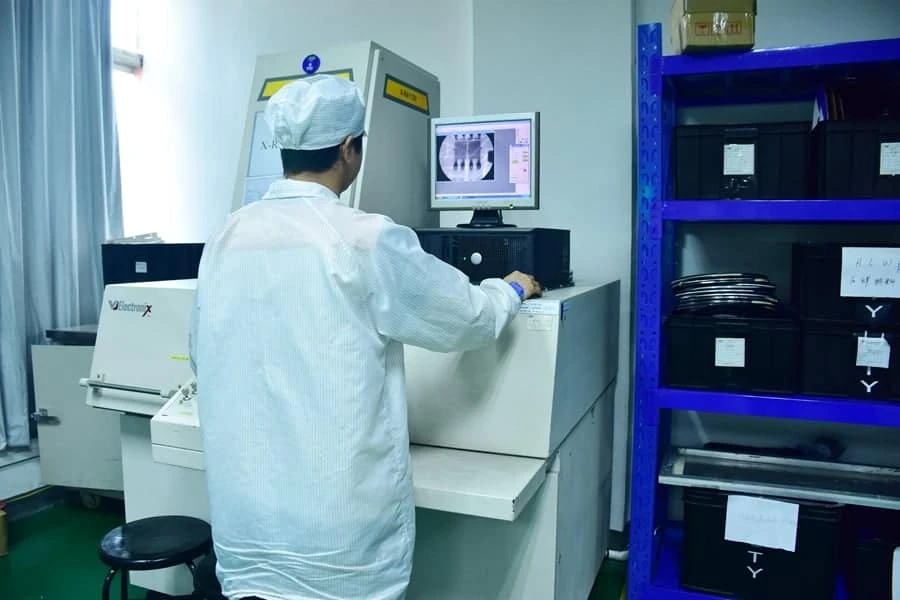
Quality Assurance for Complex PCBs

Provides reliable inspection of multi-layer boards, accurate assessment of dense designs, and assembly validation for miniaturized and hidden-joint components.

Minimized Risk of Product Failure

Catches latent defects early to prevent field failures, reduce warranty claims, and ensure safety and reliability of critical electronic systems.

Cost Savings Through Early Detection

Reduces rework and scrap rates, improves overall yield, and prevents problems from compounding into larger, more costly rectifications.

Common Defects Identified by APTPCB's PCB X-Ray Inspection

Voiding in Solder Joints:
  • Reduces mechanical strength
  • Increases thermal resistance
  • Can cause thermal runaway in power electronics
Open Circuits:
  • Reveals lifted pads, incomplete wetting, micro-cracks
  • Often invisible during AOI or functional test
Short Circuits:
  • Internal bridging between conductors
  • Microscopic solder whiskers under BGA/QFN bodies
  • Copper debris or plating defects
Component Misalignment:
  • Identifies shifted BGAs and misaligned bottom-terminated components
  • Detects tombstoning and insufficient solder volume
Internal Layer Defects:
  • Tracks internal trace breaks
  • Identifies delamination, voids, and structural imperfections
  • Detects via barrel separation or incomplete plating

Partner with APTPCB for Unrivaled PCB X-Ray Inspection

At APTPCB, we understand the critical role that X-ray inspection plays in ensuring the quality and ultimate reliability of your PCBs and PCBAs. Our state-of-the-art X-ray inspection capabilities are a cornerstone of our comprehensive PCB manufacturing and quality assurance services.
Our X-Ray Inspection Expertise:
  • Advanced Systems: Utilizing cutting-edge 2D, 2.5D, and 3D CT X-ray systems for unparalleled insights
  • Experienced Technicians: Our highly trained technicians possess years of specialized experience in X-ray analysis and interpretation
  • Rigorous Quality Control: Implementing robust quality control processes meticulously aligned with the highest industry standards
Don't let hidden defects compromise your products' integrity. Partner with APTPCB to leverage our cutting-edge X-ray inspection capabilities and ensure that your PCBs and PCBAs meet the most stringent standards of quality and reliability.

Get Started with PCB X-Ray Inspection

Contact APTPCB today to receive a quote or discuss how our X-ray inspection services can elevate your PCB quality assurance process.