High-volume PCB assembly inspection and production release

RELEASE BASELINE • CHANGE CONTROL • LOT EVIDENCE

High-volume PCB assembly with controlled production release

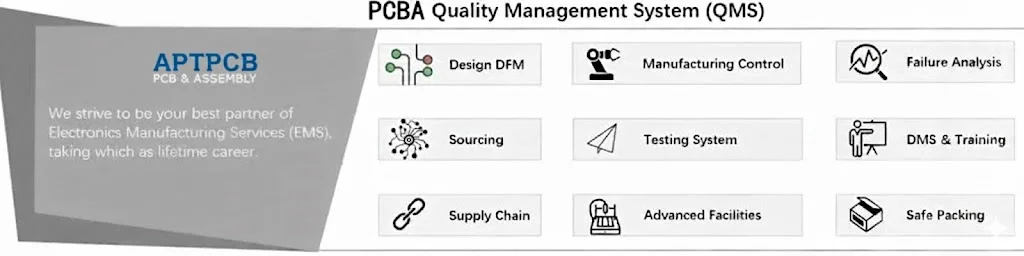
High-volume PCB assembly is the controlled transition from an approved product baseline into repeatable production lots. APTPCB links revision release, material readiness, assembly controls, test strategy, traceability, change approval and replenishment planning before a production slot is committed.

Get an Instant Quote

Revision releasedProduct baseline
BOM and AVL alignedMaterial gate
Controls approvedProcess gate
Coverage definedTest gate
Lot or serial as agreedTraceability
Approval before useChange control
Revision releasedProduct baseline
BOM and AVL alignedMaterial gate
Controls approvedProcess gate
Coverage definedTest gate
Lot or serial as agreedTraceability
Approval before useChange control

What makes PCBA mass production repeatable?

Capacity alone does not make a PCBA program ready for volume. Repeatability comes from one released product baseline, controlled material and process inputs, measurable acceptance criteria, and a change system that prevents the next lot from silently becoming a different product.
This page covers sustaining assembly after engineering release. Use NPI PCB assembly to close prototype and pilot risks, and mass production PCB manufacturing for the bare-board fabrication controls that precede assembly.

What must be released before mass production starts?

Product baseline. PCB revision, editable BOM, AVL, centroid data, assembly drawings, panel requirements, firmware and labeling must identify the same build.
Material baseline. Approved manufacturers, alternates, customer-supplied parts, MSL controls, date or lot-code limits and shortage rules must be explicit before purchasing and kitting.
Process baseline. Stencil, tooling, placement, soldering, press-fit, cleaning, coating and mechanical assembly instructions must match the approved product configuration.
Inspection and test baseline. Required SPI, AOI, X-ray, ICT, boundary scan, programming, functional test and final inspection must have defined methods and acceptance criteria.
Traceability baseline. The order must state whether records stop at the production lot or extend to panel and serial number, and which materials, processes and results remain linked.
Commercial baseline. Lot size, forecast, committed order, delivery split, excess material, packaging, shipment and change-cost responsibility must be agreed before the slot is released.

Prototype, NPI and mass production solve different problems

Prototype assembly proves basic design intent and exposes early manufacturing questions. NPI and pilot builds close design, process, tooling and test gaps. Mass production protects the approved baseline across recurring lots and manages only approved changes.
Moving to volume too early transfers open engineering issues into purchasing, fixtures, work instructions and inventory. The release decision should therefore be based on closed issues and available evidence, not only on a requested quantity.

Choose the production scope before comparing quotes

Turnkey, partial-turnkey and consigned production assign different ownership for components, shortages, excess inventory and incoming quality. Box build adds firmware, cables, labels, mechanical parts, final configuration and system-level acceptance that are not implied by a PCBA-only quote.
The assembly route may combine SMT, through-hole, press-fit or selective soldering, but the released process must be based on the actual component mix, board design, access, cleanliness and product requirements.

How should assembly and test controls be selected?

Paste and placement. Stencil design, paste condition, SPI, placement program and first-piece verification address deposit, polarity, package and alignment risk.
Reflow and soldering. Profile approval, thermal mass, component limits and joint access determine the soldering route; a generic recipe is not suitable for every assembly.
Hidden joints. BGA, QFN and other obscured connections may require X-ray based on risk and agreed acceptance criteria; X-ray does not replace electrical or functional coverage.
Electrical faults. ICT, flying probe, boundary scan or other structural tests depend on access, design-for-test provisions, fault coverage and fixture economics.
Product behavior. Programming and functional testing require controlled software, interfaces, limits, fixtures and failure disposition supplied or approved for the product.
Final release. Visual, dimensional, labeling, cleanliness, packaging and documentation checks follow the customer-approved control plan rather than an automatic universal inspection bundle.

Six release gates from pilot build to repeat production

Gate 1 — Baseline lock. All manufacturing files share one revision and the customer identifies the approved pilot or reference unit.
Gate 2 — Issue closure. DFM, DFA, first-article, pilot, test and supplier exceptions are closed, accepted as deviations or assigned a documented action.
Gate 3 — Material readiness. Approved sources, alternates, consigned inventory, shortages, MSL condition and critical date or lot-code rules are resolved for the lot.
Gate 4 — Process readiness. Programs, tooling, profiles, work instructions, operator criteria and special processes are released for the current configuration.
Gate 5 — Test readiness. Fixtures, software, limits, golden references, data capture and failure disposition are available and tied to the same revision.
Gate 6 — Schedule release. Lot size, capacity window, material commitment, packaging, delivery split and commercial terms are confirmed before the production clock starts.

What evidence should return with each production lot?

The agreed lot record may include the released revision, material or component lot references, route and process status, inspection results, test results, nonconformities, deviations, rework disposition, quantity reconciliation and shipment identifiers.
Evidence depth depends on product risk and contract requirements. Define the deliverable record before quoting so that data collection, retention and review are part of the production plan rather than an after-shipment request.

How do dense or specialized assemblies change the control plan?

Fine-pitch packages, bottom-terminated components, press-fit connectors, heavy thermal masses, rigid-flex interfaces, RF paths and high-current assemblies can change stencil design, support tooling, thermal profiling, handling, inspection access and test coverage.
APTPCB confirms these requirements against the released files and the agreed production route. A technology name does not prove that every stack-up, component combination or test method can be combined in one build without DFM, DFA and fixture review.

Where does PCBA manufacturing responsibility end?

Industrial, medical, automotive, communications and other controlled products may require additional documentation, validation or customer-specific controls. APTPCB can manufacture and inspect the PCBA to the released order requirements, but final product safety, regulatory approval and system-level performance remain with the product owner and its authorized validation process.

Which standards and acceptance criteria belong in the order?

Relevant references may include IPC-A-610J for electronic assembly acceptability, J-STD-001J for soldered electrical and electronic assemblies, IPC-1782B for risk-based traceability, IPC/JEDEC J-STD-033D for moisture-sensitive device handling and IEC 61340-5-1 for ESD control.
The order must define the applicable document revision, class, customer workmanship rules, sampling, inspection, test and acceptance criteria. Listing a standard does not mean every class, test or traceability level automatically applies. Bare-board criteria should be released separately, for example through IPC-6012F and IPC-A-600M when specified.

Traceability must connect revision, material, process and result

A useful identifier does more than print a serial number. It links the shipped unit or lot to the released product revision, relevant PCB and component lots, approved deviations, production route, inspection and test status, and shipment record at the level agreed for the program.
Record retention, access, serialization format and customer data fields must be defined before launch. Do not assume board-level genealogy when the quotation covers only order- or lot-level records.

Material readiness is a production release gate

The released BOM and AVL control what may be purchased and kitted. Component sourcing should distinguish confirmed supply from observed availability, isolate alternates that need approval and expose EOL, NRND, allocation, minimum-order and packaging constraints.
Received material enters production only after the agreed incoming quality control and disposition process. Turnkey and customer-supplied materials require the same revision, ownership and lot-status discipline.

How are changes and exceptions kept out of the wrong lot?

An ECN, AVL change, alternate component, supplier PCN, process deviation, tooling update or firmware revision must identify the affected baseline, open inventory, validation requirement, approval owner and first effective lot.
Material under review stays segregated until disposition. Rework, use-as-is, return, scrap and concession decisions should remain linked to the affected lot so the next repeat order does not inherit an undocumented exception.

Forecasts guide planning; released orders create commitments

Forecast horizon, firm order window, lot size, split deliveries, buffer ownership, component shelf-life, packaging, labeling and shipment mode affect material and capacity planning. These inputs should be separated from generic lead-time language.
Moisture barrier, ESD protection, mechanical support and customer labels are selected for the actual assembly and route. Delivery dates remain conditional until material, capacity, packaging and commercial release are confirmed.

RFQ checklist for high-volume PCB assembly

Product data. PCB manufacturing files, editable BOM and AVL, centroid file, assembly drawings, panel data, revision history and approved reference build.
Process scope. SMT, THT, press-fit, selective soldering, cleaning, coating, programming, mechanical assembly, box build and special handling requirements.
Inspection and test. Acceptance class, customer workmanship criteria, SPI/AOI/X-ray requirements, ICT or boundary-scan access, functional test specification, limits, fixtures and golden references.
Materials. Turnkey or consigned responsibility, approved sources and alternates, MSL/ESD controls, date or lot-code rules, traceability documents and excess-material disposition.
Demand and logistics. Annual forecast, lot sizes, firm order window, required deliveries, split-shipment tolerance, packaging, labeling and destination.
Change and records. ECN approval flow, deviation authority, serialization level, required lot evidence, retention period and customer reporting format.

High-volume PCB assembly FAQ

What is high-volume PCB assembly?

High-volume PCB assembly is the controlled production of repeat PCBA lots from an approved product and process baseline. The release must connect the PCB revision, BOM and AVL, placement data, assembly drawings, firmware, test strategy, acceptance criteria and traceability requirements.

When is a PCBA ready to move from NPI to mass production?

A PCBA is ready when the customer has approved the build baseline and open pilot issues have a disposition. Material, tooling, work instructions, inspection, test, packaging and change-control responsibilities must also be released before the recurring production schedule is committed.

How is mass production different from prototype or NPI assembly?

Prototype and NPI builds are used to discover and close design or process issues. Mass production protects an approved baseline across repeat lots, so revision control, approved materials, qualified tooling, test limits, traceability and formal change approval become the central controls.

What files are required for a high-volume PCBA quote?

Send the PCB manufacturing data, editable BOM and AVL, centroid or pick-and-place file, assembly drawings, panel requirements, firmware and programming instructions, test requirements, acceptance criteria, forecast, packaging specification and current revision history.

How is inspection and test coverage defined?

Coverage is selected from product risk, component and joint visibility, fault coverage, access, volume economics and customer requirements. SPI, AOI, X-ray, ICT, boundary scan, programming and functional test are applied only where the approved control and test plans require them.

Can lot-level or serial-level traceability be provided?

Traceability can be defined at order, lot, panel or serial level as the program requires. The RFQ must state which material, component, process, operator, equipment, inspection, test and shipment records must remain linked and how long records must be retained.

How are engineering changes handled during repeat production?

A proposed ECN, BOM or AVL change, alternate component, process deviation or tooling update is isolated from the released baseline. Its impact, validation need, affected inventory, effective lot and approval owner are recorded before the change enters production.

How do you manage component shortages, EOL and long lead times?

The sourcing plan separates confirmed supply from observed availability and flags shortages, allocation, EOL or NRND status. Split deliveries, last-time buys, alternates or redesign are different decisions; no substitute is released without customer approval or an updated AVL.

Do you support turnkey, partial turnkey and consigned production?

Yes. The production model can be turnkey, partially sourced or fully consigned. The quote and release package should identify purchasing ownership, customer-supplied material, spare quantities, excess and shortage rules, incoming inspection, storage and disposition responsibilities.

When can a recurring production delivery date be confirmed?

A delivery schedule can be confirmed after the released revision, material availability, tooling, test readiness, capacity window, lot size, packaging and commercial terms are aligned. Forecasts support planning, but they do not reserve material or capacity unless the order defines that commitment.

Request a mass-production PCBA release review

Send the released build package, forecast, production scope, test requirements and traceability level. We will identify missing release inputs and prepare a quote around the confirmed material, process and schedule boundaries.