Special PCB manufacturing floor

Advanced Technologies for Complex, High-Performance Designs

Special PCB Manufacturing for Complex, High-Performance Builds

We build complex, high-performance PCBs: multi-layer HDI, hybrid stack-ups, extreme thermal, embedded parts, and high-frequency circuits. For semiconductor test, telecom, automotive, aerospace, and medical electronics.

Get an Instant Quote

±0.05mm cavitiesMechanical Precision
Copper coin / MCPCB / CICThermal Management
Any-layer / mSAP / VIPPOHDI & Microvia

Special PCB Manufacturing: Advanced Technologies for Complex, High-Performance Designs

In the rapidly evolving electronics industry, Special PCB Manufacturing is essential for the most intricate and high-performance applications. From complex multi-layer HDI designs to hybrid material stack-ups, extreme thermal management, embedded components, and high-frequency circuits, we specialize in manufacturing specialized PCBs that meet the most stringent requirements. Whether you are working on the latest semiconductor testing boards, high-performance computing, telecommunication systems, or automotive electronics, our expertise and advanced manufacturing techniques enable you to push the boundaries of innovation.
This service is tailored for industries where performance, reliability, and precision are non-negotiable. From complex via structures to advanced material combinations, our manufacturing capabilities ensure that we can meet your requirements for both high-mix low-volume production and large-scale projects.

Key Special PCB Features and Capabilities

Explore the 10 special PCB capability pillars below—mechanical precision, thermal, HDI, RF/microwave, rigid-flex/3D, semiconductor test, embedded tech, exotic materials, high-voltage, and advanced packaging.

Advanced Mechanical & Depth Control

This category involves physical modifications to the PCB structure, requiring exceptional precision in Z-axis depth control, often within ±0.05mm or even smaller. These features enable complex mechanical functionalities, such as deep cavities for component placement or thermal management.
  • Metal Blind Slot / Metal Cavity PCB: These PCBs are machined with non-through slots on a metal substrate (e.g., aluminum, copper). This allows for the placement of large components or weight reduction, while maintaining the metal base for heat dissipation or shielding. Ideal for high-power electronics such as LED drivers and automotive systems.
  • Step-Down Cavity PCB: Multiple steps are machined into the PCB to expose different layers for wire bonding (such as 2-layer or 3-layer steps). These cavities are crucial for semiconductor packaging, power devices, and other applications where components need to be positioned precisely for electrical connections.
  • PCB Opening / Lid PCB: In certain applications, sections of the solder mask and dielectric layers are removed by laser or mechanical means to expose internal components or heat spreaders. This process is widely used in automotive electronics, high-power systems, and aerospace applications that need specific heat dissipation paths.
  • Backdrilled PCB (Stub Removal): Non-functional sections of vias (via stubs) are drilled out from the back of the PCB to eliminate signal reflection and enhance signal integrity. This is crucial for high-speed data applications, such as 25Gbps+ systems, network switches, and high-performance processors.
  • Controlled Depth Drilling / Routing: Drilling only to a specific depth within the board, rather than through it, to accommodate specialized connectors or mechanical mounting pins. This process is often used in power electronics, where components must be mounted without violating the board's structural integrity.
  • Counterbore / Countersink PCB: These designs involve creating conical or cylindrical recesses around holes for the installation of screws or other mechanical fasteners. Commonly used in industrial systems, medical devices, and consumer electronics where robust mechanical connections are required.
  • Castellated Hole / Half-Cut Via: A half-hole or half-cut via on the edge of the PCB, ideal for module-on-board connections, used in modular electronics and RF systems. This allows easy mounting of devices such as sensors, LEDs, and connectors.
  • Edge Plating / Side-Wetted PCB: The sides of the PCB are plated with metal to improve EMI shielding and grounding. Used in applications requiring robust electromagnetic interference (EMI) protection, such as telecommunication equipment and automotive electronics.

Extreme Thermal Management

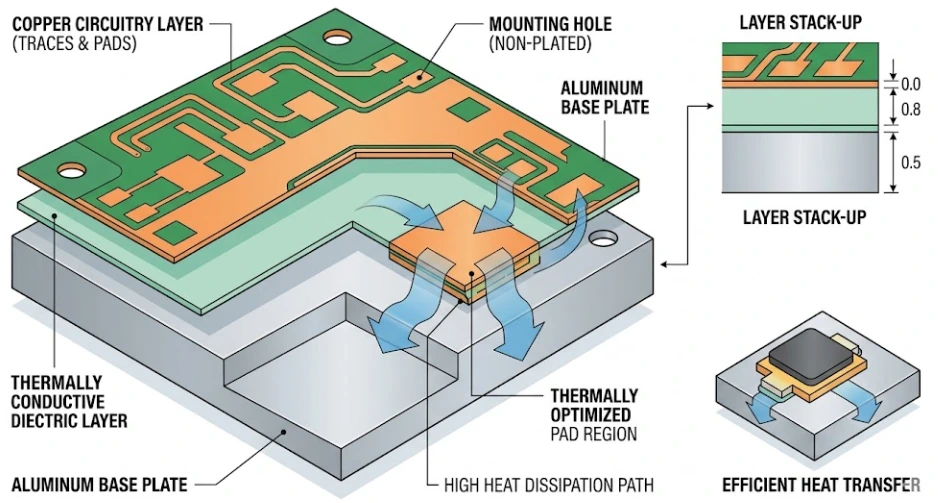
High-power components, such as high-power LEDs, IGBT, and GaN devices, require effective heat dissipation to prevent thermal stress. Our extreme thermal management techniques ensure reliable operation under intense heat conditions.
  • Embedded Copper Coin - I-Type: A copper block embedded throughout the PCB, visible on both sides, designed for thermal management in power electronics. The copper coin improves heat conduction and enhances the overall performance of high-power devices.
  • Embedded Copper Coin - T-Type: A copper coin shaped like a T, embedded within the PCB, offering targeted thermal conductivity for areas with high power dissipation, typically used in power supplies, LED drivers, and power converters.
  • Embedded Copper Coin - U-Type: Specially shaped copper coins embedded within the PCB to avoid component leads while effectively managing heat dissipation in power modules and high-performance LEDs.
  • Sweat Soldering / Post-Bonded Coin: A copper coin placed on the backside of the PCB using conductive adhesives or reflow soldering. This method is typically used for high-current applications and thermal management in automotive electronics.
  • Heavy Copper PCB: With copper thickness reaching 3oz to 10oz per square foot, these PCBs can handle high-power signals and thermal management for devices such as power transistors, high-power LEDs, and power conversion systems.
  • Extreme Heavy Copper / Busbar PCB: Copper thickness exceeding 10oz, even embedded as busbars for handling hundreds of amps in industrial power systems and electric vehicle chargers.
  • Pedestal MCPCB: Metal-based PCB with raised copper pillars that directly connect with LEDs for effective thermal separation and heat dissipation, making it ideal for LED lighting and power electronics.
  • Copper-Invar-Copper (CIC) PCB: Used in aerospace and military applications, this copper-invar-copper laminate is ideal for environments requiring low thermal expansion and high thermal conductivity.

HDI & Microvia Technology

HDI technology allows for high-density interconnections in compact spaces, enabling the design of miniaturized electronics. Our microvia processes support high-speed and high-performance applications such as smartphones, tablets, and advanced graphics cards.
  • Any-Layer HDI (ELIC): An advanced HDI process where each layer is interconnected using stacked microvias without the need for through-holes. This results in highly dense and compact PCBs used in mobile devices, wearables, and automotive electronics.
  • Stacked Microvia PCB (3+ Layers): Multiple layers of stacked microvias created using laser drilling for dense routing and signal integrity. This method is ideal for high-frequency applications such as RF communication, networking equipment, and high-performance computing.
  • Skip Via HDI: Involves drilling from Layer 1 (L1) directly to Layer 3 (L3), skipping Layer 2 (L2) to reduce unnecessary vias and save space. Perfect for high-speed circuits used in data centers and telecommunications.
  • Deep Microvia: Uses high-precision laser drilling to create vias with an aspect ratio that exceeds conventional designs. This is crucial for high-density interconnections in medical devices, automotive applications, and consumer electronics.
  • Via-in-Pad Plated Over (VIPPO/POFV): This method addresses BGA pads with embedded vias, which are filled with resin and plated over, providing a smooth surface and improved solderability for high-density devices like processors and memory chips.
  • mSAP (Modified Semi-Additive Process): A fine-line process that allows for line widths/spacing below 30um, enabling fine-pitch designs used in complex package substrates and advanced telecommunications.

Hybrid & RF/Microwave PCBs

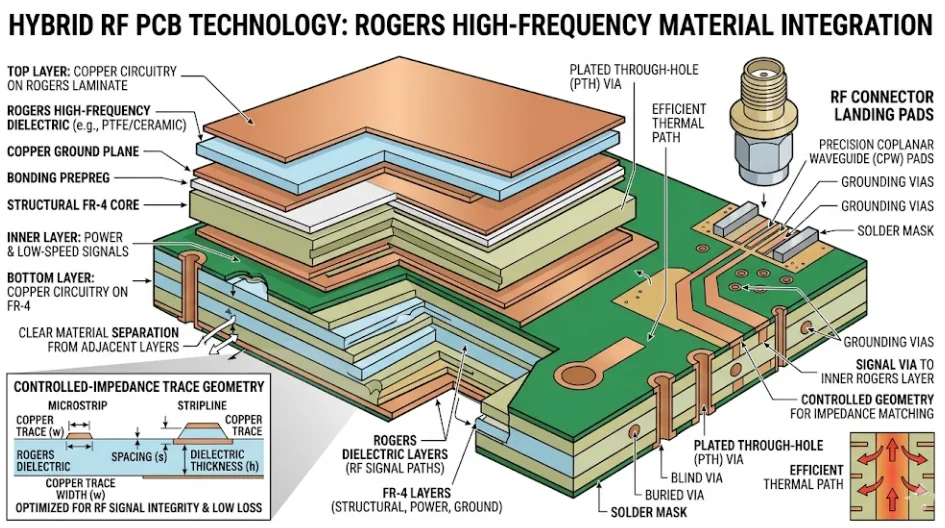
Hybrid PCBs and RF/microwave circuits are used in applications that require precise material combinations, signal integrity, and high-frequency performance. These solutions offer optimal performance in telecom, aerospace, and military electronics.
  • Hybrid Stack-up (FR4 + Rogers/Taconic): FR4 is combined with Rogers or Taconic (high-frequency materials) to achieve the best balance of performance and cost. Commonly used in telecom and satellite communications.
  • Fusion Bonding PCB (PTFE Fusion): A high-temperature PTFE fusion bonding process used for high-frequency radar and other microwave applications requiring extreme precision.
  • Metal-Backed PTFE: PTFE laminated onto a metal backplate such as aluminum or copper for thermal dissipation and signal integrity in RF and high-power applications.
  • Patch Antenna PCB: Specialized microstrip antenna designs for wireless communication and satellite systems. These require strict control over copper foil roughness and dielectric material tolerances.
  • Cavity Filter PCB: Combining RF circuits with precision cavity milling, this solution is used in telecommunications for high-frequency filtering.

Rigid-Flex & 3D Structures

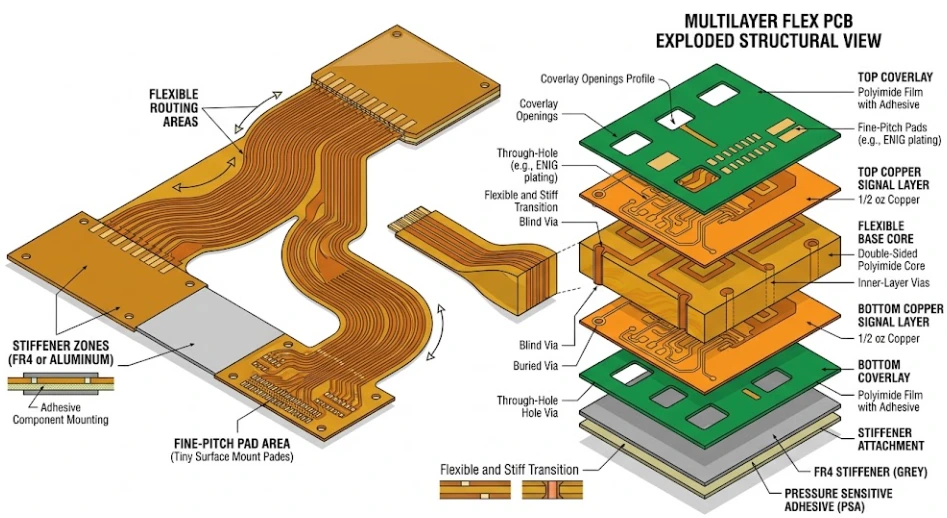
Rigid-flex PCBs and 3D structures are ideal for designs requiring flexibility, compactness, and dynamic bending capabilities, used in wearables, medical devices, and automotive systems.
  • Bookbinder Rigid-Flex: Flexible inner layers are designed for small-radius bending, making them ideal for compact wearable electronics or implantable medical devices.
  • Air-Gap Rigid-Flex: The flexible sections of the PCB are designed with independent layers that are not laminated together, improving flexibility and reliability.
  • Windowed Rigid-Flex: The rigid sections of the PCB have cutouts to expose the flexible circuits beneath. This design is commonly used in applications where both flexibility and rigidity are required.
  • Flying Tail / Finger Flex: A PCB design that extends flexible tails or fingers from a rigid base, ideal for external connections such as display interfaces.
  • Sculptured Flex: Copper conductors are etched and thickened directly, forming pin-like contacts or thermal management pathways for power-sensitive applications.
  • Semi-Flex (Deep Milled FR4): FR4 material milled to a very thin profile (around 0.2mm), offering limited flexibility for applications such as connectors or interface boards.

Semiconductor Test & Substrates

Semiconductor testing boards represent the highest layer counts and largest thickness-to-diameter ratios in the PCB industry, often exceeding 60-100 layers for wafer testing.
  • Probe Card PCB: Test boards for wafer testing, capable of handling up to 100 layers, critical for semiconductor fabrication.
  • Load Board / DUT Board: Test boards designed for post-packaged chip testing, requiring high-frequency performance and high aspect ratios.
  • Burn-in Board: Used for high-temperature testing of chips, typically made from high-TG or polyimide materials, capable of withstanding 250°C+ environments.
  • Coreless Substrate: Substrate made without a core, using multi-layer stacking, common for flip-chip bonding.
  • FC-BGA Substrate: Flip-chip ball-grid array substrates with high-density connections, crucial for advanced ICs.

Embedded Technology

Embedded components within the PCB save space and improve signal integrity, offering solutions for applications ranging from medical devices to consumer electronics.
  • Active Component Embedding (Die Embedding): Bare die embedded directly into the PCB's core layer for high-performance applications like sensors and power management.
  • Passive Component Embedding: Passive components such as resistors and capacitors embedded into the PCB to save space and improve overall signal integrity.
  • Embedded Waveguide / Optical PCB: Incorporating optical fibers or polymer waveguides into the PCB for high-speed optical communication and photonics applications.
  • Embedded NFC/RFID Coil: Coils etched into the PCB for NFC/RFID applications, perfect for contactless payment systems or tracking solutions.
  • Embedded Wire (Wire-laid PCB): A specialized technique where copper wire is placed inside the PCB for high-current delivery, typically used for power electronics.

Exotic Materials & Ceramics

Advanced materials, including ceramics, graphite, and transparent glass, are used in specialized applications requiring high thermal conductivity, low thermal expansion, and electrical insulation.
  • DBC (Direct Bonded Copper) Ceramic: Copper bonded to ceramic substrates, typically used for high-power applications like automotive and industrial power electronics.
  • DPC (Direct Plated Copper) Ceramic: Copper plating on ceramic substrates for precision RF applications.
  • AMB (Active Metal Brazing) Ceramic: Used for high-performance SiC power devices, combining ceramic and metal to form a highly durable bond.
  • LTCC (Low Temperature Co-fired Ceramic): Multi-layer ceramic boards used for high-reliability aerospace and military applications.
  • Transparent Glass PCB: Glass-based substrates used for advanced display technologies and optical electronics.
  • Graphite / Carbon PCB: Graphite or carbon-based PCBs used for their high thermal conductivity, ideal for power-sensitive electronics.
  • Thick Film PCB: Silk-screened conductive inks such as silver paste are printed onto substrates, forming the electrical circuits for hybrid circuits and automated testing systems.

High Voltage PCB Design and Manufacturing

As electronics become increasingly powerful, high voltage PCBs are essential in many applications that deal with large currents and voltages, such as power transmission systems, industrial equipment, and electric vehicles. These PCBs must meet strict safety standards and incorporate specialized design features to ensure reliability and durability under high-voltage conditions.
  • High Voltage PCB Design: High-voltage PCBs are designed with careful consideration of creepage distance and clearance between traces to prevent arc-over and breakdown. These PCBs are often used in applications such as electric power systems, solar inverters, and automotive power supplies. Special attention is given to the dielectric material, which must have high dielectric strength to resist electrical breakdown.
  • Customized Slotting and Vias: Slotting is often employed to manage high-voltage circuit paths, ensuring that the signal does not create unintended arcs. Additionally, specialized vias with reinforced insulation are used in high-voltage designs to prevent short-circuits and ensure reliable power delivery.
  • Use of High-Voltage Materials: We utilize high-voltage rated materials such as high-TG FR4 or ceramic substrates that offer superior insulation properties. These materials can withstand thousands of volts and ensure that the board remains operational without degradation over time.
  • Thick Copper for Power Distribution: Thick copper layers (up to 30oz) are commonly used in high-voltage designs for power distribution systems. This allows the board to handle high currents without overheating, which is critical in applications like power electronics, industrial machinery, and electric vehicle charging stations.

3D PCB Design and Advanced Packaging Solutions

As technology continues to miniaturize, 3D PCBs and advanced packaging solutions are becoming more prevalent. These designs allow for greater functionality in smaller spaces, enabling more compact devices in industries like wearables, IoT, medical devices, and consumer electronics.
  • 3D PCB Integration: 3D PCBs take advantage of vertical stacking and integration of multiple layers, allowing for compact designs that do not compromise on performance. This is ideal for wearables and smart gadgets that require both compactness and high-performance electronics. Multiple layers are interconnected vertically with precision and can include embedded components.
  • Through-Silicon Vias (TSVs): TSVs are vertical interconnects that enable the integration of multiple chips or PCB layers into a single, highly dense 3D package. This approach is critical for advanced microprocessors, memory modules, and system-on-chip (SoC) designs where space-saving and performance are essential.
  • Advanced IC Packaging: We offer flip-chip bonding, BGA (Ball Grid Array), CSP (Chip Scale Package), and 3D packaging solutions for the most demanding applications. These advanced packaging solutions provide greater thermal efficiency, higher speed, and better signal integrity compared to traditional methods.
  • Stacked Chip Integration: Stacked chip designs allow for the stacking of multiple dies in a single package, offering space efficiency and improved power management. This is especially important in applications like smartphones, IoT devices, and high-performance computing systems where real estate is limited but performance demands are high.

Industries We Serve

  • Telecommunications: 5G infrastructure, satellite communications, RF applications.
  • Automotive: ADAS, electric vehicles, power electronics, sensors.
  • Medical Devices: Implantable devices, diagnostic equipment, wearables.
  • Aerospace: High-reliability electronics, satellite communications, avionics.
  • High-Performance Computing: Server PCBs, GPU boards, high-performance interconnects.
  • Consumer Electronics: IoT devices, smartphones, wearables.

Why Partner with Us for Your Special PCB Manufacturing Needs?

  • Unmatched Expertise: With years of experience in crafting high-performance, specialized PCBs, we bring a wealth of knowledge in using advanced materials and innovative manufacturing techniques. We understand the intricacies of complex designs, ensuring your PCB meets the highest standards of functionality and performance.
  • Tailored, Precision Solutions: Every project is unique, and we pride ourselves on offering customized solutions that address your specific needs. Whether it's designing high-frequency circuits, optimizing thermal management, or creating complex multi-layer stack-ups, we work closely with you to ensure your vision is brought to life with precision.
  • Cutting-Edge Technology: We stay ahead of the curve by leveraging the latest state-of-the-art technology in PCB manufacturing. From laser drilling and stacked vias to advanced thermal management solutions and the use of specialized materials, our capabilities ensure your PCBs perform at the highest level, even in the most demanding applications.
  • Rigorous Quality Assurance: Quality is our top priority. Every PCB we manufacture undergoes thorough testing and inspection to ensure it meets the highest standards of performance, reliability, and durability. With our comprehensive quality assurance process, you can trust that your product will consistently perform, no matter the complexity or environment.

Frequently Asked Questions

Answers to the questions we hear most from hardware teams.

What is Special PCB Manufacturing compared to standard builds?

It covers advanced technologies beyond standard FR4: multi-layer HDI, hybrid RF/microwave stackups, rigid-flex/3D structures, extreme thermal solutions (copper coin/heavy copper/MCPCB/CIC), semiconductor test boards, embedded components, exotic materials (ceramics/glass/graphite), and high-voltage/3D packaging.

Which advanced mechanical features can you support?

Metal cavities/slots, step-down cavities, PCB openings, backdrilling, controlled-depth drilling/routing, counterbore/countersink, castellated holes, and edge plating—typically with ±0.05mm depth control.

How do you handle high-power thermal demands?

Embedded copper coins (I/T/U), sweat-soldered or post-bonded coins, heavy and extreme heavy copper, pedestal MCPCB, and CIC laminates for low CTE and better heat spreading.

What HDI and microvia capabilities are available?

Any-layer HDI (ELIC), stacked/skip/deep microvias, via-in-pad plated over (VIPPO/POFV), and mSAP fine-line processes below 30µm line/space.

Which materials and structures are supported for RF/microwave and hybrids?

FR4 + Rogers/Taconic hybrids, PTFE fusion bonding, metal-backed PTFE, patch antennas, and cavity filter PCBs.

Request a Custom PCB Manufacturing & Assembly Quote

Share your stackup, materials, and target application. Our engineers will return DFM guidance, process options, and a confirmed build window for your special PCB program.