What order size counts as mass production?
There is no universal quantity threshold. A program becomes mass production when recurring volume justifies fixed panel arrays, dedicated tooling, controlled change management, scheduled releases, and a documented inspection plan. We confirm the production model after reviewing the design, monthly demand, and delivery schedule.
What should be included in an RFQ for volume PCB or PCBA production?
Provide Gerber or ODB++, fabrication drawings, stack-up and impedance requirements, target quantities, release schedule, and required reports. For PCBA, also provide the BOM, approved vendor list, centroid or pick-and-place file, assembly drawings, test requirements, and approved alternates.
Is a pilot or first-article build required before volume release?
A pilot or first-article build is recommended when the design, material, tooling, supplier, assembly process, or test method is new or changed. The release should define what must be approved, such as dimensions, stack-up, impedance coupons, soldering results, functional tests, and the reference sample.
Which PCB technologies can move into scheduled production?
FR-4 multilayer, HDI, rigid-flex, metal-core, heavy-copper, and selected RF or low-loss constructions can be reviewed for scheduled production. Release depends on the approved stack-up, material availability, process capability, panel design, inspection plan, and application-specific requirements.
How are component shortages and substitutions controlled?
The BOM review identifies lifecycle, lead-time, packaging, and sourcing risks before release. Proposed alternates must meet the required form, fit, function, electrical, and compliance criteria and must be approved by the customer before use. No unapproved substitution should enter production.
Which standards and quality records can support a volume program?
APTPCB company materials list ISO 9001:2015, IATF 16949, and ISO 13485:2016 quality-management certifications. Before supplier approval, verify the current certificate, legal entity, manufacturing site, and scope for the proposed fabrication or assembly route. For rigid bare boards, the purchase specification may reference IPC-6012 performance requirements and IPC-A-600 acceptability criteria; assemblies may reference IPC-A-610. The order must define the class, customer-specific criteria, traceability, and records; product-level approval remains the customer's responsibility.
How is lead time set for a mass-production order?
Lead time is confirmed after material, tooling, component availability, panel quantity, test coverage, documentation, and release cadence are reviewed. Recurring programs can use scheduled releases, but the agreed plan should define forecast windows, firm-order dates, and change cutoffs.
How are bare boards and assembled boards tested at volume?
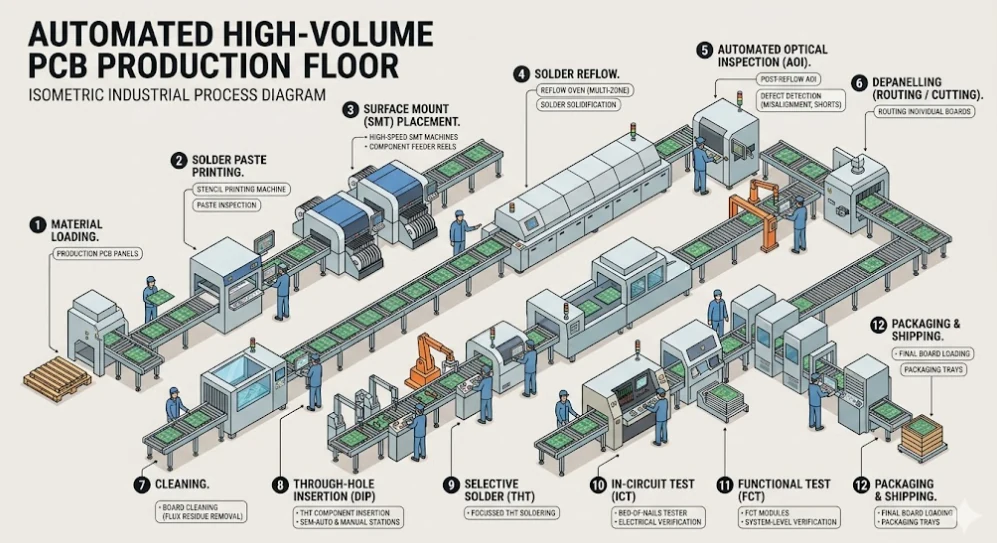
The test plan is design-specific. Bare-board release may combine AOI, electrical test, dimensional inspection, impedance coupons, and microsection sampling. PCBA release may add SPI, AOI, X-ray for hidden joints, in-circuit test, or functional test when specified in the approved control plan.
Can production be shipped in scheduled or split releases?
Yes, when the commercial and logistics plan defines batch quantities, ship dates, storage responsibility, packaging, shelf-life controls where applicable, and the point at which each release becomes firm. Inventory and rescheduling terms should be agreed before production starts.
Which documents can accompany a production shipment?
The required package should be listed in the RFQ and purchase order. Depending on the program, it may include a Certificate of Conformance, material certificates, electrical-test results, impedance reports, first-article records, microsection reports, traceability data, or customer-requested PPAP elements when agreed in the order.