
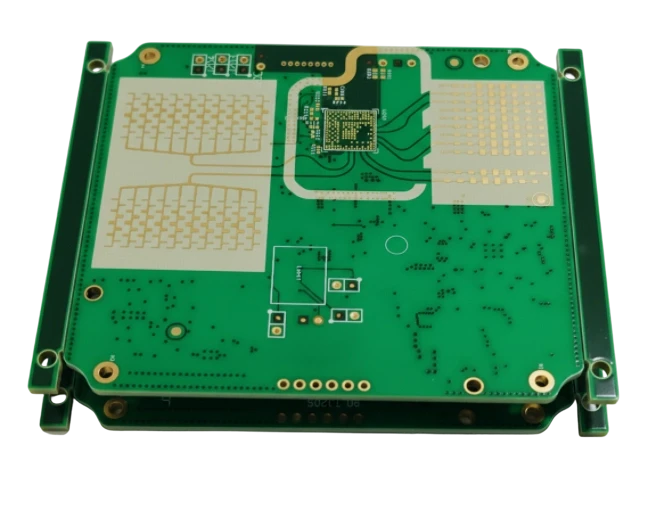
A 5G combiner PCB is not simply a controlled-impedance circuit board. It is part of an RF network that determines how multiple frequency bands or channels are combined while maintaining insertion loss, isolation, return loss, power capability, phase stability, and passive intermodulation (PIM) performance.
The correct design process starts with the RF system requirements and ends with manufacturing evidence. Material selection, stackup construction, connector launches, copper geometry, assembly processes, cleaning, and test configuration all influence the final RF behavior.
What information should be defined before designing a 5G combiner PCB?
The term “combiner” can describe several architectures, including diplexers, triplexers, RF power combiners, and PCB interfaces connected to cavity filters or passive modules.
Before layout begins, define the complete RF network.
| Required input | Why it matters |
|---|---|
| Frequency bands | Determines filter topology, coupling structures and material requirements |
| Number of ports | Defines routing complexity and isolation requirements |
| Port impedance | Establishes RF reference conditions |
| Forward and reverse power | Determines conductor, dielectric and thermal limits |
| Insertion loss target | Controls link budget and heating |
| Return loss/VSWR | Defines mismatch tolerance |
| Isolation requirement | Prevents unwanted interaction between channels |
| Rejection requirement | Controls out-of-band performance |
| Phase/group delay | Protects system synchronization |
| PIM limit | Determines material, contact and process controls |
| Operating temperature | Defines drift and reliability limits |
| Mechanical enclosure | Influences grounding, shielding and connector behavior |
A 50-ohm port specification does not mean every internal structure is a simple 50-ohm transmission line. Couplers, filters, resonators and matching networks must be synthesized and modeled as part of the complete RF structure.
How should the PCB stackup and materials be selected for a 5G combiner?
The RF stackup directly affects impedance, insertion loss, coupling behavior and manufacturing repeatability.
A suitable stackup decision considers:
| Decision | Engineering consideration |
|---|---|
| Transmission structure | Microstrip, stripline or grounded coplanar waveguide must match RF performance needs |
| Dielectric thickness | Controls impedance width, coupling distance and manufacturability |
| Dielectric constant | Affects phase velocity and electrical length |
| Dissipation factor | Influences dielectric loss at operating frequency |
| Copper roughness | Changes conductor loss due to skin effect |
| Copper thickness | Affects resistance and current handling |
| Surface finish | Can affect RF loss, contact reliability and PIM |
| Hybrid construction | Must balance RF layers with mechanical and thermal requirements |
For commercial material scope, see Rogers PCB manufacturing and microwave PCB. The impedance calculator is useful for initial estimates, but final RF structures require stackup-specific modeling.
Which PCB layout features have the highest RF impact?
RF performance is often lost at transitions rather than in straight transmission lines.
Maintain continuous return paths
RF current always follows a return path. Ground discontinuities, plane gaps, poor via transitions and uncontrolled reference changes can create:
- impedance discontinuities;
- unwanted radiation;
- mode conversion;
- isolation degradation.
Ground-via fences may improve shielding and mode control, but spacing, diameter and placement should match the operating frequency.
Model connectors and launches
Connector transitions are part of the RF circuit.
The simulation model should consider:
- connector geometry;
- pad dimensions;
- via transitions;
- antipads;
- mounting hardware;
- enclosure boundaries.
A connector that works electrically in a simple model may introduce significant mismatch after assembly.
Control RF interaction with digital circuits
Some combiners include monitoring, switching or tuning circuits. These sections require:
- controlled bias entry points;
- filtered power paths;
- separated noisy digital routing;
- predictable grounding.
How does power handling affect 5G combiner PCB thermal design?
Insertion loss becomes heat.
Even a small RF loss can create significant temperature rise when transmitting high power continuously.
Thermal analysis should include:
- conductor loss;
- dielectric loss;
- component dissipation;
- connector contact heating;
- reflected power;
- enclosure heat spreading.
Important checks include:
| Area | Evaluation |
|---|---|
| RF traces | Current density and local heating |
| Pads and junctions | Hot spots caused by geometry changes |
| Vias | Thermal extraction capability |
| Connectors | Power and mismatch rating |
| Components | Temperature margin |
| Enclosure | Heat removal path |
Thermal validation should use realistic operating conditions, including waveform, duty cycle, enclosure and airflow.
A room-temperature small-signal VNA measurement cannot confirm high-power thermal stability.
How should passive intermodulation (PIM) be controlled in a 5G combiner PCB?
PIM occurs when strong RF signals interact with nonlinear elements.
Potential sources include:
- contaminated surfaces;
- loose mechanical contacts;
- corrosion;
- damaged plating;
- ferromagnetic materials;
- unstable solder joints;
- current concentration areas;
- poor connector interfaces.
A low-loss laminate alone does not guarantee low PIM performance.
PIM control matrix
| Risk source | Control approach | Verification evidence |
|---|---|---|
| Connector interface | Approved low-PIM connectors and torque control | Assembly records and PIM test |
| Surface finish | Qualified RF-compatible finish | Material/process approval |
| Contamination | Controlled cleaning and handling | Process records |
| Mechanical joints | Stable pressure and contact design | Torque traceability |
| Solder defects | Controlled assembly process | Inspection data |
| Ground path instability | Continuous RF current return | Layout review and test |
IEC 62037-1:2025 provides general requirements for passive intermodulation measurement. The product specification must still define carriers, frequencies, power levels, measurement direction, limits and sampling.
What manufacturing controls are required for repeatable RF performance?
A successful RF design must survive fabrication variation.
| Process variable | RF consequence | Evidence |
|---|---|---|
| Dielectric thickness | Impedance and coupling shift | Controlled stackup documentation |
| Line width/gap | Filter response change | Dimensional inspection |
| Copper thickness | Loss and geometry variation | Cross-section data |
| Registration | Launch and via asymmetry | Registration coupon |
| Connector position | Matching variation | Mechanical inspection |
| Solder volume | Parasitic change | SPI/AOI/X-ray data |
| Coating or mask | Dielectric loading | Process control |
RF coupons should reproduce the actual critical geometry. A standard impedance coupon may not represent a coupled-line filter or combiner structure.
What RF tests should be included in 5G combiner PCB acceptance?
A production acceptance plan should define:
- VNA calibration method.
- Measurement reference planes.
- Cable and adapter configuration.
- De-embedding method where applicable.
- Frequency sweep range.
- S-parameter limits.
- Port termination conditions.
- PIM carrier frequencies and power levels.
- Temperature conditions.
- Serial-number traceability.
- Raw measurement data retention.
Required measurements may include:
- insertion loss;
- return loss;
- isolation;
- rejection;
- phase response;
- group delay;
- PIM level;
- thermal drift.
Golden samples are useful for monitoring test consistency but cannot replace numeric acceptance limits.
What should be included in a 5G combiner PCB supplier RFQ?
A complete supplier package should include:
- schematic and RF block diagram;
- port definitions;
- Gerber or ODB++ files;
- stackup requirements;
- RF laminate requirements;
- controlled impedance information;
- copper and finish requirements;
- connector specifications;
- enclosure and grounding details;
- PIM requirements;
- thermal conditions;
- RF simulation assumptions;
- acceptance limits;
- inspection requirements;
- traceability expectations.
5G combiner PCB decision checklist
| Decision area | Required supplier confirmation |
|---|---|
| RF capability | Experience with microwave and telecom RF boards |
| Materials | Qualified low-loss laminate processing |
| Simulation support | Stackup-aware RF modeling capability |
| Manufacturing | Controlled impedance and RF inspection |
| PIM | Defined low-PIM process and testing |
| Thermal | High-power validation capability |
| Testing | Calibrated RF measurement equipment |
| Documentation | Traceability and production records |
FAQ
Is a 5G combiner PCB just a 50-ohm PCB?
No. Ports may use 50-ohm interfaces, but internal RF structures can require different impedances and distributed electromagnetic behavior.
Does controlled impedance guarantee RF performance?
No. Loss, connectors, transitions, copper roughness, fabrication variation and assembly quality also affect the final result.
Can electrical testing detect PIM problems?
No. Standard continuity testing does not reproduce the high-power multi-carrier conditions that create PIM.
Should every RF trace have solder mask removed?
Not necessarily. Solder mask changes dielectric loading and must be modeled and controlled according to the RF design.
Why can a combiner pass initial testing but fail after assembly?
Mechanical interfaces, connector launches, thermal effects, contamination and process variation can change RF behavior after fabrication.
Build the RF network with manufacturing evidence
A reliable 5G combiner PCB requires alignment between RF requirements, electromagnetic modeling, materials, fabrication processes, assembly controls, PIM management and acceptance testing.
The finished product is not defined by artwork alone. It is defined by the measured RF network delivered from production.