
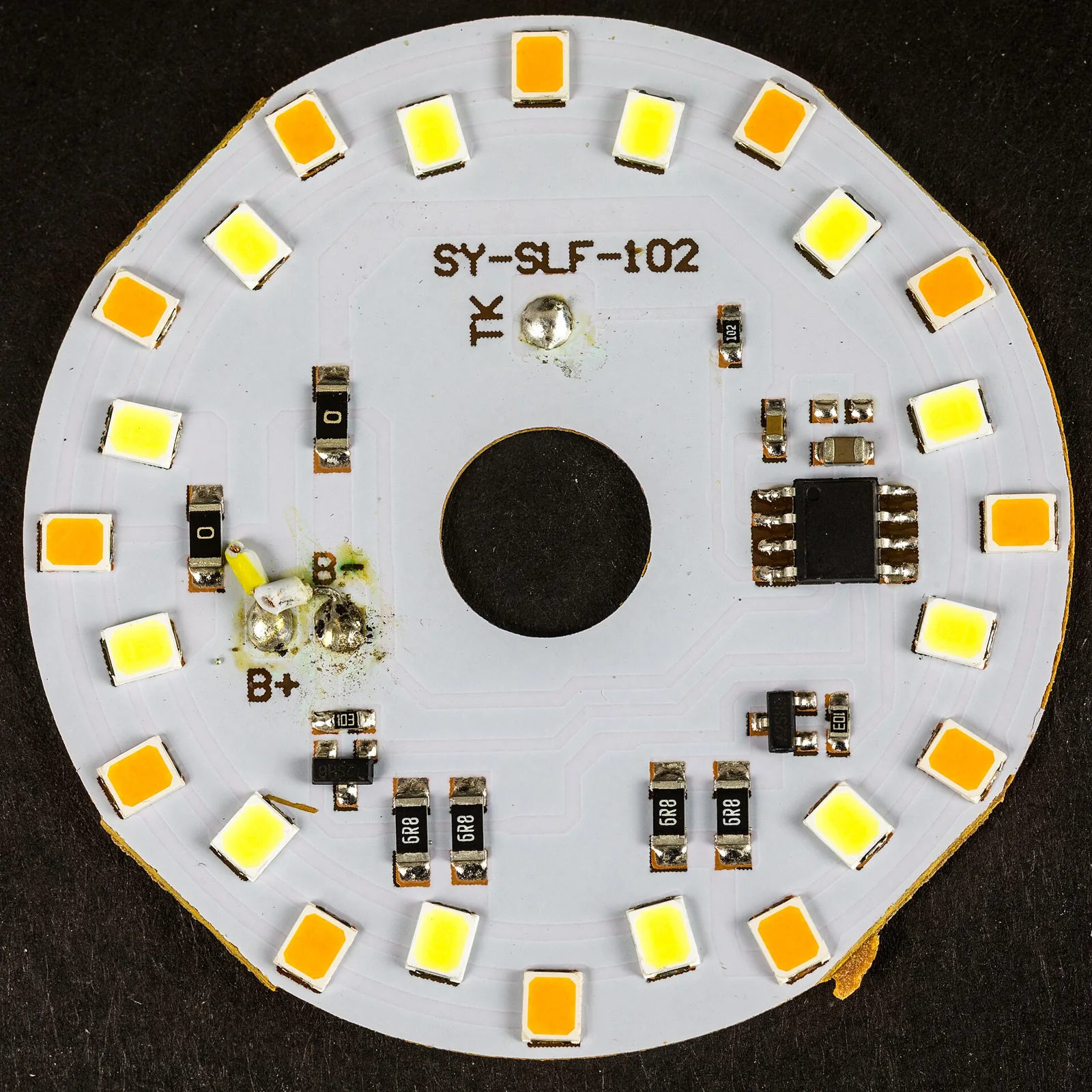
- An aluminum PCB is best chosen as a material decision, not a default thermal upgrade. The question is whether a metal core actually fits the heat, voltage, and routing the design has to carry.
- The construction is built around one thin dielectric between copper and an aluminum base, and that layer carries both the heat path and the electrical isolation at the same time.
- An aluminum core usually competes against FR-4 with thermal vias, heavy copper, and ceramic substrates. Which route wins depends on the trade-off, not on a universal ranking.
- The most consequential choice is rarely the alloy. It is the dielectric, because its thermal and voltage behavior pull in opposite directions and have to be read off the laminate datasheet.
- This is a selection and construction guide. It does not predict finished-product thermal output, LED lifetime, or qualification results.
Quick Answer An
aluminum PCB(also called an insulated metal substrate or metal-core PCB) is best treated as a material selection problem before it is a layout problem. The practical question is notIs aluminum better than FR-4?It isDoes this design's heat load, isolation requirement, and routing actually favor a metal core over FR-4 with vias, heavy copper, or ceramic — and is the dielectric specified to carry both heat and voltage at once?Those answers come from the design constraints and the laminate datasheet, not from a generic best-material claim.
Table of Contents
- What an aluminum PCB is — construction and where it fits
- Selection criteria: when an aluminum core beats FR-4 or other thermal routes
- The dielectric layer is the real decision
- Design and manufacturability trade-offs to confirm
- FAQ
- Public references
- Author and review information
What an aluminum PCB is — construction and where it fits
An aluminum PCB is built around a base metal plate rather than a fiberglass laminate. On top of that plate sits a thin dielectric layer, and on top of that the copper circuit that carries the components. The whole intent of the stack is vertical heat flow: heat from a hot part drops through the copper, through the dielectric, and into the aluminum base, which spreads and holds it. That is structurally different from a standard FR-4 board, where the laminate itself is a poor conductor and heat has to move laterally through copper or down through thermal vias.
It helps to be clear about what an aluminum PCB is not. It is not simply an FR-4 board with better thermals, and it is not a natural fit for dense multi-layer signal routing. The construction is most natural as a single conductive layer over the dielectric and plate, so a design that needs many routing layers is often a different problem than a thermal one. Where the metal core specifically is the question, Metal Core PCB is the primary reference. Where the driving constraint is moving heat out rather than the metal backing itself, High Thermal PCB frames the wider option set, and Heavy Copper PCB is the comparison point when lateral spreading in thick copper is part of the strategy.
Aluminum cores fit most naturally where a concentrated heat source sits on a board that also needs to stay mechanically rigid and mount flat against a heatsink or chassis — LED lighting and power conversion are the common homes. Whether that fit is real for a given design is a selection call, which is the next section.
Selection criteria: when an aluminum core beats FR-4 or other thermal routes
An aluminum core is one of several thermal routes, and it is not automatically the best one. The honest framing is a comparison against the alternatives, each of which wins under different constraints. Treat the table below as a way to locate your design, not as a ranking.
| Thermal route | Tends to fit when | The trade-off to weigh against it |
|---|
When sizing high-current traces on single- or double-sided aluminum IMS boards, verify conductor width and thermal rise with the PCB trace width calculator (IPC-2221).
| Aluminum core (IMS / MCPCB) | A concentrated heat source needs a short vertical path to a spreader, the board is mostly single-layer, and rigidity and heatsink mounting matter | Largely single-sided; plated through routing is awkward; the dielectric becomes the limiting interface | | FR-4 with thermal vias and heavy copper | The design needs multi-layer routing and the heat load is moderate enough to manage through a via field and copper spreading | Lateral and via-based heat paths are less direct; via design and copper balance get complex; see PCB Stack-Up | | Heavy copper on FR-4 | Lateral spreading and high current carrying dominate over pure vertical extraction | Adds copper cost and processing; thermal path is still through laminate vertically; see Heavy Copper PCB | | Ceramic substrate | Very high heat flux, high operating temperature, or demanding isolation push past what a polymer dielectric comfortably handles | Higher cost, smaller panel sizes, and different handling; see Ceramic PCB |
The selection logic that holds up is this: an aluminum core earns its place when the heat path wants to go straight down into a spreader, the routing stays simple, and mechanical rigidity is useful. The moment the design needs real multi-layer routing, or the heat flux climbs past what a polymer dielectric handles comfortably, the comparison shifts toward an FR-4 hybrid or ceramic. None of these is a universal winner, and "aluminum is the best thermal material" is the claim worth resisting. For application context where these decisions recur, Power & Energy PCB and Communication Equipment PCB show the kind of designs where the trade-off is live.
The dielectric layer is the real decision
Most selection conversations start with the aluminum alloy. That is usually the wrong starting point. The alloy affects machinability, stiffness, and how the panel behaves under V-scoring, but it rarely decides whether the board works thermally or electrically. The dielectric does.
The dielectric is the center of gravity because it is asked to do two opposing jobs at once. It is the thermal series element between the copper and the aluminum base, so its conductivity and thickness set how much thermal resistance sits between the component and the spreader. It is also the isolation barrier, so the same layer has to hold off the operating voltage between the circuit and the metal base. These two roles pull against each other directly. A thinner dielectric moves heat better but offers less voltage isolation; a thicker one isolates better but adds thermal resistance. Where that balance should land is a selection decision tied to the laminate datasheet and the operating voltage, not a universal best value.
This is the trade-off that, if mis-specified, surfaces only under sustained load. The thin dielectric between the copper and the aluminum base is simultaneously the heat path and the electrical isolation. If its thermal-versus-voltage trade-off is set wrong, the result is one of two quiet failures: a dielectric chosen for isolation can leave too much thermal resistance in the path, or a dielectric thinned for heat transfer can leave too little isolation margin. Neither shows up as an immediate open or short. They show up later — as thermal derating once the board runs hot for a sustained period, or as dielectric stress that accumulates under repeated heating and cooling. The early electrical checks can pass while the board is already carrying a margin problem that only the operating condition reveals.
The practical consequence is that the dielectric specification belongs in the fabrication notes by its datasheet properties, not as a generic "MCPCB" or "aluminum board" label. Naming the laminate family and confirming its conductivity, thickness, and isolation rating against the design's voltage and heat load is the step that makes the selection real. Treat any specific thermal-conductivity figure, dielectric thickness, or breakdown rating as a number to confirm from the laminate datasheet, not one to assume. Surface-finish choices that affect solder wetting flatness on these boards are covered in PCB Surface Finishes.
Design and manufacturability trade-offs to confirm
Once the substrate route and dielectric direction are set, a handful of construction realities decide whether the design is buildable as drawn. These are trade-offs to confirm early, because most of them are hard to change after layout.
| Confirm before layout lock | What to check | Why it is a selection issue |
|---|---|---|
| Layer count and routing | The design is genuinely single-layer-friendly, or a hybrid build is planned and priced | Standard aluminum cores are single-sided; plated through routing to the other side fights the construction |
| Interconnect strategy | Crossovers are handled by jumpers or planned routing, not by assuming through-hole vias | A standard plated via shorts to the metal core; routing has to respect that constraint |
| Copper weight | Copper weight matches the lateral-spreading need before heat passes vertically through the dielectric | Heavier copper spreads heat sideways first; it is a deliberate trade against cost and etch resolution |
| Alloy versus mechanical need | The alloy family matches whether the board is tapped, machined, V-scored, or formed | A softer alloy can strip threads or deform on V-scoring; a harder one machines cleaner — confirm against the mechanical drawing |
| Edge and isolation clearance | Copper-to-edge and copper-to-V-score clearance keeps the circuit away from the exposed metal edge | Too little clearance risks exposing copper at the cut or arcing to the base |
| Dielectric integrity through handling | Edges and isolation expectation survive depaneling and handling, per the laminate datasheet and any hi-pot requirement | The dielectric is both heat path and isolation; damage there is hard to see and serious |
| Panel flatness and warp | The construction and processing keep bow and twist within the agreed acceptance class | A bowed board breaks contact with its heatsink regardless of how good the joints are |
The recurring theme is that aluminum-core construction trades routing flexibility for a direct thermal path, and most of its constraints follow from that single trade. A design that quietly assumes FR-4 freedoms — vias anywhere, easy multi-layer, generous edge routing — will fight the substrate. Confirming these against the actual mechanical drawing and the laminate datasheet before layout lock is what keeps the selection honest. When the package needs manufacturing-note alignment, DFM Guidelines is the companion resource, and for inspection and validation language at board level, Testing & Quality is the closest support page.
When the substrate route, dielectric direction, and construction constraints are settled and you want a manufacturing review against your own files and acceptance criteria, the metal core PCB thermal review request is the place to start that conversation.
FAQ
Is an aluminum PCB always better than FR-4 for thermal management?
No. An aluminum core gives a short vertical heat path into a spreader, which is strong for a concentrated source on a mostly single-layer board. But FR-4 with thermal vias and heavy copper can handle moderate loads while keeping multi-layer routing, and ceramic substrates handle higher heat flux and isolation demands. It is a trade-off against routing, heat load, and cost, not a universal upgrade.
Why is the dielectric the most important part of the selection?
Because it does two opposing jobs at once. The same thin layer is the heat path between copper and the aluminum base and the electrical isolation between them. A thinner dielectric moves heat better but isolates less; a thicker one isolates better but adds thermal resistance. Where that balance lands is a datasheet-and-voltage decision, which is why it matters more than the alloy choice.
What goes wrong if the dielectric trade-off is specified incorrectly?
The failure is usually quiet at first. A dielectric set for isolation can leave too much thermal resistance, so the board derates thermally under sustained load. A dielectric thinned for heat transfer can leave too little isolation margin, so dielectric stress accumulates under repeated heating and cooling. Neither appears as an immediate fault in early electrical checks; both surface later under the operating condition.
Does the aluminum alloy choice decide whether the board works?
Rarely on the thermal or electrical side. The alloy mainly affects machinability, stiffness, and how the panel behaves under V-scoring, threading, or forming. Match the alloy family to the mechanical drawing — tapped holes and machining favor a harder family, while a softer one can deform. The thermal and isolation performance is governed by the dielectric, not the alloy.
Can an aluminum PCB be multi-layer or use plated through-holes?
Standard aluminum cores are single-sided, and a plated through-hole would short to the metal base. Crossovers are usually handled with jumpers, and genuine multi-layer needs are typically met with an FR-4 hybrid bonded to aluminum rather than a true multi-layer metal core. Confirm the construction with the manufacturer before layout, because this constraint shapes the whole routing strategy.
How should the dielectric and stackup be written in the fabrication notes?
By the laminate's datasheet properties against your design's voltage and heat load, not as a generic "MCPCB" label. Name the laminate family and state the dielectric direction you need, then confirm conductivity, thickness, and isolation rating from the datasheet. Treat any specific thermal-conductivity figure or breakdown rating as a value to confirm from the source, not one to assume.
Public references
Metal Core PCB Primary support page for metal-core and IMS substrate selection and construction.
High Thermal PCB Support-page context for the wider set of heat-removal substrate options.
Heavy Copper PCB Support-page context for lateral spreading and high-current copper construction.
Ceramic PCB Support-page context for high-heat-flux and high-isolation substrate alternatives.
PCB Stack-Up Support-page context for layer definition and controlled construction planning.
DFM Guidelines Support-page context for manufacturing review intake and pre-release clarification.
Author and review information
- Author: APTPCB editorial team
- Technical review: Materials / thermal PCB engineering review team
- Review scope: Material selection, dielectric and substrate trade-offs, aluminum-core construction, and manufacturability consistency at the board boundary