

Contents
- What is an annular ring in PCB manufacturing?
- How do drill tolerance and hole size affect annular ring reliability?
- What annular ring size should a PCB design use?
- Annular ring decision matrix for PCB designers
- How to implement annular ring rules before fabrication
- PCB annular ring failure modes and troubleshooting
- PCB supplier qualification checklist
- FAQ
- Conclusion
What is an annular ring in PCB manufacturing?
An annular ring is the remaining copper area surrounding a drilled PCB hole. It forms the electrical and mechanical connection between the hole barrel, via pad, component lead, and internal copper layers.
The basic calculation is:
[ \text{Annular Ring}=\frac{\text{Pad Diameter}-\text{Hole Diameter}}{2} ]
However, production reality is more complex because PCB manufacturers do not drill exactly at the theoretical CAD center. Drill positioning error, material movement, tool wear, and lamination variation all reduce the available copper margin.
A design that appears acceptable in CAD can fail during fabrication if the remaining copper after drilling becomes too small.
The main failure condition is drill breakout:
- The drill removes part of the copper land.
- The connection between the pad and trace becomes weakened or disconnected.
- The defect may appear only after thermal cycling or vibration.
For high-density multilayer boards, annular ring control becomes especially important because inner layers can experience registration movement during lamination.
How do drill tolerance and hole size affect annular ring reliability?
The most common design mistake is calculating annular ring using the finished hole diameter only.
A PCB designer may define:
- Finished hole: 0.30 mm
- Pad diameter: 0.50 mm
The theoretical ring is:
[ (0.50-0.30)/2=0.10mm ]
However, a plated through hole normally requires a larger drill tool because copper plating reduces the final hole diameter.
Example:
- Finished hole: 0.30 mm
- Drill tool: 0.40 mm
- Pad diameter: 0.50 mm
Actual ring:
[ (0.50-0.40)/2=0.05mm ]
The manufacturing margin has been reduced by half.
Drill tolerance includes several contributors:
| Source of variation | Effect on annular ring |
|---|---|
| CNC drill positioning accuracy | Moves hole away from pad center |
| Drill bit deflection | Creates off-center holes, especially with small tools |
| Spindle runout | Reduces drilling precision |
| Panel movement | Changes layer registration |
| Lamination expansion | Affects inner-layer alignment |
What annular ring size should a PCB design use?
The correct value depends on board class, manufacturing capability, and reliability requirements.
A practical starting point for standard rigid PCB fabrication is:
| Parameter | Standard PCB | High reliability / HDI |
|---|---|---|
| Outer-layer minimum annular ring | 5 mil (0.127 mm) | 3.5 mil (0.089 mm) |
| Inner-layer minimum annular ring | 5 mil (0.127 mm) | 4 mil (0.10 mm) |
| Mechanical drill tolerance | ±3 mil (0.075 mm) | ±2 mil (0.05 mm) |
| Typical via pad increase | Hole + 10-12 mil | Hole + 6-10 mil |
| Teardrops | Recommended | Strongly recommended |
IPC Class 2 designs generally allow more manufacturing flexibility, while Class 3 applications require tighter control and higher reliability margins. Manufacturers define their own achievable limits based on equipment and process capability.
Annular ring decision matrix for PCB designers
The best annular ring specification balances routing density, fabrication cost, and field reliability.
| Design decision | Benefit | Trade-off |
|---|---|---|
| Larger via pad diameter | Higher yield and stronger copper connection | Uses more routing space |
| Smaller pad diameter | Improves density | Requires tighter manufacturing control |
| Mechanical drill | Lower fabrication cost | Larger tolerance margin required |
| Laser microvia | Enables HDI density | Higher process cost |
| Teardrops | Improves resistance to breakout | Slight CAD complexity |
| Larger component pads | Better solder reliability | More board area |
For example:
- A consumer prototype may prioritize compact routing.
- An automotive controller may prioritize annular ring margin and inspection evidence.
- Aerospace or medical electronics may require Class 3-level controls.
How to implement annular ring rules before fabrication
Configure CAD rules using manufacturing capability
PCB design rules should be defined before routing begins.
Set:
- Minimum annular ring constraints.
- Via pad and hole relationships.
- Inner-layer and outer-layer differences.
- Hole-to-copper clearance.
- Teardrop requirements.
Modern PCB tools can detect minimum annular ring violations during DRC checks before files reach fabrication.
Calculate pad size from production requirements
A practical calculation approach:
Pad Diameter = Finished Hole + Plating Allowance + 2 × Manufacturing Margin
Example:
For a 0.30 mm finished via:
- Finished hole: 0.30 mm
- Drill allowance: approximately 0.10 mm
- Required ring margin: 0.10 mm total
A typical pad diameter may become approximately:
0.30 + 0.10 + 0.20 = 0.60 mm
The final value should match the PCB manufacturer's capability.
Use teardrops for vulnerable connections
Teardrops enlarge the copper transition between the trace and pad.
They are especially useful for:
- Small vias.
- Thin traces.
- High vibration environments.
- High-layer-count boards.
They provide additional mechanical support if the drill approaches the edge of the pad.
PCB annular ring failure modes and troubleshooting
| Failure mode | Visible symptom | Root cause | Corrective action |
|---|---|---|---|
| Drill breakout | Hole cuts into pad edge | Insufficient ring margin or drill offset | Increase pad size, improve drill capability |
| Inner-layer breakout | Outer layer looks correct but internal connection fails | Lamination registration error | Improve stackup control and scaling compensation |
| Intermittent electrical failure | Failure appears during temperature cycling | Weak copper connection | Increase annular ring and verify plating |
| Excessive cost increase | Fab requests engineering review | Design exceeds standard capability | Adjust pad size or select advanced process |
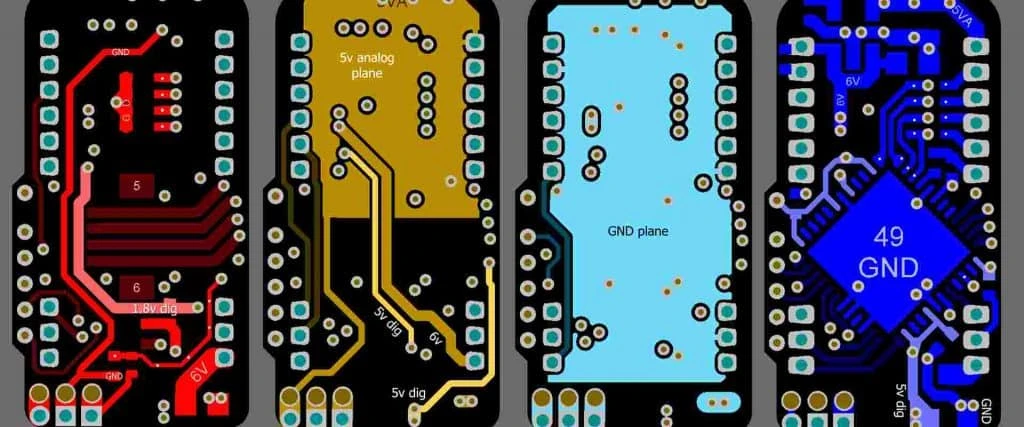
Annular ring failures are often discovered late because the defect may not be obvious from external inspection. Electrical testing, microsection analysis, and cross-section review are commonly used to validate internal connections.
PCB supplier qualification checklist
Before releasing a design with tight annular ring requirements, confirm the manufacturer's process capability.
- What minimum annular ring values are supported for outer and inner layers?
- What drill positional tolerance is guaranteed?
- Are mechanical drilling and laser drilling capabilities separated?
- Is X-ray drilling alignment available for multilayer boards?
- Are lamination scaling factors applied based on material behavior?
- Can the supplier provide microsection reports?
- Are IPC Class 2 or Class 3 requirements documented?
- Does CAM review check drill breakout risks before production?
A supplier with strong CAM engineering support can often identify manufacturability problems before tooling begins.
Glossary
Annular Ring: Copper remaining around a drilled PCB hole.
Breakout: A condition where the drill removes part of the surrounding copper pad.
Drill Wander: The deviation between intended hole location and actual drilled location.
Teardrop: A copper reinforcement feature connecting a trace to a pad.
PTH: Plated through hole containing a copper barrel.
Aspect Ratio: PCB thickness divided by drilled hole diameter.
FAQ
What is the minimum annular ring for a standard PCB?
A practical standard target is approximately 5 mil (0.127 mm) for many Class 2 rigid PCB applications. Final requirements depend on manufacturer capability and board reliability requirements.
Why does the drill tool size matter more than the finished hole?
Because the drill tool creates the original hole before copper plating. The finished hole becomes smaller after plating, so using only the finished diameter can overestimate available annular ring.
Are smaller annular rings always better for high-density PCB designs?
No. Smaller rings increase routing density but require better fabrication control and may increase manufacturing cost.
Do HDI microvias need the same annular ring rules?
No. Laser-drilled microvias have different process capabilities and can support smaller geometries than mechanical drilled holes.
Request a Quote / DFM Review for Annular Ring Rules and Drill Tolerance for PCB
Ready to validate your PCB design before production? Submit:
- Gerber files.
- Drill files.
- Stackup information.
- IPC class requirements.
- Manufacturing constraints.
A DFM review can identify annular ring, drill, and registration risks before fabrication begins.
Conclusion
Annular ring design is a manufacturing reliability decision, not only a CAD geometry decision.
Reliable PCB designs account for:
- Finished hole versus drill tool size.
- Drill positioning tolerance.
- Layer registration movement.
- IPC reliability requirements.
- Supplier process capability.
The most robust designs balance copper margin, routing density, fabrication cost, and field reliability. By defining annular ring rules early and validating them with a qualified PCB manufacturer, engineers can reduce breakout defects and improve production yield.
APTPCB engineering teams support DFM reviews, PCB fabrication planning, and reliability-focused design optimization for prototype and production programs.