
Automatic Number Plate Recognition (ANPR) systems are the backbone of modern traffic management and security. At the heart of these systems lies the ANPR Camera PCB. This printed circuit board is not just a carrier for components; it is a high-speed data highway that must endure harsh outdoor environments while processing complex optical data in real-time.
Whether you are designing a fixed highway camera or a mobile unit for law enforcement, the PCB determines the reliability of the capture. A failure in the board means a missed license plate, lost revenue, or a security gap.
This guide covers everything you need to know about engineering and manufacturing these critical boards. We draw on the manufacturing experience of APTPCB (APTPCB PCB Factory) to provide actionable insights, moving from basic definitions to advanced validation strategies.
Key Takeaways
Before diving into the technical details, here are the critical points every engineer and procurement manager should know.
- Signal Integrity is Paramount: ANPR cameras often use high-resolution sensors (similar to a 4K Camera PCB or 8K Camera PCB). The PCB must handle high-speed differential pairs without data loss.
- Thermal Management is Non-Negotiable: Continuous image processing generates significant heat. The PCB stackup must facilitate efficient heat dissipation.
- Environmental Durability: Most ANPR units sit outdoors. The PCB requires robust surface finishes and protection against moisture and UV radiation.
- Vibration Resistance: For mobile units, the mechanical stability must rival that of an Action Camera PCB.
- Validation Standards: Adherence to IPC Class 2 or Class 3 standards is essential for long-term reliability.
- Misconception: A standard FR4 board is rarely sufficient for high-end ANPR applications; specialized high-Tg materials are often required.
What Automatic Number Plate Recognition (ANPR) Camera PCB really means (scope & boundaries)
Building on the key takeaways, we must define the specific scope of an ANPR Camera PCB. It is distinct from standard CCTV boards due to the requirement for high-speed image processing at the edge.
The Definition
An ANPR Camera PCB is a specialized circuit board designed to support the optical sensor, image signal processor (ISP), and communication modules required for capturing and analyzing license plates. Unlike a standard surveillance camera that streams video, an ANPR camera often performs Optical Character Recognition (OCR) directly on the device. This requires a PCB layout that supports high-performance processors and memory (DDR) with minimal latency.
Core Functions
- Sensor Interface: Connects the CMOS/CCD sensor to the processor. This often involves MIPI CSI-2 lanes requiring strict impedance control.
- Illumination Control: Manages IR (Infrared) LED arrays for night vision. The PCB must handle high current pulses without introducing noise to the image sensor.
- Data Processing: Supports the CPU/GPU/FPGA. This area requires high-density interconnects (HDI) similar to a Body Camera PCB but often with higher power requirements.
- Connectivity: Manages Ethernet (PoE), Wi-Fi, or 4/5G modules for data transmission.
Scope Boundaries
- Includes: The mainboard, sensor board, IR LED board, and power management board.
- Excludes: The external housing, lenses, and mounting brackets (though the PCB mechanical outline must fit these precisely).
Automatic Number Plate Recognition (ANPR) Camera PCB metrics that matter (how to evaluate quality)
Understanding the definition helps, but you cannot manage what you do not measure. To ensure your ANPR Camera PCB performs correctly, you must track specific physical and electrical metrics.
The following table outlines the critical metrics for evaluating board quality.
| Metric | Why it matters | Typical Range / Factors | How to measure |
|---|---|---|---|
| Glass Transition Temp (Tg) | Determines at what temperature the PCB material becomes unstable. ANPR cameras run hot. | High Tg (>170°C) is recommended for outdoor/enclosed units. | Differential Scanning Calorimetry (DSC). |
| Impedance Control | Critical for high-speed video data (MIPI, Ethernet, USB). Mismatches cause signal reflection. | ±10% or ±5% tolerance on 50Ω single-ended or 100Ω differential pairs. | Time Domain Reflectometry (TDR) coupons. |
| CTE (z-axis) | Coefficient of Thermal Expansion. High expansion breaks plated through-holes (PTH) during thermal cycling. | < 3.5% (50°C to 260°C) is ideal for reliability. | Thermomechanical Analysis (TMA). |
| Dielectric Constant (Dk) | Affects signal propagation speed. Stable Dk is needed for high-frequency data. | 3.4 to 4.5 (depending on frequency and material). | Resonator method or material datasheet verification. |
| CAF Resistance | Conductive Anodic Filament growth causes shorts in humid outdoor environments. | Must be "CAF Resistant" grade material. | IPC-TM-650 2.6.25 test method. |
| Copper Thickness | Ensures adequate power delivery to IR LEDs and processors (PoE applications). | 1 oz to 2 oz inner/outer layers is common. | Microsection analysis. |
How to choose Automatic Number Plate Recognition (ANPR) Camera PCB: selection guidance by scenario (trade-offs)
Metrics provide the data, but the application dictates the choice. Not all ANPR cameras are built the same. A camera monitoring a parking lot has different needs than one tracking vehicles on a highway.
Here is how to choose the right PCB specifications based on your deployment scenario.
Scenario 1: High-Speed Highway Monitoring
- Requirement: Capture clear images of vehicles moving at 100+ mph.
- PCB Focus: Signal Integrity and Data Throughput.
- Trade-off: Higher cost for low-loss materials (like Rogers or Megtron) vs. standard FR4.
- Selection: Use a hybrid stackup (High-speed material for signal layers, FR4 for power). This supports the high frame rates of an 8K Camera PCB without breaking the budget.
Scenario 2: Solar-Powered Remote Units
- Requirement: Ultra-low power consumption for off-grid operation.
- PCB Focus: Power efficiency and leakage reduction.
- Trade-off: Design complexity vs. power savings.
- Selection: Similar to a Battery Camera PCB, prioritize low-leakage substrates and efficient power management IC (PMIC) layout. Use heavy copper to minimize resistive losses in power traces.
Scenario 3: Mobile Law Enforcement (Police Cruisers)
- Requirement: Constant vibration and shock resistance.
- PCB Focus: Mechanical reliability.
- Trade-off: Rigidity vs. flexibility.
- Selection: Consider Rigid-Flex PCB technology. This eliminates connectors (which can fail under vibration) and allows the camera to fit into compact, aerodynamic housings.
Scenario 4: Extreme Weather Environments (Desert/Arctic)
- Requirement: Survive temperature swings from -40°C to +85°C.
- PCB Focus: Thermal expansion management.
- Trade-off: Material cost vs. longevity.
- Selection: Choose materials with matched CTE (Coefficient of Thermal Expansion) to prevent delamination. A high-Tg material is mandatory here.
Scenario 5: Compact Urban Access Control
- Requirement: Small form factor to blend into architecture.
- PCB Focus: Miniaturization.
- Trade-off: Density vs. thermal management.
- Selection: Utilize HDI PCB (High Density Interconnect) technology with blind and buried vias. This allows you to pack the processing power of a server into the size of a Body Camera PCB.
Scenario 6: Budget-Friendly Parking Management
- Requirement: Low cost for mass deployment.
- PCB Focus: Cost optimization.
- Trade-off: Performance vs. Price.
- Selection: Standard FR4 (Tg 150), standard via sizes, and HASL finish. Suitable for lower resolution sensors where signal integrity is less critical.
Automatic Number Plate Recognition (ANPR) Camera PCB implementation checkpoints (design to manufacturing)
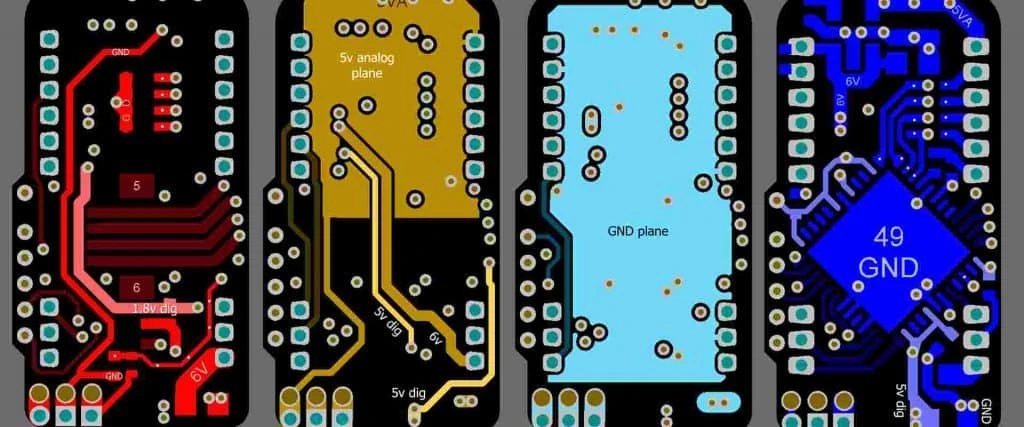
Once you have selected your scenario, you move to execution. The transition from design to manufacturing is where most errors occur.
Use this checklist to ensure your ANPR Camera PCB is built correctly.
1. Stackup Design & Impedance Modeling
- Recommendation: Define the layer stackup early. Calculate trace widths for 90Ω or 100Ω differential pairs (USB/MIPI).
- Risk: Incorrect calculations lead to signal reflection and "ghosting" in images.
- Acceptance: Review the TDR simulation report from the fabricator before production starts.
2. Material Selection Verification
- Recommendation: Specify the exact material brand or equivalent (e.g., Isola 370HR or Panasonic Megtron).
- Risk: Generic FR4 may vary in Dk/Df, affecting high-speed signals.
- Acceptance: Check the material datasheet against the Certificate of Compliance (CoC).
3. Thermal Via Placement
- Recommendation: Place thermal vias under the main processor and image sensor.
- Risk: Overheating causes the sensor to generate thermal noise (grainy images).
- Acceptance: Verify via plugging or tenting requirements to prevent solder wicking.
4. Surface Finish Selection
- Recommendation: Use ENIG (Electroless Nickel Immersion Gold) for flat pads on fine-pitch components (BGAs).
- Risk: HASL is too uneven for small components found on a 4K Camera PCB.
- Acceptance: Visual inspection for flat, uniform gold pads.
5. IR LED Board Thermal Management
- Recommendation: If the IR LEDs are on a separate board, use a Metal Core PCB (MCPCB) or heavy copper.
- Risk: LEDs overheat and dim over time, reducing night vision range.
- Acceptance: Thermal conductivity test of the substrate.
6. Solder Mask Definition
- Recommendation: Use LDI (Laser Direct Imaging) for precise solder mask dams between fine-pitch pads.
- Risk: Solder bridging on the processor pins.
- Acceptance: Check minimum solder dam width in the DFM report.
7. Silkscreen and Traceability
- Recommendation: Include QR codes or barcodes on the silkscreen for asset tracking.
- Risk: Inability to track batches if a field failure occurs.
- Acceptance: Scan test of the printed code during PCB Quality checks.
8. Electrical Testing (E-Test)
- Recommendation: 100% Netlist testing is mandatory.
- Risk: Open circuits or shorts that are invisible to the eye.
- Acceptance: Pass/Fail report for every board.
9. Cleanliness and Ionic Contamination
- Recommendation: Ensure strict washing protocols.
- Risk: Residue leads to corrosion in humid outdoor environments.
- Acceptance: Ionic contamination test results (Rose Test).
10. Panelization for Assembly
- Recommendation: Design the panel with fiducials and tooling holes for SMT machines.
- Risk: Misalignment during component placement.
- Acceptance: Confirm panel drawing matches assembly line requirements.
Automatic Number Plate Recognition (ANPR) Camera PCB common mistakes (and the correct approach)
Even with a checklist, engineers often fall into specific traps. Here are the most common mistakes seen at APTPCB when manufacturing ANPR boards.
Mistake 1: Ignoring IR Reflection
- The Error: Placing white silkscreen or exposing bright copper near the image sensor or IR LEDs.
- The Consequence: IR light reflects off the PCB into the lens, causing "fog" or glare in night mode.
- The Fix: Use matte black solder mask and remove silkscreen from the area surrounding the lens and sensor.
Mistake 2: Underestimating Power Over Ethernet (PoE) Heat
- The Error: Using standard trace widths for PoE power lines.
- The Consequence: Traces overheat, increasing resistance and potentially delaminating the board.
- The Fix: Calculate trace width based on current (IPC-2152). Use polygon pours for power rather than thin traces.
Mistake 3: Poor Grounding for Analog Signals
- The Error: Mixing analog sensor grounds with noisy digital processor grounds.
- The Consequence: Horizontal lines or static in the video feed.
- The Fix: Separate analog and digital ground planes, connecting them at a single point (star ground) or using a solid reference plane with careful component placement.
Mistake 4: Neglecting Conformal Coating Planning
- The Error: Designing the board without considering where conformal coating will be applied.
- The Consequence: Coating gets onto connectors or sensor glass, ruining the unit.
- The Fix: Define "keep-out" zones for coating in the assembly drawing.
Mistake 5: Wrong Connector Placement for Mobile Units
- The Error: Placing heavy connectors in the center of the board without support.
- The Consequence: Vibration causes the board to flex, cracking solder joints (common in Action Camera PCB scenarios).
- The Fix: Place connectors near mounting holes where the board is stiffest.
Mistake 6: Over-specifying Tolerances
- The Error: Asking for ±5% impedance on traces where it isn't needed.
- The Consequence: Unnecessary cost increases and lower yield.
- The Fix: Only apply strict tolerances to high-speed differential pairs (MIPI, Ethernet, DDR).
Automatic Number Plate Recognition (ANPR) Camera PCB FAQ (cost, lead time, materials, testing, acceptance criteria)
Here are answers to the most frequent questions regarding ANPR Camera PCB production.
Q1: What is the main cost driver for an ANPR Camera PCB? The main drivers are the layer count (due to HDI requirements) and the material type. Using high-frequency materials for 5G or high-speed sensor data increases cost significantly compared to standard FR4.
Q2: How does the lead time for ANPR PCBs compare to standard boards? Standard boards take 3-5 days. ANPR boards often require 7-10 days due to additional steps like impedance testing, via plugging, and stricter quality control inspections.
Q3: Can I use standard FR4 for a 4K ANPR camera? It depends on the speed of the interface. For the digital logic, FR4 is fine. However, for the high-speed MIPI lines carrying 4K data, you might need a "High-Speed FR4" or a hybrid stackup to prevent signal loss.
Q4: What are the acceptance criteria for these PCBs? We recommend IPC-A-600 Class 2 for general surveillance and Class 3 for critical infrastructure (highway tolling, police units). Class 3 ensures higher reliability under thermal stress.
Q5: Do I need a specific surface finish for outdoor cameras? Yes. ENIG is preferred over HASL. It is flatter (good for BGAs) and more resistant to corrosion before assembly. For extreme environments, ENEPIG is an even more robust option.
Q6: How do you test the impedance on the finished board? We manufacture a "test coupon" on the production panel that mimics the traces on your board. We use a TDR (Time Domain Reflectometer) to measure the impedance of this coupon to ensure it meets your specs.
Q7: What materials are best for heat dissipation in ANPR cameras? High-Tg FR4 (Tg 170+) is the baseline. For the LED board, Metal Core PCB (Aluminum or Copper) is standard. For the main processor board, using thick copper (2oz) helps spread heat.
Q8: How does an ANPR PCB differ from a Body Camera PCB? Both use HDI and are compact. However, ANPR PCBs usually handle higher power (PoE), have larger thermal loads, and require more robust surge protection against lightning or electrical transients found in outdoor infrastructure.
Q9: Is X-Ray inspection necessary? Yes. ANPR cameras use BGA (Ball Grid Array) components for processors and memory. X-Ray inspection is the only way to verify the solder quality under these components.
Q10: What data do I need to provide for a quote? You need to provide Gerber files, the drill file, layer stackup details, impedance requirements, and the material specification. If you need assembly, a BOM (Bill of Materials) is also required.
Resources for Automatic Number Plate Recognition (ANPR) Camera PCB (related pages and tools)
To further assist in your design and procurement process, utilize these resources from APTPCB.
- For Material Choices: Explore our guide on High Tg PCB materials suitable for outdoor heat.
- For Design Constraints: Review the HDI PCB capabilities for compact camera designs.
- For Quality Assurance: Understand our Testing & Quality protocols including AOI and X-Ray.
- For Security Applications: See our industry overview for Security Equipment PCB.
Automatic Number Plate Recognition (ANPR) Camera PCB glossary (key terms)
| Term | Definition |
|---|---|
| ANPR | Automatic Number Plate Recognition. |
| HDI | High Density Interconnect. PCBs with blind/buried vias and fine lines. |
| MIPI CSI-2 | Mobile Industry Processor Interface Camera Serial Interface. A high-speed protocol for connecting sensors to processors. |
| Impedance | The opposition to AC current flow. Must be controlled for high-speed data. |
| Tg | Glass Transition Temperature. The point where PCB resin turns soft. |
| CTE | Coefficient of Thermal Expansion. How much the material expands with heat. |
| PoE | Power over Ethernet. Delivering power and data over a single cable. |
| BGA | Ball Grid Array. A type of surface-mount packaging used for processors. |
| Blind Via | A via connecting an outer layer to an inner layer, not going through the whole board. |
| Buried Via | A via connecting inner layers only, invisible from the outside. |
| ENIG | Electroless Nickel Immersion Gold. A flat, corrosion-resistant surface finish. |
| OCR | Optical Character Recognition. The software process of reading text from images. |
| ISP | Image Signal Processor. The chip that processes raw data from the sensor. |
| IPC Class 3 | A manufacturing standard for high-reliability electronic products. |
Conclusion (next steps)
The ANPR Camera PCB is a complex convergence of high-speed digital design, precise power management, and rugged mechanical engineering. Whether you are building a system for high-speed tolling or a compact Battery Camera PCB for remote monitoring, the success of the project relies on the quality of the board.
To move forward with your project, ensure your design files are ready for manufacturing analysis. When submitting your data to APTPCB for a DFM review or quote, please include:
- Gerber Files: RS-274X format preferred.
- Stackup Diagram: Indicating signal layers and plane layers.
- Impedance Requirements: Specific trace widths and target ohms.
- Material Specs: Tg rating and preferred manufacturer.
- Environmental Requirements: Operating temperature range and coating needs.
By addressing these details early, you ensure a smooth transition from prototype to mass production, delivering a reliable ANPR solution that stands the test of time.