
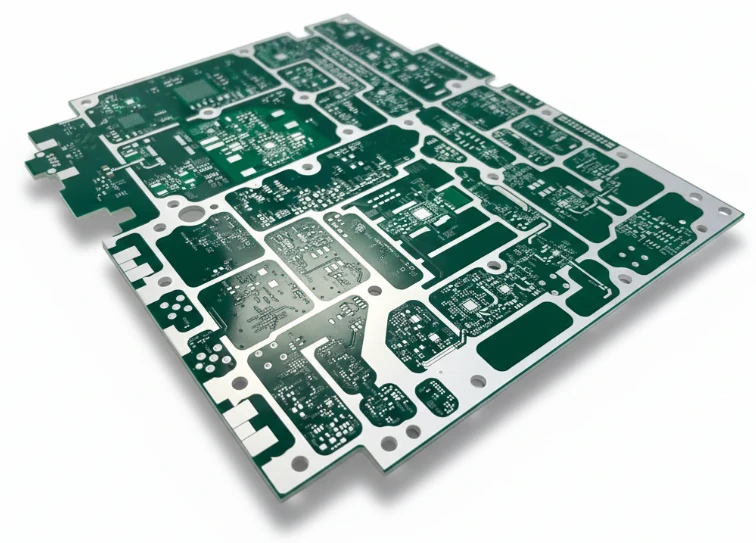
An anti-jamming PCB is designed to reduce the coupling, amplification, and propagation of electromagnetic interference that can degrade sensitive RF, navigation, communication, or mixed-signal functions.
The PCB improves interference resilience through controlled return paths, power integrity, shielding, filtering, RF isolation, and manufacturing discipline. However, anti-jamming performance is ultimately a system property involving the antenna, receiver architecture, enclosure, cables, firmware, algorithms, and validation environment.
Key Takeaways
- Define interference sources, coupling paths, victims, operating states, and acceptance limits before layout begins.
- Treat grounding, return paths, shielding, and filtering as current-flow control problems.
- Select PCB materials, stack-up, impedance targets, and shielding structures from the RF and EMC requirements—not from an “anti-jamming” label.
- Validate progressively from fabrication evidence to assembled-board measurements and final system tests.
- Require suppliers to provide measurable evidence instead of accepting generic EMI claims.
Table of Contents
- What does anti-jamming PCB design mean?
- How do engineers analyze interference paths before PCB layout?
- How should grounding and return paths be designed for EMI immunity?
- How should power rails and external interfaces be protected?
- Which PCB materials and shielding structures improve immunity?
- What should be frozen before PCB fabrication?
- How is anti-jamming PCB performance validated?
- Anti-jamming PCB failure analysis
- Anti-jamming PCB supplier checklist
- FAQ
What does anti-jamming PCB design mean?
Anti-jamming PCB design combines EMC immunity techniques with RF signal integrity practices to reduce the impact of strong interference.
Typical applications include:
- GNSS receivers
- Secure communication equipment
- Radar electronics
- Industrial wireless systems
- Satellite communication terminals
- Precision instrumentation
The PCB can control:
- Noise coupling through power rails
- RF leakage between circuits
- Common-mode interference entering through cables
- Ground-reference instability
- Internal oscillator and converter noise
The PCB cannot independently guarantee:
- Receiver blocking performance
- Antenna rejection
- Digital signal-processing robustness
- Adaptive filtering performance
- Full system anti-jamming capability
A release specification should clearly define the ownership boundary between PCB controls and system controls.
How do engineers analyze interference paths before PCB layout?
The most effective anti-jamming designs begin with a source-path-victim model.
| Interference source | Coupling path | PCB decision | Validation evidence |
|---|---|---|---|
| External RF transmitter | Antenna, enclosure opening, PCB traces | RF isolation, filtering, shielding, controlled launches | Receiver desense and RF characterization |
| DC/DC converter noise | Power plane, return current, magnetic field | Converter placement, PDN control, local shielding | Rail spectrum and near-field scan |
| Cable-borne interference | Connector, shield termination, common mode | Boundary filtering and chassis transition | Conducted immunity testing |
| Clock harmonics | Signal routing and reference discontinuity | Layer planning and return control | Radiated scan and timing verification |
| ESD/EFT events | Protection return path | Clamp placement and low-inductance discharge path | IEC immunity testing |
The interference map should define:
- Frequency range
- Source strength
- Sensitive circuits
- Operating modes
- Recovery requirements
- Pass/fail limits
How should grounding and return paths be designed for EMI immunity?
High-frequency current follows the lowest-impedance return path, not necessarily the shortest DC path.
A robust anti-jamming PCB maintains:
- Continuous reference planes
- Controlled signal transitions
- Small current loops
- Low-inductance grounding paths
- Stable chassis transitions
The PCB stack-up should place critical RF and high-speed signals near appropriate reference planes.
A solid ground plane often provides better RF return behavior than arbitrary analog/digital ground separation. Splits should only be introduced when current paths and system architecture justify them.
Critical routing practices include:
- Keep RF traces over uninterrupted reference structures.
- Review return paths at every via transition.
- Place ground vias near high-frequency transitions.
- Keep clocks, references, and high-impedance nodes away from switching regions.
- Control connector launches as RF structures.
How should power rails and external interfaces be protected?
Power and I/O interfaces frequently determine whether an otherwise clean PCB survives real-world interference.
For each power rail define:
- Operating current
- Load transient behavior
- Allowed ripple
- Frequency range
- Sensitive loads
Decoupling performance depends on:
- Component placement
- Package inductance
- ESR
- Mounting geometry
- PDN resonance
Ferrite beads and LC filters require impedance analysis because poorly selected components can introduce unwanted resonances.
External connectors should be treated as interference boundaries.
| Interface | Main concern | PCB control |
|---|---|---|
| RF connector | Leakage and mismatch | Controlled launch and grounding |
| Power input | Conducted RF | Filtering and protection placement |
| High-speed I/O | Common-mode noise | Pair balance and return continuity |
| Shielded cable | Chassis current | Correct shield termination |
Which PCB materials and shielding structures improve immunity?
Material selection depends on:
- Frequency
- Loss budget
- Phase stability
- Temperature range
- Manufacturing capability
FR-4 may be suitable for many mixed-signal designs. Lower-loss laminates are selected when RF loss, phase variation, or high-frequency stability requires them.
Review high-frequency PCB manufacturing and controlled-impedance fabrication before releasing RF structures.
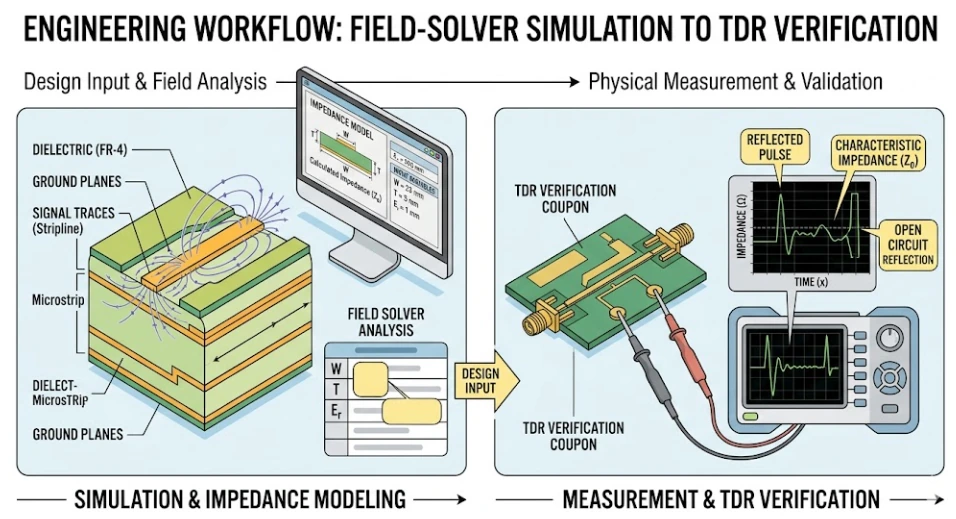
Controlled impedance should define:
- Net class
- Target impedance
- Tolerance
- Reference layer
- Copper thickness
- Mask condition
- Verification method
Shielding decisions
Shield cans, via fences, and enclosure interfaces work only when current paths are controlled.
Important parameters include:
- Shield perimeter grounding
- Aperture dimensions
- Contact resistance
- Thermal requirements
- Mechanical access
- Rework requirements
A shield is part of the RF system, not simply a metal cover.
What should be frozen before PCB fabrication?
| Release item | Required definition | Evidence |
|---|---|---|
| Stack-up | Material, thickness, reference planes, copper profile | Approved stack-up record |
| RF structures | Impedance, launches, vias, transitions | Coupon/TDR data |
| Shielding | Fence, lid, contact area, openings | Mechanical and inspection records |
| Power filtering | Filter topology and placement | Assembly verification |
| Materials | Approved grades and alternatives | Material certificates |
| Testing | Limits, methods, operating state | Traceable test records |
An early DFM review should resolve stack-up, impedance, shield mechanics, material availability, and manufacturing limitations before fabrication.
How is anti-jamming PCB performance validated?
Validation should progress from construction proof to system proof.
| Validation stage | What it proves |
|---|---|
| Design review | Architecture and interference-path control |
| PCB fabrication | Material, dimensions, impedance, construction quality |
| Assembly testing | Power integrity, clocks, interfaces, thermal behavior |
| RF testing | Loss, isolation, matching, and active performance |
| EMC testing | Immunity against defined disturbances |
| System anti-jam testing | Actual operational resilience |
A TDR confirms impedance variation. A VNA confirms RF network behavior. Neither proves receiver anti-jamming capability.
Controlled interference testing should document:
- Stimulus conditions
- Frequency range
- Signal levels
- Antenna configuration
- Cable configuration
- Firmware state
- Functional limits
- Recovery behavior
Use PCBA testing and quality controls to separate production inspection from engineering qualification.
Anti-jamming PCB failure analysis
| Symptom | Likely cause | Investigation | Correction |
|---|---|---|---|
| Receiver loses sensitivity near transmitter | Front-end overload or coupling | RF input, isolation, harmonics | Improve filtering and isolation |
| Failure only with installed cables | Common-mode cable path | Measure cable currents and shield bonds | Redesign interface filtering |
| Shield changes noise pattern | Resonance or poor grounding | Inspect seams and contacts | Improve shield integration |
| Random reset during immunity test | Protection return path issue | Monitor reset and supply rails | Improve clamp routing |
| RF test passes but system fails | Receiver/system limitation | Check antenna and firmware behavior | Validate complete architecture |
Anti-jamming PCB supplier checklist
Engineering package
- Schematics and PCB source files
- Stack-up requirements
- Controlled impedance table
- Material requirements
- Shield drawings
- RF connector details
- Assembly drawings
- Test requirements
Manufacturing evidence
Request:
- Stack-up confirmation
- Material traceability
- Impedance reports
- Microsection records
- Assembly inspection
- Lot traceability
- Nonconformance history
Validation information
Define:
- Required EMC standards
- Operating modes
- Test fixtures
- Cable configuration
- Acceptance limits
- Recovery requirements
The supplier should identify exceptions where performance depends on system-level factors.
Standards and responsibility boundary
Applicable references may include:
- IEC 61000-4-2 — Electrostatic discharge immunity
- IEC 61000-4-3 — Radiated RF immunity
- IEC 61000-4-4 — Electrical fast transient immunity
- IEC 61000-4-5 — Surge immunity
- IEC 61000-4-6 — Conducted RF immunity
- MIL-STD-461 — Military EMC requirements when contractually required
- IPC-2221 — PCB design standard
- IPC-6012 — Rigid PCB qualification
- IPC-A-610 and J-STD-001 — Assembly acceptance
A PCB supplier can control board construction, assembly quality, and agreed measurements. Final anti-jamming claims remain dependent on system architecture unless explicitly delegated.
Anti-jamming PCB FAQ
What is an anti-jamming PCB?
It is a PCB designed to reduce interference coupling through controlled grounding, shielding, filtering, RF layout, and validation.
Can a PCB alone stop RF jamming?
No. The antenna, receiver, firmware, signal processing, and system architecture determine final performance.
Is anti-jamming the same as EMC immunity?
No. Anti-jamming focuses on intentional interference scenarios, while EMC immunity covers broader electromagnetic disturbances.
Does a shield can guarantee immunity?
No. Shield performance depends on grounding, seams, apertures, and system integration.
Should every RF PCB use expensive laminate?
No. Material selection depends on frequency, loss, phase, and manufacturing requirements.
Can TDR prove anti-jamming performance?
No. TDR verifies impedance behavior, not interference rejection.
What should be included in an anti-jamming PCB RFQ?
Include PCB data, stack-up, materials, RF requirements, shielding details, test limits, and acceptance criteria.
Request an Anti-Jamming PCB DFM Review
Send the PCB package, RF requirements, stack-up intent, shielding details, validation scope, and acceptance criteria. APTPCB can review manufacturing feasibility, impedance control, shielding integration, and test requirements before release.