
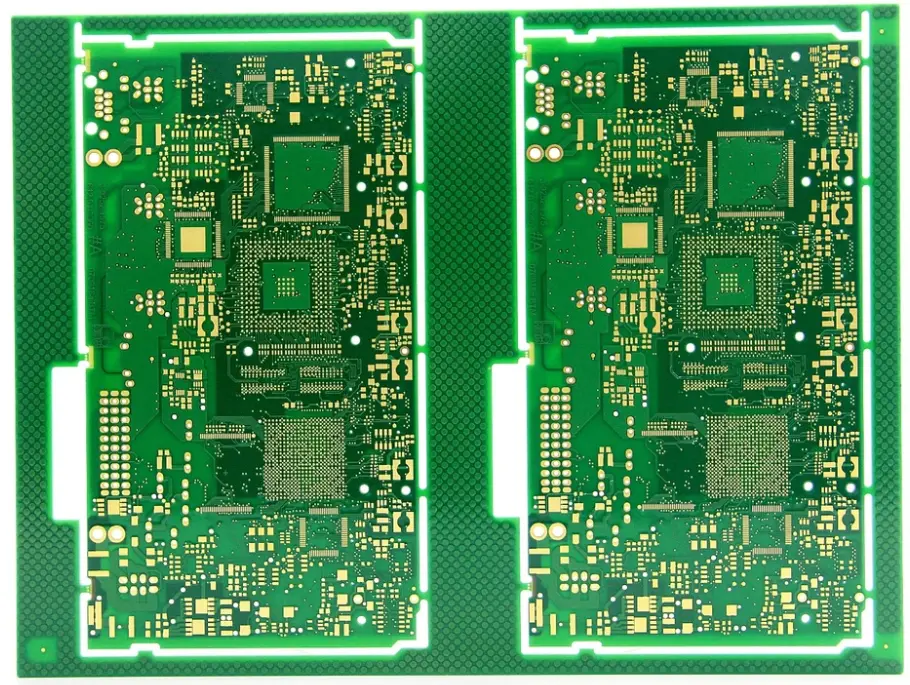
- Review automotive Ethernet as a board-path problem first: connector entry, protection placement, layer transitions, and split-reference regions usually create more risk than the long straight run.
- Keep the pair electrically balanced through short disturbed zones, not only matched in the easy interior section of the route.
- Treat every layer change as a return-path handoff question. A clean signal via with weak nearby reference continuity is still a release risk.
- Check connector-near and exposed edge-entry regions separately because those are common points for return-path collapse and differential-to-common-mode conversion.
- A board can look visually routed well and still fail later if one conductor sees a different launch, detour, or reference condition than the other.
Quick Answer Automotive Ethernet PCB layout should be reviewed as a differential-pair symmetry and return-path continuity problem at the board level. The most important checks are connector launch balance, protection-zone asymmetry, layer-transition continuity, and any split or weakened reference region that can convert intended differential behavior into common-mode noise or later link instability.
For related fabrication and release support, use High-Speed PCB for controlled-path manufacturing context and Automotive Electronics PCB for vehicle-electronics program context.
In This Guide
- What engineers should check first
- Early review table: where board risk usually concentrates
- What automotive Ethernet PCB layout means at board-review level
- Why the main failure mechanism is return-path collapse, not generic high-speed difficulty
- What a conservative release review should ask
- Next steps with APTPCB
- FAQ
- Public references
- Author and review information
What engineers should check first
Automotive Ethernet PCB layout is not the same as protocol compliance, interoperability proof, or a universal impedance recipe. At this article's boundary, the question is narrower: does the board preserve pair symmetry and local return continuity through the places where the geometry becomes non-ideal?
The first review dimensions are:
- connector-entry and launch balance
- protection-region symmetry
- layer-transition and return-path continuity
- split-plane, slot, or exposed-edge reference weakness
- the actual release package used to justify the route
Early review table: where board risk usually concentrates
| Review zone | What to confirm early | Why it matters | Typical consequence if left ambiguous |
|---|---|---|---|
| Connector launch | The pair enters the connector field without one side taking a materially different path | Launch asymmetry disturbs field balance at the first sensitive handoff | Common-mode conversion or later EMC trouble |
| Protection region | ESD or common-mode parts do not force one conductor into a different environment | Protection parts often create short but important asymmetry | Clean continuity check, but degraded real-path behavior |
| Layer transition | The signal via and nearby return continuity are reviewed together | A signal transition without local return support is still a discontinuity | Added discontinuity that shows up later in bring-up |
| Split or interrupted reference area | The pair does not cross a zone where return current must detour | Differential routing still depends on local reference continuity | Return-path collapse and field imbalance |
| Edge-entry or exposed zone | Board-edge routing still has enough local return structure | Entry zones often lose copper support earlier than the interior route | Noise sensitivity or unstable margin near I/O entry |
What automotive Ethernet PCB layout means at board-review level
At board-review level, automotive Ethernet PCB layout means checking whether the differential path stays electrically balanced through the practical disturbances that usually appear on a vehicle-electronics board:
- connector breakout
- protection-component placement
- layer changes
- plane interruptions
- exposed entry routing near the board edge
This article does not claim:
- IEEE compliance
- interoperability proof
- universal
100 ohmsuccess criteria - exact skew, spacing, meander, or via recipes
- EMC pass certainty
- automotive qualification, PPAP, or OEM approval status
Those claims need their own evidence lane. Here, the safer question is whether the board-owned route is being released with enough local electrical discipline.
Why the main failure mechanism is return-path collapse, not generic high-speed difficulty
The main mechanism family for this topic is electrical field / return path collapse.
That matters because many weak articles reduce the issue to high-speed layout is sensitive. The board-level failure chain is more specific:
differential pair leaves a balanced path at connector, protection, layer-transition, or split-reference region -> pair symmetry degrades and return current detours -> part of the intended differential behavior converts into common-mode behavior -> EMC or link instability appears later
One realistic board-level scenario:
The long interior route is visually matched and appears disciplined. At connector entry, however, one conductor is pushed around a protection device while the other side stays short and direct. The nearby reference copper is also weakened by an opening, split, or exposed-zone gap. Continuity still looks fine from end to end, but the local field environment is no longer the same on both conductors. That imbalance can remain hidden until EMC screening or later link bring-up exposes it.
The same disaster often appears in the MDI protection zone on 100BASE-T1 boards. The design correctly includes TVS protection for automotive ESD stress, but the placement is not physically symmetric: one TVS branch is slightly longer, one via pair is offset, or one side of the pair sees a different parasitic loading by only a fraction of a picofarad. At these edge rates, that small asymmetry is enough to trigger mode conversion. Part of the intended differential energy becomes common-mode noise, and the unshielded twisted pair starts behaving like an antenna. In the chamber, the board then fails radiated-emissions work such as CISPR 25 Class 5, and the damage is not limited to a test report. The platform loses EMC margin, FM or GNSS bands can be polluted, and the team is forced back into layout revision and new prototype spins because one connector-near protection region was not physically balanced.
This is why release review should stay focused on the disturbed zones, not only the calm part of the pair route.
If the stackup or controlled-path definition is still unstable, the useful supporting pages are PCB Stack-Up, PCB Impedance Control, and the front-end DFM Guidelines.
What a conservative release review should ask
Use the review as a sequence of concrete board questions rather than a generic routing checklist:
- Where does the pair first leave its quiet interior route?
- Does the connector or protection region disturb one conductor more than the other?
- Is the local reference plane continuous under or beside the path, or does return current need to detour?
- If the pair changes layers, is the nearby return handoff as clear as the signal transition?
- Are there board-edge or exposed-entry zones where the local return structure is weaker than the rest of the route?
The release package should ideally include:
| Evidence item | Why it should be frozen before release |
|---|---|
| Full stackup with reference context | The review cannot judge return continuity without seeing the real reference structure |
| Differential-route screenshots from connector to PHY or processor | The risky zones are easier to miss when the route is not reviewed as one path |
| Close views of connector and protection regions | Local asymmetry often lives in these short disturbed sections |
| Layer-transition locations for the pair | Vias should be reviewed together with nearby return continuity |
| Notes for split-plane, slot, board-edge, or exposed routing areas | These conditions are common triggers for review holds and later debug work |
Next steps with APTPCB
If your team is building an ADAS controller, cockpit domain module, or in-vehicle gateway and is already nervous about the MDI connector region, do not wait for the chamber to tell you that one small protection asymmetry consumed the EMC margin. The same applies if the pair looks length-matched on screen but the connector, TVS, or common-mode choke region still feels physically uneven.
Send the Gerber or ODB++ package, key MDI route screenshots, stackup intent, and the placement views for TVS and CMC protection parts to [email protected], or start through the automotive Ethernet EMC review request. APTPCB's high-speed and automotive-grade CAM review team will return an Automotive Ethernet Symmetry & EMC Risk Review within 24 hours.
That review is designed to catch the expensive board-level failures before chamber time is burned: connector-launch imbalance, via asymmetry, weakened return structure, protection-zone mode conversion, and transition regions that look routable but are electrically dirty. The goal is to expose the asymmetry while it is still a layout problem, not after it becomes an EMC failure and a new board spin.
If the package still needs supporting context before RFQ, start with:
FAQ
Is automotive Ethernet PCB layout mainly about impedance numbers?
No. Controlled impedance matters, but this topic is not solved by a nominal target alone. The board review should still check whether connector launch, protection placement, and return-path continuity preserve the real differential environment along the route.
If the pair length looks matched, is that usually enough?
No. A visually matched straight run can still hide a short disturbed zone where one conductor takes a different path or sees weaker reference continuity. Those local discontinuities can matter more than the easy interior section.
Why is the connector area reviewed separately from the main route?
Because the connector field is a common place where geometry, reference copper, keepouts, protection components, and board-edge exposure all change at once. That combination can disturb balance even when the rest of the route looks disciplined.
Does this article prove EMC compliance or automotive qualification?
No. It only supports a conservative board-review posture before release. EMC, interoperability, qualification, and OEM approval each need their own validation path and evidence.
What files help most when asking for a board review?
The most useful package is the full stackup, controlled-path intent, route screenshots from connector to device, close views of protection placement, and notes for any split-plane or edge-entry condition. Without those items, the review usually stays too assumption-driven.
Public references
IEEE 802.3 Automotive Ethernet Task Force Public context for the automotive Ethernet standards family without turning this article into a compliance guide.
Texas Instruments: AN-905 Transmission Lines Public background on transmission-line behavior and why local discontinuities matter in routed interconnects.
APTPCB High-Speed PCB Commercial and manufacturing context for controlled-path PCB builds.
APTPCB PCB Impedance Control Supporting page for impedance-control posture and release-stage manufacturing discussion.
APTPCB Automotive Electronics PCB APTPCB industry context for automotive electronics board programs.
APTPCB DFM Guidelines Supporting page for front-end manufacturability and release-package review.
Author and review information
- Author: APTPCB high-speed and automotive electronics content team
- Technical review: PCB SI review and manufacturing-engineering team
- Last updated: 2025-07-23