
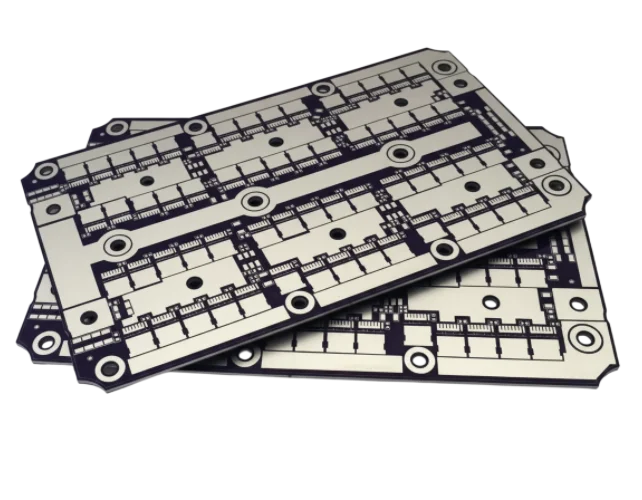
An on-board charger PCB (OBC PCB) converts external AC power into controlled DC power for an electric vehicle battery. Unlike a general automotive PCB, an OBC board combines high voltage, high current, fast switching, thermal stress, insulation boundaries, vibration exposure, and production traceability requirements.
A production-ready OBC PCB specification must connect the converter architecture with PCB construction, PCBA assembly, validation evidence, and supplier controls.
What should be defined before designing an OBC PCB?
The PCB supplier cannot determine critical requirements from charger power alone. A 3.3 kW, 11 kW, or 22 kW OBC may use different topologies, voltage ranges, cooling methods, insulation concepts, and board architectures.
Freeze these inputs before layout release or RFQ:
| Requirement input | PCB consequence | Supplier information required |
|---|---|---|
| AC input and charging mode | Input protection, EMI filter, current path, test setup | Voltage range, phase, frequency, transient conditions |
| Battery voltage architecture | Isolation boundary, dielectric stress, sensing design | Working voltage, peak voltage, transient cases |
| Power topology | Switching loops, gate drive, magnetic layout | PFC type, DC/DC topology, switching frequency |
| Current profile | Copper, vias, terminals, joints, thermal design | RMS current, peak current, overload duration |
| Cooling method | Mechanical interface and thermal path | Heat sink, cold plate, TIM, airflow or coolant limits |
| Vehicle environment | Mechanical reliability requirements | Vibration, shock, temperature cycle, enclosure |
| Production plan | Inspection and traceability scope | Test limits, records, change-control requirements |
How are OBC PCB functional zones partitioned?
A typical OBC contains several electrical domains. Each domain creates different manufacturing and validation requirements.
| Board domain | Main risks | Release evidence |
|---|---|---|
| AC input and EMI section | Surge stress, filter current, connector heating | Layout review, spacing inspection, EMC data |
| PFC stage | High di/dt loops, switching losses, thermal concentration | Waveform review, thermal measurement, assembly inspection |
| Isolated DC/DC | Transformer insulation, common-mode current, parasitics | Insulation documentation, electrical test records |
| Control section | Reset faults, sensing errors, communication issues | Programming records, functional tests |
| Auxiliary supply | Startup instability and fault recovery | Rail measurements and fault tests |
| HV sensing and interlock | Safety diagnostics and isolation failures | Calibration and diagnostic records |
The supplier should understand which functions the PCB must preserve, while system owners remain responsible for vehicle-level safety, EMC, charging interoperability, and functional validation.
How should creepage and clearance be specified for an OBC PCB?
Creepage and clearance are insulation-design outputs, not fixed values based only on “400 V” or “800 V”.
The insulation definition should include:
- Working voltage
- Repetitive peak voltage
- Transient or impulse stress
- Insulation type
- Pollution degree
- Material group or CTI
- Operating altitude
- Coating assumptions
- Slot and cutout geometry
- Component and mechanical spacing
The released insulation drawing should include:
- High-voltage domains
- Isolation boundaries
- Minimum creepage paths
- Minimum clearance distances
- Slot dimensions
- Component keep-outs
- Connector and terminal geometry
- Test method and acceptance limits
APTPCB can manufacture controlled spacing, slots, and insulation-related PCB geometry based on customer requirements. Final electrical safety approval remains part of the vehicle-system qualification process.
How should current paths and thermal design be reviewed?
OBC power paths are complete electrical and mechanical structures. Copper thickness alone does not determine current capability.
Review:
- Finished copper thickness
- Trace width and layer distribution
- Via arrays
- Terminals and connectors
- Solder joints
- Busbar interfaces
- Temperature-rise limits
- Cooling interface quality
- Fault duration
| Design area | Evaluation input | Evidence |
|---|---|---|
| High-current copper | RMS and peak current | Copper data and thermal results |
| Thermal vias | Device loss and heat path | Microsection or inspection records |
| Mechanical interface | Flatness and clamp pressure | Dimensional inspection |
| Power joints | Resistance and heating | Load testing |
Heavy-copper PCB construction can support selected high-current paths, but copper selection must match the actual electrical and thermal model.
How do SiC, GaN, and fast switching affect PCB design?
Wide-bandgap devices improve efficiency and power density, but they also increase sensitivity to parasitic effects.
The PCB review should address:
- Commutation loop area
- Gate-drive return path
- Switch-node copper area
- Parasitic inductance
- Overshoot and ringing
- Common-mode current
- Sensor protection
- EMC behavior
A lower-loss semiconductor does not remove PCB design challenges. Switching speed, layout, thermal coupling, and measurement results must be reviewed together.
Which PCB materials and structures are suitable for OBC applications?
No single PCB construction fits every OBC.
| Design choice | Selection factors | Evidence |
|---|---|---|
| Laminate system | Temperature, CAF risk, CTI, availability | Material records |
| Copper structure | Current density and thermal rise | Finished copper data |
| Dielectric stack-up | Voltage stress and mechanical needs | Approved stack-up |
| Surface finish | Assembly and reliability requirements | Finish records |
| Thermal structures | Heat path and mounting design | Thermal validation |
High-thermal PCB options and metal-core PCB construction can support specific thermal requirements, but the complete assembly must be validated.
What are the most common OBC PCB failure modes?
| Failure mode | Typical causes | Control evidence |
|---|---|---|
| Insulation breakdown | Incorrect spacing, contamination, material variation | Inspection, insulation test, failure analysis |
| Power semiconductor failure | Switching overshoot, poor thermal path | Waveform capture, thermal data |
| Connector overheating | Contact resistance, current bottleneck | Load test and inspection |
| EMC failure | Poor return path, excessive common-mode current | EMC pre-compliance data |
| Solder fatigue | Thermal cycling and mechanical stress | X-ray, microscopy, reliability testing |
| Production regression | Uncontrolled changes | Traceability and change records |
What manufacturing evidence should an OBC PCB supplier provide?
A production release package may include:
- Fabrication data revision
- Approved stack-up
- Material and finish records
- Dimensional inspection
- Bare-board electrical test
- Microsection when required
- SPI and AOI records
- X-ray inspection for hidden joints
- ICT or flying probe where designed in
- Functional test records
- Traceability data
- Approved deviations
The exact package depends on the customer program and qualification strategy.
See the PCBA testing and quality overview and PCB quality process.
How should PPAP and configuration control be handled?
An OBC PCB is released as part of a controlled hardware configuration.
Freeze:
- PCB fabrication files
- Stack-up and materials
- BOM and AVL
- Assembly process
- Firmware version
- Programming method
- Fixtures
- Test limits
- Packaging requirements
Define change triggers for:
- Material substitutions
- Component replacements
- Factory transfer
- Process changes
- Tooling changes
- Firmware updates
- Test-limit changes
IATF 16949, PPAP requirements, and customer-specific procedures must be assigned according to the vehicle program.
What should be included in an OBC PCB RFQ package?
A complete RFQ should include:
PCB fabrication data
- Gerber X2, ODB++, IPC-2581, or agreed format
- Controlled drawings
- Stack-up requirements
- Copper requirements
- Insulation boundaries
- Slots and tolerances
- Material specifications
PCBA requirements
- BOM and AVL
- Placement files
- Assembly drawings
- Mechanical interfaces
- Thermal interface requirements
- Cleaning and coating requirements
Electrical and validation requirements
- OBC block diagram
- Voltage and current envelope
- Test specifications
- Firmware/programming requirements
- Functional limits
- Traceability requirements
- Qualification evidence expectations
Run a DFM review before freezing stack-up, power footprints, slots, thermal interfaces, and test access.
Why involve APTPCB before the qualification build?
APTPCB can review OBC PCB/PCBA packages for manufacturability, thermal structure feasibility, insulation geometry, assembly access, inspection coverage, traceability, and production evidence requirements.
The published automotive and EV PCB manufacturing scope includes OBC and DC/DC PCB/PCBA support, thermal-management options, SPI, AOI, X-ray, ICT/flying probe when designed in, customer-defined functional testing, and traceability.
The PCB supplier supports the hardware release process but does not replace the vehicle OEM, Tier-1 system owner, safety team, EMC laboratory, or charging-validation program.
Relevant references may include:
- IEC 60664-1
- ISO 6469-3
- ISO 26262
- CISPR 25
- ISO 11452
- ISO 7637
- IPC-6012 and IPC-6012DA
- IPC-A-600
- J-STD-001
- IPC-A-610
- IATF 16949
Frequently asked questions
What is an OBC PCB?
An OBC PCB is a circuit board used inside an electric vehicle charger to support AC input processing, power conversion, control, sensing, communication, and protection functions.
Does every OBC PCB require heavy copper?
No. Copper selection depends on current, temperature rise, cooling, geometry, terminals, vias, and fault conditions.
Are 400 V and 800 V OBC boards designed the same way?
No. Voltage architecture changes insulation requirements, component selection, spacing, and validation needs.
Does an OBC PCB automatically receive automotive certification?
No. PCB manufacturing evidence supports the vehicle qualification process. System-level certification remains the responsibility of the product owner.
What tests are used for OBC PCB production?
Depending on requirements, testing may include bare-board electrical testing, SPI, AOI, X-ray, ICT, functional testing, insulation testing, programming records, and traceability.
What files are needed for an OBC PCB quote?
Provide PCB data, drawings, BOM, AVL, stack-up requirements, insulation information, mechanical details, test requirements, quantities, and change-control expectations.
Build the evidence plan before the OBC pilot
Reliable OBC production starts with a released baseline connecting architecture, insulation, current paths, thermal design, EMC behavior, manufacturing controls, testing, and traceability.
Send the OBC block diagram, PCB/PCBA files, voltage and current envelope, insulation requirements, mechanical model, test plan, quantities, and evidence requirements for engineering review before qualification.