
The shift toward electric vehicles (EVs) has fundamentally changed power electronics, placing the automotive-grade SiC rectifier board at the center of high-efficiency charging and traction systems. Unlike traditional silicon-based setups, Silicon Carbide (SiC) technology demands printed circuit boards (PCBs) that can withstand higher switching frequencies, extreme voltages, and intense thermal loads. Engineers cannot treat these boards like standard FR4 components; they require specialized materials, precise stackups, and rigorous validation to meet automotive reliability standards.
This guide serves as a hub for understanding the lifecycle of these critical boards. We will cover everything from the basic definition and performance metrics to manufacturing checkpoints and common pitfalls. Whether you are designing an automotive-grade On-board charger PCB or a standalone rectifier module, this page provides the technical roadmap needed for success.
Key Takeaways
- Thermal Management is Priority #1: SiC components run hot; the board must dissipate heat efficiently using heavy copper or ceramic substrates.
- Low Inductance Design: High switching speeds require minimized stray inductance to prevent voltage spikes and EMI issues.
- Material Selection: Standard FR4 often fails; high Tg (Glass Transition Temperature) and high CTI (Comparative Tracking Index) materials are mandatory.
- Strict Validation: Automotive standards (AEC-Q, IPC-6012 Class 3) are non-negotiable for safety and longevity.
- Cost vs. Performance: Balancing expensive ceramic materials against cost-effective insulated metal substrates (IMS) is a key design decision.
- Manufacturing Precision: Etching accuracy and layer registration must be tighter than consumer-grade electronics to handle high voltages.
What “SiC rectifier board” means (scope & boundaries)
To effectively design these systems, we must first establish exactly what an automotive-grade SiC rectifier board encompasses and how it differs from standard PCBs.
An automotive-grade SiC rectifier board is a specialized printed circuit board designed to host Silicon Carbide rectifiers (diodes or MOSFETs) specifically for the automotive environment. Its primary function is AC-to-DC conversion (in On-Board Chargers) or DC-to-DC conversion, handling voltages often exceeding 400V or 800V.
The "automotive-grade" designation implies adherence to strict reliability standards, such as IPC-6012 Class 3, which dictates high reliability for critical systems where downtime is not an option. Unlike a standard consumer board, or even a precision automotive-grade ECG acquisition board used in medical monitoring, a SiC rectifier board deals with massive power density. It is not just about signal connectivity; it is about thermal survival and dielectric strength.
At APTPCB (APTPCB PCB Factory), we define the scope of these boards by three boundaries:
- Voltage Class: Must handle 400V–800V+ architectures without dielectric breakdown.
- Thermal Environment: Must operate reliably in ambient temperatures often exceeding 105°C, with junction temperatures pushing higher.
- Mechanical Stress: Must withstand the vibration and shock profiles typical of a moving vehicle chassis.
Metrics that matter (how to evaluate quality)
Once the scope is defined, the next step is to quantify the quality of the board using specific, measurable technical metrics.
Engineers cannot rely on generic datasheets. The performance of an automotive-grade SiC rectifier board is dictated by how well the substrate and copper layout handle the stress of SiC operation. Below are the critical metrics that determine if a board is fit for purpose.
| Metric | Why it matters | Typical Range / Factors | How to measure |
|---|---|---|---|
| Thermal Conductivity (W/m·K) | Determines how fast heat moves away from the SiC die. | 1.0 – 3.0 (IMS/FR4) up to 24+ (Ceramic). | ASTM D5470 or Laser Flash Method. |
| Comparative Tracking Index (CTI) | Prevents electrical breakdown (tracking) across the surface under high voltage. | PLC 0 or 1 (>600V) is required for HV systems. | IEC 60112 standard test. |
| Glass Transition Temp (Tg) | The point where the PCB resin softens and expands, risking via failure. | High Tg > 170°C is standard for automotive SiC. | DSC (Differential Scanning Calorimetry). |
| Dielectric Breakdown Voltage | The voltage at which the insulation layer fails. | > 4kV – 6kV AC depending on stackup. | Hi-Pot testing (IPC-TM-650). |
| Stray Inductance | High inductance causes voltage overshoots during fast SiC switching. | Target < 10nH for critical loops. | Impedance Analyzer / Simulation. |
| Copper Peel Strength | Ensures traces do not lift under thermal cycling stress. | > 1.4 N/mm (after thermal stress). | IPC-TM-650 2.4.8. |
How to choose (trade-offs by scenario)
Understanding the metrics allows you to navigate the complex trade-offs required when selecting the right board architecture for specific automotive scenarios.
Not all SiC applications require the most expensive materials. The choice depends on the power level, space constraints, and budget. Here is how to choose the right automotive-grade SiC rectifier board configuration based on common design scenarios.
Scenario 1: High-Power On-Board Charger (11kW - 22kW)
- Requirement: Extreme heat dissipation and high voltage isolation.
- Recommendation: Ceramic PCB (DBC or AMB).
- Trade-off: High cost and brittle mechanical nature, but unmatched thermal performance compared to FR4.
Scenario 2: Cost-Sensitive 400V DC-DC Converter
- Requirement: Balance between thermal performance and mass production cost.
- Recommendation: Heavy Copper PCB on High-Tg FR4.
- Trade-off: Lower thermal conductivity than ceramic, but significantly cheaper and more durable against vibration.
Scenario 3: 48V Mild Hybrid Systems
- Requirement: High current, lower voltage. Similar to an automotive-grade 48V VRM board.
- Recommendation: Metal Core PCB (IMS).
- Trade-off: Excellent for simple single-layer routing; difficult for complex multi-layer logic circuits.
Scenario 4: Space-Constrained Traction Inverter Module
- Requirement: High density interconnects with power handling.
- Recommendation: HDI PCB with embedded copper coins.
- Trade-off: Complex manufacturing process; copper coins provide localized cooling but increase board cost.
Scenario 5: High-Vibration Environment (Chassis Mount)
- Requirement: Mechanical flexibility to prevent solder joint cracking.
- Recommendation: Rigid-Flex PCB.
- Trade-off: Allows the board to fit irregular spaces and absorb vibration, but requires careful design to ensure power traces crossing the flex zone do not crack.
Scenario 6: Battery Management Integration
- Requirement: Integrating rectification with monitoring, similar to an automotive-grade BMS balancing board.
- Recommendation: Multi-layer FR4 with thick internal copper layers (3oz+).
- Trade-off: Thermal management becomes harder as layer count increases; requires thermal vias.
Implementation checkpoints (design to manufacturing)
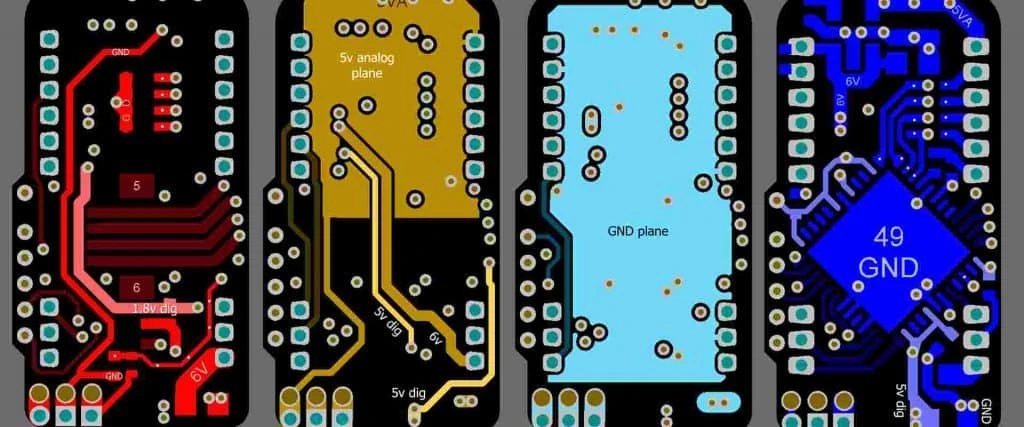
After selecting the right architecture, the focus shifts to the rigorous implementation phase, where design intent is converted into a physical product.
Manufacturing an automotive-grade SiC rectifier board requires strict adherence to checkpoints. Missing one can lead to field failures. At APTPCB, we utilize the following checklist to ensure compliance with automotive standards.
Material Verification:
- Recommendation: Confirm the laminate datasheet matches the specific Tg and CTI requirements (e.g., Isola 370HR or Rogers).
- Risk: Using standard FR4 leads to carbonization under high voltage.
- Acceptance: Certificate of Conformance (CoC) from material supplier.
Stackup Symmetry:
- Recommendation: Ensure copper balance to prevent warpage during reflow.
- Risk: Warped boards cause stress on large SiC component solder joints.
- Acceptance: Bow and twist < 0.75% (IPC Class 3).
Trace Width & Spacing (Creepage):
- Recommendation: Follow IPC-2221B for high voltage clearance.
- Risk: Arcing between traces during voltage spikes.
- Acceptance: Automated Optical Inspection (AOI) verification of spacing.
Thermal Via Design:
- Recommendation: Use plugged and capped vias (VIPPO) for direct heat transfer under pads.
- Risk: Solder wicking into open vias creates voids and poor thermal connection.
- Acceptance: X-Ray inspection for voiding < 25%.
Heavy Copper Etching:
- Recommendation: Compensate for etch factor in Gerber files.
- Risk: Over-etching reduces the current-carrying cross-section.
- Acceptance: Microsection analysis to verify final copper thickness.
Solder Mask Application:
- Recommendation: Use high-voltage rated solder mask inks.
- Risk: Standard mask may degrade or peel at high SiC operating temperatures.
- Acceptance: Adhesion test (Tape test) per IPC-TM-650.
Surface Finish Selection:
- Recommendation: ENIG or Immersion Silver for flat pads and wire bonding.
- Risk: HASL is too uneven for large SiC modules.
- Acceptance: Surface roughness measurement.
Cleanliness (Ionic Contamination):
- Recommendation: Strict washing protocols.
- Risk: Residues cause dendritic growth (shorts) over time in humid automotive environments.
- Acceptance: ROSE testing < 1.56 µg/cm² NaCl equivalent.
Common mistakes (and the correct approach)
Even with a checklist, engineers often fall into specific traps when transitioning from silicon to silicon carbide designs.
Designing an automotive-grade SiC rectifier board is not just about upgrading the components; the board layout itself must change. Here are common mistakes and how to avoid them.
- Mistake 1: Ignoring CTE Mismatch.
- Issue: SiC components and copper expand at different rates than standard FR4, leading to solder fatigue.
- Correction: Use materials with matched Coefficient of Thermal Expansion (CTE) or compliant leads.
- Mistake 2: Insufficient Creepage for Altitude.
- Issue: Designing only for sea level. Air is less insulating at altitude (e.g., mountain driving).
- Correction: Apply altitude correction factors to creepage distance calculations.
- Mistake 3: Neglecting Stray Inductance.
- Issue: Using long traces for gate drivers. SiC switches so fast that trace inductance causes ringing.
- Correction: Place drivers as close as possible to the SiC MOSFETs; use laminar busbar structures in the PCB.
- Mistake 4: Treating it like an RF Board.
- Issue: While SiC is fast, it is not an automotive-grade Beamforming module board. Prioritizing signal integrity over current capacity can lead to overheating.
- Correction: Balance impedance control with thermal mass.
- Mistake 5: Poor Thermal Interface Material (TIM) Application.
- Issue: Relying solely on the PCB for cooling without considering the interface to the heatsink.
- Correction: Specify flatness requirements and TIM thickness in the assembly drawing.
- Mistake 6: Underestimating In-rush Current.
- Issue: Traces sized for steady-state current fuse during capacitor charging spikes.
- Correction: Size traces for peak pulse current, not just RMS.
FAQ (cost, lead time, materials, testing)
To wrap up the technical details, we address the most frequent questions we receive from procurement and engineering teams regarding these boards.
Q: How does the cost of an automotive-grade SiC rectifier board compare to a standard power PCB? A: Expect a cost increase of 30% to 150%. This is driven by specialized materials (High Tg, Ceramic), heavy copper processing (up to 10oz), and rigorous Class 3 validation testing.
Q: What is the typical lead time for manufacturing these boards? A: Standard lead times are 15–20 working days. However, if specialized laminates (like Rogers or specific Arlon blends) are not in stock, lead times can extend to 4–6 weeks.
Q: Can we use standard FR4 for SiC rectifier applications? A: Generally, no. Standard FR4 has a Tg around 130-140°C. SiC junctions often run hotter, requiring High-Tg FR4 (170°C+) or Polyimide to prevent delamination.
Q: What specific testing is required for automotive acceptance? A: Beyond standard E-test, automotive boards require Thermal Cycling (-40°C to +125°C), Interconnect Stress Testing (IST), and Hi-Pot testing to verify dielectric strength at operating voltages.
Q: How do you handle the acceptance criteria for heavy copper features? A: We follow IPC-6012 Class 3. This allows for very minimal defects. For heavy copper, we pay special attention to undercut and sidewall geometry to ensure the conductor cross-section meets the spec.
Q: Is there a difference between this and an automotive-grade On-board charger PCB? A: Often they are the same. The SiC rectifier board is frequently a sub-component or the main power stage within the On-board charger (OBC) assembly.
Q: How does the material differ from an automotive-grade ECG acquisition board? A: An ECG board prioritizes low noise and signal integrity, often using standard copper weights. A SiC board prioritizes thermal mass and dielectric strength, using heavy copper and thick prepregs.
Q: What surface finish is best for SiC wire bonding? A: ENEPIG (Electroless Nickel Electroless Palladium Immersion Gold) is ideal for wire bonding, though ENIG is sufficient for standard soldering.
Related pages & tools
- Automotive Electronics PCB Solutions: Overview of our automotive capabilities.
- Heavy Copper PCB Manufacturing: Deep dive into high-current board fabrication.
- Ceramic PCB Capabilities: For extreme thermal management requirements.
- PCB Quality System: Details on our ISO and IATF certifications.
Glossary (key terms)
| Term | Definition |
|---|---|
| SiC (Silicon Carbide) | A wide-bandgap semiconductor material allowing higher voltage and temperature operation than Silicon. |
| Rectifier | A circuit or component that converts AC to DC; in EVs, this handles grid power to battery power conversion. |
| AEC-Q100/101 | Automotive Electronics Council standards for stress testing active components (ICs and discretes). |
| IPC-6012 Class 3 | The performance specification for high-reliability PCBs (automotive, aerospace, medical). |
| Tg (Glass Transition Temp) | The temperature at which the PCB substrate transitions from a hard, glassy state to a soft, rubbery state. |
| CTI (Comparative Tracking Index) | A measure of the electrical breakdown (tracking) properties of an insulating material. |
| Heavy Copper | PCB layers with copper thickness generally greater than 3oz (105µm). |
| DBC (Direct Bonded Copper) | A process used in ceramic PCBs where copper is bonded directly to a ceramic tile (Alumina or AlN). |
| IMS (Insulated Metal Substrate) | A PCB with a metal base plate (usually aluminum) separated by a thin dielectric for heat dissipation. |
| Creepage Distance | The shortest path between two conductive parts measured along the surface of the insulation. |
| Clearance | The shortest distance between two conductive parts measured through the air. |
| VIPPO | Via-in-Pad Plated Over; a technology allowing vias to be placed directly under component pads for thermal transfer. |
Conclusion (next steps)
The automotive-grade SiC rectifier board represents the backbone of modern electric vehicle efficiency. It is a complex intersection of thermal engineering, material science, and precision manufacturing. Success in this domain requires moving beyond standard PCB design rules and embracing the stringent requirements of high-voltage, high-temperature automotive environments.
Whether you are prototyping a new automotive-grade On-board charger PCB or scaling up production for a traction inverter, the manufacturing partner you choose must understand these nuances.
Ready to move forward? When requesting a quote or DFM review from APTPCB, please provide:
- Gerber Files: Including all copper layers and drill files.
- Stackup Specification: Desired material (Tg, CTI) and copper weights.
- Operating Parameters: Maximum voltage, current, and ambient temperature.
- Testing Requirements: Specific IPC Class requirements or custom thermal cycling protocols.
By providing this data upfront, we can ensure your design is optimized for both performance and manufacturability.