
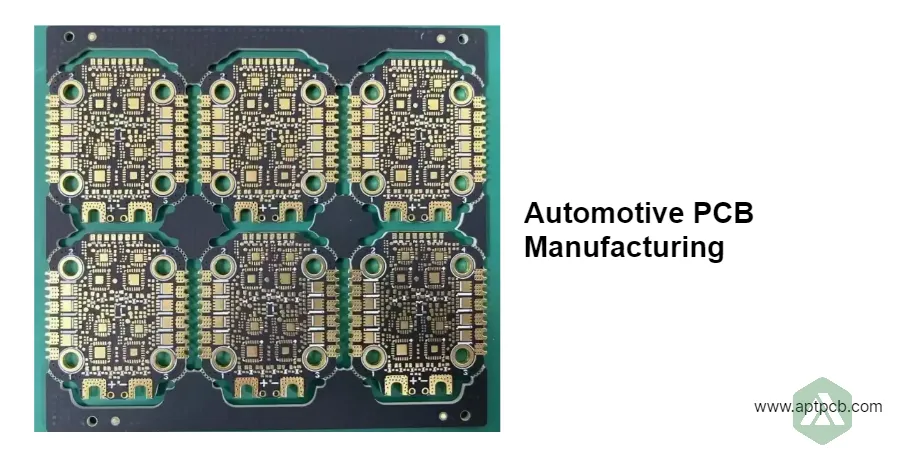
Automotive PCB manufacturing requires more than producing a board from Gerber files. Vehicle electronics must operate through years of temperature cycling, vibration, humidity exposure, electrical transients, and demanding lifecycle requirements.
Modern automotive electronics platforms including ADAS sensors, battery management systems, powertrain controllers, infotainment modules, and body electronics require controlled materials, validated processes, production traceability, and documented reliability evidence.
Automotive-grade PCB programs typically combine:
- High-reliability PCB materials and stackup control
- Automotive component qualification requirements
- IATF 16949 manufacturing discipline
- Functional safety support for ISO 26262 programs
- Environmental and mechanical validation
- Long-term lifecycle management
At APTPCB, we manufacture automotive PCBs with automotive electronics expertise implementing qualified processes, validated materials, and comprehensive testing supporting ADAS through powertrain applications.
What requirements define an automotive PCB manufacturing program?
Automotive PCB requirements depend on vehicle location, subsystem function, operating environment, and safety classification.
A cabin infotainment board and an under-hood power controller may both be automotive PCBs, but their reliability requirements are different.
| Application | Primary PCB Requirements | Typical Manufacturing Focus |
|---|---|---|
| ADAS radar and camera systems | Signal integrity, impedance control, reliability | HDI, high-speed routing, inspection, traceability |
| Battery management systems | Voltage monitoring, thermal reliability, isolation | High-reliability multilayer boards, power routing |
| Powertrain controllers | Temperature, vibration, electrical stress | High-Tg materials, robust solder joints, validation |
| Infotainment and telematics | High-speed interfaces, RF performance | Controlled impedance, RF materials, connectivity testing |
| Body electronics | Cost efficiency with long lifetime | Stable production process and lifecycle support |
Selecting the PCB technology starts with the vehicle subsystem, environmental exposure, and required evidence package.
How do AEC-Q requirements affect automotive PCB manufacturing?
AEC-Q qualification defines reliability testing for automotive electronic components. It does not independently certify an entire PCB assembly.
AEC-Q100 applies to integrated circuits, AEC-Q101 to discrete semiconductors, and AEC-Q200 to passive components. PCB manufacturing must provide the process control, material reliability, and production evidence needed to support the final automotive system qualification.
Automotive qualification implementation
- Automotive-qualified components: Supplier-controlled sourcing with qualified components through quality system management.
- Extended temperature capability: Automotive electronics commonly require operation around -40 to +125°C depending on location and subsystem.
- Thermal cycling validation: Testing confirms solder joints, laminate structures, and interfaces withstand repeated temperature changes.
- Mechanical reliability testing: Vibration and shock validation confirm PCB assemblies survive vehicle environments.
- Environmental testing: Humidity, corrosion, and contamination controls support long-term reliability.
A qualified supplier should provide evidence showing how materials, processes, and inspections support the required vehicle lifetime.
What should engineers verify before selecting an automotive PCB supplier?
Automotive PCB supplier qualification should evaluate manufacturing capability, documentation quality, and production controls.
Automotive PCB supplier checklist
| Evaluation Area | Verification Items |
|---|---|
| Quality system | IATF 16949 capability, process audits, corrective action system |
| Material control | Approved laminate sources, lot traceability, material certificates |
| Manufacturing process | Controlled plating, drilling, solder mask, surface finish processes |
| Inspection capability | AOI, electrical testing, dimensional inspection, reliability testing |
| Change management | PCN handling, engineering change approval, revision control |
| Traceability | Lot tracking from material through finished assembly |
| Production readiness | Prototype validation, PPAP support, mass production controls |
A supplier capable of automotive production should demonstrate repeatable processes rather than relying only on final inspection.
How does ISO 26262 affect automotive PCB manufacturing?
ISO 26262 defines functional safety processes for road vehicle electrical and electronic systems. PCB manufacturing contributes evidence to the overall safety case but does not independently make a PCB “ISO 26262 certified.”
Safety-related PCB programs require manufacturing controls that support system-level safety objectives.
Functional safety manufacturing considerations
- Traceable production records: Manufacturing history must support investigation and verification.
- Controlled process variation: Stable processes reduce systematic manufacturing failures.
- Failure analysis capability: Suppliers should support root cause analysis and corrective actions.
- Design verification support: PCB structures must maintain electrical and mechanical requirements defined by the system design.
For ASIL-related applications, manufacturing evidence becomes part of the complete vehicle safety lifecycle.
How are ADAS PCB requirements different from traditional automotive boards?
ADAS systems combine sensors, high-speed processing, and safety requirements. Radar, camera, lidar, and domain controller boards require careful electrical and mechanical design.
ADAS PCB manufacturing considerations
High-speed signal integrity
- Controlled impedance routing
- Stable dielectric properties
- Low-loss materials where required
- Reliable high-density interconnect structures
Thermal management
- Efficient heat spreading
- Copper structures designed for power dissipation
- Material selection based on operating temperature
Safety-related reliability
- Production traceability
- Functional testing support
- Controlled manufacturing variation
Through ADAS-optimized manufacturing coordinated with mass production scalability, APTPCB enables autonomous vehicle platforms.
What automotive PCB failure modes should suppliers control?
Automotive failures often develop from manufacturing variation combined with long-term environmental stress.
| Failure Mode | Root Cause | Manufacturing Control |
|---|---|---|
| Solder joint fatigue | Thermal cycling and vibration | Solder process control, reliability testing |
| Via failure | Mechanical stress or poor plating | Via inspection and plating control |
| Delamination | Material mismatch or thermal stress | Laminate selection and thermal validation |
| Signal integrity failure | Stackup variation or impedance drift | Controlled impedance testing |
| Corrosion | Moisture or contamination | Cleanliness control and environmental testing |
| Component lifecycle failure | Obsolescence or sourcing issues | Lifecycle management and approved alternatives |
A robust automotive PCB process connects each potential failure mechanism with a measurable prevention or detection method.
How should automotive PCB materials and technologies be selected?
Material selection depends on temperature, frequency, mechanical stress, and power requirements.
Common considerations include:
- High-Tg laminates for elevated temperature environments
- Heavy copper structures for higher current applications
- HDI technology for compact ADAS electronics
- RF materials for radar and communication systems
- Rigid-flex solutions for space-constrained assemblies
The correct material choice balances reliability, manufacturability, cost, and lifecycle availability.
How are automotive electronics supported throughout a 15-year lifecycle?
Vehicle programs often require long production availability and controlled engineering changes.
Lifecycle support includes:
- Long-term component availability: Maintaining qualified supply sources.
- Obsolescence management: Identifying replacements before production disruption.
- Design change control: Validating modifications while maintaining form, fit, and function.
- Field failure analysis: Investigating failures and implementing corrective actions.
- Production Part Approval: Supporting automotive documentation requirements.
Automotive PCB manufacturing is a long-term partnership between engineering, manufacturing, quality, and supply-chain teams.
Through comprehensive lifecycle support and automotive expertise, APTPCB enables successful automotive electronics programs from development through end-of-life.