
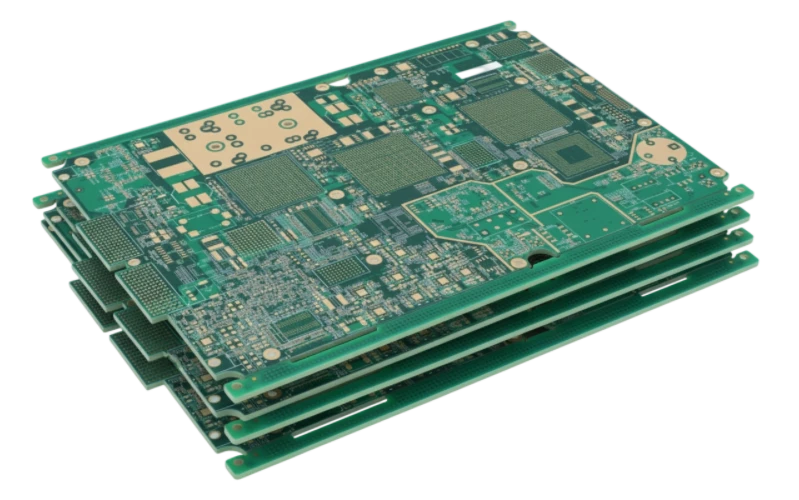
What is a Barcode Scanner PCB and when do you need one?
A Barcode Scanner PCB is the electronics platform that connects the optical scanning system, processor, power supply, user controls, and host interface inside a scanning product.
A scanner board may support:
- CMOS image sensors for 2D barcode and QR code reading
- laser or LED illumination drivers
- scan engines and embedded modules
- USB, UART, RS-232, Bluetooth, or wireless interfaces
- trigger switches, indicators, and charging circuits
Unlike a general-purpose control board, a scanner PCB must preserve optical alignment, maintain high-speed signal integrity, manage illumination heat, and survive mechanical stress from repeated handling.
This guide is intended for hardware engineers, product teams, and procurement managers selecting a PCB manufacturing partner for handheld scanners, industrial readers, retail scanners, kiosks, and embedded scanning products.
Which Barcode Scanner PCB architecture should you choose?
The correct PCB architecture depends on whether the scanner uses a complete scan engine module or a custom optical design.
| Application requirement | Recommended PCB approach | Main design priority |
|---|---|---|
| Handheld warehouse scanner | Rigid-flex PCB | Compact routing, impact resistance, connector reduction |
| Fixed kiosk scanner | Rigid multilayer PCB | Cost control and serviceability |
| Custom optical engine | Integrated scanner PCB | Sensor placement and signal integrity |
| Pre-certified scan module | Carrier PCB | Interface reliability and lower development risk |
| Wireless scanner | Multilayer PCB with RF section | Grounding, antenna isolation, power integrity |
A rigid-flex design is commonly selected for handheld products because it reduces cable assemblies and allows the electronics to follow the mechanical enclosure shape.
A standard rigid FR4 PCB is often sufficient when the scan engine is purchased as a module and the board only provides power, communication, and mechanical integration.
What PCB specifications matter most for barcode scanners?
What materials and stackup should a scanner PCB use?
Specify materials based on thermal load, mechanical stress, and signal requirements.
Typical production requirements include:
- High-Tg FR4 with Tg above 170°C for processor-based scanner boards
- Polyimide materials for rigid-flex sections
- 4 to 8 layer stackups for compact handheld designs
- Dedicated ground planes separating sensitive sensor signals from switching noise
- Symmetrical layer construction to reduce warpage
For high-speed camera interfaces, define the stackup before layout begins. MIPI, LVDS, and USB differential pairs require controlled impedance, commonly around 90Ω or 100Ω differential depending on interface requirements.
What trace, via, and surface finish requirements are typical?
| Parameter | Typical scanner PCB requirement |
|---|---|
| Minimum trace/space | 3mil/3mil or 4mil/4mil for high-density designs |
| Differential impedance | 90Ω or 100Ω ±10% depending on interface |
| Surface finish | ENIG for fine-pitch sensors and BGA packages |
| Copper weight | 1oz outer layers is common |
| Via technology | Blind vias, buried vias, or VIPPO for dense layouts |
| Solder mask | Matte black near optical paths; green for enclosed areas |
| Outline tolerance | Approximately ±0.10mm for tight housings |
ENIG provides a flat surface suitable for fine-pitch components and optical sensor assemblies. Matte black solder mask can reduce unwanted internal reflections when the PCB is located near the optical path.
What are the main Barcode Scanner PCB failure modes?
Scanner failures often appear as poor decoding performance, intermittent communication, or field reliability problems. The PCB design and manufacturing process directly influence these outcomes.
| Failure mode | Root cause | Detection method | Prevention |
|---|---|---|---|
| Optical sensor misalignment | PCB warpage or uneven solder joints | Height inspection, optical functional test | Control flatness, use stable stackups and ENIG finish |
| MIPI/LVDS signal errors | Incorrect impedance or routing | TDR testing and signal analysis | Controlled impedance stackup and coupon verification |
| Flex cracking | Excessive bend stress | Micro-section analysis, bend cycling | Correct bend radius and reinforced transitions |
| LED thermal degradation | Poor heat dissipation | Thermal imaging | Thermal vias and copper optimization |
| Trigger switch failure | Mechanical solder stress | Mechanical cycling test | Stronger pads and mechanical support |
| Sensor contamination | Flux residue or dust | Image quality test | Clean assembly environment and protective handling |
| ESD damage | Poor handling protection | Functional testing | ESD controls and protection components |
| RF interference | Digital noise coupling | RF validation testing | Ground isolation and shielding strategy |
How should you validate a Barcode Scanner PCB before mass production?
A reliable validation plan should combine PCB fabrication tests, assembly inspection, and product-level scanning tests.
Recommended acceptance testing includes:
Electrical and manufacturing verification
- 100% electrical continuity and isolation testing
- AOI inspection for component placement
- X-ray inspection for BGA and QFN solder joints
- Micro-section analysis for multilayer construction
- Impedance verification using TDR coupons
Reliability verification
- Thermal cycling
- Drop and vibration testing
- Flex bend testing for rigid-flex designs
- Ionic contamination testing
- Connector durability testing
Typical acceptance requirements include:
- impedance within ±10% of target
- no open or short failures
- no component detachment after mechanical testing
- copper plating without cracks during micro-section inspection
What files should you provide when requesting a Barcode Scanner PCB quote?
A complete RFQ package reduces engineering delays and prevents inaccurate pricing.
Provide:
- Gerber or ODB++ fabrication files
- PCB fabrication drawing
- Layer stackup definition
- Material requirements
- Finished thickness
- Surface finish requirements
- Drill files
- Netlist for electrical testing
- Assembly drawings
- BOM and approved alternatives
- Functional test requirements
- Expected annual volume
For scanner products, include additional information:
- scan engine datasheet
- sensor interface requirements
- optical keep-out zones
- enclosure constraints
- cable and connector specifications
How do you qualify a Barcode Scanner PCB supplier?
A supplier evaluation should confirm both manufacturing capability and engineering support.
Barcode Scanner PCB supplier checklist
| Qualification area | Questions to verify |
|---|---|
| HDI capability | Can the supplier manufacture microvias and fine-pitch BGA routing? |
| Rigid-flex experience | Has the supplier produced flex sections for repeated bending applications? |
| Signal integrity | Are TDR reports available with production shipments? |
| Surface finish control | Can ENIG thickness and quality records be provided? |
| Inspection capability | Are AOI, X-ray, and electrical tests available? |
| Traceability | Can material batches and production lots be tracked? |
| Change control | Are material substitutions approved before production changes? |
| Packaging | Are boards protected with ESD-safe moisture-controlled packaging? |
How do you balance cost, reliability, and performance?
Scanner PCB decisions usually involve tradeoffs between manufacturing cost and product reliability.
Rigid PCB vs rigid-flex PCB
Rigid-flex is preferred for compact handheld scanners where space and cable reliability matter.
Rigid multilayer boards are typically preferred for fixed scanners where mechanical movement is limited and cost efficiency is important.
HDI vs conventional routing
HDI technology supports compact designs with fine-pitch processors and sensors.
Standard multilayer routing remains effective when component pitch and enclosure space allow conventional manufacturing.
Integrated scanner PCB vs module carrier board
An integrated design provides maximum control over size and performance.
A carrier board using an existing scan engine reduces development complexity and certification risk.
Barcode Scanner PCB FAQ
Can a QR Code Scanner PCB use standard FR4?
Yes. Many QR Code Scanner PCB designs use high-Tg FR4 successfully. Material selection depends on thermal load, sensor interface speed, and mechanical requirements.
What is the typical prototype lead time?
A standard rigid 4-6 layer prototype may be completed within several days depending on supplier capability and testing requirements. Complex rigid-flex builds usually require additional processing time.
Why is impedance control important in scanner boards?
High-speed sensor interfaces such as MIPI and LVDS are sensitive to routing geometry and dielectric variation. Controlled impedance prevents signal degradation and intermittent image capture problems.
What testing should be required from a PCB supplier?
At minimum request electrical testing, inspection records, impedance verification for high-speed designs, and traceability documentation.
Related Barcode Scanner PCB resources
- Rigid-Flex PCB Capabilities: Understand the specific design rules and material options for creating ergonomic handheld scanners.
- HDI PCB Technology: Learn how high-density interconnects enable compact scanner designs with fine-pitch sensors.
- Box Build Assembly Services: Explore full turnkey solutions where the PCB, scan engine, and housing are assembled and tested together.
- Automated Optical Inspection (AOI): See how we verify component placement accuracy to prevent sensor misalignment.
- DFM Guidelines: Download our design rules to ensure your scanner PCB is manufacturable at scale.
- Impedance Calculator: Use this tool to estimate trace widths for your USB and MIPI differential pairs.
Request a quote for Barcode Scanner PCB
Ready to move from design to production? Request a quote from APTPCB today to get a full DFM review and competitive pricing for your scanner project.
Include:
- Gerber files
- Stackup details
- Fabrication drawing
- Volume requirements
- Rigid-flex or HDI requirements
- Testing expectations
Conclusion
A production-ready Barcode Scanner PCB requires more than correct routing. The board must maintain optical alignment, protect high-speed signals, manage thermal loads, and survive real-world mechanical conditions.
By selecting the correct architecture, defining manufacturing requirements early, validating critical parameters, and qualifying suppliers with a structured checklist, engineering teams can reduce redesign cycles and move scanner products into reliable production.