
The personal care electronics market is rapidly evolving, merging consumer convenience with medical-grade technology. However, the biggest hurdle between a prototype and a shelf-ready product is often Electromagnetic Interference (EMI). A beauty device emi compliance pcb is not just a circuit board; it is the foundational defense system that ensures your device operates safely without disrupting other electronics or being disrupted itself.
For engineers and product managers, achieving compliance (FCC, CE, or FDA standards) requires specific design strategies at the board level. This guide covers the entire lifecycle of these specialized PCBs, from initial metrics to mass production validation.
At APTPCB (APTPCB PCB Factory), we see many innovative designs fail certification due to poor layout choices. This guide aims to prevent those failures.
Key Takeaways
- Definition: A beauty device emi compliance pcb prioritizes signal integrity and grounding to pass EMC tests (Radiated and Conducted Emissions).
- Critical Metric: Loop area minimization is the single most effective way to reduce EMI at the source.
- Layer Stackup: 4-layer boards are often the minimum requirement for modern beauty devices to provide adequate ground planes.
- Component Placement: Noisy power circuits must be physically separated from sensitive analog sensors (like microcurrent probes).
- Validation: Pre-compliance testing during the prototyping phase saves thousands of dollars in final certification.
- Misconception: Shielding cans alone cannot fix a fundamentally poor PCB layout.
- Trend: IoT integration requires specific isolation strategies for Bluetooth/Wi-Fi antennas.
What beauty device emi compliance pcb really means (scope & boundaries)
Understanding the core definition is the first step before analyzing specific performance metrics.
A beauty device emi compliance pcb is a printed circuit board designed specifically to mitigate electromagnetic interference in personal care gadgets. Unlike standard consumer electronics, these devices often operate in direct contact with human skin. This creates a unique challenge: the human body acts as a large antenna, potentially coupling noise back into the device or radiating it outward.
The scope of this PCB category includes three main boundaries:
- Source Suppression: The PCB must prevent internal noise (from switching regulators or motors) from escaping.
- Susceptibility (Immunity): The PCB must function correctly even when exposed to external noise (e.g., a user using a hairdryer nearby).
- Safety Isolation: For devices like a cosmetic device fda class1 pcb, the board must maintain strict separation between high-voltage mains and the low-voltage side touching the user.
If a design fails in any of these areas, it will not pass EMC testing. This leads to costly redesigns and delayed market entry.
beauty device emi compliance pcb metrics that matter (how to evaluate quality)
Once you understand the scope, you must define the measurable attributes that determine success.
You cannot manage what you do not measure. When designing or ordering a beauty device emi compliance pcb, these are the specific metrics that dictate performance.
| Metric | Why it matters | Typical Range / Factor | How to Measure |
|---|---|---|---|
| Loop Inductance | Large current loops act as antennas, radiating noise. | Minimize to < 10nH where possible. | Simulation software or near-field probe. |
| Impedance Control | Mismatched impedance causes signal reflection (ringing), leading to EMI. | 50Ω (Single) / 90Ω or 100Ω (Diff). | TDR (Time Domain Reflectometry). |
| Ground Impedance | High ground impedance creates "ground bounce," disrupting logic levels. | < 0.1Ω across the plane. | DC Resistance measurement / PDN analysis. |
| Crosstalk | Signals jumping between traces corrupt data and increase emissions. | < -40dB isolation. | Vector Network Analyzer (VNA). |
| Shielding Effectiveness | Determines how well the PCB layout blocks external fields. | 20dB to 60dB depending on enclosure. | Radiated immunity testing. |
| Thermal Rise | Heat increases resistance and thermal noise. | < 20°C rise above ambient. | Thermal camera or thermocouple. |
How to choose beauty device emi compliance pcb: selection guidance by scenario
With metrics defined, the next step is applying them to your specific product type.
Not all beauty devices require the same PCB strategy. A beauty device emi compliance pcb for a battery-operated facial roller differs vastly from a mains-powered laser hair remover. Below are common scenarios and the necessary trade-offs.
1. The Microcurrent Facial Device
- Scenario: Handheld, battery-powered, generates low-frequency pulses.
- Challenge: The microcurrent facial device pcb is highly sensitive. The switching power supply (boosting battery voltage) can introduce noise into the treatment signal.
- Trade-off: Prioritize analog signal integrity over size. You may need a larger board to separate the boost converter from the analog output stage.
- Selection: Use a 4-layer board with a dedicated solid ground plane to shield the analog traces.
2. The Smart/IoT Beauty Mask
- Scenario: LED mask with Bluetooth/Wi-Fi app control.
- Challenge: Beauty iot app connectivity pcb designs have high-frequency RF signals. The antenna can interfere with the LED drivers, causing flickering or compliance failure.
- Trade-off: Prioritize RF isolation. You must sacrifice board space to create a "keep-out zone" around the antenna.
- Selection: Choose HDI PCB technology if space is tight, ensuring vias do not penetrate the antenna ground clearance.
3. The Wearable Posture Corrector
- Scenario: Small, worn on the back, continuous data logging.
- Challenge: Wearable posture beauty pcb designs face extreme size constraints.
- Trade-off: Prioritize miniaturization. EMI shielding cans may be impossible to fit.
- Selection: Use Rigid-Flex PCBs to fold the circuit. Rely on buried capacitance (power and ground layers close together) rather than bulky capacitors for filtering.
4. High-Power Laser/IPL Devices
- Scenario: Mains-powered, high current bursts for hair removal.
- Challenge: High current switching generates massive magnetic fields.
- Trade-off: Prioritize thermal management and current handling.
- Selection: A high temperature resistant beauty pcb (High Tg FR4 or Metal Core) is essential. Use heavy copper traces to handle surges without overheating.
5. FDA Class I/II Cosmetic Devices
- Scenario: Devices making medical claims (acne treatment, anti-aging).
- Challenge: Strict documentation and safety standards.
- Trade-off: Prioritize traceability and reliability over cost.
- Selection: Select a manufacturer with Medical PCB experience who can provide UL certification and full material traceability.
6. Disposable Beauty Tech
- Scenario: Single-use patches or testers.
- Challenge: Extreme cost sensitivity.
- Trade-off: Prioritize cost over longevity.
- Selection: 2-layer FR4 or even paper-based electronics, provided the operational life is short enough that EMI drift is not an issue.
beauty device emi compliance pcb implementation checkpoints (design to manufacturing)
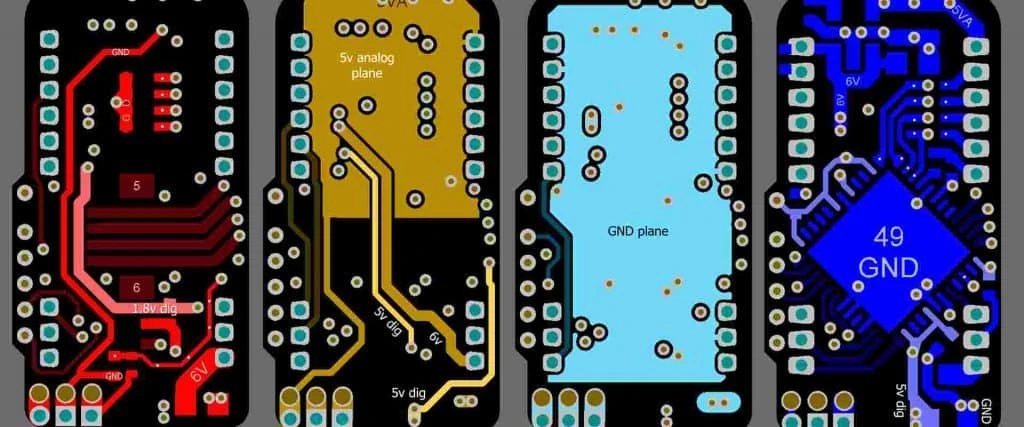
After selecting the right approach, you must execute the design through a rigorous manufacturing process.
Implementing a beauty device emi compliance pcb requires checking specific boxes at every stage of the NPI (New Product Introduction) process.
1. Stackup Design
- Recommendation: Always use a Signal-Ground-Power-Signal stackup for 4-layer boards.
- Risk: Placing signal layers adjacent to each other increases crosstalk.
- Acceptance: Review stackup diagram with the fab house before layout begins.
2. Component Placement (Floorplanning)
- Recommendation: Group components by function (RF, Power, Analog, Digital). Keep noisy DC-DC converters away from connectors.
- Risk: Placing an inductor near the I/O connector allows noise to exit the device via the cable.
- Acceptance: Visual inspection of the placement file.
3. Grounding Strategy
- Recommendation: Use a "star ground" or a solid ground plane. Avoid daisy-chaining grounds.
- Risk: Ground loops create antennas.
- Acceptance: Review Gerber files for split planes or isolated islands of copper.
4. Trace Routing
- Recommendation: Route high-speed signals as differential pairs. Avoid 90-degree angles; use 45-degree miters.
- Risk: Sharp corners cause impedance changes and reflections.
- Acceptance: Run DRC (Design Rule Check) for impedance constraints.
5. Decoupling Capacitors
- Recommendation: Place capacitors as close to the IC power pins as possible.
- Risk: Long traces between the cap and the pin add inductance, rendering the cap useless for high frequencies.
- Acceptance: Visual inspection during PCBA testing and quality checks.
6. Shielding
- Recommendation: Design footprints for shielding cans over the power management section and RF section.
- Risk: Adding shields as an afterthought (using tape or glue) is unreliable for mass production.
- Acceptance: Verify shield footprint dimensions against the BOM.
7. Connector Filtering
- Recommendation: Add ferrite beads or LC filters on all lines going to external connectors (USB, charging ports).
- Risk: Cables act as efficient antennas for internal noise.
- Acceptance: Conducted emissions simulation.
8. Silk Screen and Marking
- Recommendation: Clearly mark test points for EMC debugging.
- Risk: Debugging a failing board without labeled test points takes 3x longer.
- Acceptance: Verify readability of silkscreen in Gerber viewer.
beauty device emi compliance pcb common mistakes (and the correct approach)
Even with a solid plan, specific layout errors frequently cause compliance failures.
When analyzing failed beauty device emi compliance pcb designs, we often see the same errors repeated. Avoiding these will significantly increase your first-pass yield.
- Splitting the Ground Plane:
- Mistake: Cutting the ground plane to route a signal trace on the bottom layer.
- Correction: Never interrupt the return path. If you must route on the ground layer, use a bridge or move the trace.
- Ignoring the Return Path:
- Mistake: Thinking current only flows "to" the load.
- Correction: Current flows in a loop. High-frequency return current follows the path of least inductance (directly underneath the signal trace). Ensure this path is clear.
- Placing Connectors on Opposite Sides:
- Mistake: Placing the power input on the left and the data output on the right.
- Correction: Keep I/O connectors on the same edge of the board if possible. This reduces the voltage potential difference between grounds during ESD events.
- Over-reliance on Auto-Routers:
- Mistake: Letting software route critical clock lines or power paths.
- Correction: Hand-route all critical signals, power rails, and RF paths.
- Neglecting Thermal Vias:
- Mistake: Failing to stitch ground planes for heat dissipation in high temperature resistant beauty pcb designs.
- Correction: Use arrays of vias to transfer heat to inner planes, which stabilizes impedance.
- Floating Copper:
- Mistake: Leaving large areas of unused copper unconnected.
- Correction: Tie all unused copper pours to Ground (GND) via stitching vias to prevent them from acting as resonant antennas.
beauty device emi compliance pcb FAQ (cost, lead time, Design for Manufacturability (DFM) files, stackup, impedance, S-parameters)
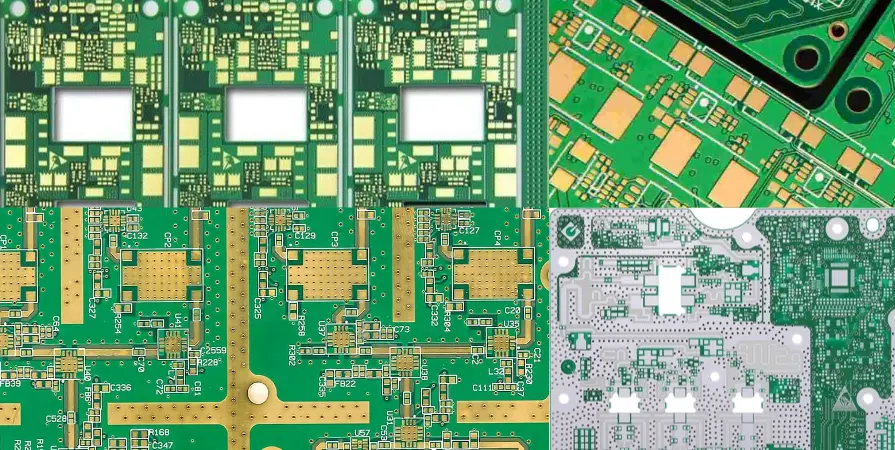
To clarify remaining doubts, here are answers to the most frequent questions regarding beauty device PCBs.
Q: Does a beauty device always need a 4-layer PCB for EMI compliance? A: Not always, but it is highly recommended. A 2-layer board makes it very difficult to maintain a continuous low-impedance ground plane, which is the primary defense against EMI.
Q: What is the difference between FCC and CE requirements for these PCBs? A: FCC (USA) focuses primarily on emissions (what your device sends out). CE (Europe) requires both emissions and immunity (how your device handles external noise). Your PCB must be designed for the stricter standard (usually CE) to sell globally.
Q: Can I use a flexible PCB for a beauty device? A: Yes. Flexible PCBs are common in ergonomic beauty tools. However, you must use cross-hatched ground planes to maintain flexibility while still providing shielding.
Q: How does the "human body model" affect PCB design? A: Since users touch the device, the PCB must handle Electrostatic Discharge (ESD) events (static shocks). You must include TVS diodes on all user-accessible contacts.
Q: Why is my microcurrent device failing radiated emissions? A: It is likely the boost converter frequency. If the switching loop area is too large, it broadcasts the switching frequency. Tighten the layout of the inductor and diode.
Q: What surface finish is best for these boards? A: ENIG (Electroless Nickel Immersion Gold) is preferred for its flat surface (good for fine-pitch components) and excellent oxidation resistance, which is vital for devices used in humid bathroom environments.
Q: How much does EMI compliance testing cost? A: Full certification can cost between $2,000 and $10,000 depending on the lab and standards. This is why investing in a high-quality beauty device emi compliance pcb upfront is cheaper than re-testing.
Q: Can APTPCB help with the layout? A: While we are primarily a manufacturer, our engineering team provides detailed DFM (Design for Manufacturing) reviews to highlight potential EMI risks in your layout before production.
beauty device emi compliance pcb glossary (key terms)
| Term | Definition |
|---|---|
| EMC (Electromagnetic Compatibility) | The ability of a device to operate in its environment without causing or suffering from interference. |
| EMI (Electromagnetic Interference) | The disturbance that affects an electrical circuit due to electromagnetic induction or radiation. |
| ESD (Electrostatic Discharge) | A sudden flow of electricity between two electrically charged objects (e.g., a static shock from a user). |
| Ground Plane | A large area of copper on a PCB connected to the circuit's ground reference, essential for shielding. |
| Return Path | The path current takes to return to the source. For high frequencies, this is directly underneath the signal conductor. |
| Differential Pair | Two complementary signals used to transmit data. They are immune to common-mode noise if routed correctly. |
| Via Stitching | Connecting ground planes on different layers with multiple vias to create a low-impedance structure. |
| Faraday Cage | An enclosure used to block electromagnetic fields. Can be simulated on a PCB using via fences. |
| Crosstalk | Unwanted signal transfer between communication channels (traces). |
| Decoupling Capacitor | A capacitor used to decouple one part of an electrical network (circuit) from another, reducing noise. |
| Ferrite Bead | A passive electric component that suppresses high-frequency noise in electronic circuits. |
| IPC Class 2/3 | Manufacturing standards. Most beauty devices are Class 2; medical-grade may require Class 3. |
Conclusion (next steps)
Achieving certification for a personal care product is a rigorous process, but it begins with the board layout. A well-designed beauty device emi compliance pcb ensures that your microcurrent, RF, or LED therapy device is safe, reliable, and legally saleable in global markets.
By focusing on loop areas, proper stackups, and strategic component placement, you can mitigate noise at the source. Remember that compliance is not an add-on feature; it is a fundamental design constraint.
Ready to move to production? When submitting your design to APTPCB for a quote, please provide:
- Gerber Files: Including all copper, solder mask, and silk layers.
- Stackup Requirements: Specify if you need controlled impedance for RF/Bluetooth lines.
- Material Specs: E.g., High Tg FR4 for heat resistance or specific flex requirements.
- Test Requirements: Let us know if you require specific impedance testing reports or material certificates for FDA documentation.
We are ready to support your innovation from the first prototype to mass production.