
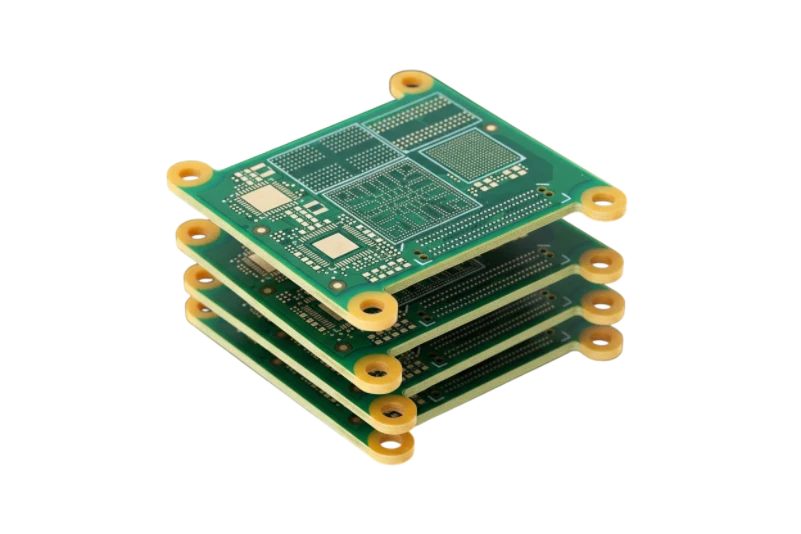
PCB depaneling should be selected before the panel is released, not treated as an afterthought after assembly. The right method depends on board geometry, material and thickness, component sensitivity, required edge condition, panel rigidity, production volume, and how much mechanical or thermal process risk the product can tolerate.
For a simple rectangular assembly, controlled V-score separation may provide the best balance of panel utilization and throughput. Irregular outlines often favor routing. Thin, flexible, brittle, or densely populated designs may justify a laser feasibility review. Whatever method is chosen, the release criterion should be measurable: the finished board must meet its dimensional and edge requirements without unacceptable board flex, laminate damage, component cracking, contamination, or assembly damage.
The most important rule is therefore simple: design the panel, separation method, support strategy, and validation plan as one manufacturing system.
How do you choose a PCB depaneling method?
Do not choose by volume alone. Start with the constraints that cannot be changed: finished outline, component locations, material system, board thickness, enclosure interfaces, acceptable edge remnants, and product reliability requirements.
The following matrix is a practical first-pass decision tool.
| Depaneling route | Best fit | Main design constraint | Primary process risk | Evidence to define before release |
|---|---|---|---|---|
| V-score separation | Rectangular arrays with continuous straight separation lines | Blade path and break line must remain accessible | Board bending during separation | Score geometry, edge condition, dimensional check, strain evidence when required |
| CNC routing | Irregular rigid-board outlines and controlled tab removal | Router access, fixture support, cutter diameter, tab placement | Vibration, tool wear, routing debris | Finished outline, tab-remnant criteria, edge inspection, cleanliness |
| Tab routing / mouse bites | Boards that need panel support through SMT but have non-straight outlines | Tab position must balance panel stiffness and breakout stress | Local bending and rough tab remnants | Released tab drawing and acceptable finished-edge condition |
| Laser depaneling | Thin, flex, rigid-flex, brittle, or edge-dense designs when mechanical contact is undesirable | Material response, thickness, cut path, thermal limits | Heat-affected edge or residue if the process is not qualified | Material-specific trial, edge inspection, dimensions, cleanliness |
| Punching / die separation | Stable, repetitive geometry where dedicated tooling is justified | Product geometry must remain compatible with fixed tooling | Mechanical shock and tooling variation | Tool qualification, dimensional inspection, crack/burr criteria |
| Manual breakaway | Limited prototype situations where the assembly is demonstrably tolerant | Break direction and support are operator-dependent | Uncontrolled bending | Use only when the released risk assessment accepts the variation |
This matrix narrows the process route; it does not establish universal design dimensions. Final clearances, score geometry, fixtures, cutting parameters, and acceptance limits must be set against the actual assembly.
For fabrication routes involving different outlines, materials, or panel structures, review the available PCB Manufacturing Services together with the project drawing rather than assuming that one depaneling process fits every design.
Why does depaneling crack MLCCs and solder joints?
The critical failure mechanism is usually board flexure, not simply contact between a cutting tool and the PCB.
An assembled PCB behaves mechanically as a structure. When a panel is bent, twisted, poorly supported, or forced through a breakaway feature, strain is transferred through the laminate and solder joints into mounted components. Ceramic components such as multilayer ceramic capacitors are particularly sensitive because excessive board bending can initiate cracks in the ceramic body.
Component manufacturers including Murata and KYOCERA AVX identify PCB bending and depanelization as important sources of mechanical cracking. IPC/JEDEC-9704A provides a methodology for strain-gauge testing of printed circuit assemblies during manufacturing and handling operations that can induce board flexure.
That does not mean there is one universal microstrain limit that makes every PCB safe. Acceptable strain depends on the component, package, board construction, mounting orientation, strain rate, customer requirement, and product qualification basis. A generic number should not replace a project-specific limit supplied by the customer, component manufacturer, or approved internal reliability specification.
Where should sensitive components be placed?
Distance from the break line matters, but distance alone is not enough.
A designer should review:
- whether the component is beside a V-score, routed tab, or other local flex point;
- the orientation of brittle components relative to the expected bending direction;
- board thickness and local stiffness;
- nearby cutouts, connectors, heavy parts, and copper features;
- how the board will be supported during the actual separation operation.
This is why a universal rule such as "all components must be 1 mm from a routed edge" or "2 mm from a V-score" can be misleading. A greater clearance can reduce risk, but the required value should follow the board construction and qualified depaneling process.
Use the Gerber Viewer to inspect the released outline, mechanical layers, copper, and separation features before manufacturing review.
What should be designed into the panel before assembly?

A good panel must remain sufficiently rigid for printing, placement, reflow, inspection, transport, and any other operations performed before singulation. At the same time, it must allow each finished board to be removed without transferring excessive force into the assembly.
Panel rails and handling support
Rails provide surfaces for conveyors, tooling, fiducials, and fixtures. Their dimensions should therefore come from the equipment route rather than a generic rail-width rule.
Thin or large panels deserve particular attention because gravity, thermal exposure, or unsupported spans can increase deflection. If reflow or transport creates unacceptable sag, center support or a dedicated carrier may be needed. The reflow profile should solve soldering requirements; mechanical support should solve excessive panel deflection rather than attempting to compensate for a weak panel only through thermal-profile changes.
Fiducials and tooling features
Panel fiducials, tooling holes, and other registration features should match the equipment that will actually process the assembly. Their purpose is repeatable alignment, not simply satisfying a drawing convention.
A depaneling fixture also needs stable datums. If the panel can shift while routing or cutting, nominal cutter accuracy does not guarantee finished-board accuracy.
Breakaway tabs
Place tabs where they provide enough support during assembly without forcing the final breakout load through a vulnerable component region.
Mouse-bite perforations can make separation easier, but they also leave a local edge condition that must be acceptable for the enclosure or final mechanical interface. If a flush, cosmetic, sealing, or precision mating edge is required, define the permitted tab remnant or specify a finishing operation.
Copper and components near the cut path
Do not evaluate only the visible board outline. Copper, plated features, edge connectors, components, and overhanging hardware can all constrain the tool path.
A V-score separator needs an unobstructed straight separation route. A router needs cutter and fixture access. A laser process needs a qualified path that accounts for the material and nearby features.
APTPCB's broader DFM Guidelines can be used to align panelization with stack-up, assembly, test, and release-package requirements before production data are frozen.
How should PCB handling be controlled before depaneling?
Depaneling is only one potential source of board strain. A qualified separation process cannot repair damage introduced earlier by poor handling.
Support the panel during transfers, test probing, connector insertion, rework, fixture loading, and other operations that can bend the assembly. Large or thin boards should not be carried or clamped in ways that allow their own weight or operator force to create substantial deflection.
ESD controls remain applicable during handling and singulation just as they do elsewhere in PCBA production. Grounding and material selection should follow the site's approved ESD control program rather than relying on the depaneling machine alone.
For routing or sawing processes, debris control also matters. Fiberglass, resin, and other process debris should be captured and removed so that finished boards meet the project's cleanliness requirement. Extraction, fixture cleaning, and post-process inspection should be defined as part of the routing cell rather than added only after contamination appears.
How do you validate a depaneling process before production release?
The validation plan should test the actual production condition: production-equivalent panel construction, component population, fixture, separator, support points, tool path, and operator or automation sequence.
A practical release gate combines four types of evidence.
| Release question | What to verify | Typical evidence |
|---|---|---|
| Did the board experience acceptable mechanical loading? | Flex at risk locations during the real operation | Strain-gauge test where required, using an approved limit and test method |
| Did separation damage the board structure? | Cracks, delamination, lifted material, excessive burrs or tab damage | Visual or magnified edge inspection against released criteria |
| Is the finished board mechanically usable? | Outline, critical dimensions, connector interfaces, enclosure fit | Dimensional inspection referenced to the fabrication drawing |
| Is the assembly still acceptable? | Relevant electrical, functional, and component integrity requirements | Defined inspection and test sequence appropriate to the product |
Do not assume that a passing electrical test proves that mechanical damage is absent. Conversely, do not specify strain-gauge testing on every product simply because it is available. Use it where component sensitivity, reliability requirements, a process change, or previous failures justify quantitative mechanical validation.
What do common depaneling defects tell you about the process?
The defect location often provides more useful information than the scrap count.
| Observed problem | Likely process question | Corrective direction |
|---|---|---|
| Cracked MLCC near a break feature | Is local board bending too high? | Review component position/orientation, support, tab or score design, and separation method |
| Delamination or fractured laminate at an edge | Is the cutting or breakout load damaging the material? | Review tool condition, cut parameters, support, material response, and edge acceptance criteria |
| Rough or excessive tab remnants | Is mouse-bite/tab geometry compatible with the finished edge? | Revise tab geometry or add controlled finishing |
| Router chatter or inconsistent edge | Is the board sufficiently supported and is the cutter condition stable? | Improve fixturing and verify spindle/feed/tool-life controls |
| Dimensional drift | Is tool wear, panel movement, or datum control affecting the outline? | Verify cutter compensation, fixture registration, and measurement method |
| Dust after routing | Is extraction and cleaning effective at the source? | Improve capture, fixture cleaning, and post-process cleanliness verification |
| Warped panel entering singulation | Did the problem originate before depaneling? | Review stack-up/copper balance, reflow support, panel rigidity, and handling |
This diagnostic sequence prevents a common mistake: changing the cutting machine when the actual root cause is panel design, component placement, fixture support, or an upstream warpage problem.
What should engineering and procurement include in an RFQ?
A depaneling quotation is more useful when the supplier receives the finished-board requirement rather than being asked simply to "choose the best method."
Submit the Gerber or other released fabrication data, drill data, mechanical outline, stack-up and material specification, finished thickness, assembly drawing where populated-board separation is involved, panel drawing if one has already been defined, quantity and expected production volume, critical edge or enclosure dimensions, and any component or region with special mechanical sensitivity.
Also state the acceptance evidence you need. Depending on the project, that may include a released panel/profile drawing, dimensional results, edge inspection criteria, cleanliness requirements, or strain-gauge validation against a customer-approved limit.
The supplier is responsible for controlling the manufacturing process to the agreed drawing and process requirements. Project feasibility must still be confirmed for the submitted material, geometry, quantity, and process combination. Product or system qualification remains separate: a manufacturable and successfully depaneled PCB is not, by itself, proof that the final product satisfies automotive, aerospace, medical, safety, environmental, or other end-use qualification requirements.
FAQ
Should depaneling happen before or after electrical testing?
There is no universal sequence. Some tests benefit from panel-level handling and fixture efficiency, while others must verify the individual board after separation. Define the sequence according to test access, mechanical risk, fixture design, and whether singulation itself could introduce defects that the final test is intended to detect.
Do router bits need a standard diameter?
No single router-bit diameter is appropriate for every board. Cutter selection depends on internal radii, routing channels, board thickness, material, dimensional requirements, tool strength, and the supplier's qualified process. If a feature requires a specific maximum internal radius or tool access, put that requirement on the mechanical drawing.
Can depaneling change RF performance?
It can matter when the finished edge forms part of an RF structure or controls the geometry around an antenna, edge-launch connector, reference plane, or other electrically sensitive feature. In those cases, define the finished edge and dimensional requirement from the RF design rather than relying on a generic depaneling tolerance.
Can one panel combine V-scoring and routing?
Yes, when the geometry and manufacturing sequence support it. A hybrid panel may use straight score lines in suitable regions and routing where contours or other constraints prevent scoring. The complete panel still needs enough rigidity for the operations performed before separation.
When should a depaneling process be revalidated?
Revalidation should be considered when a change could alter mechanical loading or finished-edge behavior—for example a new board thickness or material, component relocation near a separation feature, revised tab or score geometry, different fixture, changed cutting equipment, or another process change covered by the project's change-control requirements.
Release the separation process with the PCB, not after it
Reliable depaneling is the result of coordinated design and process control. Choose the separation route from the finished-board geometry and assembly risk; design rails, tabs, tooling features, and component locations around that route; support the panel through assembly and handling; and define measurable evidence before production starts.
For an RFQ or DFM review, provide the released fabrication and mechanical data, material and thickness, assembly information relevant to the cut path, panel preference if already defined, quantity, critical finished-edge requirements, and any customer-defined mechanical validation criteria. That gives engineering enough information to evaluate the depaneling route without confusing manufacturing feasibility with final-product qualification.