
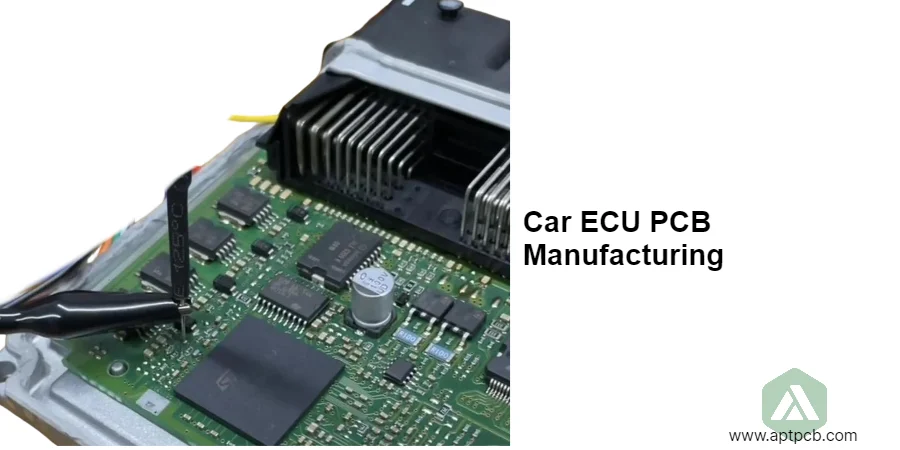
Automotive ECU PCB manufacturing requires a combination of high-reliability PCB fabrication, automotive-grade component handling, EMC-controlled layout, thermal management, and production traceability. Engine control units, transmission controllers, body control modules, and vehicle domain controllers must operate for 15+ years while exposed to temperature cycling, vibration, electrical transients, moisture, and electromagnetic interference.
A successful ECU PCB program depends on decisions made before production begins:
- PCB material selection for -40 to +125°C automotive environments
- Power and signal integrity design for sensors and actuators
- EMC protection against ignition noise, alternator ripple, and load dump events
- Automotive manufacturing controls including traceability and validation testing
- Supplier capability for prototype, PPAP, and long-term production support
At APTPCB, we manufacture automotive ECU PCBs with automotive electronics expertise implementing qualified processes and comprehensive testing supporting powertrain, transmission, and vehicle control applications.
What PCB Requirements Matter Most for Automotive ECU Manufacturing?
An ECU PCB is not simply a controller board. It is the hardware foundation connecting:
- Automotive microcontrollers
- Sensor interfaces
- Power regulators
- CAN/CAN-FD/LIN communication circuits
- Actuator drivers
- Diagnostic interfaces
Powertrain ECUs must process sensor inputs, execute control algorithms, and drive actuators with deterministic timing. Engine management systems commonly require ADC sampling in the 1-10kHz range and PWM outputs reaching 10-100kHz for injector, valve, and motor control applications.
The manufacturing strategy must support both electrical performance and vehicle lifetime reliability.
Automotive ECU PCB Material Selection: Which Stackup Supports Long-Term Reliability?
Under-hood ECUs experience repeated thermal cycling between low-temperature startup conditions and high operating temperatures near engines. Material selection directly affects:
- Laminate stability
- Via reliability
- Solder joint lifetime
- Moisture resistance
- Signal integrity
Typical automotive ECU PCB material decisions include:
| Requirement | Engineering Consideration |
|---|---|
| Glass transition temperature | High-Tg materials are commonly selected for long-term thermal stability |
| Operating temperature | Designs may require operation from -40°C to +125°C depending on vehicle location |
| Copper thickness | 2-4oz copper may support power distribution and heat spreading requirements |
| CTE control | Lower Z-axis expansion improves via reliability during thermal cycling |
| CAF resistance | Important for dense multilayer automotive boards exposed to humidity |
High-reliability ECU designs often use automotive-qualified laminate systems with controlled impedance capability for communication interfaces.
How Should Engineers Evaluate ECU PCB Manufacturing Suppliers?
Automotive ECU suppliers need more than PCB fabrication capacity. The manufacturing partner must demonstrate process control, documentation capability, and production readiness.
ECU PCB Supplier Decision Matrix
| Evaluation Area | Required Supplier Evidence | Why It Matters |
|---|---|---|
| Automotive quality system | Automotive process controls, traceability records, inspection documentation | Supports OEM and Tier-1 qualification |
| PCB fabrication | High-Tg materials, multilayer capability, impedance control reports | Ensures electrical and thermal reliability |
| Assembly capability | Fine-pitch SMT, BGA inspection, automotive component handling | Supports complex ECU layouts |
| Testing | AOI, X-ray, functional testing, programming support | Detects production defects before vehicle integration |
| Lifecycle support | BOM monitoring and change management | Protects 15+ year programs |
A qualified supplier should support engineering review before production, including DFM feedback, component availability review, and manufacturing risk analysis.
How Does EMC Design Affect Automotive ECU PCB Reliability?
Automotive ECUs operate in environments with ignition systems, motors, alternators, and switching loads that generate electrical noise. EMC design must control both emissions and immunity.
Common automotive EMC challenges include:
- Conducted noise through vehicle power rails
- Radiated interference from high-current switching
- Electrical transients from inductive loads
- Communication errors caused by signal degradation
ECU EMC Protection Implementation
- TVS diodes and suppression networks protect against load dump, ESD, and transient events.
- Pi-filters and ferrite components reduce conducted noise on supply and communication lines.
- Ground planes and controlled return paths reduce radiation from high-frequency loops.
- CAN protection circuits improve network robustness.
Automotive EMC validation typically considers requirements from vehicle manufacturers together with standards such as ISO 11452 and CISPR-based testing approaches.
How Are ECU PCBs Designed for Engine and Transmission Control?
Powertrain electronics require precise timing and reliable operation because failures directly affect vehicle performance.
Typical ECU functions include:
- Fuel injection control
- Ignition timing
- Variable valve timing
- Transmission shifting
- Exhaust system management
Powertrain ECU Hardware Requirements
- Automotive microcontrollers such as Infineon AURIX, NXP MPC5xxx, and Renesas RH850 families
- 12-16 bit ADC channels for temperature, pressure, oxygen, and position sensors
- PWM outputs for actuator control
- High-side and low-side drivers with diagnostics
- Protection circuits for automotive electrical conditions
At APTPCB, our manufacturing supports precision powertrain control achieving emissions compliance and reliable vehicle operation.
What Are the Main ECU PCB Failure Modes During Vehicle Operation?
Understanding failure mechanisms helps engineers define manufacturing controls before production.
| Failure Mode | Root Cause | Manufacturing Control |
|---|---|---|
| ECU reset during operation | EMC susceptibility or unstable power supply | Transient testing, filtering review, power integrity validation |
| Thermal shutdown | Insufficient heat dissipation from drivers or regulators | Thermal analysis, copper optimization, enclosure validation |
| Intermittent communication | CAN signal integrity issues | Controlled impedance, network validation |
| Cracked solder joints | Thermal cycling and vibration stress | Automotive solder process control and reliability testing |
| Component failure | Incorrect qualification or lifecycle issues | Automotive-grade sourcing and traceability |
How Does Thermal Management Improve ECU PCB Lifetime?
Engine compartment ECUs must dissipate heat while maintaining electrical performance. Thermal design decisions include:
- Heavy copper PCB construction
- Thermal vias beneath power components
- Heat transfer paths into aluminum housings
- Temperature-qualified components
- Thermal simulation during development
Power drivers, voltage regulators, and actuator circuits often create localized hot spots. Thermal validation should confirm component temperatures remain within rated limits during worst-case vehicle operation.
At APTPCB, our manufacturing implements thermal strategies ensuring reliable underhood operation.
Thermal Management
- Heavy Copper Construction: 2-4oz copper distributes heat from power components across the PCB area.
- Thermal Interface to Housing: Controlled mechanical interfaces transfer heat into vehicle structures.
- High-Temperature Components: Automotive-qualified components support demanding operating conditions.
- Thermal Simulation: Analysis validates temperature performance before production.
How Are CAN and Vehicle Networks Implemented on ECU PCBs?
Modern vehicles may contain dozens of electronic modules communicating through CAN, CAN-FD, LIN, FlexRay, and automotive Ethernet networks.
Reliable ECU communication requires:
- Automotive CAN transceivers
- Correct termination and biasing
- Controlled routing
- Diagnostic communication support
- Protection against electrical disturbances
Poor network implementation can create communication failures, diagnostic problems, or intermittent vehicle behavior.
At APTPCB, our manufacturing supports automotive network integration achieving reliable vehicle communication.
Network Implementation
- CAN Transceivers: Automotive-qualified devices with fault protection.
- Termination and Biasing: Proper impedance matching maintains signal integrity.
- Protocol Implementation: Validated CAN/CAN-FD communication support.
- Network Diagnostics: OBD-II and UDS capability enables service and troubleshooting.
What Testing Should an Automotive ECU PCB Supplier Provide?
Automotive ECU manufacturing requires verification beyond basic PCB inspection.
Typical validation includes:
- Electrical testing
- AOI inspection
- X-ray inspection for hidden solder joints
- Functional testing
- Programming and flashing support
- Environmental reliability testing
- Thermal cycling validation
Production documentation should include traceability information covering materials, components, assembly parameters, and inspection results.
What Should Be Included in an ECU PCB Manufacturing RFQ?
A complete ECU PCB manufacturing request should define:
Design Information
- PCB layer count and stackup requirements
- Controlled impedance requirements
- Operating temperature range
- Copper thickness requirements
- Mechanical drawings
Component Information
- BOM with automotive qualification requirements
- Approved component alternatives
- Lifecycle expectations
- Obsolescence management needs
Manufacturing Requirements
- Prototype quantity
- Mass production volume
- Testing requirements
- Traceability requirements
- PPAP documentation expectations
How Does Long-Term Support Protect Automotive ECU Programs?
Vehicle platforms remain in production for many years. ECU manufacturers need stable component supply, controlled engineering changes, and reliable production continuity.
Lifecycle support includes:
- Long-term component availability planning
- Alternative component qualification
- Controlled engineering changes
- Field failure analysis
- Production quality improvement
Through comprehensive lifecycle support and automotive expertise coordinated with component sourcing management, APTPCB enables successful ECU programs from development through end-of-life.