Definition, scope, and who this guide is for
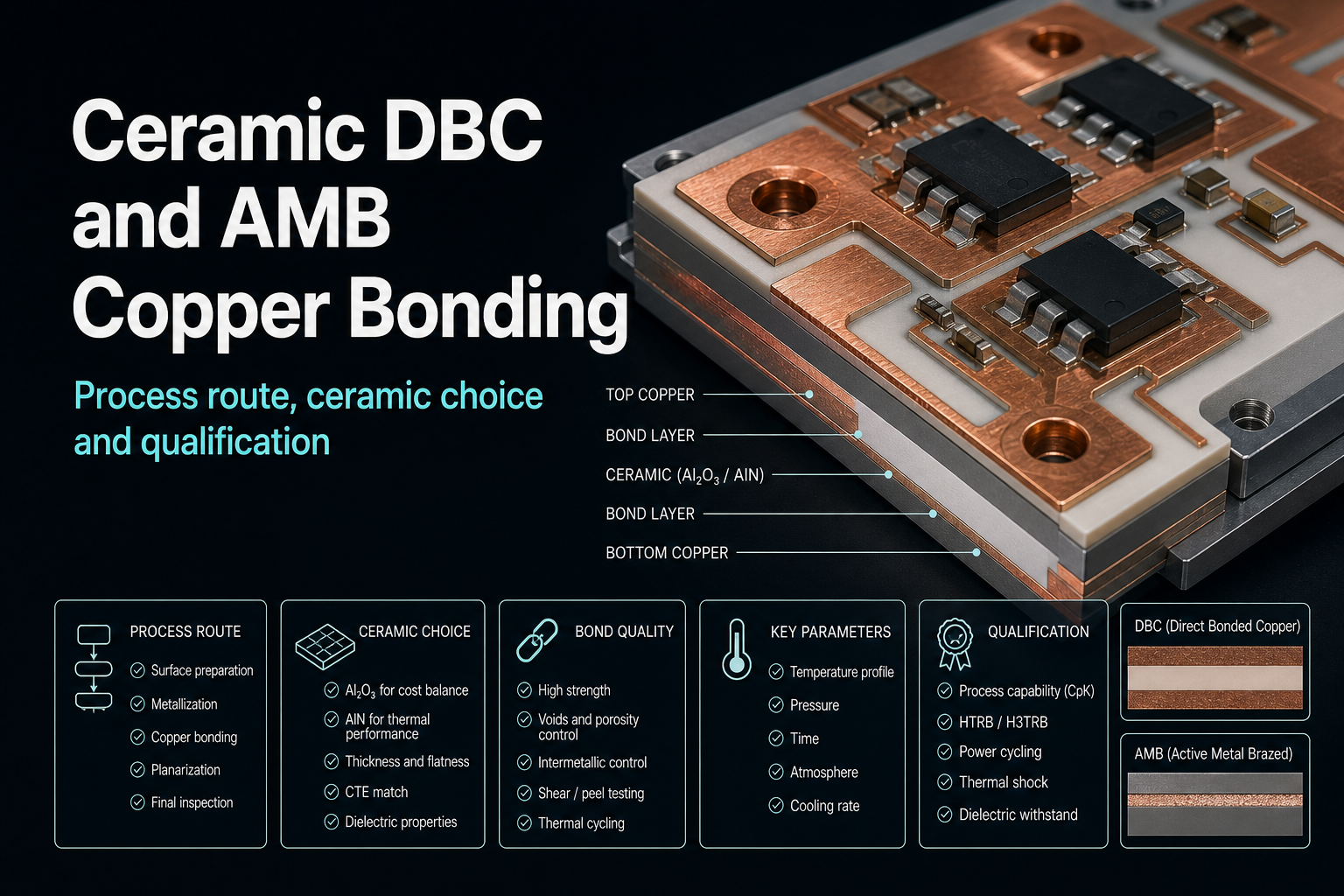
High-power electronics demand substrates that do more than just route signals; they must survive extreme thermal stress and dissipate massive amounts of heat. This is where ceramic DBC/AMB copper bonding becomes the critical technology choice. Unlike standard FR4 or even metal-core PCBs, Direct Bonded Copper (DBC) and Active Metal Brazing (AMB) technologies create a robust interface between thick copper conductors and ceramic insulators (Alumina, Aluminum Nitride, or Silicon Nitride). This bond determines the reliability of power modules in EVs, rail traction, and renewable energy inverters.
This playbook is designed for power electronics engineers, NPI managers, and procurement leads who need to source ceramic substrates without compromising reliability. It moves beyond basic datasheets to cover the practical realities of manufacturing: how to define specifications that prevent field failures, how to validate the bonding quality, and how to audit a supplier’s capability.
At APTPCB (APTPCB PCB Factory), we often see projects delayed because the initial specifications for copper bonding did not account for the specific thermal cycling requirements of the end application. This guide aims to bridge that gap. It provides a structured approach to selecting between DBC and AMB, defining acceptance criteria, and ensuring your manufacturing partner can deliver consistent quality at scale.
When to use ceramic chnology choice. Unlike standard FR4 or even metal-core PCBs, Direct Bonded Copper (DBC)/and Active Metal Brazing (AMB) copper bonding (and when a standard approach is better)
Understanding the transition point from standard thermal solutions to ceramic bonding is essential for cost control. Ceramic DBC/AMB copper bonding is not a replacement for every circuit board; it is a specialized solution for high-voltage and high-thermal-density applications.
You should transition to DBC or AMB when:
- Voltage Isolation is Critical: Your application requires isolation voltages exceeding 3kV–5kV, which standard dielectric layers in IMS (Insulated Metal Substrate) cannot reliably sustain over long periods.
- Thermal Conductivity Requirements are High: You need thermal conductivity ranging from 24 W/m·K (Alumina) to over 170 W/m·K (Aluminum Nitride). Standard IMS dielectrics typically top out at 3–8 W/m·K.
- CTE Matching is Required: You are mounting bare die (IGBTs, MOSFETs) directly to the substrate. The Coefficient of Thermal Expansion (CTE) of ceramic (4–7 ppm/°C) closely matches Silicon and Silicon Carbide (SiC), reducing stress on the die attach.
- Current Density is Extreme: You need very thick copper (300µm to 800µm+) to carry hundreds of amps without excessive voltage drop or heating.
Conversely, stick to aluminum vs copper core IMS or heavy-copper FR4 if:
- The components are packaged (e.g., TO-247) rather than bare die.
- The thermal load is manageable with active cooling and thermal vias.
- Cost is the primary driver and the reliability requirements do not mandate ceramic-level performance.
- The mechanical environment involves high shock and vibration where brittle ceramics (specifically Alumina DBC) might fracture without specialized housing.
ceramic chnology choice. Unlike standard FR4 or even metal-core PCBs, Direct Bonded Copper (DBC)/and Active Metal Brazing (AMB) copper bonding specifications (materials, stackup, tolerances)

Defining the correct specifications upfront prevents costly engineering change orders (ECOs). When specifying ceramic DBC/AMB copper bonding, you must define the interaction between the ceramic base, the bonding interface, and the copper foil.
Key Specification Parameters:
- Ceramic Material Type:
- Al2O3 (96% Alumina): Standard for DBC. Low cost, moderate thermal conductivity (~24 W/m·K).
- AlN (Aluminum Nitride): High performance. Excellent thermal conductivity (~170 W/m·K), close CTE match to Si.
- Si3N4 (Silicon Nitride): Best for AMB. Extremely tough mechanically, good thermal conductivity (~90 W/m·K), ideal for automotive.
- Ceramic Thickness: Standard thicknesses are 0.25mm, 0.32mm, 0.38mm, 0.635mm, and 1.0mm. Thicker ceramic offers better isolation but higher thermal resistance.
- Copper Thickness: Typically ranges from 127µm (5 oz) to 800µm (23 oz). Both sides usually require equal thickness to prevent bowing (camber).
- Bonding Technology:
- DBC: Copper is bonded via a eutectic melt at ~1065°C. Requires oxygen in copper.
- AMB: Copper is brazed using active metals (Ti, Zr, Ag) at ~800°C–900°C. Creates a chemical bond with the ceramic.
- Peel Strength:
- DBC: > 5 N/mm typically.
- AMB: > 10–15 N/mm (significantly stronger).
- Surface Finish:
- Electroless Nickel Immersion Gold (ENIG): Common for soldering.
- Electroless Nickel Electroless Palladium Immersion Gold (ENEPIG): For wire bonding reliability.
- Ag Sintering Compatible: Bare copper with OSP or Ag plating for high-temp die attach.
- Etching Tolerances: Due to thick copper, etching factors are significant. Gap spacing usually requires min 0.3mm–0.5mm depending on copper thickness.
- Camber / Flatness: Critical for heatsink attachment. Specification should be < 0.3%–0.5% of diagonal length.
- Void Content: The bonding interface must be nearly void-free to prevent hotspots. Spec: < 1–2% total void area, with no single void > 0.5mm diameter in active areas.
- Thermal Cycling Capability: Define the number of cycles (e.g., -40°C to +150°C) the bond must survive without delamination.
- Partial Discharge (PD): Specify PD inception voltage if the application is high voltage (>1kV).
- Traceability: Laser marking on individual units for lot tracking is standard in automotive.
ceramic chnology choice. Unlike standard FR4 or even metal-core PCBs, Direct Bonded Copper (DBC)/and Active Metal Brazing (AMB) copper bonding manufacturing risks (root causes and prevention)
Manufacturing ceramic substrates involves high temperatures and brittle materials. Understanding the risks associated with ceramic DBC/AMB copper bonding allows you to implement better quality controls.
Risk 1: Interface Voids (Delamination Precursor)
- Root Cause: Trapped gas during the eutectic melting (DBC) or brazing (AMB) process, or poor surface cleaning of the ceramic.
- Detection: Scanning Acoustic Microscopy (C-SAM) is the only non-destructive way to see this.
- Prevention: Vacuum bonding processes and strict cleanroom environments for material preparation.
Risk 2: Ceramic Cracking (Conchoidal Fracture)
- Root Cause: Thermal shock during cooling (CTE mismatch between Cu and Ceramic) or mechanical stress during singulation (dicing/laser cutting).
- Detection: Electrical isolation testing (Hi-Pot) and visual inspection with backlight.
- Prevention: Controlled cooling profiles in the furnace; using AMB (Si3N4) for mechanically demanding applications; dimples in copper layout to relieve stress.
Risk 3: Copper Etching Undercut
- Root Cause: Thick copper requires long etching times, leading to trapezoidal trace profiles rather than rectangular ones.
- Detection: Cross-section analysis (microsection).
- Prevention: Design compensation (DFM) applied to artwork; strict control of etchant chemistry.
Risk 4: Surface Oxidation before Plating
- Root Cause: Copper surface reacts with air after etching but before surface finish application.
- Detection: Poor solderability or wire bond lift-offs.
- Prevention: Minimize hold times between processes; micro-etching prior to plating.
Risk 5: Warpage (Camber)
- Root Cause: Asymmetric copper layout on top vs. bottom side causes bowing as the substrate cools.
- Detection: Laser profilometry or go/no-go gauges.
- Prevention: Strict design rule: Top and bottom copper thickness and area density must be balanced.
Risk 6: Silver Migration (AMB specific)
- Root Cause: Brazing material often contains silver. Under high voltage and humidity, silver can migrate, causing shorts.
- Detection: Temperature Humidity Bias (THB) testing.
- Prevention: Proper etching of the braze material overflow between traces; applying conformal coating or encapsulation.
Risk 7: Solder Mask Adhesion Failure
- Root Cause: Ceramic surfaces are extremely smooth, making it hard for polymer solder masks to adhere.
- Detection: Tape test (cross-hatch adhesion).
- Prevention: Physical or chemical roughening of the ceramic surface in non-copper areas; using specialized ceramic-compatible soldermasks.
Risk 8: Wire Bond Failure
- Root Cause: Surface roughness of the plating is too high, or the underlying copper is too soft/hard.
- Detection: Wire pull and shear testing.
- Prevention: Specifying the correct surface finish for ceramic PCB (e.g., ENEPIG) and controlling grain structure.
ceramic chnology choice. Unlike standard FR4 or even metal-core PCBs, Direct Bonded Copper (DBC)/and Active Metal Brazing (AMB) copper bonding validation and acceptance (tests and pass criteria)

You cannot rely on standard PCB acceptance criteria (IPC-A-600) alone for ceramic substrates. You must validate the integrity of the ceramic DBC/AMB copper bonding specifically.
Validation Plan:
Scanning Acoustic Microscopy (C-SAM):
- Objective: Detect internal voids between copper and ceramic.
- Method: Ultrasonic scanning of 100% of panels (or AQL sampling).
- Acceptance Criteria: Total void area < 2%; no single void > 0.5mm under power die locations.
Thermal Shock Cycling:
- Objective: Verify bond reliability under stress.
- Method: Cycle between -40°C and +150°C (or +175°C for SiC applications).
- Acceptance Criteria: No delamination after 1000 cycles (AMB) or 100-300 cycles (DBC, depending on spec).
Peel Strength Test:
- Objective: Measure mechanical adhesion of copper.
- Method: Vertical pull of a copper strip.
- Acceptance Criteria: DBC > 5 N/mm; AMB > 12 N/mm.
Dielectric Breakdown Voltage (Isolation):
- Objective: Ensure ceramic integrity.
- Method: Apply AC/DC voltage across the ceramic (Top Cu to Bottom Cu).
- Acceptance Criteria: Leakage current < specified limit (e.g., 1mA) at rated voltage + margin (e.g., 5kV).
Dimensional Verification:
- Objective: Check etching accuracy and flatness.
- Method: CMM or optical measurement.
- Acceptance Criteria: Trace width ±10% (or ±0.1mm for thick Cu); Flatness < 0.4%.
Solderability and Wire Bondability:
- Objective: Ensure assembly readiness.
- Method: Dip and look / Wire pull test.
- Acceptance Criteria: >95% wetting; Wire pull force > min spec (e.g., 10g for 1 mil wire) with failure in wire, not lift-off.
High Temperature Storage (HTS):
- Objective: Check for oxidation or diffusion issues.
- Method: Store at 150°C–200°C for 1000 hours.
- Acceptance Criteria: No discoloration or change in electrical resistance.
Partial Discharge Testing:
- Objective: Detect micro-voids in ceramic that ionize under high voltage.
- Method: IEC 60270 standard.
- Acceptance Criteria: < 10 pC at operating voltage.
ceramic chnology choice. Unlike standard FR4 or even metal-core PCBs, Direct Bonded Copper (DBC)/and Active Metal Brazing (AMB) copper bonding supplier qualification checklist (RFQ, audit, traceability)
When vetting a supplier like APTPCB, use this checklist to ensure they have the specific capabilities for ceramic substrates.
Group 1: RFQ Inputs (What you must provide)
- Gerber files with clear copper layers and solder mask.
- Material specification: Al2O3, AlN, or Si3N4.
- Bonding type preference: DBC or AMB (or "Supplier to Recommend").
- Copper thickness and tolerance requirements.
- Surface finish requirements (ENIG, Ag, Bare Cu).
- Flatness/Camber specifications.
- Testing requirements (C-SAM, Hi-Pot).
- Volume projections (affects tooling choice).
Group 2: Capability Proof (What to look for)
- Do they have in-house brazing/firing furnaces? (Outsourcing this step adds risk).
- Can they handle copper thickness > 500µm?
- Do they have C-SAM equipment on-site?
- Experience with surface finish for ceramic PCB specifically for wire bonding?
- Capability to laser cut or scribe ceramic for singulation?
- Examples of previous work in Automotive or Industrial Power sectors.
Group 3: Quality System & Traceability
- ISO 9001 is mandatory; IATF 16949 is preferred for automotive.
- Do they perform 100% electrical isolation testing?
- Is there a system to track ceramic batches to finished lots?
- How do they control the brazing paste thickness (for AMB)?
- Do they have a cleanroom for the layup/bonding process?
Group 4: Change Control & Delivery
- Policy on changing ceramic raw material suppliers (PCN required?).
- Packaging capability: Vacuum packing to prevent oxidation of thick copper.
- Buffer stock agreements for long-lead ceramic materials.
- RMA procedure for delamination issues found at assembly.
How to choose ceramic chnology choice. Unlike standard FR4 or even metal-core PCBs, Direct Bonded Copper (DBC)/and Active Metal Brazing (AMB) copper bonding (trade-offs and decision rules)
Selecting the right technology involves balancing thermal performance, mechanical reliability, and cost. Here are the decision rules to navigate the trade-offs.
Trade-off 1: Thermal Cycling Reliability (DBC vs. AMB)
- Rule: If your application involves frequent, harsh temperature swings (e.g., EV traction inverters, start-stop systems), choose AMB (Silicon Nitride). The brazed bond is mechanically stronger and Si3N4 is tougher.
- Rule: If the temperature is relatively stable or the cycling is mild (e.g., industrial power supplies, LED lighting), choose DBC (Alumina). It is cost-effective and sufficient for steady-state thermal management.
Trade-off 2: Thermal Conductivity vs. Mechanical Strength
- Rule: If you need the absolute highest heat dissipation (e.g., high-density laser diodes), choose DBC or AMB on Aluminum Nitride (AlN). Note that AlN is brittle.
- Rule: If you need a balance of high heat dissipation and mechanical robustness (to resist cracking during assembly or vibration), choose AMB on Silicon Nitride (Si3N4). It conducts heat better than Alumina and is far stronger than AlN.
Trade-off 3: Cost vs. Performance
- Rule: If budget is the primary constraint and voltage is < 1kV, consider aluminum vs copper core IMS.
- Rule: If you need ceramic isolation but budget is tight, Alumina DBC is the entry-level ceramic solution.
- Rule: AMB is typically 2–3x the cost of DBC due to expensive active metal pastes and vacuum brazing processes. Use it only when DBC reliability is insufficient.
Trade-off 4: Copper Thickness
- Rule: If you need > 500µm copper for massive current, AMB is often preferred as the brazing process handles the CTE mismatch stress of thick copper better than the eutectic bond of DBC.
Trade-off 5: Design Complexity
- Rule: If your design requires fine pitch traces (< 0.3mm space), ceramic substrates are challenging due to thick copper etching. You may need to relax design rules or move to a Thin Film ceramic process (different technology entirely).
ceramic chnology choice. Unlike standard FR4 or even metal-core PCBs, Direct Bonded Copper (DBC)/No delamination after 1000 cycles (AMB) copper bonding FAQ (cost, lead time, Design compensation (DFM) files, materials, testing)
Q: What are the primary cost drivers for ceramic DBC/AMB copper bonding?
- Answer: The ceramic material itself (Si3N4 is expensive, Al2O3 is cheap) and the copper thickness.
- Drivers:
- Ceramic type (Si3N4 > AlN > Al2O3).
- Copper thickness (thicker = longer etch time + more material).
- Yield (AMB yields are lower than DBC).
- Gold plating thickness (for wire bonding).
Q: What is the typical lead time for ceramic DBC/AMB copper bonding prototypes?
- Answer: Standard lead time is 3–5 weeks.
- Details:
- Ceramic material procurement can take 2 weeks if not in stock.
- Master card layout and tooling take 1 week.
- Expedited services are harder than FR4 due to furnace scheduling.
Q: What DFM files are required for ceramic DBC/AMB copper bonding manufacturing?
- Answer: Standard Gerbers (RS-274X) are accepted, but you must include a mechanical drawing specifying the stackup.
- Crucial:
- Specify the "pullback" (distance from copper edge to ceramic edge) – usually min 0.5mm.
- Define the etching compensation if you are doing the layout, or ask the supplier to apply it.
Q: How does testing for ceramic DBC/AMB copper bonding differ from FR4?
- Answer: Electrical continuity is similar, but structural integrity testing is unique.
- Differences:
- C-SAM is mandatory for ceramic to check for voids.
- Partial Discharge testing is common for high voltage.
- Warpage measurement is more critical due to heatsink mounting.
Q: Can I use standard surface finishes like HASL on ceramic DBC/AMB?
- Answer: No. HASL is not suitable due to the thermal shock and flatness issues.
- Options:
- ENIG: Most common for soldering.
- ENEPIG: Best for wire bonding.
- Ag (Silver) Plating: For sintering.
- Bare Cu (OSP): For specific sintering processes.
Q: What are the acceptance criteria for voids in ceramic DBC/AMB copper bonding?
- Answer: It depends on the class of product, but generally strict.
- Criteria:
- < 1% to 2% total void area under the die pad.
- No voids connecting edges (insulation breach).
- No voids > 0.5mm in diameter in critical thermal paths.
Q: Why is "aluminum vs copper core IMS" not sufficient for my high-voltage application?
- Answer: IMS relies on a thin polymer dielectric layer (typically 75µm–150µm) for isolation.
- Reason:
- Polymer dielectrics can degrade over time under high voltage (partial discharge).
- Ceramics (0.38mm+) provide inherent, non-degrading physical isolation capable of withstanding >5kV easily.
Q: How do I specify the surface finish for ceramic PCB to ensure wire bond reliability?
- Answer: Specify ENEPIG or thick soft gold.
- Spec:
- Nickel: 3–5µm.
- Palladium (if ENEPIG): 0.05–0.15µm.
- Gold: > 0.1µm (for Au wire) or thin Au for Al wire.
- Roughness: Ra < 0.3µm is often required for fine wire bonding.
Resources for ceramic chnology choice. Unlike standard FR4 or even metal-core PCBs, Direct Bonded Copper (DBC)/and Active Metal Brazing (AMB) copper bonding (related pages and tools)
- Ceramic PCB Capabilities – Detailed breakdown of our Alumina and Aluminum Nitride manufacturing limits.
- High Thermal PCB Solutions – Explore how ceramic compares to other thermal management technologies like heavy copper and metal core.
- Metal Core PCB (IMS) – Understand the alternative: when to stick with cost-effective aluminum base substrates.
- DFM Guidelines – Essential design rules to ensure your ceramic layout is manufacturable.
- Heavy Copper PCB – Learn about high-current traces on standard substrates if ceramic is overkill for your project.
Request a quote for ceramic chnology choice. Unlike standard FR4 or even metal-core PCBs, Direct Bonded Copper (DBC)/No delamination after 1000 cycles (AMB) copper bonding (Design compensation (DFM) review + pricing)
Ready to validate your design? APTPCB provides a comprehensive DFM review to identify thermal and mechanical risks before you commit to tooling.
To get an accurate quote and DFM, please send:
- Gerber Files: Including copper layers, soldermask, and outline.
- Stackup Drawing: Specify ceramic type (Al2O3/AlN/Si3N4), ceramic thickness, and copper thickness.
- Surface Finish: E.g., ENIG, ENEPIG, or Ag.
- Volume: Prototype quantity vs. production targets.
- Special Requirements: C-SAM reporting, specific voltage isolation, or wire bonding specs.
Click here to Request a Quote & DFM Review
Conclusion (next steps)
Ceramic DBC/AMB copper bonding is the definitive solution for power electronics that require uncompromised thermal conductivity and high-voltage isolation. By selecting the right material—balancing the cost of Alumina DBC against the reliability of Silicon Nitride AMB—and enforcing strict validation for voids and peel strength, you can ensure your power modules perform reliably in the field. Whether you are building EV inverters or industrial power supplies, defining these specs early is the key to a smooth manufacturing launch.