
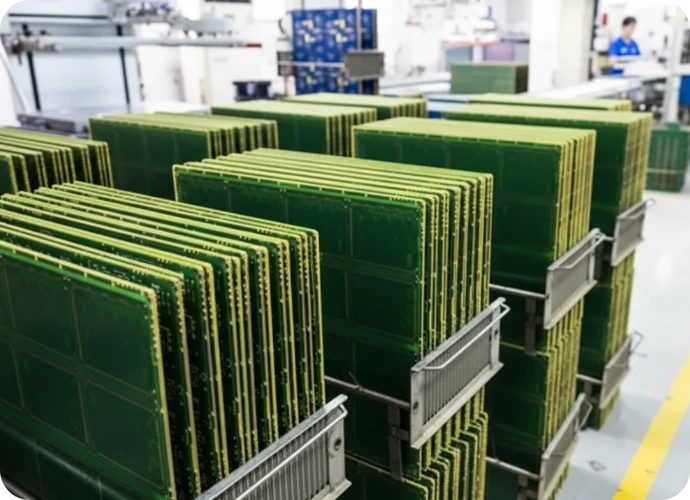
A CFP module PCB is a high-speed optical transceiver circuit board that connects the host electrical interface, SerDes channels, management electronics, power conversion, and optical engine within strict mechanical and thermal limits.
A successful CFP PCB design is not determined only by routing density or layer count. The design must satisfy the combined requirements of:
- CFP-family mechanical specifications;
- high-speed electrical channel performance;
- connector launch and via transition behavior;
- optical assembly requirements;
- thermal path constraints;
- manufacturing repeatability.
CFP, CFP2, CFP4, and CFP8 modules use different mechanical and electrical definitions. The selected MSA form factor, lane architecture, optical engine, and host interface must be frozen before PCB stack-up and routing decisions begin.
Key CFP module PCB design decisions
- Select the exact CFP-family specification before PCB release.
- Build the electrical channel budget from connector to optical device, including vias and packages.
- Choose laminate based on insertion loss, frequency, route length, copper roughness, and margin.
- Use backdrilling, HDI, or advanced via structures only when channel or density requirements justify them.
- Define separate finishes for mating contacts, SMT pads, and optical/wire-bond areas.
- Validate the complete thermal path including PCB, heat spreader, cage, airflow, and power states.
What information must be frozen before CFP PCB layout?
The first engineering step is creating a controlled interface definition.
The PCB team should record:
| Design item | Required definition |
|---|---|
| Form factor | CFP, CFP2, CFP4, CFP8 and applicable MSA revision |
| Host interface | Connector type, contact assignment, lane configuration |
| Electrical signaling | SerDes rate, modulation method, channel limits |
| Management | Control interface, alarms, resets, low-power states |
| Mechanical | Outline, datum, keepouts, heat-sink interface |
| Optical interface | Device package, flex, connector, wire bond or attach process |
| Power | Rails, sequencing, current demand, thermal operating states |
CFP generations are not interchangeable. Connector geometry, lane architecture, power density, and routing constraints change between versions.
How should a CFP module PCB stack-up be selected?
The PCB stack-up must be designed around the complete high-speed channel rather than only the PCB trace.
The electrical path includes:
- host connector contacts;
- connector breakout;
- vias and antipads;
- differential traces;
- AC coupling components;
- packages;
- optical-engine interface.
A small discontinuity at one transition can consume significant insertion-loss and return-loss margin.
CFP PCB material and stack-up decision matrix
| Decision | Engineering question | Required evidence |
|---|---|---|
| Laminate | Does the material provide sufficient loss margin? | Dk/Df data, copper roughness model, simulation |
| Layer assignment | Are high-speed lanes close to continuous references? | Stack-up review and return-path analysis |
| Copper profile | Does conductor roughness affect insertion loss? | Fabricator material data |
| Impedance | Are differential targets maintained through manufacturing variation? | Field solver results and TDR plan |
| Construction | Can fabrication hold thickness and registration targets? | Supplier capability review |
| Via structure | Does the transition meet electrical requirements? | 3D simulation and coupon data |
Use high-speed PCB manufacturing and PCB stack-up support before routing is finalized.
How do CFP PCB designers control SerDes loss and signal integrity?
High-speed CFP channels require controlled impedance and predictable transitions.
Important review points include:
- differential pair geometry;
- reference-plane continuity;
- connector launch design;
- via stub length;
- return-current paths;
- crosstalk between adjacent lanes;
- power noise coupling into sensitive signals.
A channel simulation should evaluate:
| Parameter | Design concern | Verification |
|---|---|---|
| Insertion loss | Excess attenuation reduces link margin | Channel simulation and VNA testing |
| Return loss | Discontinuities create reflections | S-parameter analysis |
| Crosstalk | Adjacent lanes interfere with each other | Aggressor/victim simulation |
| Impedance variation | Manufacturing drift changes eye performance | TDR coupon measurement |
| Jitter contribution | Clock and power noise affect timing | BER and eye analysis |
Bare-board electrical inspection alone cannot prove module-level performance.
When does a CFP PCB need backdrilling or HDI?
Via technology should follow electrical and mechanical requirements.
| Technology | Typical application decision |
|---|---|
| Through-via | Suitable when residual stub does not affect channel margin |
| Backdrilled via | Used when via stubs create unacceptable resonance or return-loss impact |
| Blind via | Used when routing density or transition length requires it |
| Microvia HDI | Used for dense component escape and compact routing |
A backdrill specification should define:
- drill side;
- target layer;
- finished hole size;
- tolerance;
- acceptable residual stub length.
Reference vias should support the return path while maintaining connector and package escape requirements.
How should CFP module PCB finishes be specified?
The edge connector, SMT pads, and optical assembly areas have different requirements.
| Interface | Finish considerations |
|---|---|
| Edge contacts | Wear resistance, contact resistance, hardness, bevel, connector compatibility |
| SMT pads | Solderability, flatness, package pitch, rework capability |
| Wire-bond pads | Bond material, metallurgy, pull/shear requirements |
| Optical attach area | Cleanliness, coplanarity, contamination control |
Hard gold, ENIG, and ENEPIG are not interchangeable board-wide specifications. The finish must match the function of each interface.
How is CFP module PCB thermal design validated?
CFP modules combine optical devices, processors, drivers, and power converters in limited volume.
Thermal analysis should include:
- component power by operating mode;
- copper spreading capability;
- thermal vias;
- case or heat-spreader interface;
- cage and airflow interaction;
- maximum inlet temperature conditions.
A thermal validation plan should evaluate:
| Failure symptom | Possible cause | Verification |
|---|---|---|
| Thermal shutdown | Weak thermal path, airflow limitation, power-state issue | Thermal chamber, sensor logging, power sweep |
| Optical drift | Optical temperature variation or supply instability | Optical/thermal correlation testing |
| Link instability | Temperature-dependent electrical margin loss | BER testing across temperature |
| Power noise | Converter layout or decoupling weakness | Rail measurement and correlation |
What manufacturing controls are required for CFP PCB assembly?
CFP module assembly requires tighter coordination than a standard communication PCB.
Production controls should include:
- SPI and AOI inspection;
- X-ray inspection for hidden solder joints;
- BGA and connector coplanarity control;
- controlled cleaning processes;
- optical-area contamination protection;
- wire-bond or optical attachment acceptance criteria;
- traceability for PCB, components, firmware, and calibration.
The assembly process should define cleanliness requirements, flux chemistry, storage conditions, and handling controls.
CFP module PCB failure analysis checklist
| Symptom | Possible PCB or assembly cause | Verification |
|---|---|---|
| High BER or reduced link margin | Loss, impedance mismatch, crosstalk, power noise | TDR, VNA, eye test, BER analysis |
| Intermittent host connection | Contact finish, contamination, dimensional variation | Contact inspection and mating-cycle testing |
| Thermal shutdown | Insufficient thermal path or airflow limitation | Thermal imaging and environmental testing |
| Optical output drift | Temperature, supply variation, assembly stress | Optical and thermal correlation |
| BGA or connector opens | Warpage, solder volume, reflow variation | X-ray and cross-section |
| Lane-to-lane variation | Trace variation, via transition, process drift | Electrical test and coupon correlation |
CFP module PCB RFQ checklist for suppliers
A complete quotation package should include:
- CFP-family MSA revision;
- mechanical drawing and connector definition;
- electrical lane architecture and channel requirements;
- PCB fabrication files;
- stack-up requirements;
- laminate and copper specifications;
- impedance targets and tolerance;
- via and backdrill requirements;
- HDI sequence if applicable;
- edge-contact finish requirements;
- BOM and assembly data;
- optical attachment requirements;
- thermal conditions;
- testing requirements;
- traceability and change-control requirements.
Submit the controlled package through the PCB quotation page. Include electrical test limits and MSA information so manufacturing capability is evaluated against the real module requirements.
Standards and reference documents
- CFP MSA — Applicable hardware and management interface specification
- IEEE 802.3 — Ethernet physical-layer requirements applicable to selected interfaces
- OIF implementation agreements — High-speed electrical interface requirements
- IPC-6012 — Qualification and performance specification for rigid printed boards
- IPC-TM-650 — Test methods manual
Confirm current revisions before release. MSA compatibility alone does not prove electrical, optical, or thermal compliance.
CFP module PCB FAQ
What is the difference between CFP, CFP2, CFP4 and CFP8 PCBs?
Each form factor defines different mechanical dimensions, connector arrangements, lane configurations, and power limits. The PCB design must follow the selected MSA specification.
Does every CFP module PCB require backdrilling?
No. Backdrilling depends on channel simulation results and whether via stubs consume acceptable signal margin.
Can standard FR-4 be used for CFP PCB designs?
Material selection depends on lane speed, route length, loss budget, copper roughness, and electrical margin. Some designs require lower-loss laminate systems.
Should the entire CFP PCB use hard gold?
No. Edge contacts, SMT pads, and optical assembly areas usually require different finish decisions based on their function.
What files are required for CFP PCB quotation?
Provide fabrication data, stack-up, impedance requirements, mechanical drawings, MSA revision, assembly information, testing requirements, and production quantities.
Which follow-up version would be more useful: CFP PCB supplier RFQ checklist or CFP high-speed SI review checklist?