
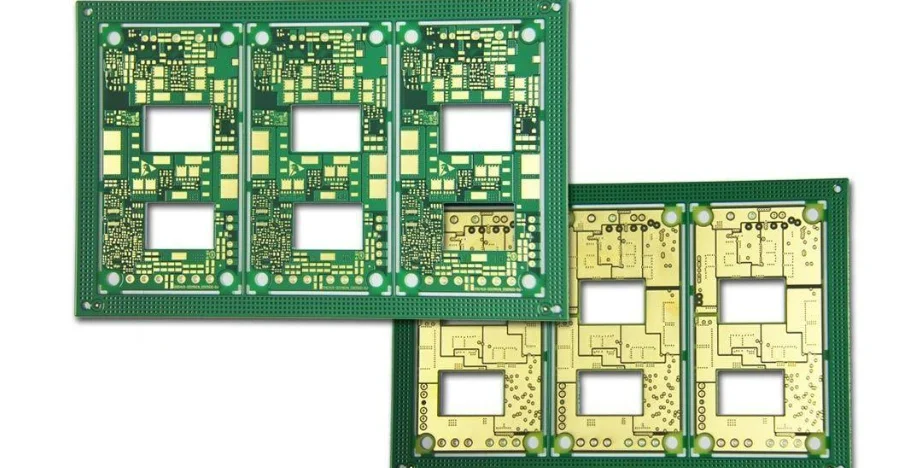
A clinical information PCB supports the electronics chain that acquires, processes, stores, displays, or communicates healthcare information. It is not a formal regulatory PCB category. The correct design approach starts with the clinical function, the consequences of failure, the electrical architecture, and the evidence required to release the hardware.
For engineers, quality teams, and procurement groups, the key challenge is translating clinical requirements into measurable PCB requirements: stack-up, materials, isolation, signal integrity, manufacturing controls, inspection coverage, and validation records.
What requirements define a clinical information PCB?
The PCB should be designed around the complete information path rather than only the circuit board itself.
| Information-chain block | PCB design concern | Release evidence |
|---|---|---|
| Sensor or electrode interface | Leakage, protection, contamination, connector integrity | Approved schematic/BOM and input functional test |
| Analog front end | Noise, offset, filtering, grounding, isolation | Accuracy and noise verification |
| ADC and timing | Reference stability, clock coupling, sampling accuracy | Calibration and functional records |
| Processor and memory | Power sequencing, BGA assembly, firmware control | Programming log and inspection results |
| Communication and storage | Data integrity, EMC, isolation, link reliability | Interface and error-handling tests |
| Alarm or actuator path | Fault response, output reliability | Device-defined alarm testing |
| Power and patient isolation | Creepage, clearance, dielectric barriers | Dimensional inspection and safety testing |
A clinical evaluation is not a PCB manufacturing process. Clinical evaluation assesses clinical data for the finished medical device. The PCB supplier supports controlled hardware builds and verification evidence; the legal manufacturer remains responsible for device validation and regulatory decisions.
How should engineers translate clinical requirements into PCB requirements?
A requirements matrix connects device risk to measurable board characteristics.
| Device requirement | PCB consequence | Information required before layout |
|---|---|---|
| Intended use and critical functions | Reliability priorities and fault controls | Hazard analysis and critical-function list |
| Patient/operator boundary | Isolation structure and leakage controls | Device architecture and protection classification |
| Working voltages | Creepage, clearance, insulation materials | Voltage map and safety requirements |
| Signal accuracy | Noise control and component selection | Error budget and measurement limits |
| Operating environment | Materials, coating, connectors, thermal design | Temperature, humidity, cleaning, vibration profile |
| Device life cycle | Component lifecycle and change control | Service life and obsolescence plan |
| Manufacturing release | Inspection and test requirements | Acceptance criteria and record package |
Terms such as “medical grade,” “zero defect,” or “100% tested” are incomplete requirements unless they define the material, process, measurement method, limits, and evidence.
How do you protect clinical signals from PCB noise?
Clinical information can become incorrect before software processes it. ECG, SpO₂, laboratory sensing, and other low-level measurements can be affected by switching regulators, clocks, displays, radios, motors, return-current paths, or poor reference structures.
Layout reviews should follow the complete signal route:
- Sensor connector to analog front end.
- Analog conversion path to ADC reference.
- Digital processing path to memory and communication.
- Power delivery path to every critical circuit.
Sensitive analog routes should maintain controlled return paths and separation from high-energy switching nodes. Ground labels alone do not create isolation. Current flow, shielding, plane transitions, connector interfaces, and enclosure bonding determine actual behavior.
For high-speed interfaces, define impedance targets from the interface requirement and loss budget. Material selection should consider frequency, dielectric behavior, moisture, thermal stability, fabrication capability, and mechanical requirements. Standard FR-4 may satisfy many applications; PTFE, ceramic, metal-core, flex, rigid-flex, or HDI construction should be selected only when the electrical or mechanical design requires it.
How do MOOP, MOPP, creepage, and clearance affect medical PCB design?
IEC 60601-1 defines safety and essential performance requirements for medical electrical equipment. PCB isolation features support compliance, but spacing cannot be selected from a generic distance table alone.
The device team must define:
- Means of Operator Protection (MOOP) or Means of Patient Protection (MOPP).
- Working and transient voltages.
- Insulation type.
- Pollution degree.
- Material group or CTI.
- Altitude.
- Coating and enclosure assumptions.
The PCB manufacturer then implements the approved design:
- Maintain released isolation barriers.
- Control slots, keep-outs, copper spacing, and materials.
- Verify safety-related dimensions.
- Control approved components and substitutions.
- Provide agreed manufacturing records.
Leakage current, dielectric strength, EMC, and essential performance are verified at the assembly or finished-device level. A PCB is not IEC 60601 certified by layout geometry alone.
Which PCB architecture fits different medical applications?
| Device context | PCB priorities | Design decision |
|---|---|---|
| Bedside or portable monitor | Low-noise acquisition, isolation, alarms, connectivity | Optimize signal integrity and safety barriers |
| IVD analyzer | Sensor stability, thermal control, calibration | Prioritize repeatability and controlled interfaces |
| Imaging subsystem | High-speed conversion, thermal paths, impedance | Select materials based on signal requirements |
| Wearable or probe | Size, flex reliability, battery performance | Use flex or rigid-flex when system benefits justify it |
| Therapeutic controller | Safety functions, interlocks, power integrity | Expand verification around critical functions |
| Connected gateway | Communication reliability and storage integrity | Include EMC and data-integrity controls |
Use rigid-flex PCB when eliminating connectors or improving mechanical integration provides a verified benefit. Use HDI PCB when density, routing, or miniaturization requirements justify the process complexity.
What manufacturing controls support medical PCB validation?
A regulated hardware program depends on controlled inputs, revisions, materials, processes, and records.
Important controls include:
- Released design data: Gerber, ODB++, IPC-2581, drawings, stack-up, BOM, placement files, and firmware.
- Material control: Approved laminates, components, substitutions, and lifecycle management.
- Process control: Stencil, reflow, cleaning, coating, programming, and handling procedures.
- Inspection control: Defined methods, limits, sampling, calibration, and reports.
- Traceability: Board, lot, material, and process history.
- Change control: Approval rules for hardware, software, suppliers, materials, and manufacturing processes.
ISO 13485 applies to quality-management systems, not individual PCBs. Supplier qualification should verify the organization's certificate scope and current status.
Which PCB inspection and test methods should be included?
Inspection methods detect different failure modes.
| Failure mode | Control | Detection method | Evidence |
|---|---|---|---|
| Wrong component | BOM and approved vendor control | Incoming inspection, ICT, functional test | Material record |
| Placement defect | Assembly process control | AOI | AOI report |
| Hidden solder defect | Package and process control | X-ray | X-ray record |
| Open or short circuit | Netlist control | Flying probe or ICT | Electrical test log |
| Signal drift | Design margin and calibration | Functional testing | Calibration record |
| Isolation defect | Controlled geometry | Dimensional inspection | Inspection report |
| Configuration mismatch | Firmware control | Programming verification | Version log |
SPI, AOI, X-ray, ICT, flying probe, and functional testing should be selected from risk and fault coverage. No single inspection method proves every clinical function.
What should a clinical information PCB RFQ include?
A supplier quotation should define the complete build and evidence package.
Fabrication requirements
- Gerber RS-274X, ODB++, or IPC-2581 files.
- Fabrication drawing and stack-up.
- Material, copper thickness, finish, and impedance requirements.
- IPC acceptance class and special criteria.
- Flex zones, slots, keep-outs, and controlled dimensions.
Assembly requirements
- BOM with manufacturer part numbers and approved alternates.
- Placement files and assembly drawings.
- Programming requirements.
- Test points and functional requirements.
- Cleaning, coating, and packaging requirements.
Quality and documentation requirements
- Traceability level.
- First article requirements.
- AOI/X-ray/electrical test records.
- Material certifications.
- Change-notification requirements.
- Shipment documentation.
Use a DFM review before tooling and production commitments.
What is the difference between PCB verification and medical device validation?
PCB verification confirms that the board meets released requirements:
- Dimensions.
- Materials.
- Assembly workmanship.
- Electrical connectivity.
- Programming.
- Defined functional limits.
Device validation confirms that production-representative devices meet user needs and intended use.
Clinical evaluation determines whether available clinical evidence supports device safety and performance.
A PCB supplier can provide manufacturing records, controlled builds, inspection results, and verification support. The device manufacturer remains responsible for risk management, usability, software validation, cybersecurity, clinical evidence, and regulatory submission.
Relevant standards may include:
- IEC 60601-1 — medical electrical equipment safety and essential performance.
- IEC 60601-1-2 — electromagnetic disturbances.
- ISO 13485:2016 — medical-device quality management systems.
- ISO 14971:2019 — medical-device risk management.
- ISO 10993-1 — biological evaluation.
- IPC-6012 and IPC-A-600 — rigid PCB qualification and acceptance.
- IPC-6013 — flexible and rigid-flex PCB qualification.
- J-STD-001 and IPC-A-610 — assembly requirements.
Why involve APTPCB before the first build?
APTPCB can review PCB fabrication and assembly packages to identify missing manufacturing inputs, test requirements, traceability needs, and release documentation before production.
Available project-dependent capabilities include rigid, flex, rigid-flex and HDI construction; SPI, AOI and X-ray inspection; electrical, flying-probe/ICT and customer-defined functional testing; and lot- or board-level traceability.
These manufacturing controls support the device program but do not certify the finished medical device.
From clinical function to controlled hardware
A reliable clinical information PCB begins with a traceable connection between clinical purpose, electrical design, manufacturing controls, validation testing, and release evidence.
Send APTPCB the current PCB/PCBA package, critical-function requirements, test expectations, and documentation needs. The engineering review can identify gaps before they become validation delays.
Frequently asked questions
Is “clinical information PCB” a regulatory category?
No. It describes electronics that manage healthcare information. Requirements come from the device risk analysis and product specifications.
Does every medical PCB require IPC Class 3?
No. The required acceptance class depends on reliability needs, risk, and contractual requirements.
Does ISO 13485 certify a PCB?
No. ISO 13485 certifies a quality-management system within a defined scope.
Can a PCB supplier determine IEC 60601 spacing?
The supplier can review manufacturability and verify released dimensions. The device design team defines the safety architecture.
Are AOI and X-ray enough?
No. They identify assembly defects but do not replace electrical, functional, safety, or system-level validation testing.
What should be included in a medical PCB quote request?
Provide fabrication data, BOM, drawings, stack-up, testing requirements, acceptance criteria, traceability expectations, and release-document requirements. Use the PCB quote form to begin the engineering review.