
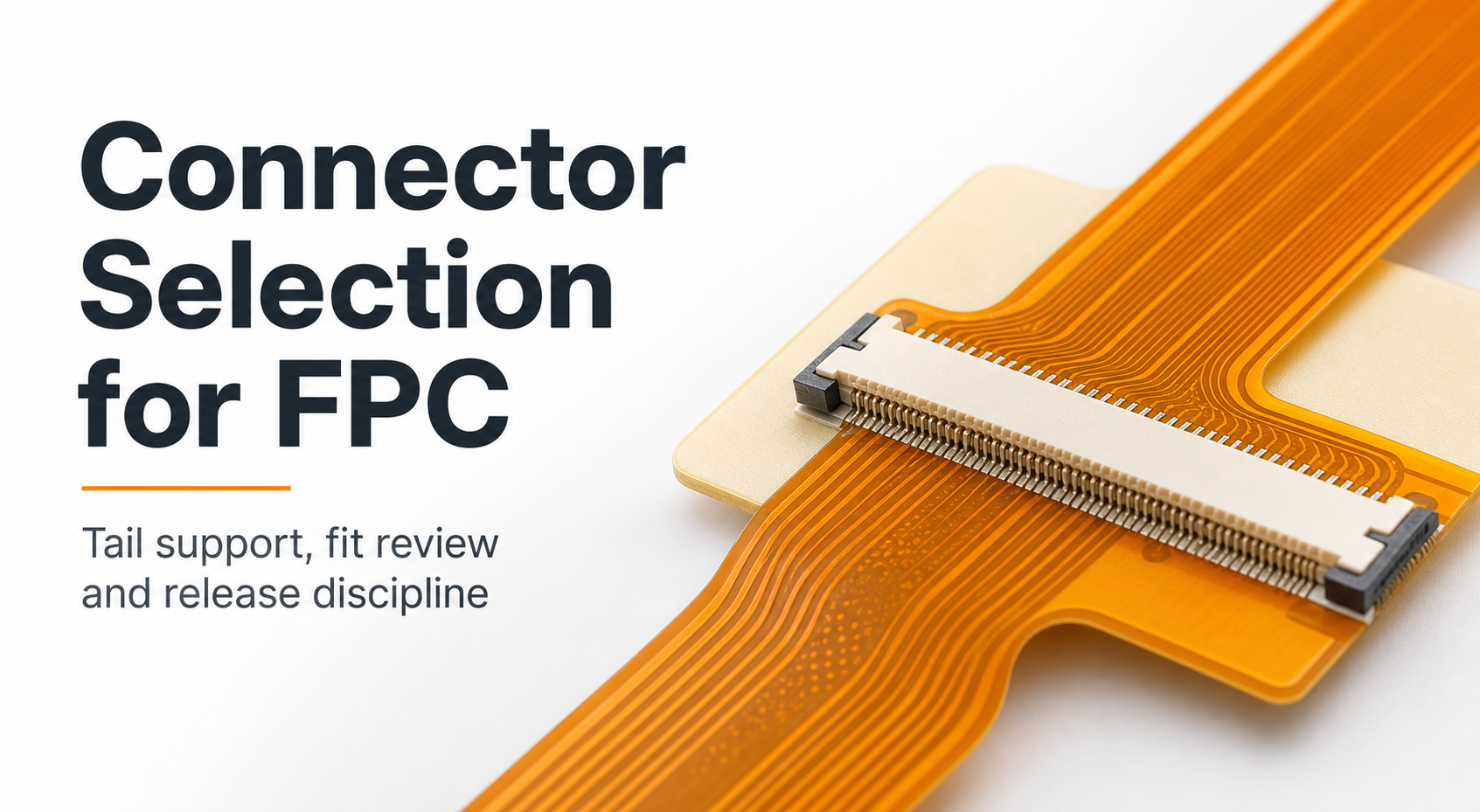
Choosing a connector for an FPC is not just a footprint or pitch decision. At release stage, the safer question is whether the FPC tail, stiffener build, adhesive wet-out, and connector entry geometry stay stable enough that the cable can be inserted, locked, and held without creating latent mechanical damage.
For this topic, the primary failure mechanism is mechanical load and strain. A connector that looks electrically correct can still become the start of intermittent contact, pull-out, or solder-joint cracking if the FPC tail is under-supported or the connector-fit review is incomplete.
Key takeaways
- The first review gate is tail support and fit stability, not a generic connector-feature comparison table.
- PSA and stiffener bonding should be treated as deformation control for the connector area, not as a cosmetic add-on.
- Connector flatness, tail thickness build, and actuator orientation need to be frozen together before release.
- Unsupported tail sections, poor adhesive wet-out, or local warpage can create latent field failures even when early continuity checks pass.
- Exact pitch, cycle-life, current, and compatibility claims should stay with the connector owner's datasheet, not with a generic FPC article.
Quick Answer Connector selection for FPC should be reviewed as a tail-support and fit-stability problem, not just a pitch or footprint choice. The main engineering checks are stiffener readiness, PSA wet-out, tail flatness, actuator orientation, and whether the connector region stays mechanically stable through insertion, locking, and handling.
Table of Contents
- What this article does and does not cover
- What connector selection really controls on an FPC
- Why PSA and stiffener bonding belong inside connector review
- The real failure pattern to watch
- What to freeze before release
- Connector orientation and fit documentation
- A conservative fit-review checklist
- What should stay with owner datasheets instead
- FAQ
- Next steps
- Public references
- Author and review information
What this article does and does not cover
This article is intentionally narrow. It covers the board-level review posture for:
- FPC tail support
- PSA or stiffener wet-out at the connector region
- connector flatness and orientation control
- connector-fit review before release
It does not try to rank every connector family or provide universal numeric tables for pitch, current, mating cycles, insertion force, or plating compatibility. Those claims require connector-family owner data and should not be generalized from board-level FPC review.
What connector selection really controls on an FPC
On a rigid board, the connector footprint is often reviewed as a placement and solderability item. On an FPC, the connector area is also a shape-control zone. The cable tail has to present the right thickness, flatness, backing support, and insertion direction so that the connector can clamp it without forcing the flex into a distorted shape.
That means the selection step is not complete when a connector part number is chosen. You still need to confirm:
- whether the connector expects a supported tail
- whether a backside stiffener or reinforcement layer is required
- whether the adhesive has enough surface contact and dwell to develop usable bond strength
- whether the released tail geometry stays flat enough for the chosen connector entry style
- whether the operator can insert and lock the cable in the intended orientation
If those items are vague, the connector is not really selected yet. It is only nominally named.
Why PSA and stiffener bonding belong inside connector review
PSA and stiffener bonding should not be treated as a separate downstream note. In the connector region, they directly influence whether the FPC tail keeps its shape during assembly and use.
The key engineering point is simple: the adhesive bond and the reinforcement layer define how the tail behaves when it is pushed into the connector and when the product sees handling or vibration later. If the adhesive has poor surface contact, insufficient dwell, or inconsistent bond area, the tail may not stay flat. If the stiffener is misplaced or underspecified for the connector region, the cable can deform at the point where the contact system expects a stable mating surface.
That is why connector-fit review, stiffener placement, and adhesive readiness should be frozen as one release decision rather than three loosely related notes.
The real failure pattern to watch
One common field-risk pattern is straightforward: an FPC tail enters assembly with incomplete backside support or poor PSA wet-out under the reinforced area. During insertion, locking, handling, or later service, the unsupported section takes the load instead of the reinforced section. The tail begins to warp or twist, and the connector sees fit stress rather than a flat, stable entry.
The board may still pass early electrical checks. The real damage appears later as intermittent contact, cable pull-out, or solder-joint cracking at the connector attachment because the mechanical load path was wrong from the start.
In short, the failure chain is:
unsupported tail or poor wet-out -> fit stress or warpage -> intermittent contact, pull-out, or solder-joint crack
A more destructive version appears in very compact products that rely on ZIF or LIF connectors with strict tail-thickness windows, such as 0.30 mm +/- 0.03 mm at the insertion end. If the FPC supplier misses stiffener placement by 0.15 mm, or if the PSA introduces microscopic squeeze-out, bubbles, or edge lift during lamination, the tail no longer enters the connector as a uniform section. It enters as a stepped mechanical part with local thickness error.
That is where the actuator becomes the failure tool. The operator inserts the tail, closes the ZIF latch, and the hard actuator loads the high spot first. Instead of clamping a flat supported tail, it crushes the copper at the local step and creates micro-fractures in the traces near the insertion edge. Static ICT or FCT often still passes because the crack remains electrically bridged at room condition. In the field, with temperature change or light vibration, the damaged line opens intermittently and the product starts showing display flicker, sensor dropout, or other unstable open-circuit behavior. This is why FPC connector review is not only about pitch matching. It is physical control of stiffener tolerance, PSA lamination behavior, and connector clamping load.
That is the main reason this topic belongs to the mechanical load / strain family rather than to a generic connector-spec roundup.
What to freeze before release
Before releasing an FPC connector design, make the connector-entry intent explicit enough that fabrication and assembly do not need to guess.
| Item to freeze | Why it matters | What goes wrong when it stays vague |
|---|---|---|
| Tail support strategy | Defines where the cable is reinforced and where it remains flexible | Load shifts into the unsupported tail during insertion or handling |
| Stiffener location and extent | Controls local thickness and deformation at the connector edge | Tail lift, misfit, or unstable seating appears during assembly |
| PSA bond area and dwell posture | Affects whether the reinforcement actually holds shape | Bonded area looks present on paper but does not behave as stable support |
| Connector entry orientation | Confirms how the tail is inserted and locked | The build reaches assembly with avoidable operator confusion or reversal risk |
| Flatness review at the connector region | Confirms the tail presents a usable mating surface | Intermittent engagement or uneven retention starts at first insertion |
| Pin-1 and installation marking | Keeps orientation control inside the released package | Local teams rely on memory or visual guesswork instead of controlled documentation |
| Connector keep-clear and actuation access | Confirms the latch or insertion path remains usable | The connector can be populated but not safely operated in production |
Connector orientation and fit documentation
A practical release package should document connector orientation instead of assuming that the assembly team will infer it correctly from the footprint alone.
For this topic, the safe reusable rule is narrow:
- keep pin-1 and visible orientation cues in the released documentation set
- use controlled library convention for generic footprint-governance wording
- use the connector owner's drawing when the exact series layout and insertion direction matter
This is especially important on FPC projects because a cable that can physically enter the connector is not automatically entering it in the correct facing direction. Contact side, latch direction, pull tab access, and local enclosure posture all need to align.
A conservative fit-review checklist
If the article is being used as a DFM or pre-release review aid, the most useful questions are mechanical:
- Is the tail supported where the connector expects it to be supported?
- Has the stiffener location been checked against the actual connector entry geometry rather than only against the outline drawing?
- Is the PSA or bonding method being treated as a real deformation-control step with surface-contact and dwell considerations?
- Does the connector region remain flat enough that insertion does not force the tail to twist or bow?
- Are pin-1, contact side, and actuator orientation obvious in the released documentation?
- Is there enough surrounding access for insertion, locking, inspection, and any service action that the product requires?
These questions will not finish connector-family selection for every product. They do, however, catch the most common release-stage mistakes that lead to fit-driven failure later.
What should stay with owner datasheets instead
Some connector questions are real, but they should not be generalized here without owner-backed data. Keep the following with the connector family's own documentation and validation route:
- exact pitch comparison
- exact current rating claims
- mating-cycle or durability tables
- insertion-force values
- universal plating-compatibility rules
- compatibility claims across multiple connector families that only look similar
That boundary matters because a conservative technical article is more useful than a broader article that quietly overclaims.
FAQ
Is connector selection for FPC mainly an electrical decision? No. At board level, it is also a mechanical support and fit-control decision. If the tail does not stay supported and flat, the connection can fail even when the netlist is correct.
Why does the stiffener matter so much? Because the connector is usually expecting a stable entry condition, not a freely deforming tail. The stiffener helps the FPC present the required shape in the connector region.
Can adhesive bonding be reviewed later during assembly preparation? It should be reviewed earlier. Bond quality, wet-out posture, and dwell affect whether the reinforced area behaves correctly during insertion and handling.
Does matching the footprint mean the connector choice is safe? No. Footprint match alone does not prove tail thickness build, flatness, orientation, actuation access, or fit stability.
Next steps with APTPCB
If you are developing compact consumer hardware, a medical probe, or another dense interconnect product, the real risk is usually not the nominal pitch. It is whether the FPC tail thickness build actually matches the ZIF connector window, whether insertion stress will tear the copper at the latch point, and whether the selected PSA can survive SMT heat without changing the tail geometry.
Send the full package to [email protected], or route it through /en/quote. Include the Gerber or ODB++, FPC thickness buildup, stiffener and adhesive drawings, and the connector datasheet.
APTPCB's flex-process and interconnect review team will return a FPC Connector Fit & Mechanical Strain DFM Review within 24 hours. The review will check stiffener tolerance, calculate the tail-thickness buildup, and identify connector-fit assumptions that could turn into assembly breakage or field returns before you release the job into volume build.
Public references
IPC flex and rigid-flex standards overview Use this reference for board-level flex and rigid-flex construction vocabulary without turning it into a numeric design-table claim.
APTPCB Flex PCB page Supports public manufacturing context for flex-tail construction, coverlay, and handling-sensitive review topics.
APTPCB Rigid-Flex PCB page Supports public transition-zone and support-structure framing where FPC connector regions interact with reinforcement strategy.
APTPCB DFM Guidelines Supports the release-review posture used here for orientation control, package completeness, and assembly-readiness checks.
Author and review information
- Author: APTPCB flex, interconnect, and DFM content team
- Technical review: flex construction, connector-fit, and assembly-planning engineering team
- Last updated: 2026-05-15