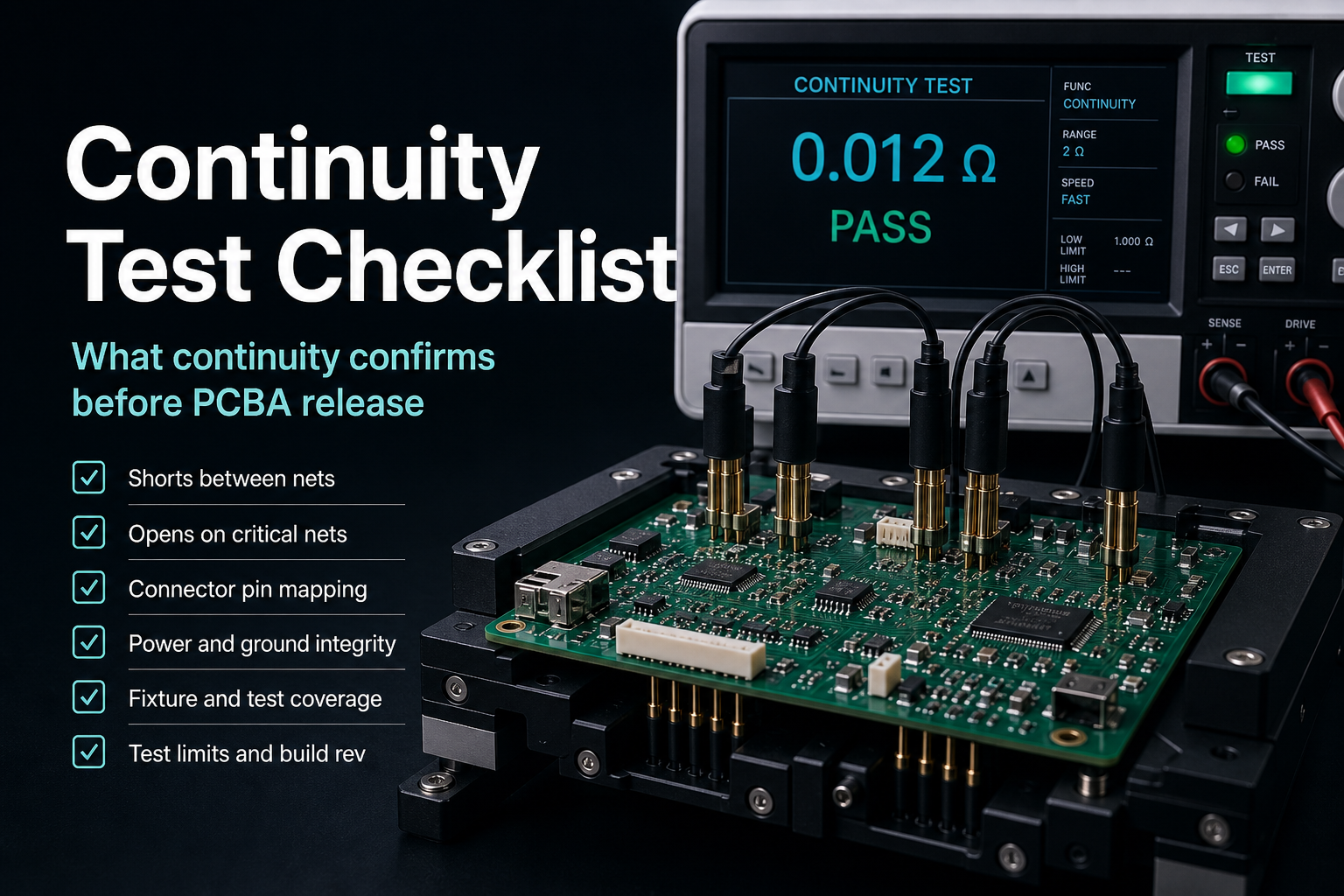
A robust continuity test checklist is the primary defense against open circuits, short circuits, and high-resistance interconnect defects in printed circuit board (PCB) manufacturing. For engineers and quality managers, this checklist defines the boundary between a reliable electrical connection and a latent field failure. It ensures that every trace, via, and pad matches the IPC-D-356 netlist without unintended bridges or breaks.
At APTPCB (APTPCB PCB Factory), we integrate these verification steps directly into our electrical test (E-Test) workflow to guarantee signal integrity before components are even mounted. This guide provides a comprehensive continuity test checklist, covering specifications, implementation steps, and troubleshooting protocols for both bare boards and assembled units.
continuity test checklist quick answer (30 seconds)


- Define Resistance Thresholds: Standard continuity is typically verified at < 10 Ω to 50 Ω; anything higher indicates a potential "near-open" or defective via.
- Validate Isolation (Shorts): Ensure isolation resistance is > 10 MΩ (often tested at 40V–250V) to detect unintended bridging between adjacent nets.
- Netlist is King: Always test against the IPC-D-356 netlist derived from Gerber data, not a "golden board," to avoid replicating design errors.
- Test Coverage: Verify 100% net coverage, including unconnected pads (for isolation) and blind/buried vias.
- Current Injection: Use appropriate test current (e.g., 10mA–100mA) to ensure the circuit can carry signal without heating or fusing micro-cracks temporarily.
- Fixture Selection: Choose Flying Probe for prototypes (no fixture cost, slower) and Bed of Nails (ICT) for mass production (high speed, fixture required).
When continuity test checklist applies (and when it doesn’t)
Understanding when to deploy a strict continuity test checklist ensures resources are focused on detecting the right defects at the right stage.
When it applies:
- Bare Board Fabrication (BBT): Verifying the PCB substrate has no broken tracks or etched shorts before assembly.
- Cable and Harness Assembly: Checking point-to-point connections, crimp quality, and pinout verification.
- In-Circuit Testing (ICT): Validating that soldered components (resistors, connectors) create the correct path continuity on a PCBA.
- Multilayer Stackups: Detecting internal layer registration errors that cause open vias or shorts between power and ground planes.
- Impedance Controlled Traces: While TDR is used for impedance, basic continuity ensures the trace exists before high-frequency testing.
When it doesn’t (or is insufficient):
- Functional Logic Verification: Continuity checks paths, not logic states. For system behavior, refer to functional test planning.
- Dielectric Breakdown Testing: Continuity uses low voltage. To test insulation strength against high voltage arcing, you need a Hipot test (see resources for hipot test beginner guides).
- High-Speed Signal Integrity: A continuous trace can still suffer from insertion loss or crosstalk; continuity does not measure signal quality.
- Component Parametric Testing: Continuity confirms a resistor is connected, but not necessarily that it is the correct resistance value (unless combined with ICT).
- Solder Joint Voiding: A joint may have electrical continuity but insufficient mechanical strength (voids); X-ray inspection is required here.
continuity test checklist rules and specifications (key parameters and limits)
A precise continuity test checklist relies on quantitative rules. Vague instructions like "check connections" lead to escapes. Use this table to set specific pass/fail criteria.
| Rule / Parameter | Recommended Value / Range | Why it matters | How to verify | If ignored (Risk) |
|---|---|---|---|---|
| Continuity Threshold | 5 Ω – 50 Ω (Class 2/3 dependent) | Defines a "closed" circuit. High resistance indicates weak plating or cracks. | 4-wire Kelvin measurement for precision. | Latent opens; intermittent failures under vibration. |
| Isolation Threshold | > 10 MΩ (often 20 MΩ – 100 MΩ) | Defines an "open" circuit between separate nets. | High-voltage leakage test (40V–250V). | Short circuits; battery drain; signal crosstalk. |
| Test Voltage | 10V – 250V DC | Higher voltage helps detect high-resistance shorts (dendrites/contamination). | Programmable E-Test equipment settings. | Missed micro-shorts that only conduct under load. |
| Test Current | 10 mA – 200 mA | Sufficient current ensures robust contact but prevents trace damage. | Constant current source verification. | False passes on micro-cracks (arcing) or trace burnout. |
| Adjacency Window | < 1.27mm (50 mil) radius | Limits isolation testing to likely short candidates to save time. | CAM software adjacency analysis. | Missed shorts between physically close but electrically distinct nets. |
| Dwell Time | 10 ms – 100 ms | Allows capacitance to charge/discharge for stable reading. | Test program timing settings. | Inconsistent readings; false failures on long nets. |
| Netlist Format | IPC-D-356 / IPC-D-356A | Contains X-Y coordinates and net names for accurate mapping. | Compare CAD output vs. Tester input. | Testing against wrong data; false passes on bad designs. |
| Probe Pressure | 70g – 150g (depending on tip) | Ensures contact through oxidation without damaging pads. | Strain gauge or manufacturer spec sheet. | Witness marks on pads (too high) or false opens (too low). |
| Retest Limit | Max 2 attempts | Prevents "testing into compliance" by burning through contamination. | Tester log configuration. | Passing defective boards that have intermittent contacts. |
| Flying Probe Speed | Optimized (e.g., 20-50 tests/sec) | Balances throughput with probe accuracy and vibration. | Machine calibration settings. | Probe slippage; damage to fine-pitch pads. |
| Fixture Strain | < 500 microstrain | Prevents PCB flexing during Bed of Nails testing. | Strain gauge analysis during fixture setup. | Cracked MLCC capacitors; broken solder joints. |
| Calibration Interval | Daily / Weekly | Ensures measurement accuracy of the test machine. | Standard resistor verification block. | Drift in measurements; rejecting good boards. |
continuity test checklist implementation steps (process checkpoints)
Implementing a continuity test checklist requires a systematic approach from data preparation to final stamping.
Data Preparation & Netlist Extraction
- Action: Generate IPC-D-356 netlist from the approved Gerber/ODB++ files.
- Parameter: Ensure netlist includes all blind/buried vias and test points.
- Check: Verify net count matches the schematic.
Fixture/Program Selection
- Action: Decide between Flying Probe (Prototype) or Bed of Nails (Mass Production).
- Parameter: Volume > 50 panels usually justifies fixture cost.
- Check: Confirm test point density allows for chosen probe size (e.g., min 0.2mm pad).
Adjacency Analysis
- Action: Software calculates which nets are physically close enough to require isolation testing.
- Parameter: Typically check nets within 0.5mm - 1.0mm of each other.
- Check: Ensure power and ground planes are included in isolation checks.
Machine Setup & Calibration
- Action: Load the board and align fiducials.
- Parameter: Alignment accuracy < 25µm.
- Check: Run a known "Golden Board" or calibration standard to verify machine status.
Continuity Test Execution (Opens)
- Action: Measure resistance of every net.
- Parameter: Pass if R < Specified Threshold (e.g., 10 Ω).
- Check: Log any nets exceeding threshold as "Open".
Isolation Test Execution (Shorts)
- Action: Apply voltage between adjacent nets.
- Parameter: Pass if R > Isolation Threshold (e.g., 10 MΩ).
- Check: Log any leakage current as "Short".
Retest Verification
- Action: Automatically retest failures to rule out contact issues.
- Parameter: Clean probes if false failure rate > 5%.
- Check: If failure persists, mark location with UV ink or digital map.
Visual Confirmation of Failures
- Action: Operator inspects reported failure locations under microscope.
- Parameter: Look for etching residue, dust, or broken plating.
- Check: Classify defect (repairable vs. scrap).
Data Logging & Serialization
- Action: Save test results linked to PCB serial number.
- Parameter: 100% traceability.
- Check: Ensure database reflects Pass/Fail status for shipping control.
Final Marking
- Action: Mark passed boards (stamp or laser).
- Parameter: Permanent, non-conductive ink.
- Check: Verify mark is visible and does not cover solderable pads.
continuity test checklist troubleshooting (failure modes and fixes)
When the continuity test checklist flags a failure, or when false failures disrupt production, use this troubleshooting guide.
1. Symptom: High False Open Rate (Good boards failing continuity)
- Causes: Oxidized test pads, dirty probes, low probe pressure, board warping.
- Checks: Inspect probe tips for contamination; check PCB surface finish (HASL/ENIG) for oxidation.
- Fix: Clean probes; increase stroke/pressure slightly; implement "scrub" motion in flying probe settings.
- Prevention: Improve storage conditions to prevent oxidation; use fresh surface finish.
2. Symptom: Intermittent Continuity (Passes then fails)
- Causes: Micro-cracks in vias (barrel cracks), cold solder joints (PCBA), floating pins.
- Checks: Perform temperature cycling or "wobble" test; check via plating thickness.
- Fix: If via crack, scrap board (process issue). If fixture issue, replace worn pogo pins.
- Prevention: Review PCB Quality standards for plating ductility.
3. Symptom: False Shorts (Good boards failing isolation)
- Causes: High humidity, flux residue (PCBA), ionic contamination, capacitive coupling.
- Checks: Measure humidity in test area; check for "no-clean" flux residues that are conductive while wet.
- Fix: Bake boards to remove moisture; optimize wash process; increase settling time (dwell) in test program.
- Prevention: Control environment humidity (< 60% RH); validate flux compatibility.
4. Symptom: Witness Marks on Pads (Deep indentations)
- Causes: Excessive probe pressure, sharp probe tip selection, soft surface finish (e.g., Immersion Tin).
- Checks: Measure indentation depth; verify spring force of pogo pins.
- Fix: Switch to crown or cup style probes; reduce overdrive distance.
- Prevention: Specify maximum probe pressure in the continuity test checklist.
5. Symptom: "Phantom" Shorts in High-Density Areas
- Causes: Solder mask slivers, copper whiskers, incomplete etching.
- Checks: AOI inspection of fine pitch areas; check etching process parameters.
- Fix: Manual removal (if allowed) or scrap.
- Prevention: Improve DFM for spacing; check HDI PCB design rules.
6. Symptom: Test Passes but Board Fails Functionally
- Causes: High resistance via (within continuity limit but too high for signal), netlist error (testing to wrong design).
- Checks: Compare netlist to schematic; perform 4-wire Kelvin test for precise resistance.
- Fix: Update netlist; tighten resistance threshold (e.g., from 50Ω to 5Ω).
- Prevention: Always generate netlist from final Gerber data.
How to choose continuity test checklist (design decisions and trade-offs)
Selecting the right approach for your continuity test checklist depends on volume, complexity, and budget. The "vs" decision here is primarily between Flying Probe and Fixture-Based (ICT/Bed of Nails) testing.
1. Flying Probe Testing (FPT)
- Best for: Prototypes, NPI (New Product Introduction), Low Volume (< 50 panels).
- Pros: No fixture cost; flexible (easy to update program); can test fine pitch (down to 4 mil).
- Cons: Slow (minutes per board); limited access to component leads on assembled boards compared to ICT.
- Decision: Choose FPT if your design is still changing or volume is low. It allows for immediate implementation of the continuity test checklist without tooling lead time.
2. Bed of Nails / In-Circuit Test (ICT)
- Best for: Mass Production, Stable Designs.
- Pros: Extremely fast (seconds per board); simultaneous testing of all nets; robust contact.
- Cons: High fixture cost ($1k - $5k+); long lead time for fixture fab; difficult to modify if pads move.
- Decision: Choose ICT if you have locked the design and need high throughput. For Mass Production, the fixture cost is amortized quickly.
3. Manual Multimeter Check
- Best for: Quick debugging, harness repair, extremely simple boards.
- Pros: Zero cost; immediate.
- Cons: Human error prone; cannot reliably test isolation (shorts) on complex nets; not scalable.
- Decision: Only use for troubleshooting specific failures found by automated methods, never as the primary manufacturing gate.
4. 2-Wire vs. 4-Wire (Kelvin) Measurement
- 2-Wire: Standard continuity. Measures lead resistance + trace resistance. Good for general connectivity (< 10Ω).
- 4-Wire: Precision measurement. Eliminates lead resistance. Essential for measuring very low resistance (< 1Ω) power rails or current sense resistors.
- Decision: Include 4-wire checks in your continuity test checklist for high-current power traces or precision analog circuits.
continuity test checklist FAQ (cost, lead time, common defects, acceptance criteria, Design for Manufacturability (DFM) files)
1. How does a strict continuity test checklist impact PCB cost? A strict checklist (e.g., 100% net list test, IPC Class 3) adds minor processing time but saves significant cost by preventing scrap at the assembly stage. Flying probe testing is usually included in prototype pricing, while ICT fixtures are a non-recurring engineering (NRE) cost.
2. What is the difference between continuity testing and functional test planning? Continuity testing verifies the physical pathways (wires/traces) exist and are isolated. Functional test planning verifies that the device actually performs its intended logic or operation (e.g., "does the LED blink?"). Continuity is structural; functional is behavioral.
3. Can continuity testing detect "near opens" or weak vias? Standard continuity tests might pass a weak via if the threshold is set too high (e.g., 50Ω). To detect weak vias (latent defects), you must use 4-wire Kelvin measurement or set a tighter resistance limit (e.g., < 5Ω) in your checklist.
4. What files are required to generate a continuity test program? You need the IPC-D-356 netlist file, which is generated from your CAD software. Using Gerbers alone requires the fab house to reverse-engineer the netlist, which introduces risk. Always supply the IPC-D-356 for accurate Testing Quality.
5. How does lead time change with 100% continuity testing? For prototypes (Flying Probe), it adds 1-2 hours to the batch process, usually negligible in a 24-hour turn. For mass production (ICT), the fixture fabrication adds 5-10 days to the initial setup, but subsequent testing is instantaneous.
6. What are the acceptance criteria for isolation resistance? IPC-6012 specifies isolation resistance requirements. Typically, > 10 MΩ is acceptable for general digital boards. High-impedance analog or high-voltage circuits may require > 100 MΩ or even GΩ ranges, often verified via hipot test beginner protocols.
7. Why do I need a continuity test checklist for cable assemblies? Cables are prone to mis-wiring (crossed wires) and crimp failures. A checklist ensures every pin maps correctly to the other end and that no strands are shorting to the shell or adjacent pins.
8. Does continuity testing damage sensitive components? It can if the test current or voltage is too high. Modern testers use "compliance limiting" to keep voltage/current safe (e.g., < 0.5V for sensitive logic). Ensure your checklist specifies "Safe Test" parameters for populated PCBAs.
9. How do I handle "false failures" due to oxidation? If boards fail continuity due to oxidation (common with OSP finish after storage), the checklist should include a "cleaning cycle" or "re-probe" step. Do not simply widen the resistance threshold, as this masks real defects.
10. Is visual inspection a substitute for continuity testing? No. Visual inspection (AOI) cannot see internal layer shorts, broken barrel plating inside a via, or hairline cracks under solder mask. Electrical continuity testing is mandatory for validating the integrity of Multilayer PCBs.
11. What is the "Adjacency" setting in continuity testing? Adjacency defines the search radius for short circuits. Testing every net against every other net is too slow ($N^2$ complexity). The checklist should specify an adjacency window (e.g., 1mm) to test only nets that are physically close, optimizing speed without risking escapes.
12. How does DFM affect continuity testing success? Good DFM Guidelines ensure test points are accessible (min 0.8mm spacing for ICT) and not covered by solder mask. Poor DFM leads to low test coverage, forcing reliance on manual probing or risky assumptions.
13. Can I use continuity testing for impedance control? No. Continuity checks DC resistance. Impedance is an AC characteristic. You need TDR (Time Domain Reflectometry) for impedance, though continuity is a prerequisite to ensure the trace exists for the TDR pulse.
14. What happens if I skip the continuity test checklist for prototypes? Skipping it risks debugging a "bad design" that is actually just a "bad board." You might spend days troubleshooting firmware, only to find a broken trace. Always insist on 100% E-Test for prototypes.
Resources for continuity test checklist (related pages and tools)
- Testing Quality: Overview of APTPCB's comprehensive testing protocols including AOI, X-Ray, and ICT.
- Flying Probe Testing: Detailed capabilities of our fixtureless test solutions for NPI.
- DFM Guidelines: How to design your PCB to ensure 100% testability and reduce fixture costs.
- PCB Quality: Standards and certifications (IPC Class 2/3) that define continuity acceptance.
continuity test checklist glossary (key terms)
| Term | Definition | Context in Checklist |
|---|---|---|
| Netlist | A data file describing all electrical connections (nets) and their coordinates. | The "master map" used to verify the physical board matches the design. |
| Open Circuit | A break in the electrical path where continuity should exist. | The primary defect detected by resistance measurement > threshold. |
| Short Circuit | An unintended connection between two distinct nets. | Detected by isolation testing (resistance < isolation threshold). |
| IPC-D-356 | Standard file format for netlist data exchange. | The preferred input format for programming test machines. |
| Flying Probe | A tester with moving arms/probes that test without a fixture. | Used for low volume/prototype continuity checks. |
| Bed of Nails (ICT) | A fixture with fixed "pogo pins" contacting all test points simultaneously. | Used for high volume continuity and component testing. |
| Kelvin (4-Wire) | A measurement method using separate force and sense pairs. | Used to measure very low resistance accurately, ignoring lead resistance. |
| Isolation Resistance | The resistance between two separate electrical nodes. | Must be very high (MΩ) to pass the shorts test. |
| Test Point | An exposed pad designed for a probe to make contact. | Essential for achieving 100% test coverage. |
| Adjacency | The physical proximity of two nets. | Determines which nets are candidates for short circuit testing. |
| Golden Board | A known good board used to calibrate or verify the tester. | Used to validate the test setup before running production lots. |
| Latent Defect | A flaw (like a cracked via) that passes initial test but fails later. | Mitigated by stricter resistance thresholds and stress testing. |
Request a quote for continuity test checklist (Design for Manufacturability (DFM) review + pricing)
Ready to ensure your PCBs meet the highest reliability standards? At APTPCB, we include comprehensive electrical verification in every project, from prototype to mass production.
Send us your data for a free DFM and Testability Review:
- Files: Gerber RS-274X, IPC-D-356 Netlist, Drill files.
- Specs: Layer stackup, impedance requirements, and volume.
- Test Requirements: Specify if you need IPC Class 3, 4-wire Kelvin test, or custom reporting.
Request a Quote today and let our engineering team validate your design against our rigorous continuity test checklist before fabrication begins.
Conclusion (next steps)
A well-defined continuity test checklist is more than just a manufacturing step; it is the baseline for product reliability. By strictly enforcing resistance thresholds, validating against the IPC netlist, and choosing the right test method (Flying Probe vs. ICT), you eliminate the most common causes of dead-on-arrival boards. Whether you are managing functional test planning or are a hipot test beginner, starting with solid continuity verification ensures a stable foundation for all subsequent testing and deployment.