
Definition, scope, and who this guide is for
A Current Sensor PCB is a specialized printed circuit board designed to measure electrical current flow—either through integrated shunt resistors, Hall effect sensor ICs, or embedded planar coils (like Rogowski coils). Unlike standard logic boards, these PCBs must often handle high power loads, manage significant thermal dissipation, and maintain precise signal integrity for the low-voltage measurement data. They act as the critical bridge between high-power systems (batteries, motors, grid infrastructure) and low-voltage control units (MCUs, DSPs).
This guide is written for engineering leads, procurement managers, and product designers who need to source reliable Current Sensor PCBs. It moves beyond basic definitions to cover the specific manufacturing constraints that affect accuracy and safety. Whether you are designing a Battery Management System (BMS) for electric vehicles or a precision industrial power supply, the physical properties of the PCB—copper weight, etching tolerance, and thermal stackup—directly impact the sensor's linearity and lifespan.
In this playbook, we focus on the "buy" side of the equation: how to specify requirements to avoid manufacturing defects, how to validate the incoming boards, and how to audit suppliers. We will reference APTPCB (APTPCB PCB Factory) as a manufacturing partner capable of handling these complex requirements, but the principles apply regardless of your chosen vendor. The goal is to equip you with a technical checklist that reduces risk during the transition from prototype to mass production.
When to use Current Sensor PCB (and when a standard approach is better)
Understanding the definition and scope of these boards leads directly to the question of application suitability; not every current measurement scenario requires a specialized PCB design.
A dedicated Current Sensor PCB is the correct choice when your system requires high integration, consistent thermal management, or specific form factors that off-the-shelf sensor modules cannot provide. For example, in automotive inverters or high-density server power supplies, the current sensor must be integrated directly into the busbar or the main power board to minimize resistance and inductance. If your design involves currents exceeding 50A, requires isolation voltages above 1kV, or needs to fit within a custom enclosure where standard modules are too bulky, a custom PCB solution is necessary.
Conversely, a standard approach—using a pre-packaged current transducer module wired to a generic PCB—is better for low-volume prototyping, maintenance-heavy industrial panels, or applications where space is not constrained. If the current is low (<5A) and precision requirements are loose, a standard FR4 board with a simple shunt resistor component is sufficient and cost-effective. However, once you push for higher power density or need to eliminate the parasitic inductance of external wiring, the custom Current Sensor PCB becomes the only viable engineering path.
Current Sensor PCB specifications (materials, stackup, tolerances)
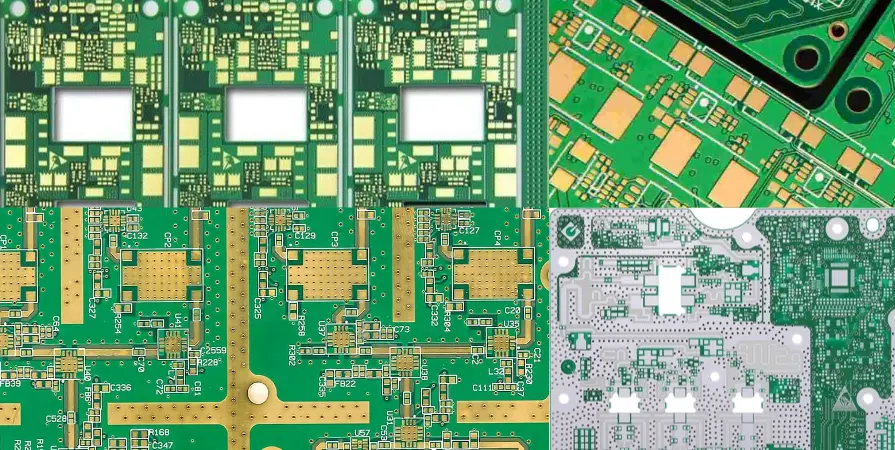
Once you have determined that a custom Current Sensor PCB is required, the next step is to define the rigid specifications that will govern its manufacturing quality and performance.
- Base Material (Laminate): Specify High-Tg FR4 (Tg > 170°C) as a baseline to withstand the thermal cycling of high-current loads. For extreme heat, consider Metal Core PCB (MCPCB) or ceramic substrates.
- Copper Weight (Inner/Outer Layers): Define copper weight explicitly based on current capacity. Common specs range from 2oz to 10oz (Heavy Copper). Ensure the spec includes "finished copper thickness" to account for plating.
- Trace Width and Spacing: For high-voltage isolation (Voltage Sensor PCB applications), specify creepage and clearance distances strictly according to UL/IEC standards (e.g., >8mm for certain high-voltage classes).
- Etching Tolerance: If using PCB traces as a shunt resistor, specify tight etching tolerances (e.g., ±5% or better) rather than the standard ±10-20%. The cross-sectional area directly defines resistance.
- Thermal Vias: Define the density and plating thickness of thermal vias. A common spec is 0.3mm hole size with 25µm plating to ensure efficient heat transfer from the sensor element to the heatsink.
- Surface Finish: Prefer ENIG (Electroless Nickel Immersion Gold) or Immersion Silver for flat pads, which are critical for soldering precision shunt resistors or Hall effect sensors without tilting.
- Solder Mask: Specify high-temperature, crack-resistant solder mask (often specific colors like matte green or black) to prevent flaking under thermal stress.
- Layer Stackup: For Rogowski coil designs, the layer-to-layer registration (alignment) is critical. Specify registration tolerances of <3 mil to ensure the coil geometry remains symmetrical for noise rejection.
- Cleanliness: Require ionic contamination testing results (e.g., <1.56 µg/cm² NaCl equivalent) to prevent electrochemical migration in high-voltage sensing areas.
- Dimensional Stability: Ensure the board dimensions are stable over temperature changes, especially if the PCB mounts directly to a rigid busbar.
- Silkscreen/Marking: Mandate clear polarity markings and high-voltage warning symbols on the silkscreen for safety during assembly and servicing.
- Documentation: Require a "Read-Out" of the actual copper thickness and dielectric thickness in the final inspection report.
Current Sensor PCB manufacturing risks (root causes and prevention)
Defining specifications is only half the battle; understanding where the manufacturing process typically fails allows you to preemptively address risks before they become field failures.
Risk: Over-Etching of Sensing Traces
- Root Cause: Inconsistent etchant concentration or speed during the manufacturing process reduces the trace width.
- Detection: Resistance measurement differs from simulation; localized hotspots.
- Prevention: Add "Etch Compensation" notes in Gerber files; require TDR or 4-wire resistance testing on coupons.
Risk: Heavy Copper Delamination
- Root Cause: Thermal stress causes the copper foil to separate from the resin due to mismatched CTE (Coefficient of Thermal Expansion).
- Detection: Blistering visible after reflow or thermal cycling tests.
- Prevention: Use high-performance bond ply; specify "Low Profile" or "Very Low Profile" copper foil for better adhesion; use multiple thin prepregs.
Risk: Solder Voiding under Power Components
- Root Cause: Large thermal pads on the PCB release volatiles from flux that get trapped under the component.
- Detection: X-Ray inspection showing >25% voiding area.
- Prevention: Design window-pane stencil apertures; specify vacuum reflow if available; use thermal vias that are plugged/capped to prevent solder wicking.
Risk: High Voltage Arcing (Creepage Failure)
- Root Cause: Contamination (flux residue, dust) or insufficient spacing between high-voltage and low-voltage sections.
- Detection: Hi-Pot testing failures; visible carbon tracks.
- Prevention: Implement routing slots (milling) between high/low voltage areas; apply conformal coating; strict cleanliness standards.
Risk: Plated Through Hole (PTH) Cracking
- Root Cause: Z-axis expansion of the PCB material during thermal cycling breaks the copper barrel.
- Detection: Intermittent open circuits during operation; resistance spikes.
- Prevention: Use high-Tg material (lower Z-axis expansion); ensure minimum plating thickness is met (Class 3 requires average 25µm).
Risk: Layer Misalignment (Coil Asymmetry)
- Root Cause: Material shrinkage or scaling errors during lamination affect internal layers.
- Detection: Poor linearity in PCB-based Rogowski coils; sensitivity to external magnetic fields.
- Prevention: Use pin-lamination for tighter registration; add fiducials on inner layers for X-ray verification.
Risk: Bow and Twist
- Root Cause: Asymmetrical copper distribution (e.g., heavy copper on top, light on bottom) causes warping.
- Detection: Board does not sit flat in the fixture; assembly pick-and-place errors.
- Prevention: Balance copper coverage on all layers (copper pouring on empty areas); use stiffeners if necessary.
Risk: Inaccurate Solder Mask Dam
- Root Cause: Misalignment of solder mask exposes copper between fine-pitch pads of sensor ICs.
- Detection: Solder bridging during assembly.
- Prevention: Use Laser Direct Imaging (LDI) for solder mask application; specify minimum dam width in DFM.
Risk: Thermal Via Wicking
- Root Cause: Open vias in pads suck solder away from the component joint.
- Detection: Insufficient solder fillets; weak mechanical joints.
- Prevention: Specify "Via-in-Pad Plated Over" (VIPPO) or cap the vias on the backside.
Risk: Impedance Mismatch on Signal Lines
- Root Cause: Variation in dielectric thickness or trace width affects the analog signal from the sensor to the MCU.
- Detection: Signal noise; data corruption.
- Prevention: Controlled impedance coupons; specify dielectric constant (Dk) tolerances.
Current Sensor PCB validation and acceptance (tests and pass criteria)

To ensure the risks identified above have been effectively mitigated, a robust validation plan with clear acceptance criteria must be executed on the first article and production batches.
Objective: Verify Copper Thickness
- Method: Micro-section analysis (cross-section) on a test coupon or actual board.
- Acceptance Criteria: Measured thickness must meet IPC-6012 Class 2/3 requirements (e.g., min 24.9µm for 1oz nominal) or the specific heavy copper drawing requirement (-0/+10%).
Objective: Validate Thermal Integrity
- Method: Thermal Shock Testing (-40°C to +125°C, 100 cycles).
- Acceptance Criteria: No delamination, no measling, change in resistance < 5%.
Objective: Confirm High Voltage Isolation
- Method: Hi-Pot (Dielectric Withstand Voltage) test between primary current path and secondary sensor circuit.
- Acceptance Criteria: No breakdown or arcing at specified voltage (e.g., 2.5kV AC for 60s); leakage current < 1mA.
Objective: Check Solderability and Surface Flatness
- Method: Solderability test (dip and look) and Bow/Twist measurement.
- Acceptance Criteria: >95% wetting coverage; Bow/Twist < 0.75% (or <0.5% for SMT).
Objective: Verify Trace Resistance (for Shunt PCBs)
- Method: 4-Wire Kelvin resistance measurement on the specific current carrying trace.
- Acceptance Criteria: Measured resistance within ±5% (or specified tolerance) of the design value.
Objective: Inspect Internal Layer Alignment
- Method: X-Ray inspection of the PCB.
- Acceptance Criteria: Layer-to-layer registration error < 5 mil (or tighter for coil designs); drill breakout meets IPC Class 2.
Objective: Assess Ionic Cleanliness
- Method: ROSE test (Resistivity of Solvent Extract) or Ion Chromatography.
- Acceptance Criteria: Contamination levels below 1.56 µg/cm² NaCl equivalent (standard) or lower for high-reliability automotive specs.
Objective: Validate Via Reliability
- Method: Interconnect Stress Test (IST) or floating solder test.
- Acceptance Criteria: No barrel cracks or corner cracks; resistance change < 10% after stress.
Objective: Visual Inspection of Etching
- Method: AOI (Automated Optical Inspection) and manual magnification.
- Acceptance Criteria: No nicking or mouse bites reducing conductor width by more than 20%; etch factor meets DFM agreement.
Objective: Solder Mask Adhesion
- Method: Tape test (IPC-TM-650 2.4.28).
- Acceptance Criteria: No solder mask removal or flaking.
Current Sensor PCB supplier qualification checklist (RFQ, audit, traceability)
With validation criteria in hand, the final step before ordering is ensuring your supplier is equipped to deliver. Use this checklist to audit potential partners like APTPCB or others.
Group 1: RFQ Inputs (What you must provide)
- Complete Gerber files (RS-274X or X2) with clear layer stackup.
- Fabrication drawing specifying IPC Class (2 or 3).
- Netlist (IPC-356) for electrical test verification.
- Specific notes on "Critical Dimensions" (e.g., shunt trace width).
- Material datasheet requirements (Tg, CTI value for high voltage).
- Copper weight specifications for each layer (inner vs outer).
- Panelization requirements (if assembly is automated).
- Solder mask and silkscreen color preferences.
- Impedance control table (if applicable for signal lines).
- Surface finish thickness requirements (e.g., ENIG gold thickness).
Group 2: Capability Proof (What they must demonstrate)
- Proven experience with Heavy Copper (up to 6oz or 10oz).
- Capability for "Via-in-Pad" and resin plugging (VIPPO).
- LDI (Laser Direct Imaging) capability for fine-pitch masks.
- In-house micro-sectioning lab for quality verification.
- UL certification (ZPMV2) for the specific stackup/material combo.
- Automated optical inspection (AOI) for inner layers.
- Controlled impedance testing equipment.
- Ability to handle mixed copper weights (e.g., 1oz logic, 4oz power).
Group 3: Quality System & Traceability
- ISO 9001 and IATF 16949 (for automotive) certifications.
- System to trace raw materials (laminate, foil) to specific batches.
- Records of chemical bath analysis (etchant, plating) maintenance.
- Calibration records for E-test and measurement tools.
- Procedure for handling non-conforming material (MRB).
- First Article Inspection (FAI) report format availability.
- ESD control program in the manufacturing area.
Group 4: Change Control & Delivery
- Formal PCN (Product Change Notification) policy for material changes.
- Capacity planning to ensure lead times during volume ramps.
- Packaging standards (vacuum sealed, desiccant, humidity indicator).
- DFM feedback loop (do they catch errors before building?).
- Logistics partners for secure and timely shipping.
- Warranty terms regarding latent defects (e.g., CAF growth).
How to choose Current Sensor PCB (trade-offs and decision rules)
Selecting the right supplier and technology often involves balancing competing constraints. Here are the key trade-offs to navigate when finalizing your Current Sensor PCB strategy.
Heavy Copper vs. Busbar Integration:
- If you prioritize compactness and automated assembly, choose Heavy Copper PCB. It keeps everything on one board.
- If you prioritize extremely high current (>200A) and low cost, choose Busbar Integration (screwing a metal bar to the PCB) as heavy copper becomes exponentially expensive above 4-6oz.
PCB Trace Shunt vs. Discrete Resistor:
- If you prioritize zero component cost and high durability, choose PCB Trace Shunt.
- If you prioritize high precision (<1%) and low temperature drift, choose Discrete Resistor. Copper has a high temperature coefficient (~0.39%/°C), making it poor for precision without complex software compensation.
Integrated Hall Sensor vs. External Transducer:
- If you prioritize isolation and small footprint, choose Integrated Hall Sensor on the PCB.
- If you prioritize non-intrusive measurement and very high range, choose External Transducer (e.g., a toroid around a cable).
Metal Core (IMS) vs. FR4 with Thermal Vias:
- If you prioritize maximum heat dissipation for power components, choose Metal Core.
- If you prioritize multilayer routing complexity and lower cost, choose FR4 with Thermal Vias. IMS is typically limited to 1-2 layers.
ENIG vs. HASL Surface Finish:
- If you prioritize flat pads for sensor ICs and wire bonding, choose ENIG.
- If you prioritize lowest cost and shelf life, choose HASL (though not recommended for fine-pitch sensors).
Current Sensor PCB FAQ (cost, lead time, Design for Manufacturability (DFM) files, materials, testing)
Q: How does copper weight affect the cost of a Current Sensor PCB? A: Increasing copper weight significantly increases cost due to longer etching times, more chemical usage, and specialized lamination processes. Moving from 1oz to 3oz can increase the bare board cost by 30-50%, and heavy copper (e.g., 6oz) is a premium process.
Q: What is the typical lead time for Current Sensor PCB manufacturing? A: Standard lead times are 10-15 working days. However, boards requiring heavy copper, special materials (like Rogers or ceramic), or complex via structures (VIPPO) may require 15-20 working days. Quick-turn options (3-5 days) are often available for simpler specs.
Q: What specific DFM files are needed for Current Sensor PCBs? A: Beyond standard Gerbers, you must provide a detailed stackup drawing indicating copper thickness per layer and a drill file that clearly distinguishes between plated and non-plated holes. For high-voltage designs, a "netlist" is crucial to verify isolation distances during CAM review.
Q: Can I use standard FR4 materials for high-current sensor boards? A: Yes, but you should specify "High-Tg" (Glass Transition Temperature) FR4 (Tg > 170°C). Standard FR4 (Tg 130-140°C) may soften and expand excessively under the thermal load of high currents, leading to via cracks or pad lifting.
Q: How do you test the reliability of a Current Sensor PCB? A: Reliability is tested through thermal cycling (stressing the vias and material interfaces) and Hi-Pot testing (verifying isolation). For automotive applications, Interconnect Stress Testing (IST) is often required to simulate years of thermal fatigue.
Q: What are the acceptance criteria for heavy copper etching? A: Heavy copper etching inevitably results in a trapezoidal trace shape rather than a perfect rectangle. Acceptance criteria usually allow for an "etch factor" where the top of the trace is narrower than the bottom; the design must account for this reduction in cross-sectional area.
Q: Why is "resin starvation" a risk in Current Sensor PCBs? A: Heavy copper layers create deep "valleys" between traces that must be filled with resin during lamination. If the prepreg (glue layer) doesn't have enough resin content, voids occur. Suppliers must use "high resin content" prepregs to prevent this.
Q: Is conformal coating necessary for Current Sensor PCBs? A: It is highly recommended if the sensor operates in high-voltage environments or humid conditions. Coating prevents "dendritic growth" or arcing between closely spaced pads, which is a common failure mode in voltage sensor PCBs.
Resources for Current Sensor PCB (related pages and tools)
- Heavy Copper PCB Capabilities – Understand the manufacturing limits and benefits of using thick copper for high-current paths.
- Power & Energy Industry Solutions – See how current sensor boards are applied in renewable energy and grid infrastructure.
- High Thermal PCB Technologies – Explore material options like MCPCB and heavy thermal vias for managing heat dissipation.
- PCB Quality Control System – Review the specific inspection standards (IPC Class 2/3) used to validate sensor reliability.
- DFM Guidelines for Manufacturing – Access design rules to ensure your current sensor layout is manufacturable at scale.
Request a quote for Current Sensor PCB (Design for Manufacturability (DFM) review + pricing)
Ready to move forward? Request a Quote from APTPCB to get a comprehensive DFM review and accurate pricing for your project. When submitting your data, please include your Gerber files, layer stackup with copper weight specifications, and any special testing requirements (such as Hi-Pot or specific resistance tolerances). Our engineering team will review your design for potential thermal or etching risks before production begins.
Conclusion (next steps)
A Current Sensor PCB is more than just a carrier for components; it is an active element in the power measurement chain. By defining strict specifications for materials and copper weight, understanding the risks of heavy copper manufacturing, and enforcing a rigorous validation plan, you can secure a component that delivers precise data and long-term safety. Use the checklist provided to audit your suppliers and ensure they have the capability to meet these demands. With the right preparation, you can scale your power electronics designs with confidence.