
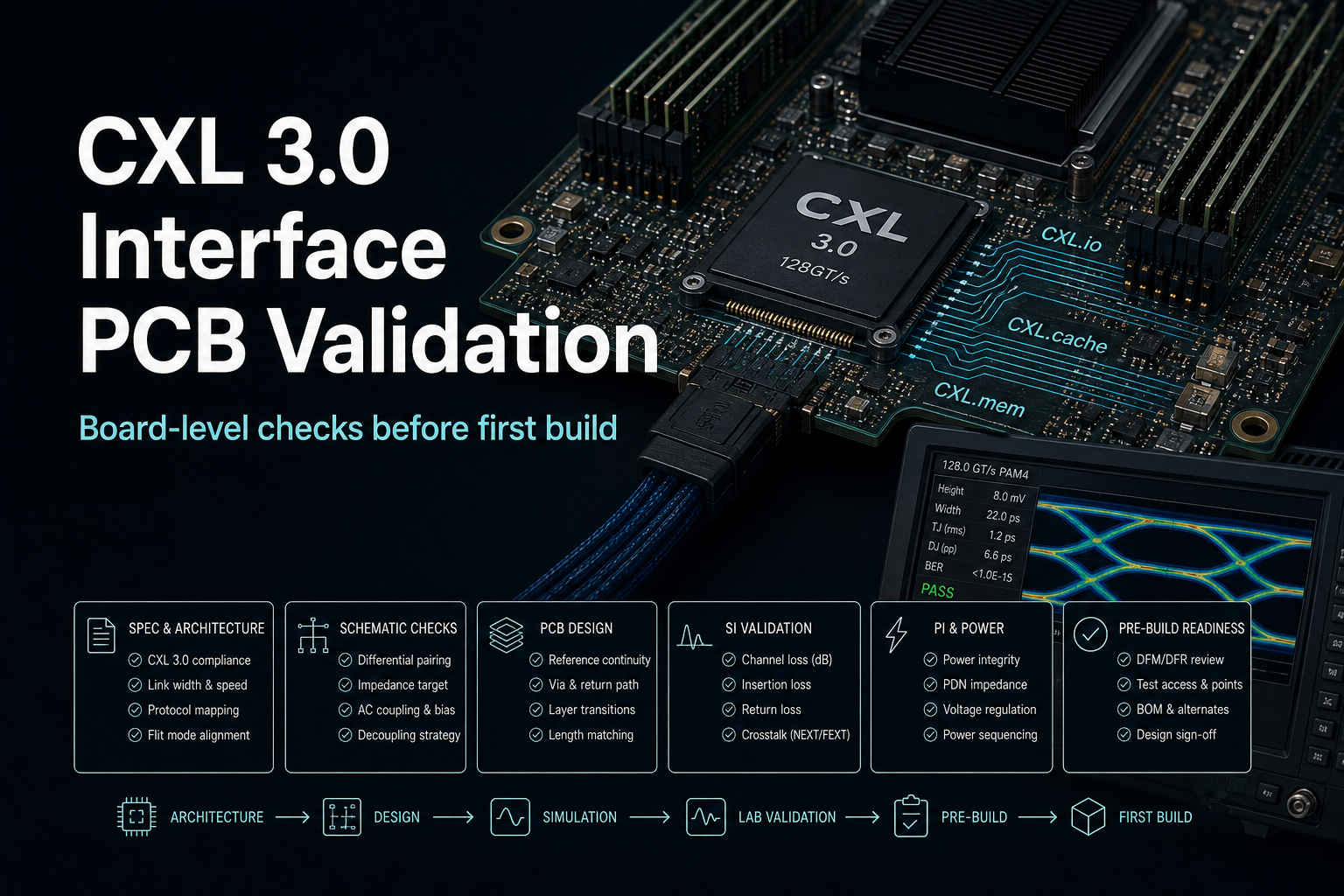
CXL 3.0 interface PCB validation should begin before fabrication, not after the first board fails link training.
For PCB teams, the most important question is not whether the design is “CXL ready.” The practical question is whether the board-owned portion of the high-speed channel has been defined clearly enough that fabrication, assembly, and later SI validation are working from the same physical intent.
CXL 3.0 uses PCIe 6.0-class signaling conditions, including 64 GT/s PAM4 operation. That increases sensitivity to local discontinuities, reference-plane changes, via structures, connector launches, and manufacturing variation.
Quick Answer
Before the first CXL 3.0 PCB build, validate the board path ownership, stackup definition, BGA breakout strategy, connector launch geometry, return-path continuity, via and backdrill requirements, and supplier evidence package. These checks reduce the risk of discovering avoidable SI problems after expensive fabrication and assembly.
For manufacturing support, review the related APTPCB resources:
In This Guide
- What should be checked before a CXL 3.0 PCB first build?
- CXL 3.0 PCB validation decision matrix
- Which PCB structures create the highest validation risk?
- How should backdrill requirements be validated?
- What evidence should a supplier provide before release?
- How to separate PCB validation from CXL compliance testing
- Next steps with APTPCB
- FAQ
What should be checked before a CXL 3.0 PCB first build?
The first review should establish five ownership areas:
- Board-path ownership
- Stackup and material definition
- Transition geometry
- Manufacturing capability
- Validation evidence
A CXL label alone does not define the board risk. The PCB team needs to identify whether the critical path includes:
- processor or accelerator BGA escape
- retimer region
- connector launch
- add-in card edge interface
- backplane transition
- long through-via structures
The purpose of this review is to prevent the high-speed path from becoming a collection of disconnected assumptions.
CXL 3.0 PCB validation decision matrix
| Validation area | Decision to make before build | Evidence to review | Failure created by unclear definition |
|---|---|---|---|
| Channel ownership | Define which PCB sections are responsible for electrical performance | Layout ownership map and critical-path drawings | SI problems cannot be assigned to the correct structure |
| Stackup | Confirm signal layers and reference planes | Approved stackup, dielectric information, impedance notes | Routing may meet geometry rules but miss electrical intent |
| BGA breakout | Confirm escape geometry and via strategy | Breakout screenshots, via structures, return-path review | Local impedance discontinuity near dense escapes |
| Connector launch | Confirm transition from connector to PCB routing | Footprint, launch geometry, vendor data | Excessive reflection or mode conversion |
| Backdrill | Define where stub removal is required | Fabrication notes, stub targets, must-not-cut layers | Residual via stubs reduce margin |
| Validation plan | Separate fabrication, SI, and system validation | Inspection plan and test ownership | One test result is incorrectly treated as total proof |
Which PCB structures create the highest validation risk?
BGA breakout transitions
Dense BGA regions are often the first place where a theoretically correct channel becomes electrically difficult.
The review should include:
- differential pair escape geometry
- via arrangement
- anti-pad structure
- nearby return vias
- reference-plane continuity
A breakout that looks acceptable in a two-dimensional layout image may still create a three-dimensional discontinuity when the complete field structure is considered.
Via transitions and return paths
High-speed validation depends on current return behavior, not only signal trace geometry.
Review:
- signal via transitions
- ground return paths
- plane changes
- voids around transitions
- connector reference continuity
The key question is whether the electromagnetic path remains continuous through every transition.
Connector-adjacent launches
Connector launches often combine several discontinuity sources:
- mechanical structures
- pin fields
- antipads
- layer transitions
- reference changes
The connector region should be reviewed as part of the channel rather than as an isolated footprint.
How should backdrill requirements be validated?
Backdrilling is a targeted manufacturing control for removing unwanted via barrel length. It is not a universal indicator that a PCB is high-speed capable.
A useful backdrill definition includes:
- affected vias
- drill span
- target residual stub condition
- must-not-cut layer
- manufacturing tolerance expectations
Backdrill process validation depends on accurate stackup information, drill registration, and process repeatability.
A supplier discussion should answer:
| Question | Why it matters |
|---|---|
| Which vias require backdrill? | Defines actual electrical intent |
| What layer must not be damaged? | Protects signal connectivity |
| How is depth controlled? | Determines process capability |
| What inspection evidence is available? | Confirms execution quality |
Backdrill should be reviewed as a three-dimensional tolerance problem involving electrical cleanup and mechanical control.
What evidence should a supplier provide before release?
A complete first-build package should contain more than fabrication files.
Recommended release evidence includes:
Design evidence
- approved stackup
- critical-route screenshots
- layer ownership
- breakout details
- connector launch information
Manufacturing evidence
- impedance requirements
- drill and backdrill requirements
- registration capability
- inspection approach
Validation evidence
- fabrication inspection plan
- impedance measurement approach
- SI correlation plan
- first-build learning loop
Controlled impedance evidence can show that the manufactured structure follows the intended impedance target. It does not prove CXL interoperability, BER performance, or complete system margin.
How to separate PCB validation from CXL compliance testing
CXL 3.0 validation exists at multiple levels.
| Validation level | What it answers | What it does not answer |
|---|---|---|
| PCB design review | Is the physical channel clearly defined? | Does the complete system pass compliance? |
| Fabrication validation | Was the board built according to requirements? | Does the platform achieve link margin? |
| SI measurement | Does the channel behave as modeled? | Does software and protocol operation succeed? |
| CXL system validation | Does the complete platform operate correctly? | Which PCB structure caused a manufacturing issue? |
Protocol validation requires system-level tools and measurements beyond PCB release review.
If material and stackup definition are still being developed, review:
Next steps with APTPCB
For CXL 3.0, PCIe 6.0, and accelerator-class boards, the highest-value review usually happens before the first panel is released.
Provide:
- ODB++ or IPC-2581 package
- stackup information
- critical routing screenshots
- connector regions
- backdrill requirements
- impedance requirements
APTPCB can support a pre-build review focused on:
- via-transition risks
- breakout discontinuities
- manufacturability boundaries
- backdrill feasibility
- release-package completeness
Supporting resources:
FAQ
Does CXL 3.0 PCB validation prove compliance?
No. PCB validation confirms that the board-owned electrical path is clearly defined and manufactured according to intent. Compliance and interoperability require separate system-level testing.
Is low-loss material enough for CXL 3.0?
No. Material selection supports the channel, but breakout quality, return paths, vias, launches, and manufacturing tolerance remain critical.
Why review return paths during breakout analysis?
Because high-speed current follows a field path involving both signal and reference structures. A signal route can appear correct while the return path creates a discontinuity.
When should backdrill be specified?
When through-via structures introduce unnecessary stub length that may affect the channel. The requirement should define electrical intent and manufacturing limits.
What should be included before sending a PCB for fabrication?
The release package should include stackup, routing intent, transition details, impedance requirements, manufacturing notes, and the planned validation flow.
Public references
Author and review information
- Author: APTPCB high-speed interconnect and release-review content team
- Technical review: PCB SI, multilayer fabrication, and first-build validation engineering team
- Last updated: 2025-09-23