
Definition, scope, and who this guide is for
The data-center AI server motherboard PCB represents the pinnacle of printed circuit board fabrication, designed to support high-performance computing (HPC) workloads such as Large Language Model (LLM) training and inference. Unlike standard commodity server boards, these PCBs must handle extreme power densities (often exceeding 1000A per board), high-speed signal integrity for PCIe Gen 5/6 and NVLink/Infinity Fabric, and significant thermal stresses. They typically feature high layer counts (20–30+ layers), advanced HDI structures, and ultra-low loss materials.
This playbook is designed for hardware engineers, procurement leads, and supply chain managers responsible for sourcing these critical components. It moves beyond basic definitions to provide a structured framework for decision-making. You will find specific material requirements, a breakdown of manufacturing risks, validation protocols, and a supplier qualification checklist to ensure your chosen partner can deliver reliability at scale.
At APTPCB (APTPCB PCB Factory), we understand that the cost of failure in a data center environment is astronomical. This guide aims to align your engineering specifications with procurement realities, ensuring that the final product meets the rigorous demands of 24/7 AI operations without unnecessary cost overruns or delays.
When to use data-center AI server motherboard PCB (and when a standard approach is better)
Before finalizing your design specifications, it is crucial to determine if your project truly requires the advanced architecture of a data-center AI server motherboard PCB or if a standard server-grade board suffices.
Use a specialized AI Server PCB when:
- Signal Speed: Your design utilizes PCIe Gen 5 (32 GT/s) or Gen 6 (64 GT/s), or proprietary high-speed interconnects (e.g., NVLink) requiring ultra-low loss transmission.
- Layer Count & Density: The design requires 20+ layers to accommodate massive routing density and power planes, often necessitating HDI (High Density Interconnect) technology with multiple lamination cycles.
- Power Delivery: The board must support high-wattage GPUs or TPUs (350W–700W+ per chip), requiring heavy copper layers (2oz–4oz) and advanced thermal management.
- Reliability: The hardware is deployed in Tier 1 data centers requiring 99.999% uptime and 5–7 year lifecycles under constant thermal load.
Stick to a Standard Server PCB when:
- Workload: The server is for general-purpose compute, storage, or web hosting where standard PCIe Gen 4 speeds are sufficient.
- Material Cost: Standard Mid-Loss or Low-Loss FR4 materials (like Isola 370HR) meet the signal integrity requirements, avoiding the premium cost of Ultra-Low Loss materials.
- Complexity: The design can be achieved with fewer than 16 layers and standard through-hole technology, avoiding the cost and yield risks of HDI.
data-center AI server motherboard PCB specifications (materials, stackup, tolerances)
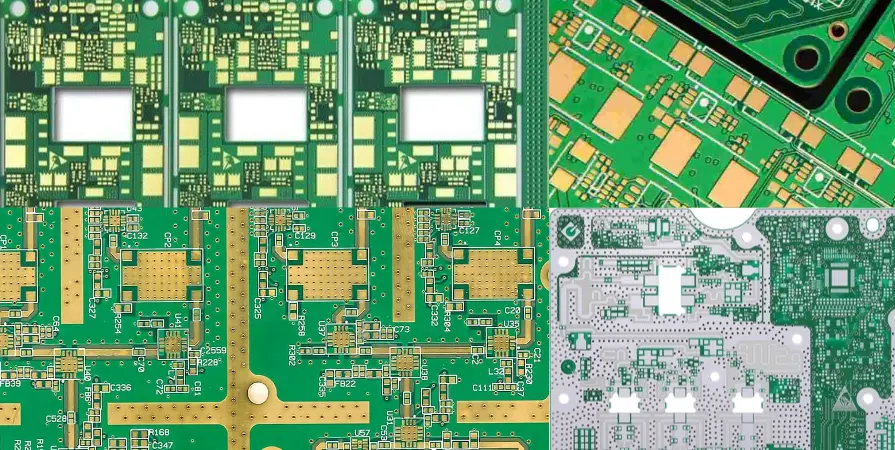
Defining the correct specifications upfront prevents costly engineering change orders (ECOs) later. Below are the critical parameters for a robust data-center AI server motherboard PCB.
- Base Material (Laminate): Must use Ultra-Low Loss materials. Common choices include Panasonic Megtron 7 or Megtron 8, Isola Tachyon 100G, or SY Tech S7439. Dk (Dielectric Constant) should be < 3.4 and Df (Dissipation Factor) < 0.004 at 10GHz.
- Layer Count: Typically 20 to 32 layers. This allows for sufficient signal isolation (stripline routing) and massive power planes.
- Copper Weight: Inner layers often require 2oz to 4oz copper to handle high current delivery (Power Delivery Network - PDN) with minimal voltage drop. Outer layers are typically 0.5oz to 1oz plated up.
- Stackup Structure: Hybrid stackups are common to balance cost and performance (e.g., using high-speed materials for signal layers and standard FR4 for power/ground cores), though full low-loss stackups are preferred for maximum reliability.
- HDI Technology: 3+N+3 or 4+N+4 structures using stacked microvias are standard to route out of high-pin-count BGA sockets (2000+ pins).
- Backdrilling: Mandatory for high-speed signal vias to remove unused stubs. Depth tolerance is critical, typically controlled to within ±0.15mm (6 mils) or tighter to minimize signal reflection.
- Impedance Control: Strict control is required, typically ±5% for single-ended (50Ω) and differential pairs (85Ω or 100Ω).
- Aspect Ratio: High aspect ratios (up to 15:1 or 20:1) for through-holes due to thick boards (3.0mm–5.0mm) and small drill diameters.
- Surface Finish: ENIG (Electroless Nickel Immersion Gold) or ENEPIG is preferred for flat pads (fine-pitch BGAs) and wire bonding reliability. OSP is generally avoided for high-value AI boards due to shelf-life and reflow limitations.
- Warpage Control: Maximum bow and twist must be < 0.5% (stricter than IPC Class 2 standard of 0.75%) to ensure proper BGA soldering on large footprint chips.
- Thermal Reliability: Tg (Glass Transition Temperature) > 180°C and Td (Decomposition Temperature) > 350°C are required to withstand multiple lead-free reflow cycles and rework.
- Cleanliness: Ionic contamination levels must be strictly controlled (e.g., < 1.56 µg/cm² NaCl equivalent) to prevent electrochemical migration (ECM) under high voltage bias.
data-center AI server motherboard PCB manufacturing risks (root causes and prevention)
Manufacturing these complex boards involves significant risks. Understanding the root causes helps you discuss mitigation strategies with your supplier.
- Risk: Conductive Anodic Filament (CAF) Growth
- Root Cause: Electrochemical migration along the glass fibers inside the PCB material, caused by high voltage gradients between vias and moisture absorption.
- Detection: High-voltage insulation resistance testing.
- Prevention: Use "Anti-CAF" or "CAF-resistant" grade materials (spread glass weave) and ensure optimal resin content to fill voids.
- Risk: Pad Cratering
- Root Cause: Brittle fracture of the laminate under the BGA pads due to mechanical stress or thermal expansion mismatch during reflow/operation.
- Detection: Dye and pry testing or cross-sectioning after thermal cycling.
- Prevention: Use resins with higher fracture toughness, optimize curing profiles, and use non-solder mask defined (NSMD) pads where appropriate.
- Risk: Plating Voids in High Aspect Ratio Vias
- Root Cause: Incomplete plating solution exchange in deep, narrow holes (e.g., 0.2mm hole in a 4mm thick board).
- Detection: Cross-section analysis and electrical continuity testing.
- Prevention: Utilize pulse plating technology and high-throw power chemistry; ensure aspect ratio design rules match supplier capabilities.
- Risk: Layer-to-Layer Misregistration
- Root Cause: Material movement (scaling) during lamination cycles, especially in high-layer-count boards with hybrid materials.
- Detection: X-ray inspection of drill alignment coupons.
- Prevention: Use advanced scaling factors based on historical data, pin-lamination techniques, and automated optical alignment systems.
- Risk: Backdrill Depth Errors
- Root Cause: Variation in board thickness or drill machine Z-axis accuracy.
- Detection: Cross-sectioning and TDR (Time Domain Reflectometry) analysis.
- Prevention: Controlled depth drilling with electrical sensing (contact drilling) rather than mechanical depth control.
- Risk: Impedance Deviations
- Root Cause: Variations in trace width (etching factor) or dielectric thickness (pressing variation).
- Detection: TDR testing on coupons and in-circuit traces.
- Prevention: strict etching compensation protocols and automated optical inspection (AOI) of inner layer trace widths before lamination.
- Risk: Resin Starvation
- Root Cause: Insufficient resin flow into the copper pattern during lamination, often due to heavy copper weights.
- Detection: Visual inspection (measling) and cross-sectioning.
- Prevention: Select high-resin content prepregs and optimize lamination pressure profiles.
- Risk: Solder Mask Delamination
- Root Cause: Poor adhesion due to surface contamination or improper curing.
- Detection: Tape test (IPC-TM-650).
- Prevention: Ensure proper surface preparation (chemical or mechanical scrubbing) and strict control of curing oven profiles.
data-center AI server motherboard PCB validation and acceptance (tests and pass criteria)
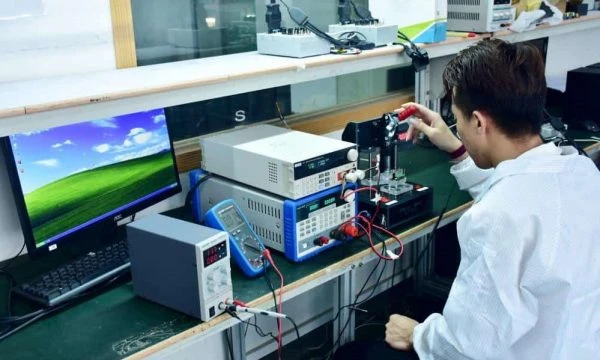
To ensure the data-center AI server motherboard PCB will survive in the field, a rigorous validation plan is required.
- Objective: Signal Integrity Verification
- Method: TDR (Time Domain Reflectometry) measurement on all critical high-speed lines and coupons.
- Acceptance Criteria: Impedance within ±5% of design target; no significant discontinuities at via transitions.
- Objective: Thermal Stress Endurance
- Method: Interconnect Stress Test (IST) or Highly Accelerated Thermal Shock (HATS) - 500+ cycles from -40°C to +145°C.
- Acceptance Criteria: Resistance change < 10%; no barrel cracks or corner cracks in vias.
- Objective: Plating Quality & Thickness
- Method: Micro-sectioning (Cross-section analysis) on at least one board per lot.
- Acceptance Criteria: Copper thickness meets IPC Class 3 (typically average 25µm in hole); no voids, cracks, or separation.
- Objective: Cleanliness / Ionic Contamination
- Method: Ion Chromatography (IC) or ROSE testing.
- Acceptance Criteria: < 1.56 µg/cm² NaCl equivalent (or stricter customer spec).
- Objective: Solderability
- Method: Solder float test or wetting balance test.
- Acceptance Criteria: > 95% coverage; uniform wetting; no de-wetting.
- Objective: Warpage Measurement
- Method: Shadow Moire interferometry at room temperature and reflow peak temperature (260°C).
- Acceptance Criteria: Bow/Twist < 0.5% across the diagonal; specific flatness requirements for BGA areas.
- Objective: High Voltage Reliability
- Method: Hi-Pot (High Potential) testing.
- Acceptance Criteria: No breakdown or leakage current exceeding limits at specified voltage (e.g., 500V or 1000V).
- Objective: CAF Resistance
- Method: Temperature Humidity Bias (THB) testing (e.g., 85°C/85% RH/100V for 1000 hours).
- Acceptance Criteria: Insulation resistance remains > 10^8 Ω; no dendritic growth.
data-center AI server motherboard PCB supplier qualification checklist (RFQ, audit, traceability)
Use this checklist to vet potential partners. A supplier must demonstrate more than just "capability"—they need process control.
Group 1: RFQ Inputs (What you must provide)
- Complete Gerber X2 or ODB++ files.
- IPC-356 Netlist for electrical test comparison.
- Detailed Stackup drawing with material trade names (e.g., "Megtron 7" not just "Low Loss").
- Impedance control table with reference layers and trace widths.
- Drill drawing distinguishing plated, non-plated, and backdrilled holes.
- Panelization requirements (if assembly requires specific rails/fiducials).
- Acceptance criteria document (referencing IPC Class 3).
- Volume projections (EAU) and batch sizes.
Group 2: Capability Proof (What they must show)
- Demonstrated experience with 20+ layer counts in mass production.
- In-house LDI (Laser Direct Imaging) for fine line/space (< 3 mil).
- Automated backdrilling equipment with depth control verification.
- Pulse plating capability for high aspect ratio vias (15:1+).
- Vacuum lamination presses capable of high-temperature cycles.
- In-house lab for reliability testing (IST, Cross-section, Impedance).
Group 3: Quality System & Traceability
- ISO 9001 and preferably AS9100 or TL9000 certification.
- IPC-A-600 Class 3 manufacturing capability.
- UL certification for the specific stackup/material combination.
- Full traceability system: Can they trace a specific board serial number back to the raw material lot, lamination press cycle, and plating bath data?
- MES (Manufacturing Execution System) implementation for real-time process tracking.
- IQC (Incoming Quality Control) data for laminates and prepregs.
Group 4: Change Control & Delivery
- Formal PCN (Process Change Notification) policy—no changes to materials or chemistry without approval.
- DFM (Design for Manufacturing) review process depth—do they just check rules or suggest improvements?
- Capacity planning: Do they have surge capacity for AI server ramps?
- Packaging standards: Moisture Barrier Bags (MBB) with HIC (Humidity Indicator Cards) and desiccant.
- Logistics: Experience shipping heavy, high-value PCBs internationally without damage.
How to choose data-center AI server motherboard PCB (trade-offs and decision rules)
Engineering is the art of compromise. Here is how to navigate the trade-offs when selecting a data-center AI server motherboard PCB solution.
- Signal Integrity vs. Cost: If you prioritize maximum signal reach (long traces), choose ultra-low loss materials like Megtron 8. If cost is the constraint and traces are short, simulate if Megtron 6 or Isola Tachyon is sufficient.
- Density vs. Yield: If you prioritize miniaturization, choose HDI with stacked microvias. If you prioritize yield and lower cost, try to stick to through-hole or single-lamination cycles if the form factor allows (e.g., E-ATX).
- Thermal Performance vs. Manufacturability: If you prioritize cooling, choose heavy copper (3oz+). However, be aware this increases the risk of resin starvation and uneven surfaces. Balance this with coin-embed technologies or external busbars.
- Reliability vs. Lead Time: If you prioritize proven reliability, mandate IST testing on every lot. This adds 1–2 weeks to lead time. If speed is critical for NPI, skip lot-based IST but rely on quarterly monitoring data (risky for production).
- Backdrilling vs. Blind Vias: If you prioritize signal integrity on thick boards, backdrilling is standard. However, if stub length requirements are extremely short (< 5 mils), blind vias are more precise but significantly more expensive.
data-center AI server motherboard PCB FAQ (cost, lead time, Design for Manufacturability (DFM) files, materials, testing)
Q: What are the primary cost drivers for a data-center AI server motherboard PCB?
- Material: Ultra-low loss laminates can cost 3x–5x more than standard FR4.
- Layer Count: Jumping from 18 to 26 layers significantly increases lamination cycles and yield loss.
- HDI: Each sequential lamination cycle adds roughly 20–30% to the base cost.
- Drill Count: AI boards often have 50,000+ holes, consuming significant machine time.
Q: What is the typical lead time for these high-complexity PCBs?
- NPI (Prototype): 10–15 working days (expedited) to 20 working days.
- Mass Production: 4–6 weeks standard.
- Material Availability: Specialized materials (e.g., Megtron 7) may have their own lead times of 4–8 weeks if not stocked.
Q: What files are required for a comprehensive DFM review of an AI server motherboard PCB?
- Gerber X2 or ODB++ (preferred).
- IPC-356 Netlist.
- Fab drawing with drill chart and stackup.
- Impedance requirements.
- Crucial: A "read-me" file detailing backdrill layers and specific critical nets.
Q: How do I choose between Megtron 7 and Isola Tachyon for data-center AI server motherboard PCB materials?
- Both are excellent ultra-low loss materials.
- Megtron 7: Industry standard for high-end servers, excellent thermal stability.
- Isola Tachyon: Often chosen for very high-speed digital applications (100Gb/s+) due to extremely stable Dk/Df over frequency.
- Decision often comes down to supplier stock availability and UL certification status for your specific stackup.
Q: What specific testing is recommended for data-center AI server motherboard PCB acceptance criteria?
- 100% Electrical Test: Flying probe or fixture tester (essential for open/short).
- 100% AOI: Inner and outer layers.
- Impedance TDR: On coupons (standard) or in-board (premium).
- Ionic Contamination: Per lot.
- Micro-section: To verify plating thickness and internal alignment.
Q: Why is backdrilling critical for data-center AI server motherboard PCB design?
- It removes the unused portion of a plated through-hole (stub).
- Stubs act as antennas, causing signal reflections and resonance that destroy signal integrity at high frequencies (25Gbps+).
- It is a cost-effective alternative to using blind/buried vias for deep layer transitions.
Q: How does APTPCB handle the warpage challenges of large AI server PCBs?
- We use low-CTE (Coefficient of Thermal Expansion) materials.
- We employ balanced stackup designs (copper distribution).
- We utilize specialized fixtures during reflow simulation and baking processes to relieve stress before final inspection.
Q: Can you support "Hybrid Stackups" to reduce cost?
- Yes. We can combine low-loss materials (for signal layers) with standard FR4 (for power/ground).
- Note: This requires careful engineering to manage CTE mismatches and prevent delamination or registration issues.
Resources for data-center AI server motherboard PCB (related pages and tools)
- Server & Data Center PCB Solutions – Explore our specific capabilities and case studies for the data center sector.
- HDI PCB Technology – Understand the microvia and sequential lamination technologies essential for high-density AI boards.
- High-Speed PCB Manufacturing – Learn about the material selection and process controls required for signal integrity.
- Panasonic Megtron PCB Materials – Detailed specs on the preferred material family for AI server applications.
- PCB Quality Control System – Review our certifications and testing protocols to ensure reliability.
- PCB Stackup Design – Guidelines on optimizing layer arrangements for power and signal performance.
Request a quote for data-center AI server motherboard PCB (Design for Manufacturability (DFM) review + pricing)
Ready to validate your design? Contact APTPCB for a Quote and receive a comprehensive DFM review alongside your pricing.
For the most accurate quote and DFM, please include:
- Gerber/ODB++ Files: Complete data set.
- Stackup & Material: Specify "Megtron 7" or equivalent if required.
- Drill Drawing: Clearly mark backdrill locations.
- Volume: Prototype quantity vs. production EAU.
- Test Requirements: Specify if IPC Class 3 or custom reliability testing is needed.
Conclusion (next steps)
Sourcing a data-center AI server motherboard PCB is not just about buying a component; it is about securing the foundation of your AI infrastructure. By defining rigorous specifications for materials and stackups, understanding the manufacturing risks like CAF and warpage, and enforcing a strict validation checklist, you mitigate the risk of catastrophic field failures. APTPCB is equipped to guide you through this complex landscape, ensuring your high-performance designs are manufactured to the highest standards of reliability and precision.