
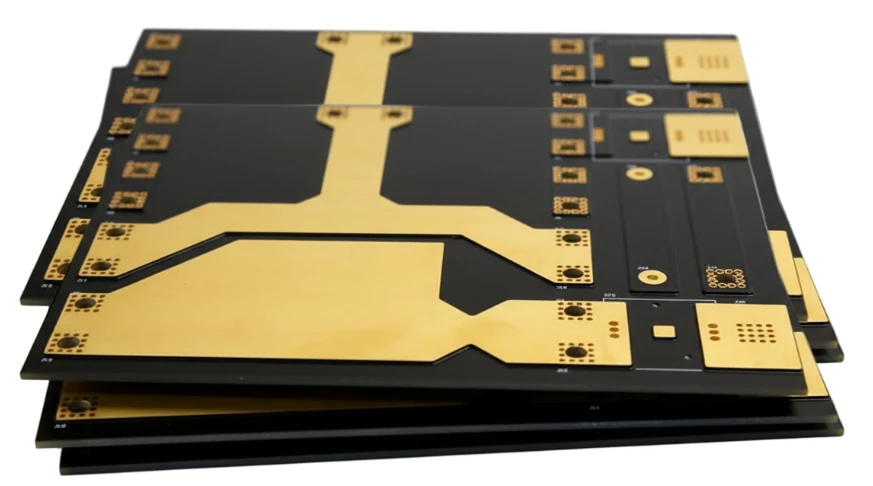
Data centers are the backbone of the modern digital economy, requiring near-perfect uptime and efficiency. While servers and storage units get the most attention, the electromechanical systems that keep them cool and operational—such as cooling fans, liquid cooling pumps, and robotic tape handlers—rely heavily on precision control. At the heart of these systems lies the data-center Servo motor driver PCB.
This printed circuit board is not a standard component. It must handle high power switching for motor actuation while maintaining signal integrity for precise control logic, all within the thermally constrained and electrically noisy environment of a server rack. Designing and manufacturing these boards requires a specific focus on thermal management, heavy copper utilization, and rigorous reliability testing.
APTPCB (APTPCB PCB Factory) specializes in high-reliability interconnects for critical infrastructure. This guide covers everything engineers and procurement managers need to know to successfully deploy these critical components.
Key Takeaways
- Dual Nature: These PCBs must bridge the gap between high-current power stages (MOSFETs/IGBTs) and sensitive low-voltage logic (MCUs/FPGAs).
- Thermal Priority: Heat dissipation is the primary failure mode; heavy copper and metal-core designs are often required.
- Signal Integrity: High-frequency switching noise (EMI) from the driver must not interfere with adjacent server data buses.
- Reliability Standards: IPC Class 3 standards are often recommended due to the 24/7 continuous operation requirement.
- Assembly Complexity: Servo motor driver PCB assembly often involves mixed technology (SMT and Through-Hole) to accommodate robust connectors and bulk capacitors.
- Validation: Automated Optical Inspection (AOI) is insufficient; functional testing under load is mandatory.
- Material Selection: High-Tg FR4 or Aluminum substrates are preferred over standard materials to prevent warping under thermal cycling.
What “servo motor driver PCB” means (scope & boundaries)
Understanding the core requirements of these boards is the first step before analyzing specific metrics. A data-center Servo motor driver PCB is a specialized circuit board designed to control the speed, torque, and position of servo motors used specifically in data center infrastructure.
Unlike a generic industrial motor driver, data center variants face unique constraints. They must often fit into slim 1U or 2U rack configurations, meaning component height is restricted. Furthermore, they must operate with high energy efficiency to contribute to a lower Power Usage Effectiveness (PUE) rating for the facility.
The scope of Servo motor driver PCB design in this context includes:
- Power Stage: The area handling high voltage and current to drive the motor coils.
- Control Stage: The logic section processing feedback from encoders and communicating with the main server management system (BMC).
- Isolation Barrier: Galvanic isolation (optocouplers or digital isolators) to protect the sensitive server logic from high-voltage spikes.
- Thermal Interface: The physical design features (vias, heatsinks, metal core) that transfer heat away from switching components.
If a PCB does not account for the specific airflow and electromagnetic compatibility (EMC) requirements of a server room, it does not qualify as a data-center grade solution.
Metrics that matter (how to evaluate quality)
Once the scope is defined, you must quantify quality using specific engineering metrics. The following table outlines the critical parameters for a data-center Servo motor driver PCB.
| Metric | Why it matters | Typical Range / Factor | How to Measure |
|---|---|---|---|
| Glass Transition Temp (Tg) | Determines the temperature at which the PCB substrate becomes unstable. | High Tg (>170°C) is standard for server environments. | Differential Scanning Calorimetry (DSC). |
| Copper Weight | Thicker copper handles higher current without excessive heating. | 2 oz to 4 oz (Heavy Copper) for power layers. | Micro-section analysis. |
| CTI (Comparative Tracking Index) | Measures resistance to electrical breakdown (tracking) on the surface. | PLC 0 or 1 (>400V) to prevent arcing in dusty racks. | IEC 60112 standard testing. |
| Thermal Conductivity | How fast heat moves through the dielectric material. | 1.0–3.0 W/mK for FR4; >2.0 W/mK for Metal Core. | Laser Flash Method. |
| Impedance Control | Ensures clean communication signals (e.g., PWM, CAN bus, EtherCAT). | ±10% tolerance on differential pairs. | Time Domain Reflectometry (TDR). |
| Dielectric Breakdown Voltage | Safety margin against voltage spikes from motor back-EMF. | >1000V per mil typically required. | Hi-Pot Testing. |
How to choose (trade-offs by scenario)
Understanding the metrics allows you to make informed decisions based on the specific application within the data center. Different subsystems require different Servo motor driver PCB architectures.
1. High-Performance Liquid Cooling Pumps
- Scenario: Driving powerful pumps for direct-to-chip liquid cooling.
- Recommendation: Use Heavy Copper PCB (3oz+).
- Trade-off: Higher cost and longer etching time, but essential for handling continuous high current without overheating.
2. Server Rack Cooling Fans (Air Cooled)
- Scenario: Arrays of fans operating at variable speeds (PWM control).
- Recommendation: Standard High-Tg FR4 with thermal vias.
- Trade-off: Lower cost than metal core, but requires careful layout to ensure airflow cools the driver MOSFETs effectively.
3. Robotic Tape Library Actuators
- Scenario: Precision motion for retrieving archival tape cartridges.
- Recommendation: Rigid-Flex PCB.
- Trade-off: Higher manufacturing complexity, but eliminates cabling reliability issues in moving parts.
4. Hot-Swap Backplane Locking Mechanisms
- Scenario: Small motors that lock/unlock drives.
- Recommendation: Standard FR4 with high CTI rating.
- Trade-off: Focus is on safety and arc prevention rather than thermal dissipation, as operation is intermittent.
5. High-Density Blade Server Power Management
- Scenario: Extremely space-constrained motor drivers.
- Recommendation: HDI (High Density Interconnect) with blind/buried vias.
- Trade-off: Most expensive fabrication process, but necessary to fit complex logic and power stages into a tiny footprint.
6. Immersion Cooling Circulation
- Scenario: PCB is submerged in dielectric fluid.
- Recommendation: Specialized substrates compatible with mineral oils or engineered fluids.
- Trade-off: Material compatibility testing is critical; solder mask and silkscreen must not dissolve or contaminate the fluid.
Implementation checkpoints (design to manufacturing)

After selecting the right approach, the focus shifts to execution. The transition from design to Servo motor driver PCB assembly requires a strict checklist to avoid costly revisions.
Stackup Definition:
- Recommendation: Define the layer stackup early, placing ground planes adjacent to signal layers for EMI shielding.
- Risk: Poor stackup leads to signal crosstalk and emission failures.
- Acceptance: Impedance simulation report.
Trace Width Calculation:
- Recommendation: Use IPC-2152 standards to calculate trace widths for target currents, adding a 20% safety margin. As a quick check, the PCB trace width calculator applies the IPC-2221 curve fit.
- Risk: Traces acting as fuses and blowing open under load.
- Acceptance: Design Rule Check (DRC) verification.
Thermal Via Placement:
- Recommendation: Place stitched thermal vias directly under the thermal pads of MOSFETs and driver ICs.
- Risk: Heat entrapment leading to component failure.
- Acceptance: Thermal simulation (e.g., Ansys Icepak) or prototype thermal imaging.
Component Layout (High/Low Side):
- Recommendation: Keep high-current loops (DC link capacitor to MOSFET to Ground) as short as physically possible.
- Risk: Large loops create inductance, causing voltage spikes and EMI.
- Acceptance: Layout review focusing on power loops.
Creepage and Clearance:
- Recommendation: Adhere strictly to UL/IEC standards for high-voltage separation, especially if using 48V or higher bus voltages.
- Risk: Arcing between high-voltage and low-voltage logic sections.
- Acceptance: CAD constraint manager review.
Solder Mask Dams:
- Recommendation: Ensure sufficient solder mask dams between fine-pitch pins on driver ICs.
- Risk: Solder bridging during assembly.
- Acceptance: DFM (Design for Manufacturing) review by the fabricator.
Test Point Accessibility:
- Recommendation: Place test points on all critical power rails and signal lines for ICT (In-Circuit Testing).
- Risk: Inability to diagnose faults during mass production.
- Acceptance: Test coverage analysis.
Bill of Materials (BOM) Validation:
- Recommendation: Verify lifecycle status of all components; avoid "Not Recommended for New Design" (NRND) parts.
- Risk: Production halts due to obsolete components.
- Acceptance: Component Sourcing availability check.
Common mistakes (and the correct approach)
Even with a solid plan, specific pitfalls often plague Servo motor driver PCB best practices. Avoiding these ensures a smoother path to production.
Mistake 1: Ignoring Thermal Expansion Mismatch.
- Issue: Using ceramic capacitors near high-heat MOSFETs on a standard FR4 board can cause cracks due to different expansion rates.
- Correction: Orient capacitors parallel to the stress direction or use soft-termination capacitors.
Mistake 2: Inadequate Ground Planes.
- Issue: Using thin traces for ground returns in the power section.
- Correction: Use solid copper pours for ground planes to lower impedance and improve heat spreading.
Mistake 3: Neglecting Start-up Inrush Current.
- Issue: Traces sized for continuous current burn out during the initial motor startup spike.
- Correction: Size power traces for peak pulse current, not just RMS current.
Mistake 4: Poor Connector Placement.
- Issue: Placing connectors far from the drive circuitry, requiring long traces that pick up noise.
- Correction: Place motor and power connectors at the edge of the board, closest to the drive stage.
Mistake 5: Skipping Functional Testing.
- Issue: Relying only on electrical continuity tests.
- Correction: Implement FCT Test (Functional Circuit Testing) that simulates actual motor loads.
Mistake 6: Overlooking Vibration.
- Issue: Heavy components (inductors, capacitors) breaking off due to fan/motor vibration.
- Correction: Use adhesive staking (silicone or epoxy) to secure heavy components to the PCB.
FAQ (cost, lead time, materials, testing)
To address lingering uncertainties, here are answers to the most frequent questions regarding data-center Servo motor driver PCB projects.
Q1: How does the cost of a data-center Servo motor driver PCB compare to a standard controller? The cost is typically 30-50% higher due to the need for Heavy Copper (2-4oz), higher Tg materials, and more rigorous testing (IPC Class 3). However, this investment prevents expensive server downtime.
Q2: What is the typical lead time for prototyping these specialized boards? Standard prototypes take 5-7 days. However, if the design requires Metal Core PCB or extreme copper weights, lead times may extend to 10-12 days to accommodate specialized lamination and plating processes.
Q3: Which materials are best for high-temperature servo environments? For air-cooled systems, High-Tg FR4 (Tg >170°C) is the baseline. For high-power density applications where airflow is limited, Aluminum or Copper Metal Core PCBs (MCPCB) are superior for heat dissipation.
Q4: What specific testing protocols are required for data center compliance? Beyond standard E-test, these boards should undergo Thermal Cycling (-40°C to +125°C), Vibration Testing (to simulate fan resonance), and Hi-Pot testing to ensure isolation barriers hold up against voltage spikes.
Q5: What are the acceptance criteria for Servo motor driver PCB assembly? Acceptance is usually based on IPC-A-610 Class 2 or Class 3 standards. For data centers, Class 3 (High Reliability) is preferred, requiring 100% visual inspection, X-ray for BGA/QFN parts, and zero functional defects.
Q6: Can I use standard solder mask for these boards? Yes, but for high-voltage sections (>48V), ensure the solder mask meets the dielectric strength requirements. Matte green or black is often used to aid heat radiation, though the effect is minimal compared to copper layout.
Q7: How do I handle obsolescence for long-term data center support? Work with a manufacturer like APTPCB that offers lifecycle monitoring. Design the PCB with standard footprints where possible to allow for alternate part sourcing without redesigning the bare board.
Q8: Is conformal coating necessary? In many data centers, yes. Conformal coating protects against dust, humidity, and potential sulfur contamination (silver corrosion), which is a known issue in some server environments.
Related pages & tools
To further assist in your design and procurement process, utilize these related resources:
- Server & Data Center PCB Solutions: Deep dive into the specific requirements of the server industry.
- Heavy Copper PCB Manufacturing: Understand the capabilities and limitations of thick copper traces.
- Turnkey Assembly Services: Learn how to streamline the process from bare board to fully assembled driver.
- DFM Guidelines: Technical rules to ensure your design is manufacturable at scale.
Glossary (key terms)
| Term | Definition |
|---|---|
| MOSFET | Metal-Oxide-Semiconductor Field-Effect Transistor; the primary switch used to drive the motor. |
| PWM | Pulse Width Modulation; a method used to control the amount of power delivered to the motor. |
| EMI | Electromagnetic Interference; noise generated by switching that can disrupt data signals. |
| Back-EMF | Voltage generated by the motor when it spins, which flows back into the driver circuit. |
| Dead Time | A short pause in switching to prevent short circuits (shoot-through) in the power stage. |
| Gate Driver | An IC that amplifies low-voltage logic signals to trigger the high-power MOSFETs. |
| Thermal Via | A plated hole used specifically to conduct heat from one layer to another. |
| Heavy Copper | PCB copper thickness greater than 2 oz (approx. 70µm). |
| IPC Class 3 | The highest standard for PCB manufacturing, intended for high-reliability products. |
| AOI | Automated Optical Inspection; a camera-based check for assembly defects. |
| Gerber File | The standard file format used to communicate PCB design data to the manufacturer. |
| BOM | Bill of Materials; the list of all components required to assemble the PCB. |
Conclusion (next steps)
The data-center Servo motor driver PCB is a critical enabler of modern computing infrastructure. It demands a balanced approach that prioritizes thermal management, signal integrity, and long-term reliability. By understanding the metrics, selecting the right materials, and adhering to strict implementation checkpoints, you can ensure your cooling and actuation systems deliver the uptime data centers require.
When you are ready to move from design to production, APTPCB is equipped to handle the complexities of high-reliability PCB fabrication and assembly.
To get an accurate quote and DFM review for your project, please prepare the following:
- Gerber Files: Including all copper layers, drill files, and outline.
- Stackup Specifications: Desired material (Tg), copper weight, and total thickness.
- BOM (Bill of Materials): If assembly is required, include manufacturer part numbers.
- Test Requirements: Specify if ICT, FCT, or specific thermal cycling is needed.
- Volume & Lead Time: Estimated annual usage and prototype deadlines.
Submit your data today to ensure your data-center Servo motor driver PCB is built to the highest standards of performance and durability.