
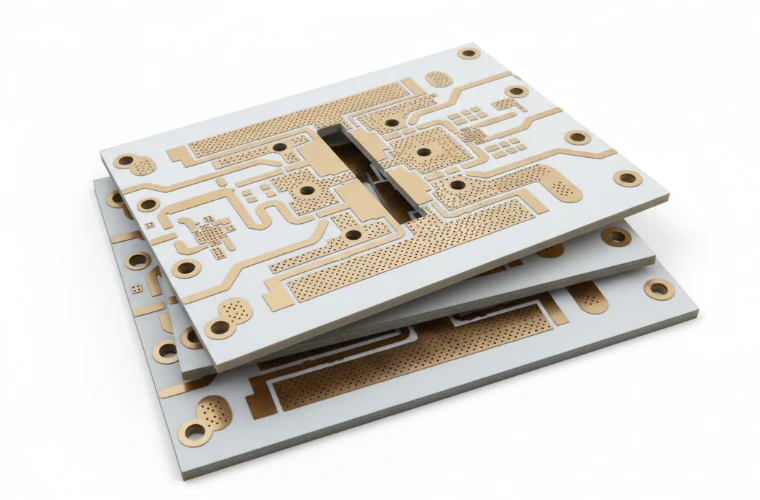
Designing a microwave PCB that operates from liquid nitrogen temperatures down to millikelvin environments requires more than standard controlled-impedance routing. A cryogenic differential microwave routing design must maintain signal integrity while managing dielectric changes, thermal contraction, heat flow, connector stress, and fabrication repeatability.
Applications such as quantum processors, superconducting resonators, cryogenic amplifiers, and astronomy instrumentation depend on transmission paths that remain predictable when materials behave differently from their room-temperature specifications.
A successful design process connects five decisions:
- Application bandwidth and signal type
- PCB stackup and material selection
- Differential transmission-line geometry
- Thermal and mechanical constraints
- Cryogenic validation strategy
At APTPCB (APTPCB PCB Factory), these designs are approached as controlled microwave structures rather than conventional PCBs.
What is cryogenic differential microwave routing?
Cryogenic differential microwave routing is the design of paired transmission lines that carry GHz-frequency signals through extremely cold environments while maintaining impedance, low insertion loss, and mechanical reliability.
Unlike room-temperature differential routing, cryogenic designs must account for:
- Dielectric constant (Dk) variation at low temperature
- Loss tangent (Df) changes
- Copper conductivity improvement and surface roughness effects
- Thermal contraction between copper, laminate, connectors, and mounting structures
- Heat transfer into sensitive cryogenic stages
A typical cryostat feedthrough PCB becomes both an electrical interconnect and a thermal management component. The design must pass microwave signals while limiting unnecessary heat conduction toward the cold stage.
Which cryogenic PCB routing approach should you choose?
The correct transmission structure depends on the priority of the system.
| Application | Preferred structure | Primary reason | Main trade-off |
|---|---|---|---|
| Dense qubit control lines | Stripline differential pairs | Strong shielding and low crosstalk | More layers and higher fabrication complexity |
| Weak LNA input signals | Microstrip or CPW | Lower dielectric interaction and low loss potential | More sensitive to radiation and external coupling |
| Flux bias line design | Wider differential routing | Supports current handling and isolation | Requires more board area |
| Thermal isolation section | Meandered or flex-based routing | Longer thermal path | Added electrical length |
| Multiplexed resonator feedlines | Controlled stripline with optimized transitions | Stable impedance across frequency range | Requires careful via and launch design |
The routing choice should be made before layout begins because stackup, impedance, and thermal performance are tightly coupled.
How should you select a cryogenic microwave PCB stackup?
A cryogenic microwave stackup should be selected from measured material behavior, not only room-temperature datasheets.
Important stackup decisions include:
| Parameter | Design impact | Validation method |
|---|---|---|
| Dielectric constant (Dk) | Changes impedance and propagation delay | Cryogenic material characterization or correction model |
| Loss tangent (Df) | Determines dielectric attenuation | VNA insertion-loss measurement |
| Copper profile | Influences conductor loss at microwave frequencies | Material documentation and roughness data |
| Dielectric thickness | Controls differential impedance | Manufacturer stackup confirmation |
| CTE mismatch | Creates mechanical stress during cooldown | Thermal cycling evaluation |
| Outgassing behavior | Affects vacuum compatibility | Material qualification data |
PTFE-based RF laminates are commonly considered for microwave cryogenic applications because of their low loss characteristics. Standard FR4 may be acceptable for mechanical layers or low-frequency sections, but microwave signal paths generally require controlled RF materials.
What differential impedance target should a cryogenic PCB use?
Most differential microwave interfaces are designed around:
- 100 Ω differential impedance
- ±5% impedance target where practical
- Controlled reference planes
- Matched pair geometry
However, room-temperature impedance is not always the final operating impedance.
As temperature decreases:
- Laminate dimensions contract.
- Dielectric properties shift.
- Copper conductivity improves.
- The effective impedance can change.
A robust design process defines whether the target impedance refers to:
- Room-temperature measurement
- Operating-temperature simulation
- Final cryogenic measurement
The stackup model should be approved before routing begins.
What geometry details matter most for cryogenic differential pairs?
Microwave performance depends on maintaining symmetry throughout the complete signal path.
Important layout requirements include:
Differential pair spacing
Maintain consistent pair spacing along the entire route. Sudden spacing changes create impedance discontinuities and differential-to-common-mode conversion.
Reference planes
Keep an uninterrupted return path beneath the pair. Plane voids, splits, and unexpected transitions can create resonances.
Via transitions
Differential vias require careful symmetry.
Use:
- Matched signal via structures
- Nearby ground stitching vias
- Backdrilled vias when stub length affects microwave performance
Connector launches
Connector transitions are frequently the largest discontinuity in a cryogenic microwave path.
A reliable launch includes:
- Optimized pad geometry
- Ground via fencing
- 3D electromagnetic simulation
- Mechanical compatibility with cooldown cycles
Which validation tests prove a cryogenic microwave PCB will work?
Validation should combine room-temperature manufacturing verification with cryogenic performance testing.
| Test | Purpose | Typical measurement |
|---|---|---|
| TDR | Confirm impedance profile and discontinuities | Differential impedance trace |
| VNA S-parameters | Measure transmission and reflection | S11, S21, crosstalk |
| Thermal cycling | Verify mechanical reliability | Repeated cooldown/warmup cycles |
| Cryogenic RF testing | Confirm operating behavior | Measurements at 77K, 4K, or mK conditions |
| Microsection inspection | Verify fabrication accuracy | Layer thickness and plating review |
High-frequency PCB validation methods commonly require correlation between simulation, fabrication, and measurement rather than relying on a single room-temperature test.
What are the most common cryogenic microwave PCB failure modes?
| Failure mode | Cause | Design response |
|---|---|---|
| Impedance shift at temperature | Incorrect dielectric assumptions | Include cryogenic material behavior in modeling |
| Excess insertion loss | Dielectric loss or copper roughness | Select low-loss laminate and suitable copper profile |
| Delamination after cooldown | CTE mismatch stress | Review material stackup and mounting method |
| Connector failure | Mechanical mismatch during contraction | Select compatible connector materials and compliant mounting |
| Crosstalk between channels | Dense routing without isolation | Use stripline structures and controlled spacing |
| Thermal overload | Excessive conductive path | Balance trace geometry and thermal isolation |
How should flux bias lines be designed for cryogenic systems?
A flux bias line design often combines DC behavior with microwave considerations.
Important requirements include:
- Sufficient conductor width for current capacity
- Isolation from sensitive readout lines
- Controlled differential geometry
- Filtering structures where required
- Mechanical reliability during cooldown
For dense quantum systems, the PCB routing strategy often needs to emulate the performance of twisted-pair wiring while reducing assembly complexity.
How do manufacturing requirements change for cryogenic microwave PCBs?
A production-ready fabrication package should include:
- Material type and thickness requirements
- Copper weight and surface roughness requirements
- Controlled impedance targets
- Differential pair identification
- Via requirements
- Surface finish selection
- Testing requirements
For microwave cryogenic applications:
- ENIG or ENEPIG finishes are commonly selected for reliability and bonding compatibility.
- High-frequency traces often require controlled solder-mask decisions.
- Copper roughness should be considered because conductor loss can remain significant even when conductivity improves at low temperature.
Supplier checklist for cryogenic microwave PCB fabrication
Provide your PCB manufacturer with:
| Information | Example requirement |
|---|---|
| Operating temperature | 77K, 4K, or millikelvin range |
| Frequency range | GHz operating band |
| Impedance target | 100 Ω differential ±5% |
| Stackup | RF laminate, thickness, copper weight |
| Simulation data | EM model and critical transitions |
| Validation plan | TDR, VNA, thermal cycling requirements |
| Mechanical constraints | Mounting method and connector interface |
This information allows fabrication decisions to be made before manufacturing changes affect electrical performance.
FAQ: cryogenic differential microwave routing
Does dielectric constant increase at cryogenic temperatures?
Material behavior depends on laminate chemistry. Many materials experience measurable dielectric changes as temperature decreases, so room-temperature simulation may require correction.
Can FR4 be used for cryogenic microwave signals?
FR4 may work for mechanical or low-frequency functions, but RF signal paths typically require materials with better controlled dielectric properties and lower loss.
Should I use stripline or microstrip for cryogenic differential pairs?
Use stripline when isolation and crosstalk control are the highest priorities. Use microstrip or CPW when minimizing dielectric interaction and simplifying layer count are more important.
What is the best surface finish for cryogenic PCBs?
ENIG and ENEPIG are commonly selected because they provide reliable plated surfaces for assembly and bonding applications.
How do I test a cryogenic microwave PCB?
Start with room-temperature impedance and S-parameter verification, then correlate results with cryogenic measurements.
Related pages & tools
- Impedance Calculator: Estimate trace dimensions before layout.
- Microwave PCB Manufacturing: Review high-frequency fabrication capabilities.
- Rogers PCB Materials: Explore RF laminate options.
- Rigid-Flex PCB: Evaluate flexible structures for thermal isolation.
- HDI PCB: Review high-density interconnect options.
Glossary
| Term | Definition |
|---|---|
| Differential Pair | Two matched transmission lines carrying opposite signals. |
| Cryostat | System maintaining extremely low temperatures. |
| Feedthrough | Electrical interface passing signals into a cryogenic chamber. |
| CTE | Coefficient of thermal expansion. |
| Dielectric Constant (Dk) | Material property affecting impedance and propagation speed. |
| Loss Tangent (Df) | Dielectric energy loss factor. |
| Stripline | Transmission line between reference planes. |
| Microstrip | Surface transmission line above a reference plane. |
| S-Parameters | Measurements describing RF network behavior. |
| TDR | Time-domain impedance measurement method. |
Conclusion: selecting a cryogenic microwave PCB strategy
Cryogenic differential microwave routing succeeds when electrical, thermal, mechanical, and manufacturing decisions are treated as one system.
The strongest designs define the stackup early, model temperature effects, control differential geometry, validate transitions, and communicate fabrication requirements clearly.
When moving from simulation to manufacturing, provide:
- Gerber files in RS-274X format.
- Stackup details including material grade, thickness, and copper weight.
- Differential impedance requirements.
- Operating temperature range.
- Required TDR, VNA, or cryogenic validation reports.
Visit our Contact Page or Quote Page to begin a cryogenic microwave PCB review.