
Definition, scope, and who this guide is for
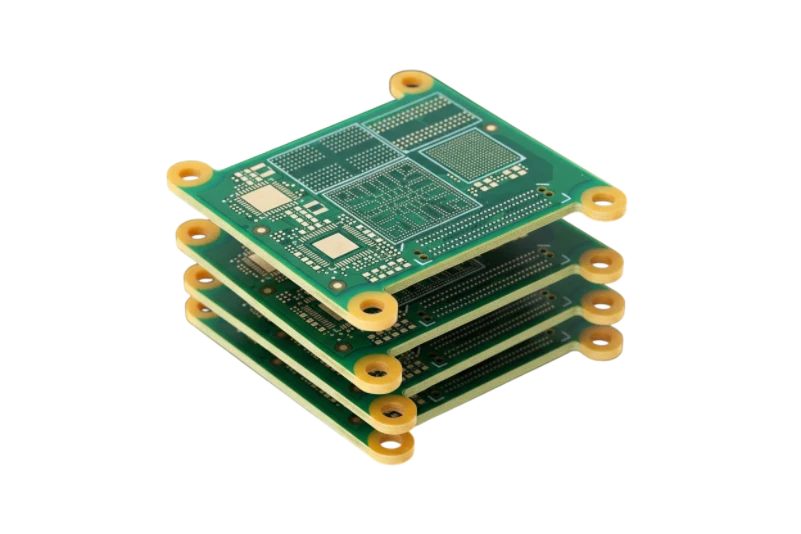
A Digital Transmitter PCB is the hardware foundation for modern broadcasting and telecommunication systems, designed to handle the complex requirements of converting digital signals into radio frequency (RF) waves for transmission. Unlike legacy analog boards, these PCBs must support high-speed digital processing (FPGA/DACs), high-frequency RF signal paths, and high-power amplification stages simultaneously. They are the critical component in systems ranging from DAB Transmitter PCB units for radio to ATSC Transmitter PCB modules for digital television.
This guide is written specifically for hardware engineers, procurement managers, and technical leads responsible for sourcing these high-performance boards. It moves beyond basic definitions to cover the procurement lifecycle: defining rigid specifications, identifying manufacturing risks, validating quality, and selecting the right partner. The focus is on actionable data to prevent signal loss, thermal failure, and costly revisions during the transition from prototype to mass production.
At APTPCB (APTPCB PCB Factory), we understand that sourcing a Digital Transmitter PCB is not just about buying a circuit board; it is about securing the integrity of the transmission chain. This playbook consolidates best practices to help you make informed decisions, ensuring your transmitter hardware meets stringent regulatory standards (such as FCC or ETSI masks) and delivers reliable long-term performance in the field.
When to use Digital Transmitter PCB (and when a standard approach is better)
Understanding the definition helps determine when this specialized technology is required versus when a standard FR4 board suffices. A Digital Transmitter PCB is mandatory when the application involves complex modulation schemes (like QAM or OFDM) that require exceptional signal linearity and low noise.
Use a specialized Digital Transmitter PCB when:
- High Frequency is critical: The carrier frequency exceeds 1GHz, or the digital data rates require controlled impedance beyond standard tolerances.
- Thermal loads are high: The board includes a Power Amplifier (PA) stage that generates significant heat, requiring specialized thermal management like metal cores or heavy copper.
- Signal Integrity is paramount: You are designing a Broadcast Transmitter PCB where low insertion loss and low Passive Intermodulation (PIM) are necessary to maintain broadcast range and clarity.
- Mixed-Signal environments: The layout combines sensitive analog RF signals with noisy high-speed digital logic, requiring advanced isolation techniques and hybrid stackups.
Stick to a standard PCB when:
- The device is a low-power, low-frequency controller that does not handle the actual RF transmission path.
- The application is purely for monitoring or user interface (UI) panels where signal speeds are low.
- Cost is the only driver, and the system can tolerate higher signal loss (though this is rarely acceptable for a primary transmitter stage).
Digital Transmitter PCB specifications (materials, stackup, tolerances)
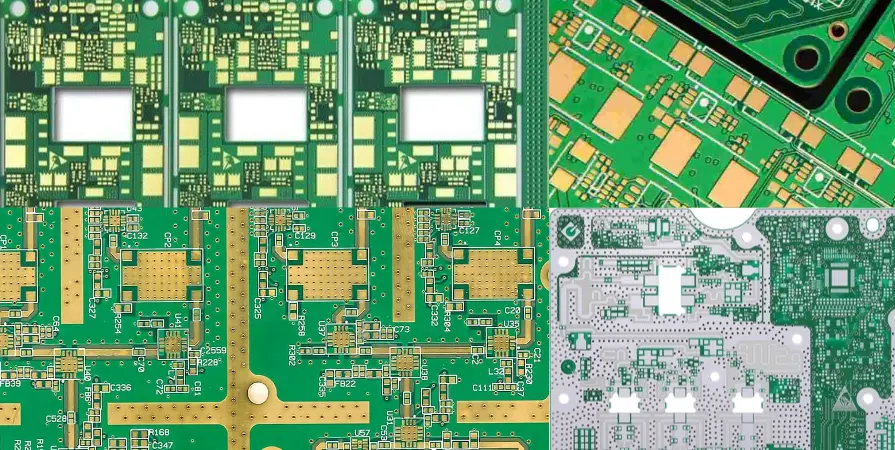
Once the need is established, the next step is defining the physical parameters to ensure the board performs as simulated. Vague specifications are the leading cause of RF performance failure.
- Base Material (RF Layers): Specify low-loss laminates such as Rogers 4350B, Rogers 4003C, or Taconic RF-35. These provide stable Dielectric Constant (Dk) and low Dissipation Factor (Df) essential for Digital Audio PCB applications.
- Base Material (Digital/Power Layers): Use high-Tg FR4 (Tg > 170°C) for non-RF layers in a hybrid stackup to reduce cost while maintaining mechanical rigidity.
- Copper Weight: Standard signal layers typically use 1oz (35µm). Power amplifier stages may require 2oz or 3oz copper to handle high current without excessive voltage drop.
- Impedance Control: Define critical traces (usually 50Ω single-ended or 100Ω differential) with a tolerance of ±5% or ±7%. Standard ±10% is often insufficient for high-power transmitters.
- Surface Finish: Electroless Nickel Immersion Gold (ENIG) or Immersion Silver is preferred. HASL is generally avoided due to uneven surfaces affecting high-frequency skin effect.
- Thermal Management: Include specifications for via-in-pad plated over (VIPPO) or copper coin embedding if the transmitter power density is high.
- Layer Count: Typically 4 to 12 layers. Ensure the stackup is balanced to prevent warping, especially if mixing dissimilar materials (Hybrid construction).
- Solder Mask: Specify LPI (Liquid Photoimageable) mask suitable for RF. In some high-frequency sections, the mask may need to be removed (windowed) to prevent dielectric loss.
- Dimensional Stability: Tolerance of ±0.1mm for outline and ±0.05mm for drilling to ensure precise connector alignment.
- Via Types: Blind and buried vias may be necessary for signal isolation in HDI designs, though through-hole is preferred for cost if density allows.
- Cleanliness: Specify ionic contamination levels (e.g., < 1.56 µg/cm² NaCl equivalent) to prevent electrochemical migration in high-voltage areas.
Digital Transmitter PCB manufacturing risks (root causes and prevention)
Even with perfect specifications, manufacturing variables can introduce failure points. Identifying these risks early allows you to implement prevention strategies during the DFM phase.
Risk: Impedance Mismatch
- Root Cause: Variation in etching (over-etching/under-etching) or dielectric thickness inconsistency.
- Detection: TDR (Time Domain Reflectometry) coupons fail.
- Prevention: Request impedance modeling from the manufacturer before fabrication; use "dummy" copper balancing to ensure even plating.
Risk: Delamination in Hybrid Stackups
- Root Cause: Mismatch in Coefficient of Thermal Expansion (CTE) between FR4 and PTFE-based RF materials during lamination.
- Detection: Blistering visible after reflow or thermal cycling.
- Prevention: Use prepregs compatible with both material types; follow specific press cycle profiles recommended by material suppliers.
Risk: Passive Intermodulation (PIM)
- Root Cause: Rough copper profile, contaminated surface finish, or poor solder joints acting as non-linear junctions.
- Detection: PIM testing equipment (often done at assembly, but root cause is PCB).
- Prevention: Use reverse-treated foils (RTF) or VLP (Very Low Profile) copper; ensure strict chemical cleaning processes.
Risk: Thermal Via Failure
- Root Cause: Incomplete plating in small vias or voids in via plugging, leading to poor heat transfer from power amps.
- Detection: X-ray inspection or thermal imaging under load.
- Prevention: Specify minimum plating thickness (e.g., average 25µm) and 100% plug verification.
Risk: Plated Through Hole (PTH) Cracking
- Root Cause: Z-axis expansion of the material stresses the copper barrel during soldering.
- Detection: Intermittent open circuits during thermal shock tests.
- Prevention: Use high-Tg materials and ensure proper aspect ratio (board thickness vs. drill diameter) is maintained (ideally < 10:1).
Risk: Signal Crosstalk
- Root Cause: Inadequate spacing between high-power RF traces and sensitive digital lines.
- Detection: Bit Error Rate (BER) testing or spectral analysis showing spurs.
- Prevention: Enforce strict design rules; use stitching vias (fencing) to shield RF sections.
Risk: Warp and Twist
- Root Cause: Unbalanced copper distribution or asymmetric stackup.
- Detection: Board does not sit flat in the SMT fixture.
- Prevention: Ensure copper balance on opposing layers; use a symmetrical stackup design.
Risk: Solder Mask Misalignment
- Root Cause: Manufacturing tolerance drift.
- Detection: Mask encroaching on pads (solderability issue) or exposing adjacent copper (short risk).
- Prevention: Use Laser Direct Imaging (LDI) for tighter registration tolerances.
Digital Transmitter PCB validation and acceptance (tests and pass criteria)
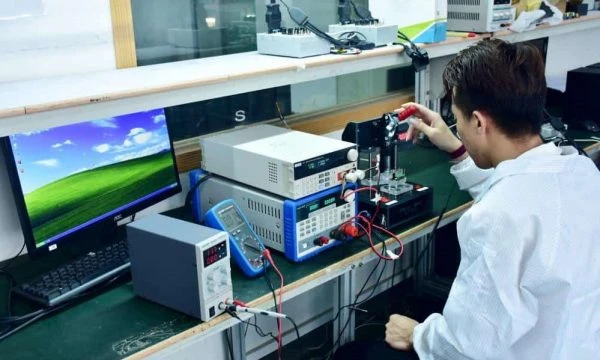
To mitigate these manufacturing risks, a robust validation plan is essential. You must define exactly what constitutes a "good" board before the shipment leaves the factory.
Objective: Verify Impedance Control
- Method: TDR testing on test coupons or actual boards.
- Criteria: Measured impedance must fall within the specified tolerance (e.g., 50Ω ±5%).
Objective: Verify Material Integrity
- Method: Microsection analysis (cross-section).
- Criteria: Verify dielectric thickness, copper plating thickness (>20µm or as specified), and layer alignment. No separation or voids.
Objective: Verify Thermal Reliability
- Method: Solder float test (288°C for 10 seconds) or thermal cycling (-40°C to +85°C).
- Criteria: No delamination, blistering, or measling visible. Resistance change < 10%.
Objective: Verify Electrical Isolation
- Method: Hi-Pot testing (High Potential).
- Criteria: No breakdown or leakage current exceeding limits between isolated nets (critical for AM Transmitter PCB high-voltage sections).
Objective: Verify Surface Finish Quality
- Method: X-ray Fluorescence (XRF) for thickness; visual inspection.
- Criteria: ENIG gold thickness 2-5µin; Nickel 120-240µin. No oxidation or exposed copper.
Objective: Verify Cleanliness
- Method: Ionic contamination testing (ROSE test).
- Criteria: Contamination < 1.56 µg/cm² NaCl equivalent (IPC-TM-650).
Objective: Verify RF Performance (Prototype stage)
- Method: Vector Network Analyzer (VNA) sweep.
- Criteria: Insertion loss and Return loss meet simulation models (e.g., S11 < -15dB).
Objective: Verify Physical Dimensions
- Method: CMM (Coordinate Measuring Machine) or optical measurement.
- Criteria: All mechanical dimensions, hole sizes, and cutouts within ±0.1mm tolerance.
Digital Transmitter PCB supplier qualification checklist (RFQ, audit, traceability)
Validation protocols are only effective if the supplier has the capability to execute them. Use this checklist to vet potential partners for Digital Transmitter PCB production.
Group 1: RFQ Inputs (What you must provide)
- Complete Gerber files (RS-274X or X2 format).
- ODB++ files (preferred for complex intelligent data).
- Fabrication drawing with clear notes on Class 2 or Class 3 requirements.
- Stackup diagram specifying material types (e.g., "Rogers 4350B 20mil").
- Impedance table linking trace widths/layers to target ohms.
- Drill chart distinguishing plated vs. non-plated holes.
- Netlist (IPC-356) for electrical test verification.
- Panelization requirements (if assembly is automated).
Group 2: Capability Proof (What they must demonstrate)
- Experience with High Frequency PCB materials (Rogers, Taconic, Isola).
- Capability for hybrid lamination (FR4 + PTFE).
- Controlled impedance etching accuracy (±5% capability).
- Back-drilling capability (to remove signal stubs).
- Laser drilling for microvias (if HDI is used).
- In-house surface finish lines (ENIG/Immersion Silver).
Group 3: Quality System & Traceability
- ISO 9001:2015 certification (minimum).
- UL listing for the specific material stackup used.
- Automated Optical Inspection (AOI) used on inner layers.
- Flying probe or bed-of-nails electrical testing availability.
- Material certificates of conformance (CoC) provided with shipment.
- Cross-section reports provided with every batch.
Group 4: Change Control & Delivery
- Formal PCN (Product Change Notification) process for material changes.
- Vacuum packaging with desiccant and humidity indicator cards.
- Clear labeling of date codes and lot numbers.
- DFM review report provided before production starts.
- Agreed-upon yield targets and scrap handling.
How to choose Digital Transmitter PCB (trade-offs and decision rules)
With a qualified supplier, you must still navigate engineering trade-offs. Decisions often balance performance against cost and manufacturability.
- If you prioritize ultra-low signal loss: Choose pure PTFE materials (like Rogers RT/duroid). Trade-off: Higher cost and more difficult processing (softer material) compared to ceramic-filled hydrocarbons.
- If you prioritize cost efficiency: Choose a hybrid stackup (RF material on top layer only, FR4 for the rest). Trade-off: More complex lamination process and potential CTE mismatch risks.
- If you prioritize thermal dissipation: Choose Heavy Copper PCB or metal-core designs. Trade-off: Finer line widths become impossible to etch accurately; limits high-density routing.
- If you prioritize high-density routing: Choose HDI with microvias. Trade-off: significantly higher tooling and testing costs.
- If you prioritize shelf life and flatness: Choose ENIG surface finish. Trade-off: Slightly higher insertion loss at very high frequencies compared to Immersion Silver.
- If you prioritize PIM performance: Choose Immersion Silver or OSP. Trade-off: Shorter shelf life and more sensitive to handling/tarnishing than ENIG.
Digital Transmitter PCB FAQ (cost, lead time, Design for Manufacturability (DFM) files, materials, testing)
Navigating these trade-offs often leads to specific questions during the procurement cycle.
1. What primarily drives the cost of Digital Transmitter PCB manufacturing? The biggest cost drivers are the specialized RF laminates (which can be 5-10x the cost of FR4), the layer count, and the complexity of the stackup (hybrid lamination). Tight impedance tolerances also reduce manufacturing yield, slightly increasing price.
2. How does lead time for Digital Transmitter PCB compare to standard boards? Standard boards take 3-5 days; Digital Transmitter PCBs typically take 8-15 days. This is due to the procurement time for specialized materials (Rogers/Taconic) and the slower, more careful plasma cleaning and lamination cycles required.
3. What DFM files are critical for Digital Transmitter PCB fabrication? Beyond Gerbers, you must provide an IPC-356 netlist and a detailed stackup drawing. The stackup must specify the dielectric constant (Dk) assumed during design so the manufacturer can match it or propose an equivalent.
4. Can I use standard FR4 for a DAB Transmitter PCB? Generally, no. While DAB frequencies (174–240 MHz) are lower than some cellular bands, the power levels and linearity requirements usually demand materials with better stability and lower loss than standard FR4 can provide.
5. What are the acceptance criteria for Digital Transmitter PCB impedance testing? Standard acceptance is ±10%, but for transmitters, ±5% is often required. The manufacturer should provide a TDR report showing the waveform and calculated impedance for the test coupons on the production panel.
6. How do I reduce the risk of PIM in my Broadcast Transmitter PCB? Specify "low profile" or "reverse treated" copper foil in your material notes. Also, ensure the solder mask is kept away from high-power RF traces (solder mask windowing) to prevent non-linear effects.
7. Is back-drilling necessary for ATSC Transmitter PCB designs? If your design involves high-speed digital signals or high-frequency RF passing through internal layers, back-drilling is recommended to remove the unused portion of the via (stub), which causes signal reflection and degradation.
8. What testing is required for high-power AM Transmitter PCB sections? For high-power sections, request Hi-Pot testing to ensure dielectric breakdown voltage is sufficient. Also, verify copper thickness on outer layers to ensure it can carry the required current without overheating.
Resources for Digital Transmitter PCB (related pages and tools)
For deeper technical details and to verify specific manufacturing capabilities, refer to these resources:
- High Frequency PCB Manufacturing: Detailed breakdown of capabilities regarding RF materials and processing techniques essential for transmitters.
- Rogers PCB Materials: Specific data on Rogers laminates, the industry standard for high-performance digital transmitter boards.
- Impedance Calculator: A tool to help estimate trace width and spacing for your required impedance before finalizing the design.
- Testing and Quality Control: Overview of the validation equipment (AOI, X-ray, Flying Probe) used to ensure board integrity.
- Heavy Copper PCB: Learn about thick copper options for the power amplifier stages of your transmitter.
Request a quote for Digital Transmitter PCB (Design for Manufacturability (DFM) review + pricing)
Ready to move from research to production? APTPCB offers a comprehensive DFM review alongside your quote to identify potential RF or thermal risks before you commit to spending.
To get an accurate quote and DFM, please send:
- Gerber Files: RS-274X or ODB++.
- Fabrication Drawing: Including material specs, stackup, and drill chart.
- Quantities: Prototype (5-10 pcs) vs. Production volume.
- Special Requirements: Impedance reports, specific material brands (e.g., Rogers 4350B), or Class 3 requirements.
Click here to Request a Quote & DFM Review
Conclusion (next steps)
Sourcing a Digital Transmitter PCB requires a shift in mindset from standard electronics procurement. It demands a focus on material science, strict impedance control, and rigorous validation to handle the power and precision of modern broadcasting. By defining clear specifications, understanding the inherent risks of hybrid stackups, and utilizing a detailed supplier checklist, you can ensure your transmitter hardware delivers the signal integrity and reliability your network demands.