
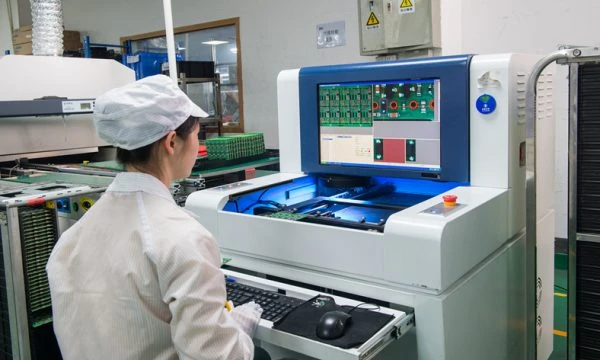
A dispatch system PCB is the electronics platform that collects operational information, maintains communications, and enables routing, assignment, monitoring, or control decisions. The same term can describe a vehicle telematics terminal, an emergency communications console, an automated warehouse controller, or a remote industrial node.
The correct PCB design begins by defining where the hardware operates, what interfaces it manages, and what failure behavior is acceptable.
What type of dispatch system PCB are you designing?
A dispatch PCB should be classified by operating environment before selecting materials, interfaces, protection, and production tests.
| Hardware class | Typical functions | Dominant PCB risks |
|---|---|---|
| Fleet mobile data terminal | GNSS, LTE/5G, Wi-Fi/Bluetooth, CAN, display, camera and driver I/O | Vehicle transients, antenna coexistence, vibration, thermal load |
| Public-safety dispatch console | Audio, Ethernet, USB, display/control, radio gateways and redundant power | Audio integrity, EMC, port surge/ESD, availability and serviceability |
| Warehouse sortation or AGV node | Sensors, motors/actuators, industrial Ethernet/fieldbus and safety I/O | Switching noise, connector stress, dust, vibration and uptime |
| Utility or field dispatch controller | Remote I/O, cellular/radio, metering and backup power | Outdoor temperature, surge, grounding and remote recovery |
A supplier quote should include the hardware class, installation method, operating environment, interfaces, firmware requirements, and test expectations. A request that only states “dispatch system PCB” does not define a manufacturable product.
What requirements should be frozen before dispatch PCB design?
The engineering package should define the system boundary before schematic capture and PCB layout.
| Requirement | Design consequence | Release evidence |
|---|---|---|
| Installation | Fixed rack, dashboard, machine, outdoor cabinet or handheld | Mechanical and environmental profile |
| Input power | AC adapter, vehicle battery, PoE, industrial DC or backup battery | Voltage/transient and brownout profile |
| Communications | Ethernet, cellular, GNSS, Wi-Fi, radio, CAN, RS-485 or fieldbus | Interface, connector and protocol matrix |
| Human interface | Audio, display, keys, touchscreen, handset or PTT | Latency, level, ESD and usability requirements |
| Machine interface | Sensors, encoders, relays, solenoids or motor control | Voltage, current, isolation and fault states |
| Availability | Restart time, offline operation, redundancy and data retention | Failure-response and recovery requirements |
| Environment | Temperature, vibration, shock, humidity, dust and chemicals | Qualification profile and acceptance limits |
| Security/service | Identity, secure update, logs, debug and recovery | Provisioning and lifecycle plan |
How do power and fault recovery affect dispatch PCB reliability?
Dispatch electronics frequently operate from unstable sources. Vehicle systems can experience cranking dips, load transients, reverse connection, conducted noise, and ground offset. Industrial systems can experience switching noise, hot-plug events, and backup-power transitions.
The power architecture should define:
- connector ratings and protection components;
- reverse-polarity protection;
- surge and transient suppression;
- EMI filtering and current-return paths;
- regulator selection and thermal loading;
- power sequencing and reset behavior;
- watchdog operation;
- brownout-safe storage handling;
- recovery after interrupted firmware updates.
Copper thickness alone does not solve power reliability. Connector pins, vias, inductors, switching devices, thermal paths, and narrow trace transitions often determine actual performance.
How should RF, communications and signal integrity be designed?
Dispatch systems commonly combine radios, GNSS, high-speed digital interfaces, industrial buses, and sensitive analog paths on one PCB.
Cellular, Wi-Fi and GNSS design
Radio placement requires controlled antenna routing, module keep-outs, ground reference planning, and enclosure-level validation.
GNSS performance can degrade from:
- switching regulator harmonics;
- display clocks;
- processor activity;
- memory interfaces;
- simultaneous radio transmissions.
Coexistence testing should evaluate the final enclosure, antenna arrangement, and operating modes.
Ethernet, USB and high-speed interfaces
Release stack-up information and impedance requirements before routing. Differential pairs should maintain symmetry through connectors, protection devices, and layer transitions.
ESD protection placement should preserve a short discharge path without forcing transient currents through sensitive digital regions.
CAN, RS-485 and industrial I/O
Industrial interfaces require defined:
- termination strategy;
- common-mode range;
- isolation requirements;
- cable environment;
- surge and transient protection;
- connector selection.
External I/O protection must match the installation environment rather than a generic reference circuit.
Audio and push-to-talk interfaces
Dispatch consoles may require microphones, speakers, codecs, handsets, and PTT controls. Audio performance depends on:
- return-current control;
- separation from switching supplies;
- radio noise isolation;
- defined gain and frequency-response limits;
- functional production testing.
Which PCB materials and ruggedization options fit dispatch environments?
Ruggedization decisions should follow measured environmental conditions.
| Stress | Design response | Validation evidence |
|---|---|---|
| Vibration/shock | Board support, connector retention, mass placement and staking | Product-level vibration/shock test |
| High temperature | Component derating, loss reduction, spreading and enclosure path | Loaded thermal map |
| Condensation/humidity | Enclosure drainage/venting, cleanliness and coating strategy | Humidity/condensation test |
| Dust/chemicals | Sealing, compatible coating or potting and connector selection | Material compatibility and ingress test |
| ESD/surge/EFT | Port protection, bonding and controlled return path | Immunity test with operating criteria |
| Continuous operation | Watchdog, health monitoring, wear control and service access | Endurance and recovery test |
High-Tg materials may improve thermal margin, but laminate selection must match operating temperature, board construction, reliability target, and manufacturing process.
Conformal coating can reduce contamination risk but does not replace enclosure design. Potting improves environmental protection but can increase thermal stress and limit repairability.
What manufacturing controls matter for dispatch PCB assembly?
Dispatch PCB assemblies may combine processors, BGA memory, radio modules, GNSS components, shield cans, connectors, relays, and power devices.
Manufacturing documentation should define:
- PCB stack-up and controlled impedance requirements;
- impedance coupon requirements;
- package moisture handling;
- solder paste requirements for fine-pitch packages;
- X-ray criteria for BGA/QFN/LGA and RF modules;
- selective or wave solder requirements;
- radio module firmware revision;
- SIM/eSIM, keys, certificates, and device identity boundaries;
- coating coverage and masking requirements;
- serialization and traceability.
Use PCB assembly testing to align inspection and functional evidence with product risk.
AOI cannot verify modem registration, GNSS reception, audio operation, protected input behavior, or recovery after power interruption.
What production tests should a dispatch PCBA include?
| Test gate | Examples | Required definition |
|---|---|---|
| Bare PCB | Opens/shorts, dimensions, impedance | Netlist, tolerances and coupon rules |
| Assembly inspection | SPI, AOI, X-ray and visual | Package-specific acceptance criteria |
| Power | Input range, rails, sleep/load current, reset | Fixture supply profile and limits |
| Digital | Memory, storage, clocks, watchdog and ports | Firmware image and pass log |
| Communications | Ethernet, CAN, RS-485, cellular, Wi-Fi/Bluetooth | Loopback/network fixture and limits |
| GNSS/RF | Module identity, antenna path or conducted check | Shield box/coupler method and threshold |
| Audio/HMI | Microphone, speaker, codec, display, keys and PTT | Stimulus, gain/noise and response limits |
| Industrial I/O | Analog/digital inputs, relays and protected outputs | Loads, thresholds and fault states |
| Recovery | Brownout, watchdog, update interruption and offline mode | Expected state and data-retention rule |
RF registration through a live network can be unstable as a factory test. Controlled conducted or shielded fixtures provide more repeatable validation where applicable.
What are the most common dispatch PCB failure modes?
| Failure mode | Field result | Engineering control |
|---|---|---|
| Incorrect hardware classification | Wrong environmental and interface decisions | Define deployment scenario first |
| GNSS routing near noisy power circuits | Poor position performance | Partition RF and switching regions |
| Insufficient transient protection | Resets or damaged input circuitry | Validate installation power conditions |
| Shared audio and power returns | Hum, interference, reduced audio quality | Control return paths |
| Missing degraded operation design | Service interruption during network loss | Define offline recovery behavior |
| Improper coating coverage | Service and connector failures | Document masking and inspection |
| AOI-only validation | Interface failures escape production | Add functional testing |
What should be included in a dispatch system PCB RFQ?
A complete supplier package should include:
- Product type: Fleet terminal, public-safety console, sortation/AGV node or field controller
- Environment: Installation, temperature, vibration, shock, humidity, dust, chemicals, duty cycle and enclosure
- Power: Nominal/range, transient profile, grounding, backup/hold-up and protected outputs
- Interfaces: Radio/GNSS, Ethernet, USB, CAN, RS-485, fieldbus, audio, display, sensors, relays and connectors
- PCB: Gerber X2, ODB++ or IPC-2581; netlist; stack-up; impedance; materials; copper; drill; profile and drawings
- Assembly: BOM, alternates, placement, modules, shields, cables, coating, mechanical hardware and torque requirements
- Software: Programming, configuration, secure provisioning, serial/MAC/IMEI data and test mode
- Test: Fixtures, loads, communication simulation, RF/audio/I/O limits, recovery cases, sampling and reports
- Quality/commercial: First article, traceability, change notification, quantities, lifecycle and schedule
Submit the controlled package through the PCB quotation page and identify customer-supplied radios, displays, harnesses, and test equipment.
Which standards apply to dispatch PCB projects?
Applicable references depend on the final product category and market requirements and may include:
- IEC 62368-1 — Audio/video, information and communication technology equipment safety
- IEC 61000-4 series — EMC immunity test methods
- IEC 60068-2 series — Environmental testing
- ISO 7637 series — Road-vehicle electrical transient disturbances
- ISO 16750 series — Environmental conditions and testing for road-vehicle electrical/electronic equipment
- ISO 11898 series — Controller area network
- EN 50155 — Electronic equipment used on rolling stock, where applicable
- IPC-2221, IPC-6012, J-STD-001 and IPC-A-610
PCB fabrication and assembly do not independently certify the complete vehicle, machine, radio system, or dispatch product.
Dispatch system PCB FAQ
What is a dispatch system PCB?
A dispatch system PCB is the control board inside equipment that collects operational data and supports routing, assignment, monitoring, or control functions.
Does every dispatch PCB require high-Tg laminate?
No. Material selection depends on temperature exposure, construction, reliability requirements, and manufacturing conditions.
Which interfaces are common in dispatch hardware?
Common interfaces include Ethernet, cellular, GNSS, Wi-Fi, Bluetooth, CAN, RS-485, fieldbus, USB, audio, and industrial I/O.
Is conformal coating required?
Only when environmental exposure requires additional protection. The coating process, masking, thickness, cure, repair process, and enclosure compatibility must be defined.
How should dispatch PCB assemblies be tested?
Testing should combine fabrication inspection, assembly inspection, power validation, communication tests, I/O verification, firmware validation, and recovery testing.
What information is required for a PCB quote?
Provide the hardware class, environment, power profile, interfaces, PCB files, BOM, firmware/provisioning requirements, test limits, quantities, and traceability expectations.