
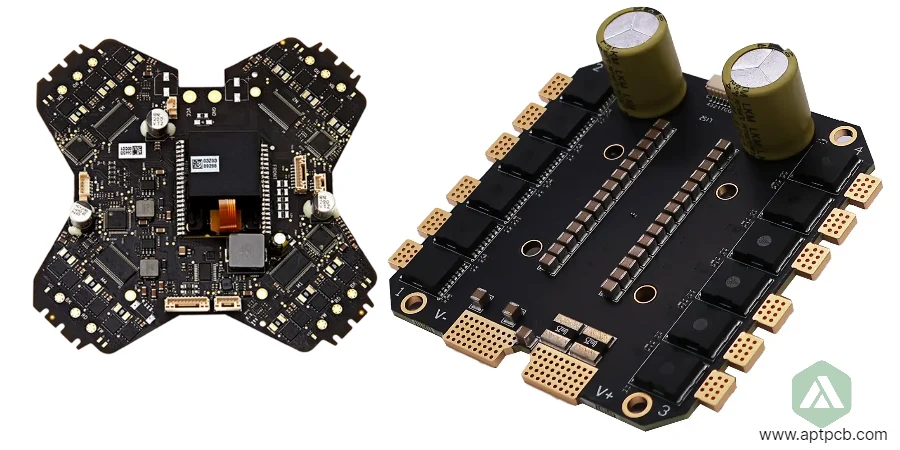
A drone PCB manufacturer handles the transition between UAV electronics design intent and a buildable, repeatable PCB assembly. The scope usually includes PCB fabrication decisions, assembly readiness, component placement review, inspection planning, protection processes, and manufacturing documentation.
The manufacturer does not certify the aircraft or prove flight performance. Instead, the board-level responsibility is ensuring that flight controllers, ESC boards, RF modules, power distribution boards, and payload electronics can be fabricated and assembled consistently.
The most important review areas are:
- multilayer stackup and material selection
- copper distribution and current-path capability
- mixed-signal and RF layout manufacturability
- connector and mounting reliability
- SMT and through-hole assembly processes
- conformal coating and protection requirements
- AOI, X-ray, ICT, flying probe, and functional test planning
Quick Answer
A drone PCB manufacturer manages the board-build decisions that affect UAV electronics reliability: stackup, fabrication, PCBA assembly, mechanical reinforcement, protection processes, and production testing. The right supplier helps identify manufacturing risks before they become flight failures.
For broader industry context, see Drone & UAV PCB. This page focuses specifically on what a PCB and PCBA supplier can review and control.
In This Guide
- What PCB types does a drone PCB manufacturer usually build?
- Which manufacturing decisions matter most for UAV boards?
- How does vibration affect drone PCB manufacturing?
- What assembly and inspection processes should UAV manufacturers review?
- What information should be included in a drone PCB RFQ package?
- Drone PCB manufacturer decision matrix
- FAQ
What PCB types does a drone PCB manufacturer usually build?
A UAV platform normally contains several specialized boards. Each board type creates different manufacturing priorities.
| Board class | Typical manufacturing focus | Main review points |
|---|---|---|
| Flight controller PCB | Dense multilayer routing, sensor integration, fine-pitch SMT | Signal integrity, grounding, component escape, inspection access |
| ESC board | High-current switching, thermal management, power reliability | Copper weight, MOSFET assembly, thermal vias, solder-joint strength |
| Power distribution board | Battery and motor power delivery | Current paths, connector retention, heat spreading |
| RF/GNSS/telemetry board | Wireless communication reliability | Controlled impedance, shielding, connector transitions, cleanliness |
| Payload interface board | External device connections | Mechanical retention, cable strain, alignment |
| Battery-management board | Protection and monitoring electronics | Thermal paths, spacing, test access |
A flight controller and an ESC may operate inside the same drone, but they require different manufacturing discussions.
The flight controller usually prioritizes:
- low-noise sensor environments
- stable power delivery
- dense component placement
- reliable fine-pitch assembly
The ESC usually prioritizes:
- current capacity
- heat removal
- copper balance
- mechanical durability under vibration
Which manufacturing decisions matter most for UAV boards?
Drone electronics combine compact size, weight limitations, vibration exposure, and demanding electrical requirements. The manufacturing review should therefore focus on decisions that influence yield and long-term reliability.
Stackup and material selection
The stackup determines how signals, power, and thermal paths are managed.
Important considerations include:
- layer count required for routing density
- controlled impedance requirements for RF or high-speed signals
- copper thickness needed for power sections
- dielectric structure compatibility with mechanical constraints
- thermal requirements around high-power components
For stackup planning, see PCB Stack Up.
Power distribution and thermal management
ESC and power boards often experience the highest electrical stress in a UAV.
Manufacturing discussions should cover:
- copper width and thickness
- thermal via structures
- component pad design
- solder volume consistency
- heat-spreading areas
A board that passes electrical testing can still experience field problems if thermal expansion and mechanical stress are not considered during manufacturing planning.
RF and mixed-signal control
Navigation, telemetry, and video systems require careful manufacturing control.
Relevant topics include:
- ground reference continuity
- shielding interfaces
- connector placement
- impedance-controlled traces
- assembly cleanliness
The supplier should understand whether a board requires RF validation support such as impedance verification or customer-defined testing limits.
How does vibration affect drone PCB manufacturing?
UAV electronics operate close to motors, propellers, batteries, and moving structures. Mechanical stress therefore becomes a PCB manufacturing concern.
Important board-level considerations include:
- connector locking mechanisms
- mounting-hole reinforcement
- cable exit direction
- heavy-component support
- solder-joint fatigue risk
- coating and protection coverage
One common example is a power board with large battery or motor wires. Heavy cables can create repeated mechanical loading at solder joints and copper pads. Under continuous vibration, the stress can develop into:
- pad lifting
- solder fatigue cracks
- barrel damage
- intermittent electrical resistance
- localized heating
A manufacturing review should determine:
| Question | Manufacturing purpose |
|---|---|
| Where are vibration loads introduced? | Identify mechanical stress points |
| Which components need reinforcement? | Reduce solder-joint fatigue |
| Which connectors require retention? | Prevent intermittent contact |
| Which areas require inspection focus? | Improve production screening |
Vibration review is not a replacement for aircraft qualification testing. It is a way to make the PCB assembly better prepared for the environment it will operate in.
What assembly and inspection processes should UAV manufacturers review?
The transition from PCB design to assembled hardware is where many manufacturing risks appear.
A drone PCBA supplier should discuss:
SMT assembly capability
Important topics include:
- fine-pitch packages
- QFN/BGA inspection requirements
- 0201 or smaller components where applicable
- placement accuracy
- solder paste process control
Inspection planning
Different inspection methods reveal different issues.
| Method | Useful for |
|---|---|
| AOI | Component placement, polarity, visible solder issues |
| X-ray | Hidden joints such as BGA/QFN connections |
| Flying probe | Prototype and low-volume electrical verification |
| ICT | Production electrical testing with fixtures |
| Functional testing | Customer-defined system behavior checks |
Testing and quality planning can be reviewed further through Testing & Quality.
Protection and coating
Conformal coating can improve environmental protection, but only when coverage requirements are clearly defined.
The manufacturing package should specify:
- coating material
- keepout areas
- connector masking
- test-point protection
- rework expectations
What information should be included in a drone PCB RFQ package?
A complete manufacturing package helps suppliers evaluate real production risks.
A typical UAV PCB handoff includes:
| Information | Purpose |
|---|---|
| Gerber or ODB++ files | PCB fabrication review |
| Stackup requirements | Material and impedance planning |
| BOM | Component sourcing and assembly planning |
| Pick-and-place files | Placement programming |
| Assembly drawings | Mechanical and process reference |
| Connector details | Retention and mating review |
| Coating requirements | Protection process planning |
| Test requirements | Verification strategy |
The more complete the release package, the more useful the supplier review becomes.
A manufacturer can then focus on meaningful questions:
- Can this board be built repeatedly?
- Are inspection points accessible?
- Are vibration-sensitive areas reinforced?
- Are assembly risks controlled before production?
Drone PCB manufacturer decision matrix
Use this matrix when comparing suppliers.
| Requirement | Supplier capability to confirm | Why it matters |
|---|---|---|
| Flight controller assembly | Fine-pitch SMT, sensor assembly, inspection support | Protects dense control electronics |
| ESC manufacturing | Heavy copper, thermal review, power assembly experience | Supports high-current reliability |
| RF board production | Impedance control and shielding support | Protects communication links |
| Prototype support | DFM feedback and first articles | Reduces design iteration cost |
| Production scaling | Process documentation and traceability | Maintains repeatability |
| Testing capability | AOI, X-ray, ICT, functional test options | Matches verification needs |
Next steps with APTPCB
If your UAV project involves flight controllers, ESC boards, RF modules, payload interfaces, or battery-management electronics, submit the manufacturing package for review through Quote.
Include:
- Gerber or ODB++ files
- BOM
- assembly drawings
- stackup requirements
- coating notes
- testing expectations
APTPCB reviews UAV PCB projects around manufacturability, assembly risk, test readiness, and production requirements before volume manufacturing.
FAQ
Does a drone PCB manufacturer certify the UAV?
No. The PCB manufacturer builds and verifies board-level assemblies. Aircraft certification and system qualification are separate processes.
Can a drone PCB manufacturer improve flight performance?
A PCB manufacturer does not tune flight algorithms or validate aircraft control performance. The manufacturer improves board reliability, manufacturability, and production consistency.
Are all drone PCBs manufactured the same way?
No. Flight controllers, ESC boards, RF modules, and power boards have different electrical and mechanical priorities.
Is conformal coating always required for UAV boards?
No. The decision depends on enclosure design, moisture exposure, service requirements, connector access, and rework needs.
What files are needed for a drone PCB manufacturing quote?
Most suppliers require fabrication files, BOM, placement data, assembly drawings, specifications, and testing requirements.
Public references
Analog Devices, "MT-031: Grounding Data Converters and Solving the Mystery of AGND and DGND"
Samtec Blog, "Shaken, Not Stirred: An Introduction To Connector Vibration Testing"
Keysight, "ICT vs Flying Probe: Best Method for High-Volume Manufacturing"
Related APTPCB pages
Author and review information
- Author: APTPCB industry solutions content team
- Technical review: PCB manufacturing, PCBA process, and DFM review team
- Last updated: 2025-03-29