
Electrowetting PCB technology represents a fusion of electronics and microfluidics. It allows for the precise manipulation of liquid droplets using electric fields directly on a printed circuit board surface. This technology is transforming industries ranging from medical diagnostics (Lab-on-a-Chip) to advanced optical lenses and next-generation displays. However, manufacturing an Electrowetting PCB requires significantly tighter tolerances and different material considerations than standard circuit boards.
For engineers and procurement managers, understanding the nuances of electrode design, dielectric layer thickness, and surface hydrophobicity is critical. A standard PCB fabrication process often fails to meet the stringent flatness and insulation requirements of electrowetting devices.
This guide serves as your comprehensive resource. We cover everything from the fundamental physics of Electrowetting-on-Dielectric (EWOD) to the specific manufacturing checkpoints required to build a functional device. Whether you are designing a variable focus lens or a digital microfluidic platform, this page details how to move from concept to validated production with APTPCB (APTPCB PCB Factory).
Key Takeaways
- Definition: An Electrowetting PCB uses a grid of electrodes covered by a dielectric and hydrophobic layer to move, split, or merge liquid droplets via voltage application.
- Critical Metric: Surface roughness is the enemy; electrodes must be exceptionally flat to prevent droplet "pinning."
- Material Focus: The choice of dielectric material (e.g., Parylene C, SU-8) determines the required actuation voltage and breakdown threshold.
- Misconception: High voltage is always required. While traditional EWOD uses 100V+, modern thin-film dielectrics on PCBs can operate at lower voltages.
- Validation: Testing goes beyond electrical continuity; it requires contact angle measurement and dielectric breakdown testing.
- Application: Primary use cases include digital microfluidics (DMF), liquid lenses for cameras, and emerging display tech like 360 Degree Display systems.
- Tip: Always design a "grounding" top plate or coplanar ground rails to close the electrical circuit through the droplet.
What Electrowetting PCB really means (scope & boundaries)
To select the right manufacturing process, you must first define the scope of the technology. An Electrowetting PCB is not just a circuit board; it is the active substrate for a micro-electro-mechanical system (MEMS).
The Core Mechanism: EWOD
The industry standard is Electrowetting-on-Dielectric (EWOD). In this setup, the copper pads on the PCB act as actuation electrodes. These electrodes are insulated by a thin dielectric layer to prevent electrolysis of the liquid. On top of the dielectric, a hydrophobic (water-repelling) layer is applied.
When no voltage is applied, the liquid droplet beads up on the hydrophobic surface (high contact angle). When voltage is applied to the electrode beneath the droplet, the "wettability" of the surface effectively changes. The droplet spreads out (contact angle decreases). By sequentially energizing adjacent electrodes, the droplet is pulled across the PCB surface.
Scope of Manufacturing
When you request an Electrowetting PCB from a manufacturer like APTPCB, the scope usually involves:
- Base PCB Fabrication: Creating the high-density electrode array.
- Surface Finishing: Ensuring extreme flatness (often ENIG or ENEPIG).
- Post-Processing (Optional): Application of the dielectric and hydrophobic layers, though some designers perform this in-house.
Related Technologies
It is important to distinguish Electrowetting PCBs from similar interfaces:
- 3D Touch PCB: This technology relies on capacitive sensing to detect pressure (Z-axis). While both involve interaction with a surface, 3D Touch PCB designs focus on sensing input, whereas Electrowetting PCBs focus on actuating output (moving liquid).
- 360 Degree Display: Electrowetting is increasingly used in liquid prisms and lenses. These components can steer light rapidly, enabling 360 Degree Display systems without bulky mechanical rotation.
Electrowetting PCB metrics that matter (how to evaluate quality)
Success in electrowetting depends on specific physical and electrical properties. Standard IPC class 2 or 3 requirements are often insufficient for the active area of an EWOD device.
| Metric | Why it matters | Typical Range / Factors | How to Measure |
|---|---|---|---|
| Dielectric Strength | Prevents current from arcing through the insulator to the liquid, which causes electrolysis and bubble formation. | > 100 V/µm (Material dependent: Parylene, SiO2, SU-8). | Hi-Pot testing or breakdown voltage sweep. |
| Surface Roughness (Ra) | Rough surfaces cause contact angle hysteresis. The droplet gets "stuck" (pinned) and requires higher voltage to move. | < 0.5 µm is ideal. Standard FR4 is often too rough; polished substrates are preferred. | Atomic Force Microscopy (AFM) or Profilometer. |
| Electrode Gap | The space between pads determines if a droplet can bridge to the next electrode. Large gaps stop movement. | 1 mil to 4 mils (25µm - 100µm). Requires HDI capabilities. | Optical Microscopy or AOI (Automated Optical Inspection). |
| Contact Angle Change | Measures the efficiency of the electrowetting effect. A larger change means better control. | Delta of 30° to 40° upon voltage application. | Goniometer (Contact Angle Meter). |
| Capacitance per Area | Higher capacitance allows for lower actuation voltages, reducing power consumption. | Dependent on dielectric thickness (thinner is better but riskier). | LCR Meter on test coupons. |
How to choose Electrowetting PCB: selection guidance by scenario (trade-offs)
Different applications impose different constraints on the PCB design. Below are common scenarios and how to choose the right stack-up and materials.
Scenario 1: Digital Microfluidics (Lab-on-a-Chip)
- Goal: Move biological samples (blood, DNA reagents) for analysis.
- Trade-off: Biocompatibility vs. Cost.
- Recommendation: Use a high-Tg FR4 or Glass-reinforced epoxy. The dielectric layer must be pinhole-free to prevent sample contamination.
- Key Feature: Requires extremely fine spacing between electrodes (HDI technology) to move small droplets (nanoliter scale).
- Link: Explore HDI PCB capabilities for fine-pitch electrode fabrication.
Scenario 2: Liquid Lenses and Optical Devices
- Goal: Change the shape of a liquid interface to focus light.
- Trade-off: Optical Clarity vs. Substrate Durability.
- Recommendation: Standard FR4 is opaque. You may need a Ceramic PCB or a rigid-flex design where the optical path is clear of the substrate. The PCB acts as the driver ring around the lens.
- Key Feature: Precision circular electrode patterning.
Scenario 3: Flexible Displays (E-Paper)
- Goal: Create a bendable display using electrowetting pixels.
- Trade-off: Flexibility vs. Dielectric Integrity.
- Recommendation: Use Polyimide (PI) based Flex PCB. However, the dielectric coating must also be flexible without cracking.
- Key Feature: The copper must be annealed to prevent cracking during bending.
- Link: Review Flex PCB options for bendable substrate requirements.
Scenario 4: High-Voltage Actuation (>200V)
- Goal: Move heavy or viscous liquids (e.g., oil/water mixtures).
- Trade-off: Insulation Thickness vs. Actuation Power.
- Recommendation: Thicker dielectric layers are safer but require higher voltage. Ensure the PCB substrate has a high CTI (Comparative Tracking Index) to prevent tracking between high-voltage pads.
- Key Feature: Increased spacing between high-voltage traces and low-voltage logic.
Scenario 5: Rapid Prototyping
- Goal: Test a concept quickly.
- Trade-off: Lead Time vs. Surface Quality.
- Recommendation: Standard ENIG finish on FR4. It may have higher hysteresis (droplets stick more), but it validates the circuit logic.
- Key Feature: Quick-turn manufacturing.
Scenario 6: High-Frequency Switching
- Goal: Rapid droplet movement for video-rate displays.
- Trade-off: Impedance Control vs. Layout Density.
- Recommendation: Use low-loss materials like Rogers or Teflon if the switching frequency is high, though electrowetting itself is usually low frequency (<1kHz). The concern is signal integrity for the control logic.
- Link: Consider Teflon PCB materials for specialized substrate needs.
Electrowetting PCB implementation checkpoints (design to manufacturing)
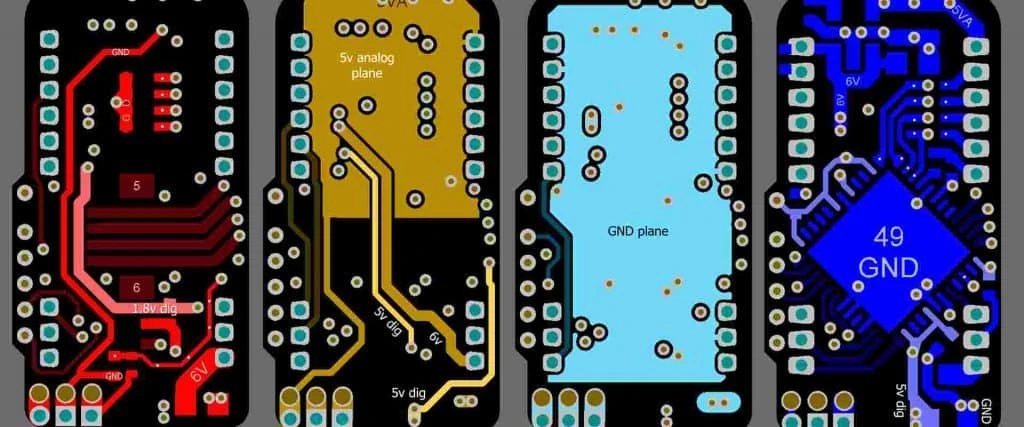
Moving from a simulation to a physical board requires a disciplined approach. Follow these checkpoints to ensure your Electrowetting PCB functions correctly.
Phase 1: Design & Layout
- Interdigitated Electrodes: Design electrode edges with a zigzag or interdigitated pattern rather than straight lines. This increases the overlap area and helps the droplet bridge the gap to the next pad.
- Grounding Strategy: Decide between a "Cover Plate Ground" (conductive glass on top) or "Coplanar Ground" (ground rails next to active pads). Coplanar is harder to manufacture (risk of shorts) but eliminates the top wire.
- Via Filling: Do not place open vias in the active droplet area. Vias must be plugged and capped (VIPPO) to ensure a flat surface for the dielectric coating.
Phase 2: Material Selection
- Substrate Flatness: Specify materials that resist warping. For high-precision applications, consider ceramic or glass-core PCBs.
- Copper Weight: Use 0.5 oz or thinner copper. Thick copper (1 oz+) creates tall "steps" between the pad and the substrate, making it hard to coat uniformly.
- Surface Finish: Choose ENIG (Electroless Nickel Immersion Gold) or ENEPIG. HASL is too uneven and will cause immediate device failure.
Phase 3: Fabrication (The APTPCB Stage)
- Etching Tolerance: Request strict etching tolerances. Over-etching increases the gap size, preventing droplet movement.
- Soldermask Clearance: In the active area, soldermask is usually omitted because it adds height and roughness. The dielectric layer will provide the insulation later.
- Cleanliness: The board must be delivered free of organic residues. Any residue will prevent the hydrophobic coating from adhering.
Phase 4: Post-Processing & Assembly
- Dielectric Coating: Apply Parylene C (CVD process) or spin-coat SU-8. The target is usually 1µm to 5µm.
- Hydrophobic Coating: Spin-coat Teflon AF or Cytop (approx. 50nm - 100nm).
- Baking: Cure the coatings properly to remove solvents and ensure adhesion.
Electrowetting PCB common mistakes (and the correct approach)
Even experienced engineers encounter hurdles with EWOD technology. Here are the most common pitfalls.
1. Ignoring Surface Topography
- Mistake: Using standard 1 oz copper with standard spacing. This creates 35µm deep "trenches" between pads.
- Consequence: The droplet gets pinned at the trench edge and cannot move.
- Correction: Use 1/3 oz or 1/2 oz copper. Use planarization techniques or fill the gaps with a dielectric filler before the final topcoat.
2. Vias in the Active Area
- Mistake: Placing standard vias under the droplet path.
- Consequence: The dielectric coating sinks into the via hole (even if tented), creating a depression that traps the liquid.
- Correction: Use "Via-in-Pad Plated Over" (VIPPO) technology to ensure a perfectly flat pad surface.
3. Insufficient Dielectric Strength
- Mistake: Assuming the soldermask is a sufficient dielectric.
- Consequence: Soldermask is porous and often too thick (reducing capacitance). High voltage eventually arcs through pinholes.
- Correction: Remove soldermask in the active area. Apply a dedicated high-quality dielectric like Parylene or amorphous fluoropolymers.
4. Wrong Surface Finish
- Mistake: Using HASL (Hot Air Solder Leveling).
- Consequence: HASL leaves a bumpy surface.
- Correction: Always specify ENIG or Hard Gold for the smoothest possible metal finish.
5. Neglecting the "Contact Angle Hysteresis"
- Mistake: Focusing only on the static contact angle.
- Consequence: The droplet beads up well but refuses to move when voltage is applied because the difference between advancing and receding angles is too high.
- Correction: Focus on surface cleanliness and the quality of the hydrophobic topcoat.
6. Overlooking Edge Effects
- Mistake: Sharp corners on electrodes.
- Consequence: Electric field concentration at sharp points leads to premature dielectric breakdown.
- Correction: Round the corners of all electrode pads.
Electrowetting PCB FAQ (cost, lead time, materials, testing, acceptance criteria)
Q: How does the cost of an Electrowetting PCB compare to a standard PCB? A: The bare board cost is moderately higher due to the need for HDI features (tight gaps), VIPPO, and ENIG finish. However, the main cost driver is the post-processing (dielectric and hydrophobic coatings), which is often done by specialized labs or assembly houses, not the bare board fab.
Q: What is the typical lead time for these boards? A: For the bare PCB fabrication at APTPCB, lead times are standard (5-10 days for prototypes). If you require specialized materials like ceramic substrates or ultra-thin copper, add 1-2 weeks for material procurement.
Q: Can I use standard FR4 for Electrowetting PCBs? A: Yes, but with caveats. FR4 has a natural surface weave texture. For high-performance microfluidics, this texture can impede droplet movement. We recommend high-Tg FR4 with a planarization step or switching to glass/ceramic cores for critical applications.
Q: What are the acceptance criteria for the bare board? A: Unlike standard PCBs where electrical continuity is key, EWOD boards require visual inspection for surface flatness and gap uniformity. Any copper burrs in the gap are cause for rejection as they create short circuits or field concentrations.
Q: How do I test the dielectric layer? A: You cannot test it with a standard multimeter. You need a "Hi-Pot" tester or a source meter unit (SMU) to sweep voltage and detect leakage current. A good dielectric should show nano-ampere range leakage until breakdown.
Q: Is Electrowetting PCB technology suitable for 360 Degree Displays? A: Yes. Electrowetting can create tunable liquid prisms. By stacking these PCBs or using flexible substrates, you can steer light in multiple directions, enabling non-mechanical 360 Degree Display solutions.
Q: What data do I need to send for a quote? A: Send Gerber files (RS-274X), a stack-up drawing specifying dielectric thickness (if you want the fab to handle lamination), and a fabrication drawing detailing the surface finish and flatness requirements.
Q: Can you manufacture the hydrophobic layer? A: Most PCB fabs, including APTPCB, focus on the electrode and substrate fabrication. The application of Teflon AF or Cytop is usually a post-fab assembly step. We can, however, recommend partners or deliver the boards "coating-ready" (ultra-clean).
Resources for Electrowetting PCB (related pages and tools)
To further assist in your design process, utilize the following resources available on our site:
- Design Guidelines: Check our DFM Guidelines to ensure your electrode gaps meet manufacturing tolerances.
- Material Data: Review Isola PCB materials for high-performance substrates.
- Advanced Fabrication: Learn about Rigid-Flex PCB if your device requires a folded architecture.
Electrowetting PCB glossary (key terms)
| Term | Definition |
|---|---|
| EWOD | Electrowetting-on-Dielectric. The standard configuration where an insulating layer separates the conductive liquid from the electrode. |
| Contact Angle | The angle where a liquid interface meets a solid surface. High angle (>90°) = Hydrophobic; Low angle (<90°) = Hydrophilic. |
| Hydrophobic | Water-repelling. A critical property for the top surface of an EWOD PCB to ensure droplets bead up. |
| Hysteresis | The difference between the advancing and receding contact angles. Low hysteresis is required for smooth droplet movement. |
| Lippmann-Young Equation | The fundamental equation governing electrowetting, relating the change in contact angle to the applied voltage and dielectric properties. |
| Pinning | When a droplet gets stuck on a surface defect or rough patch, preventing it from moving despite the applied voltage. |
| Dielectric Breakdown | The failure of the insulating layer where current arcs through, usually destroying the device and causing electrolysis. |
| Interdigitated Electrodes | A finger-like pattern of electrodes that increases the perimeter overlap between the droplet and the next pad. |
| VIPPO | Via-in-Pad Plated Over. A PCB technology where vias are filled and plated flat to prevent dimples in the electrode. |
| DMF | Digital Microfluidics. A technology platform based on electrowetting for manipulating discrete droplets. |
| Actuation Voltage | The minimum voltage required to initiate droplet movement or shape change. |
| ENIG | Electroless Nickel Immersion Gold. A flat surface finish ideal for wire bonding and electrowetting surfaces. |
Conclusion (next steps)
Electrowetting PCB technology opens the door to revolutionary products in medical diagnostics and optics. However, the transition from a university lab concept to a mass-producible device requires a manufacturing partner who understands the physics at play. It is not enough to just etch copper; the surface topography, material purity, and layer stack-up must be engineered for microfluidic performance.
If you are ready to prototype or scale your Electrowetting PCB design, APTPCB is ready to assist.
To get an accurate DFM review and quote, please provide:
- Gerber Files: With clear definition of the electrode layer.
- Stack-up Details: Specifying copper weight (recommend <0.5 oz) and substrate material.
- Surface Finish: Explicitly state ENIG or ENEPIG.
- Critical Dimensions: Highlight the minimum gap size between electrodes (e.g., 3 mil gap).
- Via Requirements: Specify VIPPO for any vias in the active region.
Contact our engineering team today to discuss how we can bring your microfluidic or display technology to life.