
Definition, scope, and who this guide is for
Electromagnetic Interference (EMI) mitigation layout refers to the strategic design and manufacturing execution of a Printed Circuit Board (PCB) to minimize the generation of unwanted electromagnetic noise and reduce susceptibility to external interference. For procurement leads and hardware engineers, this is not merely a design task; it is a manufacturing compliance challenge. A design may look perfect in CAD software, but if the fabrication process alters the stackup, material properties, or copper etching profiles, the physical board may fail EMC (Electromagnetic Compatibility) certification. This leads to costly redesigns, delayed time-to-market, and potential regulatory fines.
This guide focuses on the intersection of design intent and manufacturing reality. It covers the critical specifications required to preserve signal integrity, the manufacturing risks that can compromise an emi mitigation layout, and the validation steps necessary to ensure the final product matches the simulation. We move beyond theoretical physics to discuss practical procurement strategies: how to specify materials, how to qualify a supplier’s impedance control capabilities, and how to structure a Request for Quote (RFQ) that minimizes risk.
This playbook is written for decision-makers—Product Managers, Sourcing Managers, and Senior Engineers—who need to transition a high-reliability design into mass production. Whether you are building automotive radar systems, medical diagnostic devices, or high-speed networking gear, the principles of emi mitigation layout remain the cornerstone of functional reliability. APTPCB (APTPCB PCB Factory) has supported thousands of such projects, bridging the gap between complex EMI requirements and scalable manufacturing processes.
When to use emi mitigation layout (and when a standard approach is better)
Understanding the scope of your project is the first step in cost control, as applying rigorous EMI controls to a simple board wastes resources, while ignoring them on a complex board guarantees failure.
Use a dedicated emi mitigation layout approach when:
- High-Speed Signals are present: Any design with clock speeds exceeding 50MHz, or rise times faster than 1ns, requires strict layout controls to manage return paths and prevent radiation.
- Mixed-Signal Environments: Boards combining sensitive analog sensors (microvolts) with noisy digital processors or switching power supplies need physical and electrical isolation.
- Regulatory Compliance is mandatory: Products destined for markets requiring FCC (USA), CE (Europe), or CISPR (Automotive) certification must have EMI mitigation baked into the fabrication notes.
- Wireless Communication: Devices integrating Bluetooth, Wi-Fi, GPS, or 5G modules must prevent on-board noise from desensitizing the receiver.
- Safety-Critical Applications: Automotive ADAS, aerospace avionics, and medical life-support systems cannot tolerate interference-induced glitches.
A standard, cost-optimized approach is better when:
- Low-Frequency Designs: Simple LED lighting drivers (DC), relay boards, or low-speed microcontrollers (under 8MHz) typically do not generate significant EMI.
- Prototyping Logic: If the goal is simply to verify firmware logic on a benchtop without an enclosure, standard tolerances are sufficient.
- Cost-Sensitive Consumer Toys: Disposable electronics where occasional glitches are acceptable and regulatory scrutiny is low.
emi mitigation layout specifications (materials, stackup, tolerances)
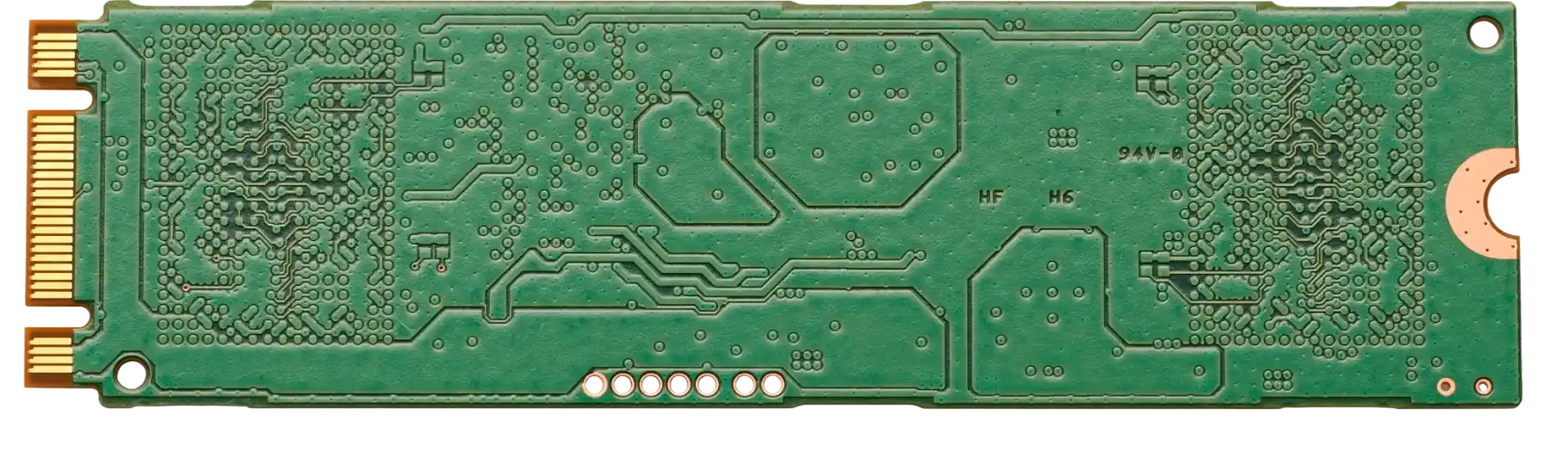
Once you determine that an emi mitigation layout is required, the specifications sent to the manufacturer must be explicit. Vague notes like "follow IPC standards" are insufficient for EMI-critical designs.
- Controlled Impedance: Specify target impedance (e.g., 50Ω single-ended, 90Ω/100Ω differential) with a tolerance of ±10% (standard) or ±5% (high-performance). This ensures signal energy is absorbed at the receiver rather than reflected back as noise.
- Stackup Symmetry: Define a balanced layer stackup to prevent warping, but more importantly, to ensure every signal layer has an adjacent continuous reference plane (Ground or Power).
- Dielectric Constant (Dk) Stability: Specify materials with stable Dk across the operating frequency. For high-speed designs, request low-loss materials (e.g., Panasonic Megtron or Rogers) rather than generic FR4.
- Copper Weight and Roughness: For high-frequency skin-effect considerations, specify Very Low Profile (VLP) or Hyper VLP copper foil to reduce insertion loss and radiated emissions.
- Via Plugging and Tenting: Require conductive or non-conductive via plugging for "stitching vias" (vias connecting ground planes). Open vias can resonate or trap chemicals; plugged vias ensure a solid ground return path.
- Solder Mask Thickness: Specify the solder mask thickness over traces, as this affects the final impedance. A variation of 10µm can shift impedance by 1-2 Ohms.
- Ground Pour Clearance: Define the minimum clearance between copper pours and signal traces (often >3x trace width) to prevent accidental coupling (crosstalk).
- Buried Capacitance: For extreme EMI reduction, specify thin core laminates (e.g., 2-4 mil) between power and ground layers to create inherent planar capacitance, filtering high-frequency noise.
- Edge Plating (Castellation): If the board requires Faraday cage-like shielding, specify edge plating to connect top and bottom ground planes along the board perimeter.
- Surface Finish: Choose finishes like ENIG (Electroless Nickel Immersion Gold) or Immersion Silver for their flat surface, which supports accurate impedance and high-frequency signal integrity better than HASL.
- Cleanliness Standards: Specify ionic contamination limits (e.g., <1.56 µg/cm² NaCl equivalent). Residues can create leakage paths that generate noise.
- Trace Width Tolerance: Tighter etching tolerances (±10% or ±0.5 mil) are necessary to maintain the calculated impedance profile.
emi mitigation layout manufacturing risks (root causes and prevention)
Even with a perfect specification, the manufacturing process introduces variables that can degrade the performance of an emi mitigation layout. Identifying these risks early allows for proactive prevention.
- Risk: Impedance Mismatch due to Etch Variation.
- Root Cause: Over-etching or under-etching of copper traces changes the trace width and height (trapezoidal effect).
- Detection: Coupon testing via TDR (Time Domain Reflectometry).
- Prevention: Use Automatic Optical Inspection (AOI) after etching; adjust etch compensation factors based on copper weight.
- Risk: Reference Plane Discontinuities.
- Root Cause: Misregistration of layers during lamination causes vias to break through anti-pads or miss the ground plane entirely.
- Detection: X-ray inspection of the laminated stackup.
- Prevention: Use laser direct imaging (LDI) for tighter registration; increase anti-pad size in non-critical areas to allow tolerance.
- Risk: Unintended Antennas (Stubs).
- Root Cause: Back-drilling depth errors leave a conductive "stub" in a via, which acts as an antenna at high frequencies.
- Detection: Cross-section analysis (microsectioning).
- Prevention: Controlled depth drilling with electrical sensing; specify maximum stub length (e.g., <10 mils).
- Risk: Inconsistent Dielectric Thickness.
- Root Cause: Poor lamination pressure or resin starvation leads to varying distance between signal and ground.
- Detection: Microsectioning; Impedance testing variance.
- Prevention: Use "dummy copper" (thieving) to equalize pressure distribution; select prepreg glass styles with high resin content.
- Risk: Shielding Can Solder Voids.
- Root Cause: Poor stencil design or reflow profile prevents shielding cans from grounding fully to the PCB.
- Detection: X-ray inspection of solder joints.
- Prevention: Segmented stencil apertures for large ground pads; optimize reflow profile for thermal mass of shields.
- Risk: Material Substitution.
- Root Cause: Supplier swaps specified low-Dk material for a generic "equivalent" without authorization.
- Detection: Dk measurement or board failure in EMC lab.
- Prevention: Require Certificate of Conformance (CoC) for laminates; forbid substitutions in the purchase order.
- Risk: PIM (Passive Intermodulation).
- Root Cause: Rough copper interface or nickel in the surface finish (for RF applications) generates noise.
- Detection: PIM testing.
- Prevention: Use Reverse Treated Foil (RTF) or VLP copper; use Immersion Silver or OSP instead of ENIG for PIM-sensitive lines.
- Risk: Return Path Breaks.
- Root Cause: Slots or splits in the ground plane created during data processing (CAM) to fix other DFM issues.
- Detection: CAM engineering review (Netlist comparison).
- Prevention: Strict instruction "Do not modify ground planes without approval."
emi mitigation layout validation and acceptance (tests and pass criteria)
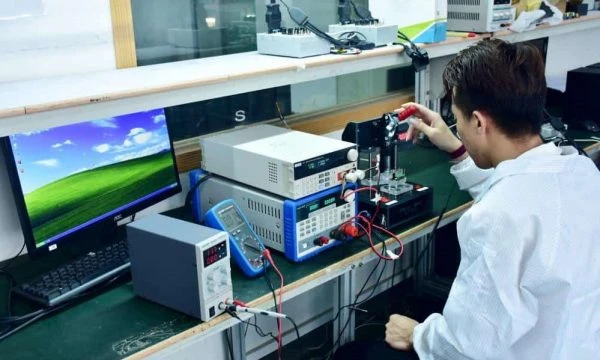
To ensure the delivered PCBs meet the emi mitigation layout requirements, a robust validation plan is essential. This moves beyond visual inspection into electrical verification.
- TDR Impedance Testing:
- Objective: Verify trace impedance matches design.
- Method: Time Domain Reflectometry on test coupons or actual boards.
- Acceptance Criteria: All controlled traces within specified tolerance (e.g., 50Ω ±5%). Report required.
- Stackup Verification (Microsection):
- Objective: Confirm layer thickness and material build.
- Method: Cross-sectioning a sample board.
- Acceptance Criteria: Dielectric thicknesses within ±10%; copper weights match spec; no delamination.
- Ionic Contamination Test:
- Objective: Ensure board cleanliness to prevent leakage/noise.
- Method: ROSE test or Ion Chromatography.
- Acceptance Criteria: <1.56 µg/cm² NaCl equivalent (or stricter for high-impedance circuits).
- Solderability Test:
- Objective: Ensure shielding cans and components will bond solidly to ground.
- Method: IPC-J-STD-003 dip and look.
- Acceptance Criteria: >95% wetting coverage.
- Interconnect Stress Test (IST):
- Objective: Verify reliability of stitching vias and ground connections under thermal cycling.
- Method: Thermal cycling coupons.
- Acceptance Criteria: Resistance change <10% after 500 cycles.
- High-Pot (Dielectric Withstand) Test:
- Objective: Ensure isolation between noisy high-voltage sections and sensitive low-voltage sections.
- Method: Apply high voltage between nets.
- Acceptance Criteria: No breakdown or leakage current >1mA.
- Dimensional Stability:
- Objective: Ensure registration of layers for tight coupling.
- Method: CMM (Coordinate Measuring Machine).
- Acceptance Criteria: Registration accuracy within ±3 mils.
- Signal Integrity (S-Parameter) Check:
- Objective: For very high frequencies, verify insertion loss.
- Method: VNA (Vector Network Analyzer) on test structures.
- Acceptance Criteria: Loss profile matches material datasheet curves.
emi mitigation layout supplier qualification checklist (impedance control capabilities, and how to structure Request for Quote (RFQ), audit, traceability)
When selecting a partner for emi mitigation layout production, use this checklist to vet their capabilities. A supplier must demonstrate more than just basic etching skills; they need process control.
RFQ Inputs (What you send)
- Gerber/ODB++ Files: Complete dataset including drill files and board outline.
- IPC Netlist: Mandatory for verifying that the CAM department hasn't broken a ground return path.
- Stackup Drawing: Explicitly defining material types (brand/series), thicknesses, and copper weights.
- Impedance Table: Listing layer, trace width, spacing, and target impedance for every controlled line.
- Drill Chart: Distinguishing between plated (ground vias) and non-plated holes.
- Fabrication Notes: Citing specific IPC class (usually Class 2 or 3) and cleanliness specs.
- Panelization: If you need specific spacing for shielding cans or testing fixtures.
- EMI Critical Areas: Highlighted regions where no rework or trace trimming is allowed.
Capability Proof (What they provide)
- Impedance Modeling Report: Pre-production simulation showing their proposed stackup meets your targets.
- Material Stock List: Confirmation they stock the specific low-Dk/low-Df materials requested.
- Equipment List: Verification of LDI (Laser Direct Imaging) and Vacuum Lamination capabilities.
- Via Plugging Capability: Proof of VIPPO (Via-in-Pad Plated Over) or conductive epoxy filling experience.
- Back-drill Tolerance: Data showing their ability to control stub depth (e.g., ±5 mil).
- Surface Finish Control: XRF data showing thickness control of ENIG/Silver.
Quality System & Traceability
- TDR Equipment: Do they have calibrated TDR machines (e.g., Polar CITS)?
- AOI Resolution: Can their AOI detect "mouse bites" or minor etching defects on fine traces?
- X-Ray Inspection: Used for verifying layer registration and BGA/QFN grounding.
- Certifications: ISO 9001 is minimum; IATF 16949 is preferred for strict process control.
- Coupon Retention: Do they keep test coupons for 1+ years for traceability?
- Calibration Records: Are their measurement tools calibrated by a third party?
Change Control & Delivery
- PCN Policy: Do they agree to zero unapproved changes to materials or chemistry?
- Sub-tier Management: Do they control where they buy the laminate?
- Packaging: ESD safe packaging with desiccant and humidity indicator cards.
- DFM Feedback: Do they provide a detailed DFM report highlighting EMI risks before building?
How to choose emi mitigation layout (trade-offs and decision rules)
Engineering is the art of compromise. When implementing an emi mitigation layout, you will face trade-offs between performance, density, and cost.
- 4-Layer vs. 6-Layer Stackup:
- Decision Rule: If you have high-speed signals (>100MHz) and need to pass strict EMC, choose 6-layer.
- Why: A 4-layer board often forces a compromise between power planes and signal reference. A 6-layer board allows for dedicated ground planes shielding the inner signal layers, drastically reducing radiation.
- Stitching Vias vs. Drill Cost:
- Decision Rule: If the frequency is >1GHz, prioritize stitching vias (fences) despite the cost.
- Why: The cost of extra drill hits is negligible compared to the cost of failing certification due to edge radiation. For lower frequencies, standard ground pours may suffice.
- Blind/Buried Vias vs. Through-Hole Vias:
- Decision Rule: If board space is tight and EMI is critical, choose blind/buried vias.
- Why: They eliminate via stubs naturally (improving signal integrity) and free up routing space on other layers, but they increase board cost by 30-50%.
- Shielding Cans vs. Board Space:
- Decision Rule: If you have a noisy switching regulator or a sensitive RF receiver, choose shielding cans.
- Why: Layout alone cannot stop near-field coupling as effectively as a metal cage. You must trade off PCB real estate for the clips/pads.
- Standard FR4 vs. High-Speed Material:
- Decision Rule: If the trace length is long (>10 inches) and speed is high (>5Gbps), choose High-Speed Material.
- Why: Standard FR4 has higher dielectric loss which attenuates the signal and can cause dispersion (EMI). For short traces, standard FR4 might still work.
emi mitigation layout FAQ (cost, lead time, Design for Manufacturability (DFM) files, materials, testing)
How much does impedance control add to the PCB cost? Typically, impedance control adds 5-10% to the bare board cost. This covers the extra TDR coupons, testing labor, and the reduced manufacturing yield buffer required to hit strict tolerances.
What is the lead time impact for using specialized EMI materials? Standard FR4 is always in stock. Specialized EMI materials (like Rogers, Taconic, or Megtron) may have a lead time of 2-4 weeks if not stocked by the fab. APTPCB stocks common high-frequency laminates to mitigate this.
What DFM files are critical for emi mitigation layout review? Beyond Gerbers, you must provide an ODB++ or IPC-2581 file. These intelligent formats contain netlist info, allowing the CAM engineer to see which vias are ground (stitching) and which are signal, preventing accidental deletion of "redundant" ground vias.
Can you test for EMI compliance at the bare board level? Not directly. EMI compliance (radiated emissions) requires the assembled, active device. However, we validate the contributors to EMI: impedance, stackup height, and shield connection integrity.
What are the acceptance criteria for stitching vias? Stitching vias must be fully plated and, if specified, plugged. Acceptance criteria include visual verification of the plug and electrical continuity checks to the ground plane. Missing stitching vias can create "slot antennas."
How does surface finish affect emi mitigation layout? Rough finishes like HASL can alter the impedance of fine traces and create uneven surfaces for shielding cans. ENIG or Immersion Silver are preferred for their flatness and conductivity, ensuring a tight EMI seal.
Why is "copper balance" important for EMI? Unbalanced copper causes board warpage. A warped board may not sit flush against the chassis or shielding enclosure, creating gaps (apertures) where RF energy can leak out.
Do I need to back-drill every via for EMI? No. Only high-speed signal vias where the "stub" length exceeds a critical fraction of the signal wavelength need back-drilling. Unnecessary back-drilling weakens the board and adds cost.
Resources for emi mitigation layout (related pages and tools)
- PCB Stack-up Design: Learn how to configure layers to ensure every signal has a clean return path, the foundation of EMI control.
- Impedance Calculator: A tool to estimate trace width and spacing requirements before finalizing your layout.
- High Speed PCB Manufacturing: Details on manufacturing capabilities specifically for digital signals that require strict noise management.
- DFM Guidelines: Comprehensive rules to ensure your EMI-focused design is actually manufacturable at scale.
- Rogers PCB Materials: Information on high-performance laminates that offer stable dielectric constants for critical RF and high-speed layers.
- Rigid-Flex PCB: Solutions for complex geometries where eliminating cables (a major source of EMI) improves overall system performance.
Request a quote for emi mitigation layout (Design for Manufacturability (DFM) review + pricing)
Ready to validate your design? Request a Quote from APTPCB to get a comprehensive DFM review focused on signal integrity and manufacturability.
For the most accurate assessment, please include:
- Gerber RS-274X or ODB++ files.
- Layer Stackup: Including material types and dielectric thicknesses.
- Impedance Requirements: A clear table of target values and layers.
- Volume: Prototype quantity vs. expected mass production volume.
- Special Requirements: Note any specific testing (TDR, IST) or cleanliness specs.
Conclusion (next steps)
Achieving first-pass EMC success requires more than just following design rules; it demands a manufacturing partner who respects the physics of your layout. An effective emi mitigation layout relies on precise stackups, controlled impedance, and disciplined material management. By defining clear specifications, understanding the manufacturing risks, and enforcing a strict validation checklist, you can transition from a sensitive prototype to a robust, compliant product. Secure your supply chain by selecting a fabricator that treats EMI mitigation as a critical quality metric, not just an afterthought.