
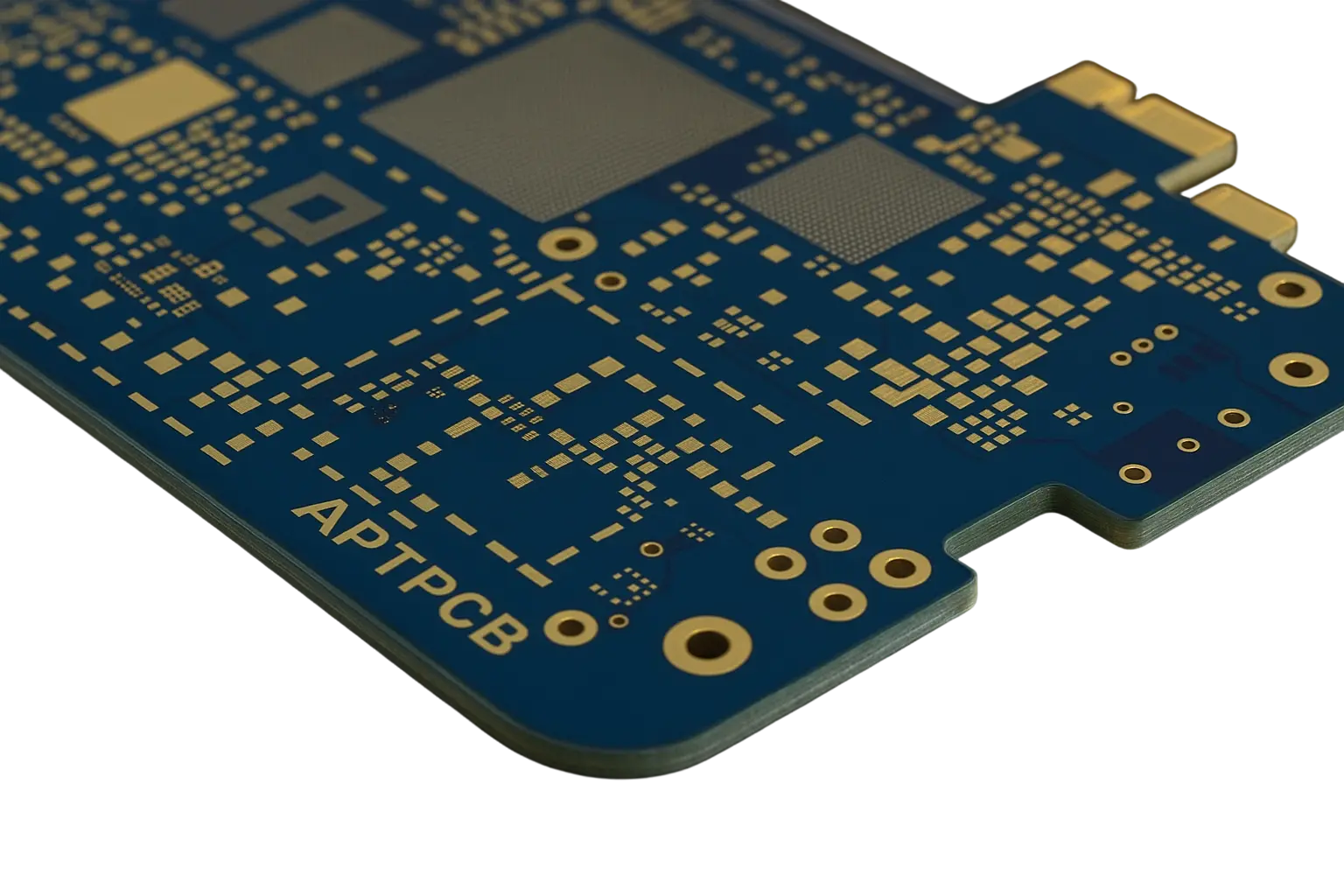
The growth of AI accelerators, HPC processors, and heterogeneous chiplet architectures has made EMIB interconnect board impedance control a critical engineering decision.
EMIB (Embedded Multi-die Interconnect Bridge) uses a silicon bridge embedded inside an organic package substrate to create high-density die-to-die communication paths. Unlike conventional PCB impedance control, EMIB-class designs must manage the complete electrical channel, including bridge routing, micro-bump transitions, build-up dielectric layers, copper geometry, and manufacturing variation.
A successful EMIB design requires coordination between package architects, signal-integrity engineers, substrate manufacturers, and assembly partners.
Key decisions for EMIB impedance control
- Define impedance requirements together with interface specifications, not after layout completion.
- Control the complete transmission path from die connection through bridge and substrate routing.
- Select low-loss dielectric materials based on frequency behavior, not only nominal dielectric constant.
- Validate with representative structures that match the final package geometry.
- Qualify suppliers using measurable process capability, not only manufacturing claims.
What is EMIB interconnect board impedance control?
EMIB interconnect board impedance control maintains predictable electrical behavior across high-speed package interconnect structures.
Traditional PCB impedance design usually focuses on trace width, spacing, dielectric thickness, and reference planes. EMIB introduces additional complexity because signals pass through multiple electrical environments:
- Silicon bridge routing layers.
- Micro-bump connection structures.
- Organic substrate build-up layers.
- High-density substrate routing.
Each transition can introduce discontinuities that increase reflection, insertion loss, jitter, or timing uncertainty.
EMIB technology enables localized high-density connections between dies without requiring a full silicon interposer, making it suitable for advanced heterogeneous integration.
Which EMIB impedance parameters should engineers specify?
| Parameter | Engineering impact | Typical control method |
|---|---|---|
| Characteristic impedance | Controls signal matching and reflection behavior | TDR measurement and simulation correlation |
| Differential impedance | Important for high-speed serial links | Controlled trace geometry and dielectric control |
| Insertion loss | Determines high-frequency attenuation | VNA S-parameter analysis |
| Return loss | Indicates discontinuities | Channel simulation and measurement |
| Skew | Affects timing margin | Length matching and structure optimization |
| Dielectric constant (Dk) | Influences propagation velocity | Material characterization |
| Dissipation factor (Df) | Influences signal loss | Low-loss material selection |
| Copper roughness | Affects conductor loss at high frequency | Copper profile evaluation |
Many advanced designs use differential impedance targets such as 85Ω or 100Ω depending on the interface requirements. Final values must be defined by the system architecture and signal budget.
How should engineers choose an EMIB substrate material?
Material selection directly affects signal integrity, reliability, and manufacturing yield.
Important material characteristics include:
- stable dielectric properties over frequency.
- low dielectric loss.
- controlled moisture absorption.
- thermal compatibility with silicon and organic substrate materials.
- compatibility with fine-line manufacturing.
Common material considerations include:
| Material family | Strength | Main consideration |
|---|---|---|
| ABF build-up materials | High-density IC substrate manufacturing | Requires advanced processing capability |
| Low-loss laminate systems | Improved electrical performance | Cost and availability trade-offs |
| High-performance RF materials | Reduced attenuation | May require specialized fabrication processes |
ABF-based substrate technologies are widely used in advanced packaging because they support fine-line routing and high-density interconnect structures.
What stackup decisions affect EMIB impedance performance?
A reliable EMIB stackup should define:
- dielectric thickness for every critical layer.
- copper thickness and surface profile.
- reference-plane continuity.
- microvia structure.
- trace width and spacing after manufacturing compensation.
A stackup review should include:
| Design factor | Why it matters | Verification |
|---|---|---|
| Dielectric thickness variation | Changes impedance | Cross-section measurement |
| Etching variation | Changes trace geometry | Process capability data |
| Layer registration | Affects fine-pitch routing | Alignment inspection |
| Copper roughness | Increases loss | Material/process records |
| Via parasitics | Creates discontinuities | 3D electromagnetic simulation |
Which EMIB impedance strategy fits different applications?
| Application | Priority | Recommended approach | Main risk |
|---|---|---|---|
| HPC / AI accelerator | Maximum bandwidth | Low-loss materials, strict impedance control | Higher manufacturing cost |
| Consumer chiplet systems | Compact integration | Optimized thin build-up layers | Increased sensitivity |
| Automotive computing | Reliability | Stable materials and thermal validation | Temperature drift |
| 5G infrastructure | Low attenuation | High-frequency material selection | Long-channel loss |
| Prototype development | Fast learning | Flexible supplier validation | Limited optimization |
| Mass production | Yield stability | Process-controlled stackup | Panel variation |
How should EMIB impedance validation be performed?
Validation should represent the actual electrical structure.
A complete workflow includes:
1. Simulation before fabrication
Analyze:
- bridge transitions.
- bump structures.
- via effects.
- differential routing behavior.
- expected loss budget.
2. Controlled manufacturing
Monitor:
- dielectric thickness.
- copper plating.
- trace geometry.
- microvia formation.
- layer alignment.
3. Electrical measurement
Typical validation methods include:
- TDR impedance testing.
- VNA S-parameter measurement.
- eye-diagram evaluation.
- insertion-loss analysis.
EMIB signal and power integrity studies show that substrate structure, insertion loss, and PDN behavior are important design considerations for high-bandwidth applications.
What supplier capabilities matter for EMIB manufacturing?
A qualified supplier should demonstrate:
Stackup engineering capability
Require:
- impedance simulation capability.
- material characterization support.
- documented stackup control.
- engineering change management.
High-density fabrication capability
Evaluate:
- laser microvia processes.
- fine-line routing capability.
- registration accuracy.
- advanced substrate manufacturing experience.
Validation capability
Request:
- TDR reports.
- measurement coupons.
- cross-section analysis.
- process capability records.
What are common EMIB impedance failure modes?
| Failure mode | Root cause | Engineering response |
|---|---|---|
| Impedance mismatch at bridge transition | Transition parasitics not modeled | Perform 3D electromagnetic analysis |
| Excess insertion loss | High-loss dielectric or rough copper | Optimize materials and copper profile |
| Differential skew | Routing imbalance | Control geometry and length matching |
| Coupon passes but product fails | Coupon does not represent structure | Create application-specific coupons |
| Production variation | Weak process control | Apply statistical monitoring |
EMIB impedance control implementation checklist
- Define impedance targets for every critical interface.
- Select substrate materials based on electrical and thermal requirements.
- Lock stackup details before routing.
- Model bridge and microvia transitions.
- Maintain continuous reference structures.
- Validate representative coupons.
- Compare simulation results with measured data.
- Approve supplier process capability before production release.
What mistakes should engineers avoid in EMIB design decisions?
Treating EMIB like a conventional PCB
The electrical path includes semiconductor packaging structures. Trace impedance alone does not define channel performance.
Using generic material parameters
Frequency-dependent dielectric behavior must be considered because package channels operate at high data rates.
Ignoring copper surface effects
Copper roughness influences conductor loss, especially as frequency increases.
Selecting unsuitable validation coupons
Coupons should reproduce:
- layer structure.
- dielectric environment.
- routing geometry.
- manufacturing process conditions.
EMIB interconnect board impedance control FAQ
Q: What impedance targets are commonly used for EMIB-related high-speed links?
A: Differential targets such as 85Ω or 100Ω are common depending on interface requirements. The final specification depends on the system architecture.
Q: Can standard FR4 be used for EMIB applications?
A: Advanced package substrates normally require specialized build-up materials with controlled electrical properties.
Q: How is buried impedance validated?
A: Manufacturers use representative coupons, TDR measurements, and correlation against simulation models.
Q: Why is copper roughness important?
A: Surface profile affects high-frequency conductor loss and therefore channel performance.
Q: Why are microvias important?
A: High-density package routing requires structures with lower parasitic effects than conventional through-hole vias.
Resources for EMIB interconnect board impedance control
- High Speed PCB Manufacturing: Explore capabilities for manufacturing boards that support high data rates.
- Impedance Calculator: A tool to estimate trace width and spacing for your target impedance.
- HDI PCB Technology: Learn about the microvia and fine-line technologies essential for EMIB substrates.
- PCB Stackup Design: Guidelines for arranging layers to achieve optimal signal integrity.
EMIB interconnect board impedance control glossary
| Term | Definition |
|---|---|
| EMIB | Embedded Multi-die Interconnect Bridge technology using a silicon bridge inside a package substrate. |
| Impedance | Electrical opposition to signal propagation. |
| TDR | Time Domain Reflectometry measurement method. |
| Microvia | Laser-drilled HDI connection between layers. |
| ABF | Build-up film used for advanced IC substrates. |
| CTE | Coefficient of thermal expansion. |
| Insertion Loss | Signal energy reduction through a channel. |
| Return Loss | Energy reflected from discontinuities. |
Conclusion: Selecting an EMIB impedance control partner
EMIB interconnect board impedance control requires coordinated decisions across electrical design, materials, fabrication, and validation.
A capable manufacturing partner should provide:
- High-density substrate manufacturing experience.
- Low-loss material knowledge.
- Controlled impedance measurement capability.
- Transparent process documentation.
- Engineering support during design release.
Prepare these inputs before supplier evaluation:
- Gerber Files (RS-274X) or ODB++ data.
- Stackup requirements.
- Target impedance values.
- Netlist information.
- Signal-integrity requirements.