
Advanced packaging technologies are reshaping the landscape of high-performance computing, and at the center of this evolution is the embedded bridge. As chip designs move toward heterogeneous integration, EMIB interconnect board validation has become a critical step in ensuring reliability and yield. Unlike traditional monolithic dies, systems using Embedded Multi-die Interconnect Bridges (EMIB) require a specialized approach to substrate manufacturing and testing.
For engineers and procurement managers, understanding how to validate these complex interconnects is essential. This guide covers the entire spectrum of the process, from initial design parameters to final production checks. Whether you are developing next-generation AI accelerators or high-speed networking gear, APTPCB (APTPCB PCB Factory) provides the expertise needed to navigate these complexities.
Key Takeaways
- Definition: EMIB interconnect board validation confirms the electrical and mechanical integrity of the silicon bridge embedded within the organic substrate.
- Critical Metric: Warpage control is the single most important factor; excessive warpage leads to bridge cracking or open joints.
- Design Focus: Proper cavity sizing and tolerance management are vital for successful bridge embedding.
- Misconception: Many assume standard PCB test methods apply, but EMIB requires much tighter pitch testing and micro-bump validation.
- Best Practice: Early simulation of Coefficient of Thermal Expansion (CTE) mismatch prevents failures during reflow.
- Validation Scope: The process includes verifying the substrate layers, the bridge placement accuracy, and the final assembly connectivity.
- Partnership: Working with a capable manufacturer like APTPCB ensures that DFM guidelines are respected from day one.
What “traditional monolithic dies, systems using Embedded Multi-die Interconnect Bridges (EMIB) validation” means (scope & boundaries)
Building on the key takeaways, it is important to define exactly what we are validating. EMIB interconnect board validation is not just about testing a bare printed circuit board. It is a multi-layered assurance process that verifies the organic package substrate, the embedded silicon bridge, and the interface between them.
In a standard PCB, validation might stop at electrical continuity and impedance testing. However, an EMIB interconnect board serves as a high-density conduit between heterogeneous dies (like a CPU and HBM memory). The validation scope expands to include the physical dimensions of the cavity where the bridge sits, the flatness of the build-up layers, and the alignment accuracy of the micro-vias.
The boundary of this validation extends from the raw material selection to the final assembly readiness. It involves checking the dielectric materials for stability under heat and ensuring that the copper plating within the bridge interconnects meets strict resistance specifications. If the validation process fails to catch a micron-level misalignment, the entire multi-die system can fail. Therefore, this process is the gatekeeper between a theoretical design and a functional high-performance product.
Metrics that matter (how to evaluate quality)
Understanding the scope of validation leads us directly to the specific data points that define success. To perform effective EMIB interconnect board validation, you must track specific metrics that quantify the board's physical and electrical health.
| Metric | Why it matters | Typical range or influencing factors | How to measure |
|---|---|---|---|
| Substrate Warpage | High warpage prevents proper die attachment and causes bridge stress. | < 50 µm (room temp) to < 100 µm (reflow temp). Depends on core thickness. | Shadow Moiré Interferometry. |
| Cavity Dimension Tolerance | The bridge must fit perfectly; too loose causes shift, too tight causes stress. | ± 5 µm to ± 10 µm depending on bridge size. | Optical Coordinate Measuring Machine (CMM). |
| Dielectric Thickness Uniformity | Ensures consistent impedance and signal integrity across the bridge. | Variation < 5% across the build-up layers. | Cross-section analysis (SEM). |
| Micro-via Alignment | Misaligned vias lead to open circuits or high resistance in the interconnect. | < 5 µm registration accuracy. | X-Ray inspection or AOI (Automated Optical Inspection). |
| Insertion Loss | Measures signal degradation through the bridge interconnects. | < -2 dB @ 28 GHz (varies by trace length/material). | Vector Network Analyzer (VNA). |
| Die Shear Strength | Verifies the mechanical bond of the bridge to the substrate. | > 1 kgf (depends on die size and adhesive). | Shear tester. |
| Surface Roughness (Ra) | Affects fine-line adhesion and signal loss at high frequencies. | < 0.3 µm for high-speed lines. | Atomic Force Microscopy (AFM). |
| CTE Mismatch | Large differences cause delamination during thermal cycling. | Target < 3 ppm/°C difference between adjacent materials. | TMA (Thermomechanical Analysis). |
Selection guidance by scenario (trade-offs)
Once you have established the metrics, the next step is choosing the right validation strategy and board architecture for your specific application. Different industries prioritize different aspects of EMIB interconnect board design and validation.
Scenario 1: High-Performance Computing (HPC) & AI
- Priority: Maximum bandwidth and low latency.
- Trade-off: You will sacrifice cost for ultra-low loss materials and extremely tight pitch validation.
- Validation Focus: Signal integrity (insertion loss) and thermal management are paramount. Extensive testing on high-speed differential pairs is required.
Scenario 2: Mobile and Consumer Electronics
- Priority: Form factor (Z-height) and battery life.
- Trade-off: Thinner substrates are more prone to warpage.
- Validation Focus: Mechanical reliability and drop testing. Warpage control during the thinning process is the critical validation step here.
Scenario 3: Automotive ADAS Systems
- Priority: Long-term reliability and harsh environment survival.
- Trade-off: Conservative design rules are used over cutting-edge density to ensure durability.
- Validation Focus: Thermal cycling (-40°C to 125°C) and vibration testing. The validation must prove the interconnects won't crack after years of road use.
Scenario 4: 5G Infrastructure
- Priority: Signal integrity at mmWave frequencies.
- Trade-off: Requires specialized low-Dk/Df materials which are harder to process.
- Validation Focus: Impedance control and passive intermodulation (PIM) testing. Validating the material properties of the substrate is as important as the circuit itself.
Scenario 5: Prototyping and R&D
- Priority: Speed of iteration.
- Trade-off: Lower yield acceptance to get functional units faster.
- Validation Focus: Basic continuity and short testing. Advanced reliability testing is often skipped to save time, focusing only on "does it turn on?"
Scenario 6: Mass Production
- Priority: Yield and cost-efficiency.
- Trade-off: Design rules are relaxed slightly to maximize manufacturing windows.
- Validation Focus: Statistical Process Control (SPC). The goal is to validate that the process is stable, rather than testing every single parameter on every board to the extreme.
From design to manufacturing (implementation checkpoints)
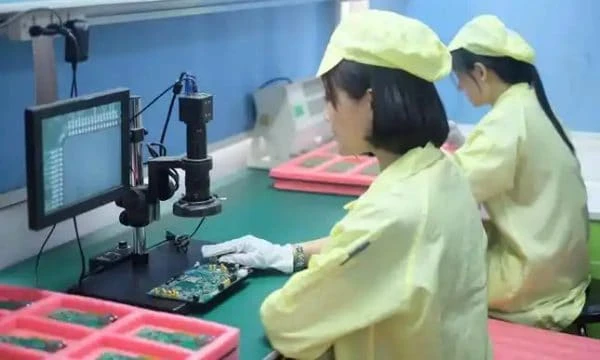
Selecting the right scenario informs the manufacturing flow, but execution requires a rigorous checklist. The following checkpoints guide you from the initial EMIB interconnect board design through to the final product, ensuring every stage is validated.
1. Material Selection & Stackup Definition
- Recommendation: Choose materials with CTE values closely matched to silicon. Use high-frequency materials if signal speed is critical.
- Risk: Wrong material choice leads to immediate warpage issues.
- Acceptance: Simulation results showing manageable stress levels.
2. Cavity Formation
- Recommendation: Use high-precision laser ablation or depth-controlled routing.
- Risk: Irregular cavity depth causes the bridge to sit tilted, ruining connectivity.
- Acceptance: 3D profilometry scan of the cavity floor.
3. Bridge Placement & Embedding
- Recommendation: Utilize high-accuracy pick-and-place machines with active alignment.
- Risk: Positional shift > 5µm can result in misalignment with the build-up layers.
- Acceptance: X-ray verification of bridge position relative to fiducials.
4. Lamination of Build-up Layers
- Recommendation: Apply vacuum lamination with optimized pressure profiles to fill gaps around the bridge.
- Risk: Voids or air entrapment around the bridge lead to "popcorning" during reflow.
- Acceptance: C-SAM (Scanning Acoustic Microscopy) to detect delamination or voids.
5. Laser Drilling (Micro-vias)
- Recommendation: Use UV lasers for precise ablation of dielectric over the bridge pads.
- Risk: Drilling through the bridge pad or failing to expose it completely.
- Acceptance: Cross-section analysis of test coupons.
6. Desmear and Plating
- Recommendation: Gentle chemical desmear followed by semi-additive process (SAP) plating.
- Risk: Aggressive chemistry can damage the silicon bridge surface.
- Acceptance: Adhesion tape test and copper thickness measurement.
7. Surface Finish Application
- Recommendation: ENEPIG is often preferred for wire bonding and soldering versatility.
- Risk: Black pad syndrome or poor wetting if the finish is contaminated.
- Acceptance: Solderability test and visual inspection.
8. Electrical Testing (E-Test)
- Recommendation: Use flying probe testers capable of hitting fine-pitch pads.
- Risk: Standard bed-of-nails fixtures may damage the delicate substrate.
- Acceptance: 100% net list verification (opens/shorts).
9. Final Warpage Inspection
- Recommendation: Measure warpage at room temperature and simulated reflow temperature.
- Risk: Board passes at room temp but curls during assembly, causing yield loss.
- Acceptance: Pass/Fail based on JEDEC standards.
10. Packaging and Shipping
- Recommendation: Vacuum seal with desiccant to prevent moisture absorption.
- Risk: Moisture absorption leads to delamination during the customer's assembly process.
- Acceptance: Humidity Indicator Card (HIC) check.
Common mistakes (and the correct approach)
Even with a checklist, errors can occur if the underlying principles of EMIB interconnect board best practices are ignored. Here are the most frequent pitfalls and how to avoid them.
Mistake 1: Ignoring Localized CTE Mismatch
- The Error: Designers focus on the global CTE of the board but ignore the local mismatch between the silicon bridge and the surrounding organic material.
- The Consequence: Micro-cracks develop at the bridge interface after thermal cycling.
- Correct Approach: Perform localized stress modeling and use underfill or stress-buffer layers around the bridge.
Mistake 2: Inadequate Cavity Tolerance
- The Error: Specifying standard mechanical routing tolerances (±100µm) for the bridge cavity.
- The Consequence: The bridge floats or tilts, making it impossible to align the subsequent via layers.
- Correct Approach: Use laser-assisted cavity formation or depth-controlled routing with tolerances tighter than ±10µm.
Mistake 3: Overlooking Test Pad Accessibility
- The Error: Designing high-density interconnects without leaving room for test probes.
- The Consequence: You cannot perform EMIB interconnect board validation electrically because probes cannot land without shorting.
- Correct Approach: Design specific test coupons on the panel rails or include sacrificial test pads that are removed or covered later.
Mistake 4: Using Standard FR4 for High-Speed Bridges
- The Error: Using standard lossy materials to save cost while using an expensive EMIB bridge.
- The Consequence: The bridge works, but the signal degrades immediately upon entering the substrate traces.
- Correct Approach: Use low-loss materials like Isola PCB or similar high-speed laminates for the build-up layers.
Mistake 5: Neglecting Moisture Sensitivity
- The Error: Treating the finished substrate like a standard rigid PCB regarding storage.
- The Consequence: Moisture trapped in the organic layers turns to steam during reflow, exploding the package (popcorning).
- Correct Approach: Strictly follow MSL (Moisture Sensitivity Level) handling guidelines and bake boards before assembly.
Mistake 6: Poor Communication with the Fab
- The Error: Sending Gerber files without a detailed stack-up or impedance requirement document.
- The Consequence: The factory uses standard processes that are incompatible with embedded die requirements.
- Correct Approach: Engage in a DFM review with APTPCB early in the design phase.
FAQ
Q1: How does EMIB interconnect board validation differ from standard PCB testing? A: Standard PCB testing focuses on connectivity and basic impedance. EMIB validation adds strict checks for cavity depth, bridge alignment, localized warpage, and micro-via registration accuracy that are orders of magnitude tighter than standard PCBs.
Q2: What is the biggest challenge in manufacturing EMIB substrates? A: Warpage control. Because you are mixing silicon (rigid) with organic laminates (flexible) and subjecting them to heat, keeping the board flat enough for assembly is the primary challenge.
Q3: Can I use standard FR4 materials for EMIB designs? A: Generally, no. Standard FR4 has a high CTE and high signal loss. Specialized build-up films and core materials are required to match the performance and thermal characteristics of the silicon bridge.
Q4: What data do I need to provide for a quote? A: You need to provide the bridge dimensions, the full layer stack-up, material requirements, blind/buried via structures, and specific tolerance requirements for the cavity.
Q5: Is X-ray inspection mandatory for EMIB boards? A: Yes. Since the bridge is embedded and connections are often buried, X-ray or high-resolution acoustic microscopy is the only way to validate alignment and check for voids non-destructively.
Q6: How does APTPCB handle the supply chain for the silicon bridges? A: Typically, the customer supplies the silicon bridges or specifies the source. APTPCB focuses on the substrate manufacturing, cavity creation, and the embedding process.
Q7: What is the typical yield for these types of boards? A: Yields are lower than standard PCBs due to complexity. However, with proper EMIB interconnect board checklist implementation and DFM, high production yields are achievable.
Q8: Can a failed EMIB board be reworked? A: Rarely. Once the bridge is embedded and laminated over, it cannot be removed. This makes the validation of the bare board before embedding and the testing during the process crucial to avoid wasting expensive silicon.
Q9: What surface finishes are best for EMIB substrates? A: ENEPIG (Electroless Nickel Electroless Palladium Immersion Gold) is popular because it supports both soldering and wire bonding, which is often needed in complex packages.
Q10: How long does the validation process take? A: For a new design, validation (including cross-sections and reliability testing) can take 2-4 weeks on top of the standard fabrication time.
Related pages & tools
To further assist with your design and manufacturing needs, utilize these resources from APTPCB:
- Manufacturing Capabilities: Explore our full range of PCB manufacturing services to understand our capacity for complex builds.
- Design Guidelines: Review our DFM guidelines to ensure your EMIB design is production-ready.
- Material Options: Learn more about high-speed materials suitable for advanced packaging in our Megtron PCB section.
Glossary (key terms)
| Term | Definition |
|---|---|
| EMIB | Embedded Multi-die Interconnect Bridge. A technology that uses a small silicon bridge embedded in the substrate to connect dies. |
| Substrate | The organic board material (often ABF or specialized core) that holds the bridge and provides routing. |
| RDL | Redistribution Layer. Metal layers created on top of the die or bridge to route connections to a wider pitch. |
| TSV | Through-Silicon Via. A vertical electrical connection passing completely through a silicon wafer or die. |
| Microbump | Very small solder bumps used to connect the die to the bridge or substrate, typically < 50µm pitch. |
| C4 Bump | Controlled Collapse Chip Connection. Standard flip-chip bumps, larger than microbumps. |
| CTE | Coefficient of Thermal Expansion. A measure of how much a material expands when heated. Mismatch causes stress. |
| Underfill | An epoxy material injected between the die and substrate to distribute stress and protect bumps. |
| Warpage | The deviation from flatness of the substrate, critical for successful assembly. |
| Interposer | A large intermediate layer (silicon or organic) used to connect dies. EMIB is an alternative to large interposers. |
| SerDes | Serializer/Deserializer. High-speed functional blocks used in communications that require high-quality interconnects. |
| Heterogeneous Integration | The packaging of separately manufactured components (dies) into a higher-level assembly. |
| SAP | Semi-Additive Process. A method of forming fine-line traces by plating copper onto a thin seed layer. |
| ABF | Ajinomoto Build-up Film. A dominant insulation material used in high-end IC substrates. |
Conclusion (next steps)
EMIB interconnect board validation is the linchpin of modern heterogeneous packaging. It bridges the gap between semiconductor design and physical reality, ensuring that high-speed signals traverse the boundary between dies without loss or failure. By focusing on critical metrics like warpage, alignment, and material stability, you can mitigate the risks associated with these complex builds.
Success in this field requires more than just a design file; it requires a manufacturing partner who understands the intricacies of embedding silicon into organic substrates. When you are ready to move from concept to production, ensure you have your Gerbers, layer stack-up, and bridge specifications ready.
Contact APTPCB today to initiate a DFM review for your next advanced interconnect project. We are ready to help you validate and manufacture the future of electronics.