
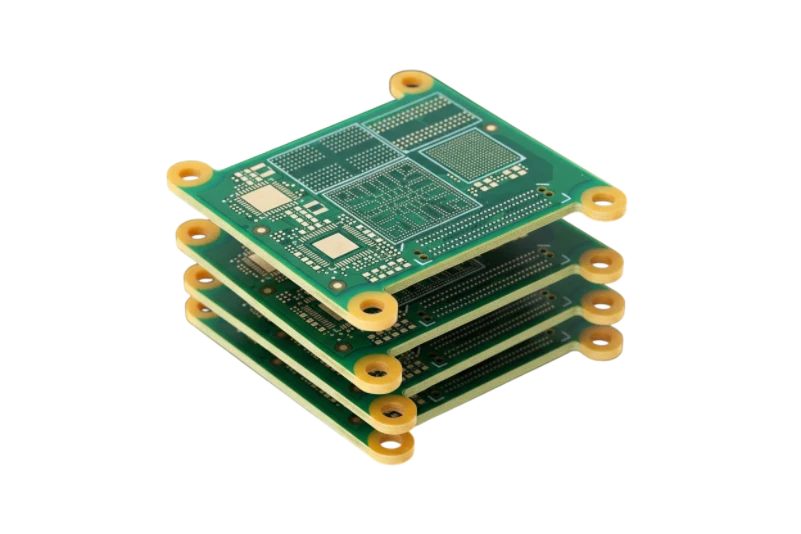
What should an encoder interface board checklist include?
An encoder interface board checklist defines the electrical, mechanical, manufacturing, and validation requirements needed to reliably transfer position feedback from an encoder to a controller, PLC, servo drive, or motion processor.
An encoder interface board is an active signal-conditioning assembly, not simply a connector adapter. It may perform:
- Differential signal reception for RS-422 encoder outputs
- Voltage conversion between encoder and controller logic levels
- Galvanic isolation between motor-side and control-side electronics
- EMI filtering and transient protection
- Signal buffering for long cable runs
- Protocol handling for absolute encoders such as SSI, BiSS, and EnDat
A complete checklist must verify the entire signal path:
- Encoder electrical compatibility
- Signal integrity under operating conditions
- PCB layout and impedance control
- Mechanical reliability
- Assembly quality
- Functional and environmental testing
How do you choose the right encoder interface board architecture?
The correct interface architecture depends on encoder type, cable length, noise environment, and control requirements.
| Application requirement | Recommended interface approach | Main checklist priorities |
|---|---|---|
| Short cable, low-speed incremental encoder | TTL or single-ended interface | Logic compatibility, protection, clean routing |
| Long cable industrial feedback | RS-422 differential interface | 120Ω termination, impedance control, shielding |
| High-noise motor environment | Isolated HTL or differential interface | Isolation voltage, EMC filtering, surge protection |
| High-precision servo system | Low-jitter differential design | Propagation delay, clock stability, controlled impedance |
| Absolute encoder system | SSI, BiSS, EnDat interface | Protocol timing, differential pairs, data integrity |
| Robotic joint with moving electronics | Rigid-Flex PCB solution | Flex durability, connector reduction, vibration resistance |
For industrial motion systems, the interface board must be matched to the encoder output type: Open Collector, Push-Pull, Line Driver, or serial communication.
Which encoder interface board parameters matter most?
A checklist should convert vague requirements such as “high reliability” into measurable specifications.
| Parameter | Why it matters | Typical target or influencing factor | Validation method |
|---|---|---|---|
| Bandwidth / Maximum Frequency | Determines whether encoder pulses can be captured without distortion | 100 kHz to 10 MHz depending on encoder resolution and RPM | Signal generator and oscilloscope |
| Propagation Delay | Affects servo loop timing and position accuracy | 50ns to 500ns depending on design | Dual-channel oscilloscope comparison |
| Common Mode Rejection | Determines immunity to industrial noise | >60 dB desirable in harsh environments | Noise injection testing |
| Rise/Fall Time | Controls edge detection accuracy | <50ns for TTL, <200ns for HTL applications | Oscilloscope measurement |
| Input Impedance | Prevents reflections on differential transmission lines | Typically 120Ω for RS-422/RS-485 systems | TDR or impedance testing |
| Isolation Voltage | Protects control electronics from machine-side faults | 1kV to 5kV RMS depending on application | Hi-Pot testing |
| Jitter | Creates velocity ripple and position errors | Less than 10% of pulse width | Eye diagram analysis |
What PCB design checklist items should be reviewed before fabrication?
Encoder boards require more attention than standard digital PCBs because small layout changes can affect timing and noise immunity.
Schematic checklist
Verify that the design includes:
- Termination resistors placed close to receiver inputs, typically 120Ω for RS-422 differential links.
- Pull-up and pull-down resistors on unused inputs to prevent floating states.
- Decoupling capacitors near encoder interface IC power pins, commonly combining 0.1µF and 10µF values.
- TVS protection devices on external connectors for ESD and transient protection.
- Correct voltage conversion between encoder output and controller input.
PCB layout checklist
Confirm:
- A/A-, B/B-, and index differential signals are routed as controlled differential pairs.
- Differential impedance targets are defined, commonly 100Ω or 120Ω depending on protocol.
- High-speed traces remain over continuous reference planes.
- Sensitive encoder signals are separated from switching regulators and motor-drive noise sources.
- Isolation barriers maintain appropriate creepage and clearance distances.
- Connectors minimize signal path length.
For high-performance motion systems, controlled impedance and stable reference planes are essential because reflections and crosstalk can create false encoder counts.
What encoder interface board selection trade-offs should engineers evaluate?
Industrial motors and VFD environments
Prioritize:
- Galvanic isolation
- HTL compatibility
- Surge protection
- Shielding strategy
Isolation improves noise immunity but introduces propagation delay. The design must balance protection and timing performance.
Semiconductor and precision positioning equipment
Prioritize:
- Low jitter
- High bandwidth
- Differential signaling
- Stable PCB materials
These systems often require controlled impedance stackups and tighter manufacturing tolerances.
Long cable installations
Prioritize:
- RS-422 differential transmission
- Correct termination
- Shielding and grounding
Cable capacitance increases with length and can slow signal edges, reducing timing margin.
Robotics and moving assemblies
Prioritize:
- Compact mechanical design
- Connector reliability
- Flex durability
Rigid-Flex PCB technology can reduce connector failures in moving joints. See our Rigid-Flex PCB capabilities for more details.
What are the most common encoder interface board failure modes?
| Failure mode | Root cause | Detection method | Design response |
|---|---|---|---|
| False encoder counts | Noise coupling or poor termination | Oscilloscope waveform analysis | Differential routing, filtering, proper termination |
| Slow signal edges | Excessive cable capacitance | Rise/fall time measurement | Add hysteresis receivers or stronger drivers |
| Controller damage | Incorrect voltage conversion | Electrical review | Use dedicated level translators or isolation |
| Intermittent position errors | Grounding or shielding problems | EMI testing | Define cable shield strategy |
| Power rail instability | Encoder current spikes | Rail noise measurement | Improve filtering and power protection |
| Thermal failure | Inefficient voltage regulation | Thermal testing | Use efficient DC-DC conversion |
| Connector failure | Vibration stress | Mechanical testing | Add strain relief and robust connectors |
How should an encoder interface board supplier be qualified?
A supplier checklist should evaluate both PCB manufacturing capability and assembly quality.
Required RFQ documentation
Provide:
- Gerber files
- Fabrication drawing
- Stackup requirements
- Controlled impedance requirements
- BOM and approved vendor list
- Pick-and-place files
- Functional test requirements
Manufacturing capability review
Confirm:
- Controlled impedance manufacturing
- TDR testing capability
- AOI inspection
- SPI solder paste inspection
- X-ray inspection for hidden solder joints
- Traceability of components and materials
For complex industrial controls, review our Industrial Control PCB guidelines.
What validation tests should an encoder interface board pass?
Functional testing should reproduce real operating conditions rather than only checking electrical continuity.
Recommended validation includes:
| Test | Purpose | Acceptance criteria |
|---|---|---|
| Functional loopback test | Confirms pulse transmission accuracy | No missed or extra counts |
| Eye diagram analysis | Verifies signal quality | Eye opening meets protocol requirement |
| TDR impedance test | Confirms controlled routing | Within ±10% of target impedance |
| Isolation test | Confirms protection barrier | Meets specified voltage rating |
| AOI inspection | Detects assembly defects | Correct components and polarity |
| Thermal cycling | Confirms environmental durability | No electrical failure after cycling |
| Vibration testing | Confirms mechanical reliability | No connector or solder failures |
A complete production checklist should also define whether the board requires IPC Class 2 or IPC Class 3 assembly standards.
What materials and manufacturing specifications should be included?
Material selection affects signal stability and environmental reliability.
Typical requirements include:
- High Tg FR4 for motor environments where thermal cycling is expected.
- Four-layer construction when dedicated ground and power planes are required.
- ENIG surface finish for fine-pitch components and reliable contacts.
- 1oz copper as a common baseline, with heavier copper when power requirements increase.
- Controlled dielectric thickness for impedance-critical designs.
For high-frequency encoder applications, review High Frequency PCB options.
Encoder interface board checklist FAQ
Can a two-layer PCB be used for an encoder interface?
Yes, for simple low-speed applications. Differential RS-422 systems and noisy industrial environments usually benefit from four-layer construction with dedicated reference planes.
What impedance should encoder differential pairs use?
Common targets are 100Ω or 120Ω depending on the interface protocol and transceiver requirements.
Does an encoder interface board require signal integrity testing?
For high-speed or long-cable applications, oscilloscope measurements, eye diagrams, and impedance verification provide much higher confidence than functional testing alone.
What files are needed for production?
Prepare:
- Gerber files
- Stackup information
- BOM
- Pick-and-place data
- Test requirements
- Mechanical drawings
Use our Gerber Viewer before submission to review manufacturing files.
Encoder interface board glossary
| Term | Definition |
|---|---|
| Quadrature | Two-phase encoder signaling using A and B channels offset by 90 degrees. |
| Differential Signaling | Signal transmission using complementary pairs to reject common-mode noise. |
| RS-422 | Differential electrical interface commonly used for encoder communication. |
| TTL | Low-voltage logic signaling commonly operating around 5V. |
| HTL | Higher-voltage logic signaling commonly used in industrial environments. |
| Line Driver | Circuit that improves signal transmission over longer cables. |
| SSI | Synchronous serial interface for absolute encoders. |
| BiSS | Open serial interface commonly used with industrial sensors. |
| EMI | Electromagnetic interference that can corrupt encoder feedback. |
| Optocoupler | Isolation component transferring signals through optical coupling. |
Conclusion: how to complete an encoder interface board checklist
A reliable encoder interface board requires coordinated decisions across electrical design, PCB fabrication, assembly, and testing.
Before production, confirm:
- Encoder output compatibility.
- Signal integrity requirements.
- Impedance-controlled routing needs.
- Protection and isolation strategy.
- Supplier manufacturing capability.
- Functional validation criteria.
A strong checklist prevents failures that are difficult to diagnose after installation, including missed pulses, unstable motion loops, and intermittent machine faults.
APTPCB supports encoder interface board projects from PCB fabrication through assembly and testing. Prepare your Gerber files, stackup details, BOM, and validation requirements to move from prototype design to reliable production.