
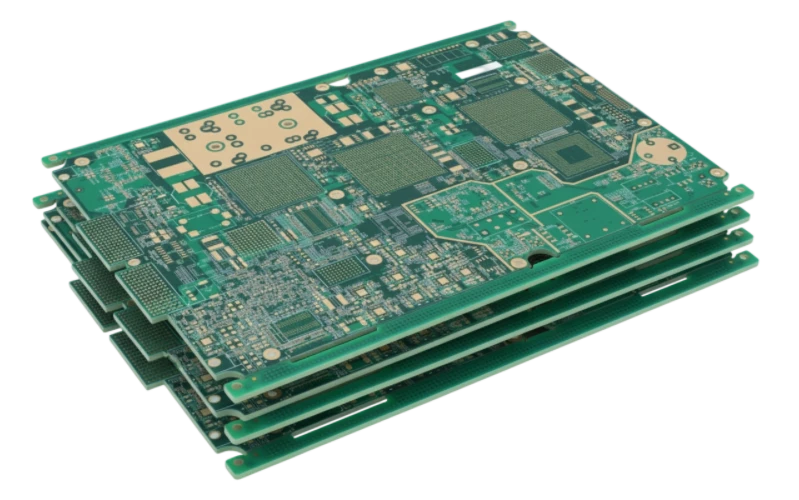
Encoder interface boards are the signal bridge between a position sensor and a motion controller. Their quality directly affects machine accuracy, servo stability, and system uptime. A board that introduces noise, timing errors, or intermittent connections can create missed encoder counts, unstable control loops, or unexpected machine stops.
For engineers and procurement teams, encoder interface board quality is not defined by PCB appearance alone. It depends on the combination of electrical design, PCB materials, manufacturing control, assembly quality, and production validation.
This guide provides a practical decision framework for selecting specifications, evaluating risks, and qualifying suppliers.
What makes encoder interface board quality different from standard PCB quality?
Encoder boards operate in environments where small signal errors become mechanical errors. Unlike simple control boards, they often handle:
- Differential signals such as RS-422, RS-485, BiSS-C, SSI, and EnDat.
- High-frequency pulse streams from incremental encoders.
- EMI exposure from servo drives, motors, and variable frequency drives.
- Mechanical stress from vibration and thermal cycling.
- Tight timing requirements in closed-loop motion systems.
A reliable encoder interface board must maintain signal integrity while protecting sensitive electronics from industrial noise.
How should you choose encoder interface board specifications?
The correct specification depends on encoder type, cable length, environment, and motion requirements.
| Application condition | Recommended PCB decision | Quality priority |
|---|---|---|
| Low-speed incremental encoder | 2-layer or 4-layer FR4 depending on noise environment | Stable power, clean routing, reliable connectors |
| RS-422 differential encoder | 4-layer PCB with controlled impedance | Differential pair routing and termination |
| BiSS/SSI/EnDat serial encoder | Controlled impedance stackup | Timing accuracy and signal integrity |
| Encoder mounted near motor or inverter | High Tg FR4, shielding, filtering | EMI resistance and thermal reliability |
| Robotic joint with movement | Rigid-flex PCB when space and cable stress require it | Mechanical durability |
| Safety-critical equipment | IPC Class 3 manufacturing controls | Traceability and inspection coverage |
Which PCB materials and tolerances should be specified?
A manufacturing drawing should define the materials and tolerances instead of relying on default supplier settings.
Key requirements include:
- High Tg FR4 with Tg above 170°C for applications exposed to motor heat and repeated thermal cycling.
- Stable dielectric properties with Dk tolerance around ±5% or better when impedance control is required.
- Copper weight of 1 oz (35µm) minimum for inner layers and 1-2 oz where current capacity or connector strength requires it.
- Four-layer construction with dedicated power and ground planes for demanding industrial environments.
- Differential impedance targets such as 100Ω or 120Ω ±10% depending on interface protocol.
- ENIG surface finish for fine-pitch components and flat sensor mounting surfaces.
- Tented or plugged vias where contamination or solder bridging risk exists.
- Outline tolerance around ±0.10mm and mounting hole location tolerance around ±0.075mm for mechanical alignment.
- Ionic cleanliness below 1.56 µg/cm² NaCl equivalent for contamination-sensitive designs.
What encoder interface board failures occur most often?
The following failure-mode table connects manufacturing issues with their impact and prevention methods.
| Failure mode | Why it happens | Detection method | Design or manufacturing response |
|---|---|---|---|
| Impedance mismatch | Trace width, dielectric thickness, or stackup variation | TDR measurement | Require controlled impedance coupons and reports |
| Signal crosstalk | Poor separation between encoder and noisy circuits | Oscilloscope analysis or simulation | Maintain controlled routing and ground reference |
| False encoder counts | Noise coupling into input signals | Functional testing under load | Add filtering, protection, and proper grounding |
| Connector fracture | Vibration and cable movement | Vibration testing | Use reinforced connectors and strain relief |
| PTH cracking | Thermal expansion stress | Microsection or thermal cycling | Use suitable laminate and plating control |
| Component tombstoning | Uneven solder heating | AOI inspection | Optimize footprints and assembly process |
| Electrochemical migration | Residue and humidity exposure | ROSE testing | Improve cleaning and apply coating when needed |
| PCB warpage | Uneven copper distribution or reflow stress | Flatness measurement | Balance stackup and use proper reflow support |
How do you validate encoder interface board quality before production?
A production approval plan should connect electrical performance with manufacturing evidence.
Recommended validation includes:
Signal integrity verification
Connect the board to a reference encoder and measure:
- Eye pattern quality for serial encoder signals.
- Rise and fall times.
- Noise margin.
- Signal overshoot and ringing.
For high-speed applications, the design should maintain acceptable eye opening and timing performance according to the selected protocol.
Impedance verification
Use TDR testing on manufacturing coupons.
Target examples:
- 100Ω differential impedance for many RS-422 style interfaces.
- 120Ω differential impedance for RS-485 applications.
Measured impedance should remain within the agreed manufacturing tolerance, commonly ±10%.
Mechanical and environmental testing
Validate:
- Thermal cycling from -40°C to +125°C when required by the application.
- Vibration resistance for motor-mounted systems.
- Connector durability.
- Mechanical alignment features.
Assembly inspection
Production inspection should include:
- SPI for solder paste quality.
- AOI for component placement and polarity.
- X-ray inspection for hidden solder joints such as QFN or BGA packages.
- Electrical testing through flying probe, ICT, or functional test fixtures.
What should be included in an encoder interface board supplier checklist?
A qualified supplier should demonstrate both PCB capability and assembly control.
RFQ documentation checklist
- Complete Gerber files.
- Fabrication drawing.
- Layer stackup requirements.
- Controlled impedance requirements.
- BOM and approved vendor list.
- Pick-and-place files.
- Functional test requirements.
- Production volume forecast.
- Packaging requirements.
Manufacturing capability checklist
- High Tg PCB manufacturing capability.
- Controlled impedance production.
- TDR testing capability.
- AOI inspection.
- SPI inspection.
- X-ray inspection capability.
- Conformal coating capability when required.
Quality system checklist
- ISO 9001:2015 quality system.
- IPC-A-600 PCB workmanship compliance.
- IPC-A-610 Class 2 or Class 3 assembly compliance.
- Material lot traceability.
- Non-conformance management process.
- ESD protection program.
- First Article Inspection reporting.
Should you choose rigid PCB or rigid-flex encoder boards?
The mechanical relationship between the encoder and controller determines the PCB structure.
Rigid PCBs are suitable when:
- The encoder remains stationary.
- Cable routing is simple.
- Mechanical stress is low.
Rigid-flex PCBs are suitable when:
- The encoder moves with a robotic joint.
- Space is limited.
- Connector elimination improves reliability.
See Rigid-Flex PCB capabilities for applications requiring flexible interconnects.
When should you use IPC Class 2 or Class 3?
IPC Class selection depends on system consequences.
IPC Class 2 is commonly used for industrial automation where reliability and cost must be balanced.
IPC Class 3 is preferred for:
- Aerospace systems.
- Medical equipment.
- Safety-critical motion systems.
- Applications requiring extended service life.
How does testing affect encoder interface board cost?
Additional testing increases initial manufacturing cost but reduces field failures.
Typical additions include:
- ICT or functional testing.
- Custom test fixtures.
- Environmental qualification.
- Signal integrity verification.
For motion systems, functional testing is especially valuable because it confirms that the board communicates correctly with the actual encoder interface rather than only passing electrical checks.
Frequently asked questions about encoder interface board quality
Can standard FR4 be used for encoder interface boards?
Yes. Standard FR4 is acceptable for many low-speed applications. High Tg FR4 is preferred for motor-mounted or thermally demanding environments.
Do all encoder boards require controlled impedance?
No. Low-speed short-distance signals may not require it. Differential high-speed interfaces such as RS-422, SSI, BiSS, and EnDat usually require controlled impedance design.
What files are needed for an accurate manufacturing quote?
Provide Gerber files, stackup information, BOM, pick-and-place files, impedance requirements, and testing requirements.
Does surface finish affect encoder reliability?
Yes. ENIG provides a flat and corrosion-resistant surface that benefits fine-pitch assembly and precision applications.
Resources for encoder interface board quality
Request a quote for encoder interface board quality
Ready to move forward? Request a Quote today to receive a DFM review and manufacturing recommendation.
Include:
- Gerber files with copper and drill information.
- Stackup and impedance requirements.
- BOM and Pick-and-Place files.
- Functional or ICT testing requirements.
- Prototype and production quantities.
Conclusion
Reliable encoder interface boards require more than correct schematics. They require controlled materials, disciplined PCB layout, verified manufacturing processes, and production testing that matches the motion system environment.
By defining encoder interface board quality requirements before manufacturing begins, engineering teams can reduce signal failures, improve machine uptime, and build a stronger production supply chain.