
Definition, scope, and who this guide is for
An EPYC Server PCB is the specialized printed circuit board designed to host AMD’s EPYC™ series processors (such as Genoa, Bergamo, or Turin). Unlike standard desktop or entry-level server boards, these PCBs must support massive I/O capabilities, including up to 128 PCIe lanes, 12 channels of DDR5 memory, and power delivery networks capable of sustaining 300W to 400W+ TDP per socket. The complexity lies in managing signal integrity for PCIe Gen 5.0 (and upcoming Gen 6.0) while maintaining thermal stability across a large surface area.
This guide covers the end-to-end procurement and engineering validation process for these high-performance boards. It moves beyond basic fabrication notes to address the specific challenges of the SP5 socket ecosystem, high-layer-count stackups, and ultra-low-loss material selection. We focus on the physical board fabrication (bare board) and the critical assembly constraints that influence yield.
This playbook is written for Hardware Engineers, Signal Integrity (SI) Engineers, and Procurement Leads who are transitioning from prototype to pilot or mass production. If you are responsible for sourcing reliable hardware for data centers, HPC clusters, or edge computing units, this guide provides the technical and commercial framework to minimize risk.
When to use EPYC Server PCB (and when a standard approach is better)
Understanding the specific architectural demands of AMD’s platform helps determine when a specialized high-speed manufacturing process is strictly necessary versus when a standard server process suffices.
Use a dedicated EPYC Server PCB manufacturing process when:
- High Core Count Virtualization: You are deploying dual-socket systems where inter-socket communication (Infinity Fabric) requires precise impedance matching to prevent data corruption.
- AI and HPC Workloads: You are building an AI Server PCB that integrates multiple GPU accelerators. The PCIe Gen 5.0 signal reach requires ultra-low loss materials and backdrilling to minimize signal reflection.
- High Density Storage: The design utilizes all 128 PCIe lanes for NVMe storage, requiring high-density interconnects (HDI) to break out signals from the massive SP5 LGA socket.
- Thermal Extremes: The server chassis is a compact 1U Server PCB where airflow is restricted, demanding heavy copper layers (2oz or 3oz) for efficient power distribution without overheating.
Stick to a standard or lower-spec process when:
- Legacy Architectures: You are using older generation processors (e.g., Naples) where PCIe Gen 3.0 speeds do not require advanced backdrilling or exotic materials.
- Low-Power Edge Nodes: You are designing a single-socket entry-level board that does not utilize the full memory bandwidth or I/O capacity.
- Cost-Sensitive General Purpose: You are comparing against a lower-end ARM Server PCB for basic web hosting where signal speeds do not push the limits of FR-4 materials.
EPYC Server PCB specifications (materials, stackup, tolerances)
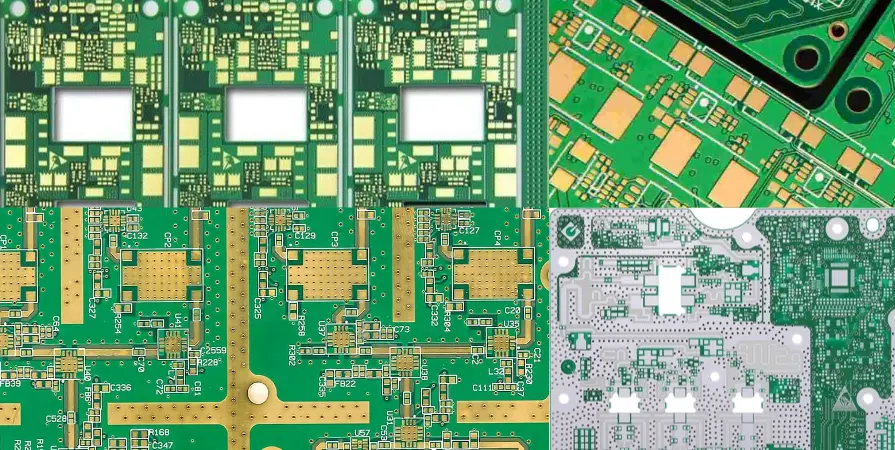
To avoid engineering queries (EQ) stalling your production, you must define specific parameters that align with the EPYC platform's electrical and mechanical needs.
- Layer Count & Stackup:
- Target: 12 to 26 layers.
- Requirement: Symmetrical stackup to prevent warpage. Dedicate specific layers for high-speed signals sandwiched between ground planes.
- Base Material (Laminate):
- Target: Ultra-Low Loss or Super Low Loss.
- Specifics: Panasonic Megtron 6, Megtron 7, or Isola Tachyon 100G. Standard FR-4 is generally insufficient for PCIe Gen 5.0 trace lengths over 5-7 inches.
- Copper Weight:
- Target: 1oz (inner signal), 2oz+ (power planes).
- Requirement: EPYC processors have high current transients. Ensure power planes can handle 300A+ delivery without excessive voltage drop (IR drop).
- Impedance Control:
- Target: 85Ω or 100Ω differential pairs (PCIe, DDR5, USB).
- Tolerance: Strict ±5% or ±7% is required. Standard ±10% is often too loose for 32 GT/s signaling.
- Backdrilling (Controlled Depth Drilling):
- Target: Stubs < 10 mils (0.25mm).
- Requirement: Essential for all high-speed vias to remove unused barrel length that acts as an antenna, causing signal resonance.
- Surface Finish:
- Target: ENIG (Electroless Nickel Immersion Gold) or OSP (Organic Solderability Preservative).
- Requirement: Must provide a perfectly flat surface for the massive SP5 LGA socket and fine-pitch BGA components. HASL is not acceptable.
- Via Technology:
- Target: Through-hole, Blind, and Buried vias.
- Requirement: Aspect ratio capability of 12:1 or higher to accommodate thick boards (2.4mm - 3.0mm) required for rigidity.
- Warpage / Bow & Twist:
- Target: < 0.5% (IPC Class 3 preferred).
- Requirement: Critical for the large LGA socket. Excessive warpage leads to open connections on the processor pins.
- Thermal Reliability:
- Target: Tg > 170°C, Td > 340°C.
- Requirement: Material must withstand multiple reflow cycles (top side, bottom side, rework) without delamination.
- Cleanliness:
- Target: Ionic contamination < 1.56 µg/cm² (NaCl equivalent).
- Requirement: Prevents electrochemical migration (dendrite growth) in high-voltage, high-humidity data center environments.
EPYC Server PCB manufacturing risks (root causes and prevention)
Moving from a functional prototype to a batch of 1,000+ units introduces variability. Here are the specific risks for EPYC-class boards and how to mitigate them.
1. Conductive Anodic Filament (CAF) Growth
- Risk: Electrical shorts forming between vias or traces along the glass fiber bundles inside the PCB material.
- Why it happens: High voltage density in server boards combined with humidity and thermal cycling.
- Detection: High-voltage insulation resistance testing.
- Prevention: Specify "CAF-resistant" materials and ensure proper glass-to-resin ratios. Design with adequate wall-to-wall spacing between vias.
2. Pad Cratering under the SP5 Socket
- Risk: The copper pad separates from the PCB resin, breaking the connection.
- Why it happens: The massive clamping force of the EPYC cooler and socket creates mechanical stress during handling or vibration.
- Detection: Dye-and-pry testing or cross-sectioning after mechanical shock tests.
- Prevention: Use "corner bonding" or underfill on BGAs. Use resin systems with higher fracture toughness. Add "teardrops" to pad-trace junctions.
3. Signal Integrity Loss due to Weave Effect
- Risk: High-speed differential pairs experience skew (timing mismatch) because one trace runs over glass bundles and the other over resin.
- Why it happens: The dielectric constant (Dk) of glass differs from resin. At 32 GT/s, this mismatch is fatal to timing margins.
- Detection: TDR (Time Domain Reflectometry) showing impedance variations; eye diagram collapse.
- Prevention: Use "spread glass" styles (e.g., 1067, 1078) where fibers are flattened. Rotate the artwork (zig-zag routing) by 10 degrees relative to the weave.
4. Plated Through Hole (PTH) Fatigue
- Risk: Barrel cracks in vias, leading to intermittent open circuits.
- Why it happens: Thick PCBs expand in the Z-axis during thermal cycling. If the copper plating is too thin or brittle, it snaps.
- Detection: Interconnect Stress Test (IST).
- Prevention: Specify minimum copper plating thickness of 25µm (1 mil) average, with no reading below 20µm.
5. Backdrill Depth Errors
- Risk: Drill does not go deep enough (leaving a stub) or goes too deep (cutting the active connection).
- Why it happens: Variation in board thickness across the panel.
- Detection: X-ray inspection of backdrilled holes; TDR testing.
- Prevention: Use depth-controlled drilling machines that sense the copper layers. Define a specific "must cut" and "must not cut" zone in the fabrication drawing.
6. Solder Mask Registration Shifts
- Risk: Solder mask climbs onto pads (poor soldering) or exposes adjacent copper (bridging).
- Why it happens: Material scaling/shrinkage during lamination of large panels.
- Detection: Automated Optical Inspection (AOI).
- Prevention: Use Laser Direct Imaging (LDI) for solder mask application, which dynamically scales to the panel's actual dimensions.
7. Impedance Discontinuity at Layer Transitions
- Risk: Signal reflection when a trace moves from an inner layer to an outer layer.
- Why it happens: Poor via design or lack of ground stitching vias.
- Detection: TDR testing.
- Prevention: Simulate via transitions in 3D field solvers. Place ground stitching vias close to signal vias to maintain the return path.
8. Warpage preventing SMT Assembly
- Risk: The board is not flat, causing the SP5 socket or large BGAs to lift during reflow (Head-in-Pillow defects).
- Why it happens: Unbalanced copper distribution or incorrect curing profile.
- Detection: Shadow Moiré measurement.
- Prevention: Balance copper coverage on all layers. Use a "low-stress" lamination cycle. Use pallets during assembly if necessary.
EPYC Server PCB validation and acceptance (tests and pass criteria)

Do not rely solely on the manufacturer's Certificate of Compliance (CoC). Implement a validation plan that proves the board can survive the server lifecycle.
1. Microsection Analysis (Coupons)
- Objective: Verify internal structure integrity.
- Method: Cross-section quality coupons from the panel border.
- Criteria: No delamination, no resin recession, plating thickness > 25µm, proper layer registration.
2. Interconnect Stress Test (IST)
- Objective: Accelerated life testing for vias.
- Method: Cycle coupons between ambient and 150°C for 500+ cycles.
- Criteria: Resistance change < 10%. No barrel cracks.
3. Impedance TDR Testing
- Objective: Verify signal integrity specs.
- Method: Test 100% of impedance coupons; spot check actual boards if design allows.
- Criteria: All differential pairs within specified tolerance (e.g., 85Ω ±5%).
4. Ionic Contamination Test (ROSE)
- Objective: Ensure board cleanliness.
- Method: Resistivity of Solvent Extract (ROSE) test.
- Criteria: < 1.56 µg/cm² NaCl equivalent.
5. Solderability Test
- Objective: Ensure pads will accept solder during assembly.
- Method: Dip and look / Wetting balance test.
- Criteria: > 95% coverage of the pad with fresh solder.
6. Thermal Stress (Solder Float)
- Objective: Simulate reflow survival.
- Method: Float sample in solder pot at 288°C for 10 seconds (3x).
- Criteria: No blistering, measles, or delamination.
7. High Potential (Hi-Pot) Test
- Objective: Check for isolation between power and ground.
- Method: Apply high voltage (e.g., 500V-1000V) between nets.
- Criteria: No leakage current exceeding limit; no breakdown.
8. Dimensional Verification
- Objective: Ensure mechanical fit in chassis (1U/2U/4U).
- Method: CMM (Coordinate Measuring Machine).
- Criteria: Outline dimensions, hole locations, and slot sizes within ±0.1mm.
EPYC Server PCB supplier qualification checklist (RFQ, audit, traceability)
When vetting a supplier for EPYC Server PCBs, general capabilities are not enough. Use this checklist to filter for high-reliability competence. APTPCB (APTPCB PCB Factory) recommends using these specific criteria to benchmark any potential partner.
Group 1: RFQ inputs for EPYC Server PCB (What you must provide)
- Gerber/ODB++ Files: Are they complete with all copper, drill, and mask layers?
- Stackup Drawing: Does it specify dielectric materials by name (e.g., Megtron 6) and thickness?
- Impedance Table: Are target lines clearly identified by layer and width?
- Drill Chart: Are backdrilled holes explicitly identified with depth requirements?
- Netlist: Is the IPC-356 netlist included for electrical test comparison?
- Panelization: Are rails and fiducials defined for your assembly line?
- Class Requirement: Is IPC Class 2 or Class 3 clearly stated?
- Surface Finish: Is the specific ENIG/OSP thickness defined?
Group 2: Capability evidence for EPYC Server PCB (Ask the supplier)
- Layer Count: Can they manufacture 20+ layers in-house without outsourcing?
- Aspect Ratio: Can they plate a 12:1 or 15:1 aspect ratio via reliably?
- Backdrilling: Do they have automated depth-controlled drilling with X-ray verification?
- LDI: Do they use Laser Direct Imaging for solder mask registration?
- Material Stock: Do they stock high-speed laminates (Megtron/Tachyon) or buy on demand? (affects lead time).
- Impedance Accuracy: Can they guarantee ±5% tolerance?
Group 3: Quality System & Traceability
- Certifications: Do they hold ISO 9001 and UL certification for the specific stackup/material combo?
- AOI: Is Automated Optical Inspection performed on every inner layer?
- ET: Is 100% Electrical Testing (Flying Probe or Bed of Nails) mandatory?
- Cross-Sectioning: Do they perform microsections on every production panel?
- Traceability: Can they trace a specific board back to the raw material lot and lamination press cycle?
- Equipment Age: Is the lamination and drilling equipment modern enough for high-precision work?
Group 4: Change Control & Delivery
- PCN Policy: Do they agree to provide Product Change Notification before changing materials or chemistry?
- EQ Handling: Do they have English-speaking CAM engineers to resolve Engineering Queries quickly?
- Capacity: Do they have spare capacity to handle your ramp-up from 50 to 5,000 units?
- Packaging: Do they use vacuum-sealed, ESD-safe packaging with humidity indicator cards?
- DFA Support: Can they provide feedback on assembly risks (e.g., component spacing)?
- Logistics: Do they have experience shipping heavy copper boards without damage?
How to choose EPYC Server PCB (trade-offs and decision rules)
Engineering is the art of compromise. Here is how to navigate the common trade-offs in EPYC Server PCB design.
1. Material Cost vs. Signal Loss
- Trade-off: Megtron 7 is significantly more expensive than standard High-Tg FR4.
- Guidance: If your longest PCIe Gen 5 trace is < 4 inches, you might get away with a mid-loss material (like Isola 370HR) if you simulate carefully. If traces exceed 5-6 inches, choose Megtron 6/7. The cost of the material is lower than the cost of a non-functional server.
2. Density vs. Layer Count
- Trade-off: Using HDI (Microvias) reduces layer count but increases process complexity and cost.
- Guidance: If you are constrained by Z-height (e.g., a dense blade server), choose HDI. If you have vertical space (standard 2U Server PCB or 4U Server PCB), choose a higher layer count with through-holes. It is generally more robust and cheaper for lower volumes.
3. Backdrilling vs. Blind Vias
- Trade-off: Backdrilling removes stubs from through-holes; blind vias avoid stubs entirely but are harder to laminate sequentially.
- Guidance: For standard server motherboards, choose Backdrilling. It is the industry standard for EPYC boards and is more cost-effective than multiple sequential lamination cycles required for deep blind vias.
4. OSP vs. ENIG Surface Finish
- Trade-off: OSP is flatter and cheaper but has a shorter shelf life. ENIG is robust but can suffer from "Black Pad" if poorly processed.
- Guidance: For large BGA sockets (SP5), choose OSP if you control the assembly timeline tightly. It offers the best coplanarity. If boards will be stored for months before assembly, choose ENIG.
5. 1U vs. 4U Thermal Design
- Trade-off: 1U Server PCB designs have high airflow resistance; 4U Server PCB designs have ample space.
- Guidance: In 1U, prioritize heavy copper inner layers to spread heat laterally. In 4U, you can rely more on heatsinks and airflow, allowing for standard copper weights.
EPYC Server PCB FAQ (cost, lead time, Design for Manufacturability (DFM) files, stackup, impedance, The dielectric constant (DK)/Df)
Q: What is the maximum board size for an EPYC server PCB? A: Most manufacturers can handle up to 24" x 30", but standard E-ATX or SSI EEB form factors are most common. APTPCB can accommodate oversized backplanes if required.
Q: Do I really need backdrilling for PCIe Gen 4? A: For Gen 4, it is recommended but sometimes optional depending on trace length. For PCIe Gen 5 (standard on EPYC 9004 series), backdrilling is mandatory to reduce stub resonance.
Q: How do I prevent warping on such a large board? A: Use a strictly symmetrical stackup (copper balance and dielectric thickness). Ensure the resin content is uniform. During assembly, use a fixture/pallet to support the board.
Q: Can I use standard FR4 for the outer layers and Megtron for inner layers? A: Yes, this is called a "Hybrid Stackup." It saves cost. However, it requires careful management of CTE (Coefficient of Thermal Expansion) mismatches to prevent delamination.
Q: What is the typical lead time for these boards? A: Prototypes typically take 10-15 days due to the complex lamination and backdrilling steps. Volume production is usually 4-5 weeks.
Q: Does the SP5 socket require special PCB reinforcement? A: Yes. A backplate is always used, but the PCB itself needs sufficient thickness (usually 2.4mm or roughly 93 mils) to handle the mounting pressure without bowing.
Q: How many layers are typical for a dual-socket EPYC board? A: A dual-socket design typically requires 16 to 24 layers to route all DDR5 channels and PCIe lanes successfully.
Q: What is the minimum drill size for these thick boards? A: Due to the high aspect ratio (board thickness vs. hole diameter), try to keep mechanical drills above 0.25mm (10 mils) if possible. 0.2mm (8 mils) is possible but increases cost and risk of plating voids.
Resources for EPYC Server PCB (related pages and tools)
- Server and Data Center PCB Solutions: Explore specific capabilities for high-performance computing and storage infrastructure.
- High Speed PCB Manufacturing: Deep dive into signal integrity, impedance control, and material selection for high-frequency applications.
- Megtron PCB Materials: Understand why Panasonic Megtron is the gold standard for PCIe Gen 5 and Gen 6 designs.
- HDI PCB Technology: Learn how High Density Interconnects enable the routing of massive BGA pin counts in server environments.
- Backplane PCB Fabrication: Review the specialized techniques used for thick, high-layer-count boards that serve as the backbone of server chassis.
Request a quote for EPYC Server PCB (Design for Manufacturability (DFM) review + pricing)
Getting an accurate quote for an EPYC Server PCB requires more than just dimensions. To ensure your design is manufacturable and cost-optimized, we provide a complimentary DFM (Design for Manufacturability) review with every inquiry.
What to send for a precise quote:
- Gerber Files (RS-274X) or ODB++: The complete dataset.
- Stackup Diagram: Including material types (e.g., Megtron 7) and impedance requirements.
- Drill File: Clearly indicating backdrill locations.
- Volume & Lead Time: Prototype quantity vs. production targets.
Click here to upload your files and get a quote from APTPCB. Our engineering team will review your stackup for signal integrity risks and provide a detailed cost breakdown within 24 hours.
Conclusion (next steps)
Successfully deploying an EPYC Server PCB requires navigating a complex landscape of signal integrity physics, material science, and mechanical constraints. By defining strict specifications for materials and backdrilling, understanding the risks of scale-up like CAF and warpage, and rigorously validating your supplier, you can secure a stable foundation for your high-performance infrastructure. This playbook serves as your roadmap to ensure that the hardware you procure matches the incredible potential of the silicon it supports.