
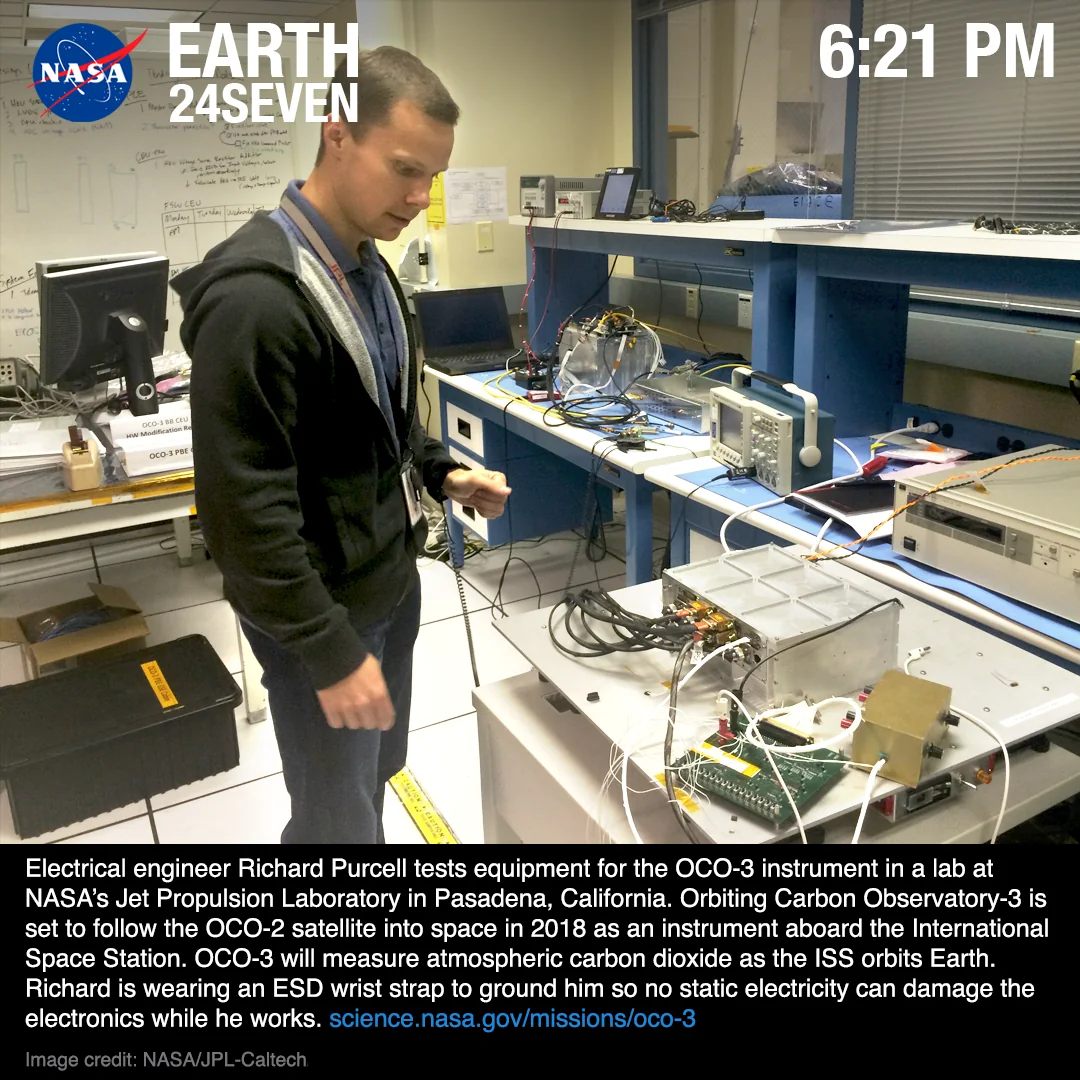
- ESD control is a handling discipline, not a single test. It runs across receiving, build, rework, and shipment.
- The dangerous failures are usually invisible at the bench. A static event can weaken a device without stopping it from passing assembly test.
- Risk enters wherever a charged person, tool, surface, or package touches a sensitive part, so the control points sit at each stage of the flow, not just at one station.
- People, surfaces, and packaging are the three levers. Grounding personnel, dissipating worksurface charge, and shielding parts in transit cover most of the exposure.
- This guide stays at the handling and process level. It names the relevant standards by identity and points exact limits back to the applicable ESD standard and the device datasheet.
Quick Answer ESD-safe handling means giving every conductor, including the operator, a controlled path to ground, and shielding sensitive parts whenever they leave that controlled zone. The practical question on the floor is not
Did the board pass functional test?It isWas this part inside a grounded, charge-controlled path at every moment a person, tool, or package touched it?Grounding specs, surface-resistance ranges, and humidity targets are set per the applicable ESD standard (ANSI/ESD S20.20, IEC 61340) and the device datasheet, not invented per build.
Table of Contents
- Why ESD damage is the defect you don't see
- Where ESD risk enters the assembly flow
- ESD-safe handling: people, surfaces, packaging
- What to specify in the assembly handoff for ESD-sensitive builds
- FAQ
- Public references
- Author and review information
Why ESD damage is the defect you don't see
Most assembly defects announce themselves. A bad joint opens, a tombstoned part fails the test, a missing component shows on AOI. ESD damage often does none of that, and that is exactly what makes it expensive.
The mechanism family here is latent damage. A static discharge during handling can deliver a sub-catastrophic stress to a junction or gate oxide, weakening the device without destroying it. The part still answers, still switches, still passes the functional test at assembly. The board ships looking clean.
The risk chain runs like this: an ESD event during handling delivers a latent junction stress, the part passes functional test at assembly, the degraded device then fails weeks or months later in the field, and the failure gets mis-attributed because the assembly test passed. By the time the return comes back, the link to a handling event on the line is gone. Teams chase design margin or supplier quality when the real cause was a charged operator or an ungrounded tool at one station.
That is why ESD belongs in the handling discipline and not only in the test plan. Inspection and functional test confirm the board works the day it is built. They do not prove the part was never stressed, and they cannot reliably catch a latent defect. Treating a passing test as proof of ESD safety is the trap. The proof lives in the process: was the part inside a controlled path the whole time? Our turnkey assembly flow treats that question as a release condition, not an afterthought.
Where ESD risk enters the assembly flow
ESD exposure is not evenly spread across the build. It spikes at specific touch points, usually wherever packaging opens or a human hand enters the loop. Mapping those points is the first move, because you cannot control a risk you have not located.
| Assembly stage | Where the risk enters | Control checkpoint |
|---|---|---|
| Incoming and IQC | Manufacturer packaging is opened to verify counts, values, and moisture indicators | Open shielded packaging only at a grounded station; flag ESD-sensitive parts on receipt. See incoming quality control. |
| Kitting and BOM staging | Sensitive parts are separated, counted, and moved between containers | Keep parts in shielded or dissipative carriers; never set them on bare bench, plastic, or metal. See components and BOM. |
| SMT and THT build | Feeders are loaded, machines place parts, hand-soldering touches pins directly | Ground the placement head and iron tip; handle bare boards by the edges. See SMT and THT. |
| Inspection and test | Boards are handled repeatedly between stations and fixtures | Use dissipative fixtures and grounded handling; treat every move as an exposure. See testing and quality. |
| Rework and repair | An iron, an ungrounded operator, and a sensitive part meet at close range | Hard-ground the rework station; verify the operator before touching the board. |
| Packaging and shipment | The finished board leaves the controlled zone | Seal into shielding packaging immediately; no plain bubble wrap against the board. |
The pattern is consistent: risk concentrates at the boundaries where a part crosses between a protected zone and an uncontrolled one. Those boundaries are where the checkpoints earn their place.
ESD-safe handling: people, surfaces, packaging
Once the risk points are mapped, control comes down to three levers. Get these right and most of the exposure is covered.
People. The operator is the most mobile charge source on the floor. Walking generates charge, and an ungrounded hand can discharge straight into a pin. The control is a continuous path to ground through a wrist strap at a seated station or ESD footwear plus dissipative flooring when standing or moving. Straps and footwear get verified before entering the protected area, because a strap that failed at the start of a shift can put a whole day's output in question. The resistance values that make a strap "safe to operator, effective for drain" are set by the applicable ESD standard, not chosen ad hoc. ESD smocks keep the operator's own clothing fields off the board.
Surfaces. Worksurfaces and floors have to dissipate charge slowly enough to avoid a spark yet fast enough to clear it. A static-dissipative mat grounded through the standard safety path does this; a bare metal bench discharges too fast and bare plastic does not discharge at all. Keep common insulators away from the work zone, that means coffee cups, plastic wrappers, tape rolls, and binders, because they hold fields that a part cannot be grounded against. Where an essential insulator cannot be removed, such as a plastic connector body or a fixture, an air ionizer neutralizes the charge it carries. Surface-resistance and ionizer decay targets are verified against the applicable ESD standard and audited on a schedule.
Packaging. The moment a part leaves the protected area, packaging becomes its only defense. Two materials get confused constantly. Anti-static (often pink poly) inhibits charge generation but does not shield against an external field, so it is fine inside the protected zone and not enough for transport. Metallized shielding forms a Faraday cage and blocks external fields, which is what shipping and inter-zone moves require. Mixing them up, shipping a sensitive board in a pink bag, is one of the most common quiet failures, and it is caught by checking the bag, not the board.
These three levers map directly to how ESD requirements fit a broader quality system: documented setup, verified daily, audited periodically.
What to specify in the assembly handoff for ESD-sensitive builds
ESD control works best when it is written into the handoff, not assumed. The assembly partner cannot protect a part they were not told is sensitive. Use this checklist to make the requirement explicit.
- Flag the sensitive parts. Mark ESD-sensitive components in the BOM, ideally with a sensitivity column, so receiving, kitting, and IQC all see the flag. A part nobody flagged is a part handled at general-purpose care.
- Name the standard at identity level. State the controlling document in the assembly notes, for example "handle per ANSI/ESD S20.20." Let the exact resistance, humidity, and decay limits resolve to that standard and the device datasheet rather than restating numbers that can drift out of sync.
- State the sensitivity class. If the device datasheet defines a class under the Human Body Model (HBM) or Charged Device Model (CDM), pass that through. CDM exposure in particular matters for automated placement, where the device itself can charge and discharge to a metal surface.
- Define packaging requirements. Specify shielding packaging for shipment and any inter-zone moves, and call out what must not be used against the board.
- Set the handling boundary. Note where edge-only handling, grounded tools, or ionization are required, especially for rework and final box-build, where a non-grounded screwdriver or an ungrounded operator is a known entry point.
- Confirm the verification expectation. Agree on what gets checked and logged: strap and footwear verification before the protected area, and periodic worksurface and flooring audits per the applicable standard.
For broader file-preparation context, the DFM guidelines cover how handling and sensitivity notes travel with the rest of the package. For builds where latent field failures carry the highest cost, such as medical PCB work, the handoff detail and continuous verification both tighten. When the design is ready and the sensitivity picture is clear, you can route it through the quote flow.
FAQ
Can a board pass functional test and still carry ESD damage?
Yes, and this is the core problem. A static event can leave a latent defect that degrades a device without stopping it from passing the test at assembly. The part can fail later in the field, which is why ESD control is a handling discipline rather than something a single test confirms.
What is the difference between anti-static and shielding packaging?
Anti-static material (often pink poly) inhibits charge generation but does not block an external field, so it suits use inside the protected area. Metallized shielding forms a Faraday cage and blocks external fields, which is what shipment and moves outside the protected zone require.
Does ESD-sensitive handling change normal assembly throughput?
In a properly set-up flow, the controls are built into the workflow. Putting on a verified wrist strap, using a grounded tool, and sealing parts into shielding packaging are part of the standard station routine rather than separate added steps.
What resistance and humidity values should I specify?
Specify them by reference, not by restating numbers. Point the handoff to the controlling standard (ANSI/ESD S20.20, IEC 61340) and the device datasheet, and let the exact wrist-strap, worksurface, flooring, and humidity limits resolve there. That keeps the build aligned with the standard rather than a number that may be out of date.
Where does ESD risk concentrate during assembly?
At the boundaries where a part crosses between a controlled and an uncontrolled zone: opening incoming packaging, kitting, hand-soldering, rework, final box-build, and shipment. Those touch points are where the checkpoints belong.
How do HBM and CDM relate to my build?
They are device sensitivity models named in datasheets. The Human Body Model describes discharge from a person; the Charged Device Model describes the device charging and discharging to a surface, which is relevant for automated placement. Pass the datasheet class through to the assembly partner rather than treating thresholds as generic facts.
Public references
Turnkey Assembly Support-page context for how handling discipline fits an end-to-end assembly flow.
SMT and THT Support-page context for component placement and hand-soldering handling controls.
Testing and Quality Support-page context for inspection and test language at the assembly level.
Incoming Quality Control Support-page context for receiving, packaging inspection, and sensitivity flagging.
DFM Guidelines Support-page context for handling and sensitivity notes traveling with the design package.
Author and review information
- Author: APTPCB editorial team
- Technical review: PCBA process / quality engineering review team
- Review scope: ESD-safe handling discipline across receiving, assembly, rework, and shipment; assembly-handoff specification; consistency of standards referenced at identity level