
Key Takeaways
- Definition: Factory ICT (In-Circuit Test) coverage for PLC refers to the percentage of nets and components on a Programmable Logic Controller board that can be electrically verified during manufacturing.
- Criticality: Unlike consumer electronics, PLCs require near-100% reliability; missed defects can lead to catastrophic industrial failures.
- Metrics: The PCOLA/SOQ standard is the industry benchmark for measuring coverage quality, not just simple percentage points.
- Design for Test (DFT): Achieving high coverage starts at the schematic stage, not the factory floor.
- Trade-offs: Higher coverage often requires larger PCBs or more expensive fixtures; balancing this is key for cost-effective production.
- Validation: Simulation reports must be validated against physical test results during the First Article Inspection (FAI).
- Partnership: Working with a capable manufacturer like APTPCB (APTPCB PCB Factory) ensures your DFT strategy aligns with actual production capabilities.
What factory In-Circuit Test (ICT) coverage for Programmable Logic Controller (PLC) really means (scope & boundaries)
Understanding the scope of testing is the first step toward ensuring industrial reliability in control systems.
Factory ICT coverage for PLC is a quantitative measure of how much of a printed circuit board's logic and connectivity can be validated using a "bed of nails" tester. In the context of Programmable Logic Controllers (PLCs), this metric is far more critical than in general electronics. PLCs operate in harsh environments involving vibration, temperature extremes, and electromagnetic interference. A solder joint that passes a visual inspection but fails an electrical stress test can cause a factory shutdown months later.
ICT (In-Circuit Test) specifically targets:
- Shorts and Opens: Ensuring no unintended bridges exist between nets and that tracks are continuous.
- Component Values: Verifying resistance, capacitance, and inductance match the Bill of Materials (BOM).
- Component Presence and Orientation: Ensuring chips are mounted and rotated correctly.
- Active Component Function: Performing basic logic checks on diodes, transistors, and ICs.
It is important to distinguish ICT coverage from Functional Circuit Test (FCT) coverage. ICT looks for manufacturing defects (solder bridges, wrong parts), while FCT verifies that the board performs its intended logic. For a PLC, high ICT coverage is the foundation that makes FCT meaningful. If the physical connections are not verified first, functional debugging becomes impossible.
At APTPCB, we emphasize that coverage is not just a percentage number. It is a risk management tool. A board with 95% coverage might still miss the one critical safety relay that protects the entire system. Therefore, the scope must prioritize "critical nets" over generic coverage statistics.
Metrics that matter (how to evaluate quality)
Measuring coverage requires more than a simple pass/fail ratio; it demands a granular analysis of specific defect types.
To truly assess factory ICT coverage for PLC, engineers use specific metrics that categorize what is being tested and how well. The industry standard for this is the PCOLA/SOQ model. This model separates component attributes (PCOLA) from connection attributes (SOQ).
| Metric | Why it matters | Typical range or influencing factors | How to measure |
|---|---|---|---|
| Test Access Ratio | Determines if the probes can physically reach the nets. | 90% - 100%. Lower on HDI boards. | (Nets with Test Points / Total Nets) × 100. |
| Component Coverage | Ensures the correct parts are installed. | 85% - 98%. Limited by bypass caps in parallel. | Count of components with verified values / Total BOM count. |
| Net Coverage | Verifies continuity and isolation. | 95% - 100%. Critical for power and ground planes. | Count of fully tested nets / Total Netlist count. |
| False Fail Rate | High false fails slow down production and damage pads. | < 500 PPM. Influenced by fixture quality and strain. | (False alarms / Total boards tested) × 1,000,000. |
| PCOLA Score | Checks Presence, Correctness, Orientation, Live, Alignment. | High. Essential for complex ICs and connectors. | Automated software analysis of the test program generation. |
| SOQ Score | Checks Shorts, Opens, Quality (solder joint integrity). | Critical. Must be near 100% for PLC safety. | Measured via resistance thresholds during the short/open test phase. |
| Gauge R&R | Ensures the test fixture is consistent and repeatable. | < 10%. If >30%, the test system is unreliable. | Statistical analysis of repeated measurements on the same unit. |
Selection guidance by scenario (trade-offs)
Different manufacturing scenarios dictate different approaches to achieving optimal test coverage.
Achieving 100% factory ICT coverage for PLC is often physically impossible or economically unviable. You must select the right strategy based on your product's lifecycle and technical constraints. Below are common scenarios and the recommended approach for each.
1. High-Volume, Low-Mix Production
- Scenario: Mass production of standard PLC I/O modules.
- Recommendation: Invest in a high-end vacuum fixture with dual-sided probing.
- Trade-off: High upfront tooling cost ($5k - $15k), but lowest per-unit test time and highest repeatability.
- APTPCB Insight: For volumes over 5,000 units, the fixture cost amortizes quickly, justifying the expense for maximum coverage.
2. Prototype and NPI (New Product Introduction)
- Scenario: First run of a new PLC CPU board.
- Recommendation: Use Flying Probe Testing (FPT) instead of a fixed ICT fixture.
- Trade-off: Zero tooling cost, but very slow test time per board.
- Why: Design changes are frequent. FPT allows you to update test points in software without rebuilding a physical fixture.
3. High-Density Interconnect (HDI) Designs
- Scenario: Compact PLCs using micro-vias and fine-pitch BGAs.
- Recommendation: Combine ICT with Boundary Scan (JTAG) and Automated X-ray Inspection (AXI).
- Trade-off: ICT probes cannot hit every net in HDI PCB technology. You must rely on JTAG for digital logic and X-ray for BGA solder joints.
- Risk: Relying solely on ICT here will result in low coverage (<60%).
4. Safety-Critical PLCs (SIL 3 / SIL 4)
- Scenario: PLCs used in emergency shutdown systems.
- Recommendation: Redundant testing. 100% ICT coverage on safety nets, followed by 100% FCT.
- Trade-off: Highest cost and longest cycle time.
- Focus: Adhering to safety standards for PLC PCB design often requires physical isolation slots, which can complicate vacuum sealing for fixtures. Mechanical press-down fixtures are preferred here.
5. High-Voltage Industrial Controllers
- Scenario: PLCs managing 220V/480V inputs directly.
- Recommendation: Selective ICT. Do not probe high-voltage nets directly if the tester cannot handle the potential discharge.
- Trade-off: Lower coverage on power inputs to protect test equipment.
- Mitigation: Use visual inspection (AOI) for the high-voltage section and ICT for the low-voltage logic.
6. Coated Boards (Conformal Coating)
- Scenario: PLCs destined for humid or corrosive environments.
- Recommendation: Test before coating. If testing after coating is required, use conductive rubber tips or specialized masking.
- Trade-off: Masking adds labor. Piercing probes can damage the coating, compromising moisture protection.
From design to manufacturing (implementation checkpoints)
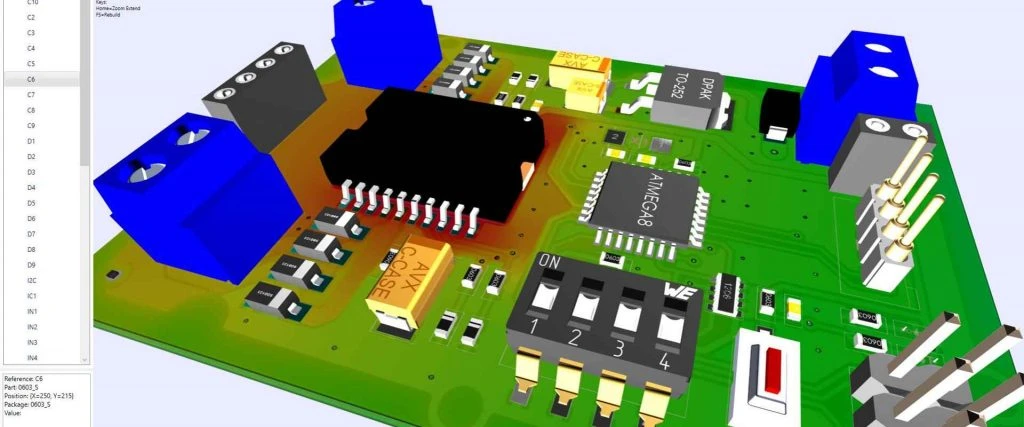
Successful ICT implementation is a linear process that begins long before the PCB layout is finalized.
To ensure high factory ICT coverage for PLC, designers must follow a strict Design for Test (DFT) workflow. Retrofitting test points onto a finished layout is a recipe for signal integrity issues and poor coverage.
- Schematic Phase - Net Prioritization: Identify critical nets (power, reset, clocks, communication buses). Mark them as "Must Test" in the schematic.
- Layout Phase - Test Point Placement: Place test points (TPs) on the bottom side of the PCB whenever possible. Single-sided fixtures are significantly cheaper and more reliable than dual-sided ones.
- Grid Alignment: Align TPs to a 2.54mm (100 mil) or 1.27mm (50 mil) grid. Off-grid points require expensive custom drilling for the fixture.
- TP Geometry: Use a minimum pad diameter of 0.8mm to 1.0mm for standard probes. Smaller pads (0.5mm) require expensive, fragile probes.
- Clearance Rules: Maintain at least 1.5mm clearance between test points and component bodies to prevent the probe head from hitting the component.
- EMC Considerations: When dealing with EMC zoning and grounding for PLC, ensure test points on high-speed lines do not act as antennas. Use "stub-free" test points or cover them with ground shielding if necessary.
- Tooling Holes: Include at least two non-plated tooling holes (3mm+) in opposite corners. These align the PCB to the fixture. Without them, accurate probing is impossible.
- Gerber Generation: Export a specific "Test Point" file or IPC-356 netlist. Do not rely on the manufacturer to guess which pads are for testing.
- Fixture Fabrication: Send data to the fixture house 2-3 weeks before the PCB build.
- Debugging: The first pass usually yields false failures. Adjust software tolerances (e.g., resistor variance) rather than physically modifying the board.
- Strain Gauge Testing: Before mass production, measure the mechanical stress the fixture applies to the PCB. Excessive bending can crack ceramic capacitors.
- Documentation: Create a "Coverage Report" detailing exactly which nets are tested and which are skipped. This is vital for future troubleshooting.
For detailed specifications on layout requirements, refer to our DFM guidelines.
Common mistakes (and the correct approach)
Even experienced engineers fall into traps that reduce coverage or increase manufacturing costs.
Avoiding these pitfalls ensures that your factory ICT coverage for PLC strategy is effective and safe.
- Mistake: Placing test points under BGA or low-profile components.
- Correction: Test points must be accessible. If a net is only accessible under a BGA, fan it out to a via or a dedicated pad.
- Mistake: Relying on "Via-in-Pad" for probing.
- Correction: Probing plated vias can cause "barrel cracking" or unreliable contact due to solder voids. Always use a flat, solid test pad.
- Mistake: Ignoring tall components.
- Correction: Tall capacitors or transformers on the bottom side prevent the board from sitting flat on the fixture. Keep the bottom side relatively flat or create "keep-out" zones for tall parts.
- Mistake: Assuming 100% coverage is necessary.
- Correction: Chasing the last 5% of coverage (usually bypass caps or pull-up resistors) can double the fixture cost. Accept lower coverage on non-critical passive parts if the process control is good.
- Mistake: Forgetting the "discharge" routine.
- Correction: Large capacitors in PLCs store energy. The ICT fixture must have a discharge circuit to prevent blowing up the tester probes upon contact.
- Mistake: Using solder mask over test points.
- Correction: Test points must be mask-opening. Probes cannot penetrate solder mask reliably without damaging the tip or the board.
- Mistake: Neglecting probe density.
- Correction: Too many probes in a small area (high density) creates massive upward pressure, potentially warping the board. Distribute test points evenly.
- Mistake: Overlooking industrial control PCB manufacturing standards.
- Correction: Industrial boards have thicker copper and different thermal profiles. Ensure the test parameters account for the higher current carrying capacity of the tracks.
FAQ
Q: What is the typical cost for a PLC ICT fixture? A: A standard "bed of nails" fixture typically costs between $2,000 and $6,000, depending on the number of test points and whether it is single or dual-sided.
Q: Can ICT test the software on the PLC? A: Generally, no. ICT tests the hardware (physics). However, some advanced ICT systems can perform "Flash Programming" to load the initial bootloader, which is a bridge to software testing.
Q: How does ICT differ from Flying Probe Testing? A: ICT uses a fixed fixture to test all points simultaneously (fast, high setup cost). Flying Probe uses moving robotic arms to test points sequentially (slow, zero setup cost). ICT is for volume; Flying Probe is for prototypes.
Q: What is the minimum spacing between test points? A: For standard probes (100 mil), keep 2.54mm center-to-center. For fine pitch (50 mil), you can go down to 1.27mm, but fixture cost increases and durability decreases.
Q: Does ICT damage the PCB? A: It leaves small "witness marks" (dimples) on the test pads. This is normal and acceptable. However, excessive pressure can crack solder joints, which is why strain gauge testing is required.
Q: Can I use vias as test points? A: It is not recommended. Vias are often tented with solder mask. Even if open, they are uneven. It is better to add a dedicated test pad connected to the via.
Q: How do I handle test points for high-speed differential pairs? A: Adding a test point creates a "stub" that can reflect signals. For very high-speed PLC communication buses, use simulation to ensure the test point does not degrade signal integrity, or test these lines via boundary scan instead.
Q: Why is my coverage report showing low percentage? A: This often happens if you have many parallel capacitors (the tester sees them as one big capacitor) or if you have many nets that are physically inaccessible (e.g., inside a BGA without fan-out).
Q: Do I need ICT if I have AOI (Automated Optical Inspection)? A: Yes. AOI only checks if the part looks correct. It cannot tell if a resistor has the wrong value, if a chip is dead, or if there is a cold solder joint underneath a component.
Q: What data does APTPCB need to quote ICT? A: We need the Gerber files, the BOM (Bill of Materials), the XY Pick and Place file, and the electrical Netlist (IPC-356 format).
Related pages & tools
- ICT Test Services: Explore our specific capabilities regarding in-circuit testing hardware and software.
- Industrial Control PCB: Learn about the specific material and fabrication requirements for industrial electronics.
- DFM Guidelines: Download our checklist to ensure your design is ready for mass production testing.
Glossary (key terms)
| Term | Definition |
|---|---|
| Bed of Nails | A traditional ICT fixture containing hundreds of spring-loaded probes that contact the PCB simultaneously. |
| DFT (Design for Test) | The engineering practice of designing a PCB layout specifically to facilitate easy and comprehensive testing. |
| DUT (Device Under Test) | The specific PCB assembly currently sitting in the test fixture. |
| Fixture | The mechanical interface (custom hardware) that holds the PCB and aligns the probes to the test points. |
| Netlist | A text file describing the electrical connectivity of the PCB, defining which component pins are connected to which nets. |
| Pogo Pin | A spring-loaded probe used in test fixtures to make electrical contact with the PCB pads. |
| IPC-356 | The standard file format used to communicate test point coordinates and net information to the manufacturer. |
| Boundary Scan (JTAG) | A method for testing interconnects on complex ICs (like FPGAs) without physical probes, using a serial interface. |
| Witness Mark | The small indentation left on a solder pad by the test probe; proof that the point was tested. |
| Strain Gauge | A sensor used to measure the physical bending or stress applied to the PCB during the vacuum compression of the fixture. |
| False Fail | A test result indicating a defect when the board is actually good, usually caused by poor probe contact or tight tolerances. |
| Guard Trace | A technique in ICT where surrounding nets are driven to a specific voltage to isolate the component being measured. |
Conclusion (next steps)
Achieving high factory ICT coverage for PLC is not an afterthought; it is a strategic decision that impacts the safety and reliability of industrial systems. By understanding the metrics of PCOLA/SOQ, selecting the right fixture strategy, and adhering to strict DFT rules, you ensure that every PLC leaving the line is ready for the harsh reality of the factory floor.
To move forward with your PLC project, APTPCB recommends a comprehensive DFM review before finalizing your layout. When requesting a quote, please provide:
- Gerber Files (including a dedicated Test Point layer if available).
- BOM with manufacturer part numbers.
- Netlist (IPC-356 format).
- Schematics (PDF) for debugging reference.
- Specific Test Requirements (e.g., "Must test 100% of safety relay circuits").
High-quality testing is the insurance policy for your brand's reputation. Start your validation journey with the right data and the right partner.