
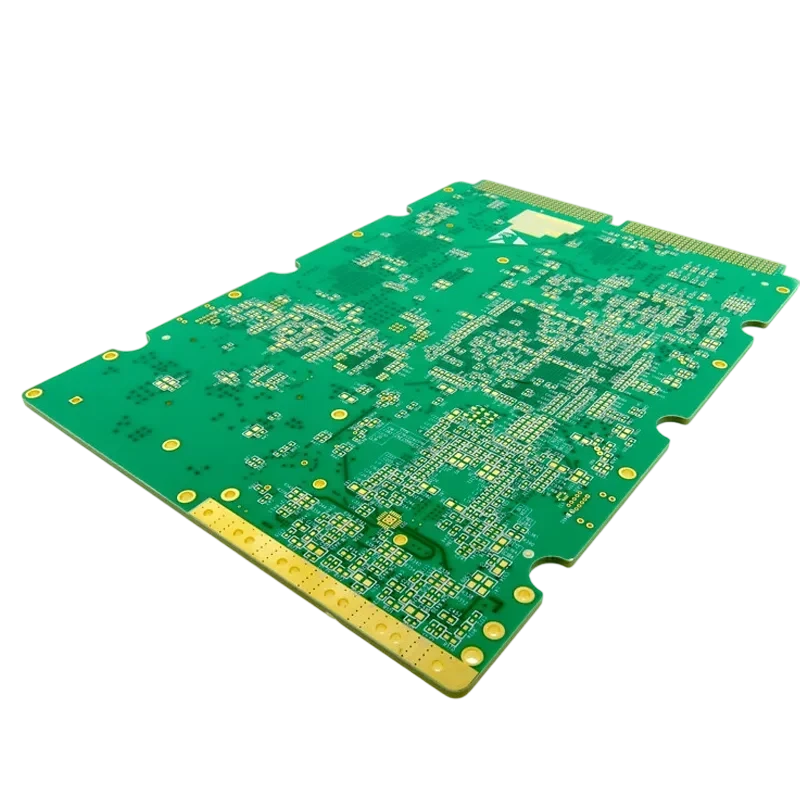
What is a Femtocell PCB and why does the design require RF-specific decisions?
A Femtocell PCB is the circuit board platform inside a small, low-power cellular base station designed for indoor or localized coverage. Unlike a standard digital control board, it combines RF front-end circuits, baseband processing, power management, timing synchronization, and often Wi-Fi coexistence functions on a compact multilayer PCB.
A femtocell must deliver carrier-grade radio performance while maintaining consumer-electronics cost targets. The PCB must support:
- 4G LTE and 5G Sub-6GHz radio paths.
- Low-loss RF transmission lines.
- Controlled impedance routing.
- Thermal management without large cooling systems.
- EMI control between RF, analog, and digital sections.
- Manufacturing consistency at production volumes.
The most important engineering decision is not simply selecting a high-frequency laminate. A successful femtocell PCB uses the correct combination of material, stackup, copper structure, grounding, thermal design, and validation testing.
Which PCB specifications matter most for femtocell performance?
The following parameters determine whether a femtocell PCB achieves stable RF performance and reliable production yield.
| Metric | Why it matters | Typical range or influencing factors | How to measure |
|---|---|---|---|
| Dielectric Constant (Dk) | Controls propagation speed and impedance behavior. | 3.0 to 4.5 depending on laminate type. | TDR or resonator method. |
| Dissipation Factor (Df) | Determines RF energy loss. | < 0.002 for high-frequency RF materials; standard digital materials can be higher. | Cavity perturbation method. |
| Passive Intermodulation (PIM) | Prevents unwanted RF distortion that can reduce network capacity. | Carrier-grade designs often target values around -150 dBc. | IEC 62037 PIM testing. |
| Thermal Conductivity | Removes heat from PA and power devices. | Approximately 0.5 W/mK for FR4 to 3.0+ W/mK for advanced thermal materials. | Thermal conductivity testing. |
| Impedance Control | Prevents signal reflection and insertion loss. | 50Ω single-ended and 100Ω differential routing with typical ±5% to ±10% tolerance. | TDR testing. |
| Glass Transition Temperature (Tg) | Maintains mechanical stability during assembly and operation. | High-reliability designs commonly use Tg above 170°C. | TMA testing. |
| CTE (z-axis) | Reduces plated-through-hole stress during thermal cycling. | Lower expansion improves reliability. | TMA testing. |
How do you choose the right Femtocell PCB material?
Material selection depends on operating frequency, RF loss budget, thermal requirements, and product cost.
| Deployment scenario | Preferred PCB approach | Design priority | Main trade-off |
|---|---|---|---|
| Residential 4G LTE femtocell | Standard FR4 4-6 layer PCB | Cost efficiency | Higher RF loss and reduced efficiency at higher frequencies. |
| Enterprise 5G Sub-6GHz small cell | Hybrid high-frequency laminate + FR4 | RF performance and cost balance | More complex lamination and material compatibility requirements. |
| High-power outdoor femtocell | Heavy copper or metal-core PCB approach | Thermal control | Higher manufacturing cost and weight. |
| 5G mmWave small cell | PTFE, LCP, or advanced RF laminate | Ultra-low signal loss | Higher material and processing cost. |
| Cellular + Wi-Fi integrated device | Multilayer PCB with shielding structures | RF isolation | More layers and tighter layout constraints. |
| Industrial low-latency IoT | High-Tg, low-CTE materials | Long-term reliability | Potential over-specification for short product cycles. |
For many 5G Sub-6GHz designs, a hybrid stackup is practical. RF layers can use materials such as Rogers laminates while digital and power layers use cost-effective FR4. This approach reduces total PCB cost while preserving RF performance.
What Femtocell PCB stackup should you use for 5G designs?
The stackup should be defined before routing begins because layer spacing directly affects impedance.
A typical 5G femtocell PCB stackup may include:
- RF signal layers with controlled dielectric thickness.
- Dedicated ground reference planes.
- Power distribution layers.
- Digital baseband routing layers.
- Thermal copper regions around high-power components.
A hybrid construction such as Rogers + FR4 requires attention to:
- Resin compatibility during lamination.
- Different thermal expansion characteristics.
- Controlled impedance calculations for each material region.
For RF traces, specify:
- 50Ω controlled impedance.
- Stable reference planes.
- Low-profile copper where insertion loss is critical.
- Consistent trace geometry after manufacturing.
What are the main Femtocell PCB design failure modes?
| Failure mode | Cause | Engineering impact | Design response |
|---|---|---|---|
| RF impedance mismatch | Incorrect stackup or uncontrolled trace width. | Signal reflection and reduced coverage. | Validate stackup with manufacturer and perform TDR testing. |
| High PIM | Rough copper, poor grounding, mechanical contact issues. | Cellular interference and degraded uplink sensitivity. | Use suitable copper treatment, grounding, and PIM validation. |
| Thermal throttling | Poor heat transfer from PA or power ICs. | Reduced transmit power and shorter lifetime. | Add thermal vias, copper spreading, and thermal analysis. |
| EMI coupling | Poor RF/digital separation. | Receiver desensitization and unstable operation. | Separate RF, analog, and digital zones. |
| Lamination failure | Incompatible hybrid materials. | Delamination during assembly or operation. | Confirm material compatibility before production. |
How does manufacturing affect Femtocell PCB reliability?
A femtocell PCB design is only successful when the fabrication process can reproduce the electrical characteristics defined in CAD.
Stackup and impedance control
Define the complete stackup before routing. Include:
- Material grade.
- Dielectric thickness.
- Copper thickness.
- Target impedance.
- Manufacturing tolerance.
If the stackup changes after routing, impedance calculations may no longer match production results.
RF shielding and grounding
RF sections require controlled return paths. Use:
- Continuous ground reference planes.
- Ground stitching vias.
- Shield-can footprints.
- Proper isolation between RF and digital circuits.
The 5G ADC PCB section requires particularly clean power and grounding because analog-to-digital conversion can be affected by digital switching noise.
Thermal management
Compact femtocells often operate without active cooling. Thermal design should include:
- Thermal via arrays beneath power amplifiers.
- Large copper heat-spreading areas.
- Appropriate PCB thickness and copper weight.
For higher-power designs, 2oz copper or greater may be required depending on the thermal load.
Surface finish selection
Common high-frequency options include:
- ENIG for flat pads and assembly reliability.
- Immersion Silver for RF performance applications where oxidation control is managed.
Surface finish selection should consider both RF requirements and production environment.
What files should you provide when requesting a Femtocell PCB quote?
A complete manufacturing package should include:
- Gerber files.
- Drill files.
- Bill of Materials (BOM).
- Layer stackup drawing.
- Fabrication drawing.
- Controlled impedance requirements.
- Material specifications.
- RF test requirements.
- Assembly requirements.
A supplier can provide a more accurate manufacturability review when these details are available before quotation.
Femtocell PCB supplier selection checklist
Use the following checklist when evaluating PCB manufacturers:
| Requirement | Supplier capability to confirm |
|---|---|
| RF PCB experience | Experience with cellular, antenna, or microwave PCB projects. |
| Material capability | Ability to process FR4, Rogers, PTFE, and hybrid stackups. |
| Impedance control | TDR testing and impedance coupons available. |
| PIM knowledge | Understanding of cellular RF manufacturing requirements. |
| Thermal capability | Heavy copper, thermal vias, and thermal analysis support. |
| Documentation | Complete fabrication reports and traceability. |
| Production scaling | Prototype capability and volume manufacturing support. |
FAQ: Femtocell PCB design and manufacturing
Can standard FR4 be used for a Femtocell PCB?
Yes, for lower-frequency digital and power sections. RF paths operating at higher frequencies often require low-loss materials because standard FR4 has higher dielectric loss.
How does a Femtocell PCB differ from a 5G AAU PCB?
A 5G AAU PCB typically supports higher power, larger antenna arrays, and outdoor environments. A femtocell PCB focuses on compact size, low power consumption, and indoor coverage.
Why is PIM testing important for femtocell boards?
Passive intermodulation can generate unwanted signals that interfere with cellular communication. Testing helps verify that PCB materials, copper structures, and mechanical interfaces do not introduce network interference.
Are blind and buried vias required?
They are not always required. HDI technology becomes useful when component density and routing complexity exceed standard through-hole via capability.
What reduces Femtocell PCB cost?
Cost optimization usually comes from:
- Selecting hybrid materials instead of full high-frequency builds.
- Optimizing layer count.
- Improving panel utilization.
- Designing for manufacturable trace widths and spacing.
Conclusion: How to move a Femtocell PCB from design to production
A reliable Femtocell PCB requires coordinated decisions across RF engineering, material selection, thermal design, and manufacturing.
The most effective designs balance:
- Low-loss RF performance.
- Controlled impedance.
- Stable thermal behavior.
- Production repeatability.
- Cost-effective material selection.
Before production, confirm the stackup, impedance requirements, RF validation plan, and manufacturing documentation. A complete engineering package allows PCB manufacturers to identify risks early and deliver boards that meet the requirements of modern 4G and 5G small-cell systems.
For prototype review or production preparation, you can begin with a quote request or review manufacturing requirements with an engineering team. APTPCB supports high-frequency PCB production, including RF-focused designs requiring controlled impedance, advanced materials, and DFM review.
For related high-frequency PCB applications, see guidance on Rogers RF materials and DFM guidelines.