
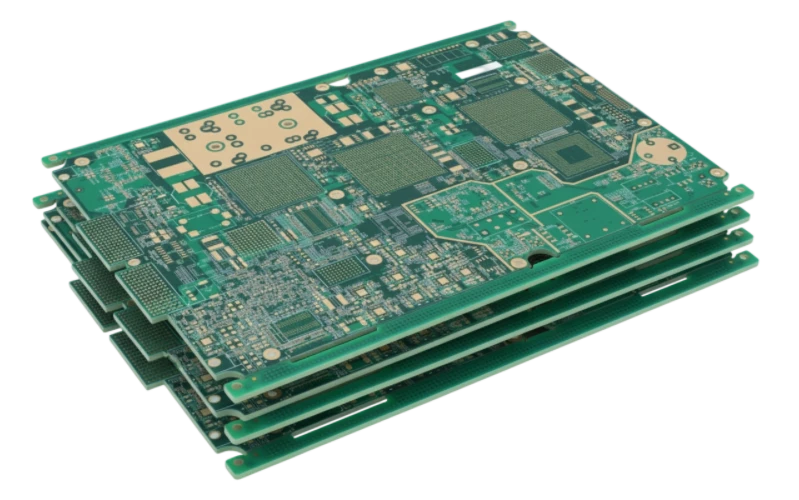
An FFT Analyzer PCB is the hardware core of spectrum analysis equipment, responsible for converting time-domain signals into frequency-domain data with high precision. These boards require rigorous mixed-signal design strategies to separate sensitive analog front-ends from high-speed digital processing units (DSP or FPGA). Engineers rely on APTPCB (APTPCB PCB Factory) to manufacture these complex boards where signal integrity and low noise floors are non-negotiable.
FFT Analyzer PCB quick answer (30 seconds)
Designing a functional FFT Analyzer PCB requires strict adherence to noise management and signal path integrity.
- Separate Analog and Digital Grounds: Use a single point of connection (star ground) or carefully partitioned planes to prevent digital switching noise from corrupting analog measurements.
- Prioritize Power Integrity: Use ultra-low noise LDOs for the analog front-end (AFE) and place decoupling capacitors as close to ADC power pins as possible.
- Control Impedance Strictly: Maintain 50Ω (or specific differential impedance) for all signal inputs to prevent reflections that appear as ghost frequencies in the FFT spectrum.
- Shielding is Mandatory: Use metal cans or dedicated ground vias (stitching) around sensitive RF sections to block external EMI.
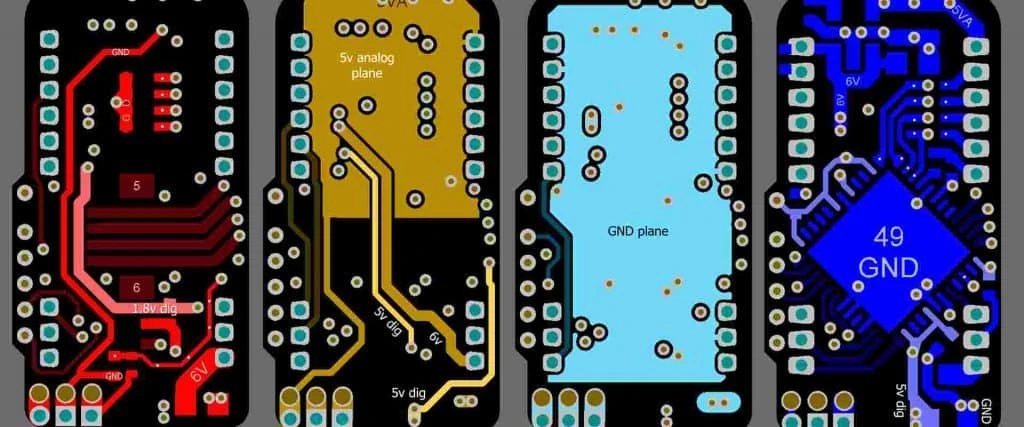
- Layer Stackup Matters: A minimum 4-layer board is required; 6 to 8 layers are recommended to provide dedicated ground reference planes for high-speed signals.
- Thermal Management: High-speed ADCs and FPGAs generate heat that alters component values; ensure thermal vias and heatsinks are part of the design.
When FFT Analyzer PCB applies (and when it doesn’t)
Understanding the specific use case ensures the board meets the required dynamic range and bandwidth.
When to use a specialized FFT Analyzer PCB:
- Vibration Analysis: When detecting micro-fractures in machinery using accelerometers requiring high dynamic range (>100 dB).
- EMC Compliance Testing: For an EMC Analyzer PCB designed to detect electromagnetic interference within specific regulatory bands.
- RF Signal Characterization: When building an Antenna Analyzer PCB to measure S-parameters and impedance matching at high frequencies.
- Power Quality Monitoring: For a Disturbance Analyzer that tracks harmonics and transients in electrical grids.
- Precision Audio Testing: When measuring Total Harmonic Distortion (THD) and noise floors in high-fidelity audio equipment.
When a standard PCB is sufficient (FFT not required):
- Simple Data Logging: If the application only records static DC voltages or slow-changing temperature data.
- Basic Logic Control: Microcontroller boards that only trigger relays or LEDs based on threshold values.
- Low-Frequency PWM Control: Motor drivers where frequency analysis of the switching noise is not critical to the function.
- Battery Management Systems (Basic): Unless it is a high-end Battery Analyzer PCB using electrochemical impedance spectroscopy (EIS).
FFT Analyzer PCB rules and specifications (key parameters and limits)
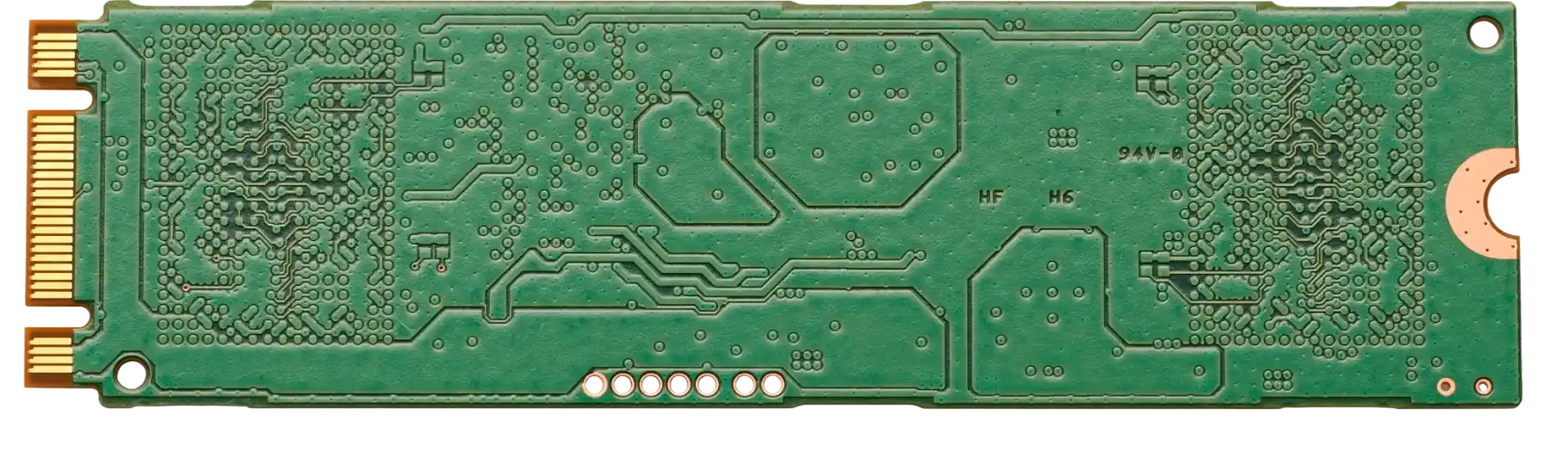
The following table outlines the critical design rules for manufacturing a high-performance FFT Analyzer PCB.
| Rule | Recommended Value/Range | Why it matters | How to verify | If ignored |
|---|---|---|---|---|
| Trace Impedance | 50Ω ±5% (Single-ended) | Prevents signal reflections that cause measurement errors. | TDR (Time Domain Reflectometry). | False peaks appear in the frequency spectrum. |
| Analog/Digital Isolation | > 3mm gap or split planes | Prevents digital clock noise from coupling into the analog signal. | Layout review & Near-field probe. | High noise floor masks low-level signals. |
| Layer Count | 6–12 Layers | Allows dedicated ground planes for return paths. | Stackup analysis tool. | Poor EMI performance and crosstalk. |
| Material Selection | High-Tg FR4 or Rogers (High Freq) | Reduces dielectric loss and maintains stability over temperature. | Check Dk/Df datasheet values. | Signal attenuation at higher frequencies. |
| Via Stitching | < λ/20 spacing | Creates a Faraday cage effect to block interference. | DRC (Design Rule Check). | External RF noise corrupts measurements. |
| ADC Clock Jitter | < 100 fs (Femtoseconds) | Jitter directly limits the Signal-to-Noise Ratio (SNR). | Phase noise analyzer. | Reduced effective number of bits (ENOB). |
| Power Supply Ripple | < 10 µVrms | Power noise couples directly into the ADC output. | Oscilloscope with AC coupling. | Spurious spikes appear in the FFT graph. |
| Copper Weight | 1 oz (Outer), 0.5 oz (Inner) | Balances current capacity with fine-pitch etching capability. | Cross-section analysis. | Overheating or etching defects on fine lines. |
| Surface Finish | ENIG or ENEPIG | Provides a flat surface for fine-pitch BGAs and ADCs. | Visual inspection. | Poor solder joints on critical ICs. |
| Thermal Vias | Under thermal pads | Dissipates heat from FPGA/DSP to prevent thermal drift. | Thermal imaging. | Component drift or thermal shutdown. |
FFT Analyzer PCB implementation steps (process checkpoints)
Follow these steps to move from concept to a manufactured board with APTPCB.
Define Frequency Range & Dynamic Range:
- Action: Determine if you need a Benchtop Analyzer (mains powered, high performance) or a portable unit.
- Parameter: Max frequency (Nyquist limit) and bit depth (16-bit vs 24-bit).
- Check: Select ADC and processor capable of handling the data throughput.
Design the Stackup:
- Action: Contact the manufacturer to confirm available materials and prepreg thicknesses.
- Parameter: Dielectric constant (Dk) and distance to reference plane.
- Check: Verify impedance calculations match the manufacturer's capabilities.
- Link: Multi-layer laminated structure
Component Placement (Floorplanning):
- Action: Place the ADC and analog front-end as far as possible from the switching power supplies and digital logic.
- Parameter: Separation distance > 20mm if possible.
- Check: Ensure analog signal paths are short and direct.
Routing and Grounding:
- Action: Route critical analog signals first. Use differential pairs for ADC inputs.
- Parameter: Length matching tolerance < 5 mils for differential pairs.
- Check: Ensure no digital traces cross over the split in the ground plane (if used).
Power Distribution Network (PDN) Design:
- Action: Place bulk capacitors and high-frequency bypass capacitors.
- Parameter: Low ESR capacitors close to pins.
- Check: Simulate PDN impedance to ensure it is low across the frequency band.
DFM Review and File Generation:
- Action: Run Design for Manufacturing checks to prevent fabrication issues.
- Parameter: Min trace width/spacing (e.g., 4/4 mil).
- Check: Export Gerbers, Drill files, and IPC-356 netlist.
Fabrication and Assembly:
- Action: Send files for manufacturing.
- Parameter: Specify controlled impedance and tolerance requirements.
- Check: Perform electrical testing (E-test) on bare boards.
Validation and Calibration:
- Action: Power up and inject known reference signals.
- Parameter: Measure noise floor and linearity.
- Check: Calibrate the input scaling factors in software.
FFT Analyzer PCB troubleshooting (failure modes and fixes)
Even with careful design, issues can arise. Use this guide to diagnose common failures.
Symptom: High Noise Floor (Grass on the spectrum)
- Cause: Poor grounding or noisy power supply.
- Check: Probe the analog power rail; check for digital ground loops.
- Fix: Add ferrite beads to power rails; improve ground plane continuity.
- Prevention: Use dedicated LDOs for analog circuits.
Symptom: Spurious Peaks (Ghost signals)
- Cause: Aliasing or clock harmonics.
- Check: Verify anti-aliasing filter cutoff frequency; check clock routing.
- Fix: Adjust filter values; shield the clock trace.
- Prevention: Route clock lines between ground planes (stripline).
Symptom: 50Hz/60Hz Hum
- Cause: Mains coupling or ground loops.
- Check: Inspect cable shielding and chassis grounding.
- Fix: Use differential inputs to reject common-mode noise.
- Prevention: Design proper chassis ground connections.
Symptom: Signal Amplitude Drop at High Frequencies
- Cause: Impedance mismatch or dielectric loss.
- Check: TDR measurement of input traces.
- Fix: Respin board with correct impedance or lower loss material.
- Prevention: Use High Frequency PCB materials for RF inputs.
Symptom: DC Offset Drift
- Cause: Thermal gradients affecting op-amps.
- Check: Thermal camera inspection during operation.
- Fix: Improve thermal isolation or add heatsinks.
- Prevention: Symmetric layout of differential amplifier components.
Symptom: Digital Data Corruption
- Cause: Crosstalk between data lines.
- Check: Eye diagram analysis of digital bus.
- Fix: Increase spacing between high-speed lines.
- Prevention: Follow 3W rule (spacing = 3x trace width).
How to choose FFT Analyzer PCB (design decisions and trade-offs)
Choosing the right architecture depends on the target frequency and precision.
Dedicated Hardware vs. PC-Based Oscilloscope A dedicated Benchtop Analyzer PCB requires a robust embedded processor and display driver, increasing complexity but offering standalone reliability. A PC-based USB analyzer moves the processing to the computer, simplifying the PCB to just the Analog Front End (AFE) and data capture interface.
Material Selection: FR4 vs. Rogers/Teflon For audio and vibration (low frequency < 100 kHz), standard FR4 is cost-effective and sufficient. However, for an Antenna Analyzer PCB operating in the MHz or GHz range, FR4 introduces too much signal loss and phase distortion. In these cases, hybrid stackups (using Rogers for signal layers and FR4 for mechanical structure) are the standard choice.
Discrete ADC vs. Microcontroller Internal ADC Internal ADCs in microcontrollers are cheap but often limited to 12-bit resolution and suffer from on-chip digital noise. High-performance FFT analysis requires discrete 16-bit or 24-bit ADCs with separate voltage references to achieve the necessary dynamic range.
FFT Analyzer PCB FAQ (cost, lead time, common defects, acceptance criteria, Design for Manufacturability (DFM) files)
1. What is the typical lead time for an FFT Analyzer PCB? Standard prototypes take 3–5 days. Complex boards with blind/buried vias or hybrid materials may take 8–12 days. APTPCB offers expedited services for urgent NPI (New Product Introduction) builds.
2. How much does an FFT Analyzer PCB cost to manufacture? Cost depends on layer count, material, and quantity. A 4-layer FR4 prototype is inexpensive, while an 8-layer Rogers/FR4 hybrid board for an EMC Analyzer PCB will cost significantly more due to material costs and lamination cycles.
3. What files are required for DFM review? You must provide Gerber files (RS-274X), NC Drill files, a stackup drawing specifying impedance requirements, and a Pick & Place file if assembly is required.
4. How do I specify impedance control for my order? Include an impedance table in your fabrication drawing or README file. List the target impedance (e.g., 50Ω), the trace width, the reference layer, and the specific layer on which the trace is routed.
5. What are the acceptance criteria for these boards? Acceptance is usually based on IPC-A-600 Class 2 or Class 3. For FFT analyzers, TDR testing reports are often required to prove impedance compliance, along with 100% electrical continuity testing.
6. Can you manufacture PCBs for Battery Analyzer applications? Yes. A Battery Analyzer PCB often requires heavy copper to handle high discharge currents while simultaneously measuring small voltage drops. We support heavy copper options up to 10 oz.
7. What is the most common defect in FFT PCB manufacturing? Impedance mismatch due to incorrect dielectric thickness is common if the stackup is not agreed upon beforehand. Always confirm the stackup with the fab house before routing.
8. Do I need gold fingers for my analyzer card? If your FFT analyzer is a PCIe card or plugs into a backplane, hard gold plating (Gold Fingers) is required for durability. ENIG is sufficient for component soldering but not for repeated insertion.
9. How do you handle mixed-signal testing? We perform Testing & Quality checks including AOI (Automated Optical Inspection) and Flying Probe testing. For functional testing of mixed-signal boards, we can use customer-supplied test fixtures.
10. Why is the noise floor higher than simulated? This is often due to real-world factors like power supply ripple or external EMI that were not modeled. Shielding cans and proper enclosure grounding are often needed in the final assembly.
FFT Analyzer PCB glossary (key terms)
| Term | Definition |
|---|---|
| FFT (Fast Fourier Transform) | An algorithm that computes the discrete Fourier transform of a sequence, converting time domain to frequency domain. |
| ADC (Analog-to-Digital Converter) | A component that converts continuous analog signals into discrete digital numbers. |
| Noise Floor | The measure of the signal created from the sum of all the noise sources and unwanted signals. |
| Dynamic Range | The ratio between the largest and smallest values that a certain quantity can assume (usually signal vs. noise). |
| Aliasing | An effect that causes different signals to become indistinguishable when sampled; prevented by Nyquist filtering. |
| ENOB (Effective Number of Bits) | A measure of the dynamic range of an ADC, considering noise and distortion. |
| Impedance Control | Manufacturing process to ensure trace resistance/reactance matches design specs (usually 50Ω). |
| Crosstalk | Unwanted signal transfer between communication channels or wires. |
| EMI (Electromagnetic Interference) | Disturbance generated by an external source that affects an electrical circuit. |
| Stackup | The arrangement of copper layers and insulating material layers that make up a PCB. |
Request a quote for FFT Analyzer PCB (Design for Manufacturability (DFM) review + pricing)
Ready to manufacture your high-precision analyzer? APTPCB provides comprehensive DFM reviews to catch noise coupling risks and impedance mismatches before production begins.
What to send for an accurate quote:
- Gerber Files: Complete set including drill files.
- Fabrication Drawing: Specify materials (e.g., Rogers 4350B), stackup, and impedance targets.
- Quantity & Lead Time: Prototype vs. Mass Production needs.
- Assembly Info: BOM and Pick & Place files if you need turnkey assembly.
For detailed pricing and engineering support, visit our Quote Page. Our team will review your data and suggest optimizations for signal integrity and cost efficiency.
Conclusion (next steps)
Designing a successful FFT Analyzer PCB requires balancing precise analog layout with robust digital processing. By adhering to strict grounding rules, selecting the right materials, and verifying impedance, you can achieve the low noise floor required for accurate spectrum analysis. Whether you are building a portable Antenna Analyzer PCB or a complex Disturbance Analyzer, partnering with an experienced manufacturer ensures your design performs as intended.