
Electromagnetic Compatibility (EMC) testing is the critical gateway between a prototype and a marketable product. However, many engineers overlook a vital component of this process: the mechanical and electrical interface holding the device. This is where fixture design for EMC validation becomes essential. A poorly designed fixture can introduce noise, reflect signals, or fail to ground the device properly, leading to false failures and costly redesigns.
At APTPCB (APTPCB PCB Factory), we understand that the fixture is not just a holder; it is an active part of the test environment. Whether you are testing for radiated emissions or conducted immunity, the fixture must be "transparent" to the radio frequency (RF) environment while providing robust mechanical support. This guide covers the entire lifecycle of fixture design, from initial metrics to final manufacturing.
Key Takeaways
- Transparency is key: The primary goal of fixture design for EMC validation is to minimize the fixture's impact on the RF field.
- Material matters: High dielectric constant materials can detune antennas; use materials like Teflon or Delrin.
- Cable management: Poor cable routing creates unintentional antennas that radiate noise.
- Grounding consistency: The fixture must replicate the grounding scheme of the final installation environment.
- Validation is mandatory: A "golden unit" test is required to prove the fixture itself is not the source of failure.
- DFM integration: Design for Manufacturing ensures the fixture can be built repeatedly with tight tolerances.
What “Electromagnetic Compatibility (EMC) fixture design” means (scope & boundaries)
To understand the nuances of this field, we must first define the scope. Fixture design for EMC validation refers to the engineering of the physical and electrical apparatus used to support and operate a Device Under Test (DUT) inside an EMC chamber or test setup.
Unlike standard functional test fixtures (ICT or FCT), which prioritize probe access and speed, EMC fixtures prioritize RF neutrality. The fixture must hold the PCB or device in a specific orientation without reflecting electromagnetic waves or shielding the device from incoming fields.
The Scope
The design process includes:
- Mechanical Structure: The non-conductive frame holding the DUT.
- Interface Cabling: Power, data, and auxiliary cables routed to Line Impedance Stabilization Networks (LISNs).
- Peripheral Simulation: On-board loads or simulators that mimic the device's real-world environment.
The Boundaries
It is crucial to distinguish this from other fixture types.
- Not a Shielding Box: The fixture is usually open-air to allow emissions to escape or enter.
- Not a Production Programmer: While it powers the device, it is rarely used for flashing firmware unless necessary for the test mode.
- Not a Stress Test: Unless combined with environmental testing, the fixture does not need to withstand extreme heat or vibration, only the test duration.
Metrics that matter (how to evaluate quality)
Building on the definition, we must establish how to measure success. A fixture is only as good as the data it allows you to capture. In fixture design for EMC validation, specific metrics determine if the rig is fit for purpose.
| Metric | Why it matters | Typical range or influencing factors | How to measure |
|---|---|---|---|
| Dielectric Constant (Dk) | High Dk materials near the DUT antenna will detune it, shifting frequency response. | Target Dk < 3.0 (e.g., Teflon, Delrin, RO4000 series). | Material datasheet verification or cavity resonator test. |
| Reflection Coefficient (S11) | Indicates how much RF energy bounces off the fixture rather than passing through or being absorbed. | < -20dB is ideal for the fixture structure itself. | Vector Network Analyzer (VNA) sweep of the empty fixture. |
| Insertion Loss | Measures signal loss through the fixture's cabling or interface board. | < 0.5dB per meter for cabling (frequency dependent). | VNA measurement of cable assemblies. |
| Shielding Effectiveness (Cabling) | Prevents the test cables from picking up noise or radiating their own noise. | > 80dB for shielded cables in the test band. | Transfer impedance measurement. |
| Mechanical Tolerance | Ensures the DUT is positioned exactly the same way for every scan to ensure repeatability. | ± 0.1mm to ± 0.5mm depending on frequency (higher freq = tighter tolerance). | CMM (Coordinate Measuring Machine) inspection. |
| Thermal Stability | The fixture must not deform under the heat generated by the DUT during long tests. | Material Tg (Glass Transition Temp) > DUT operating temp + 20°C. | Thermal chamber cycle test. |
| Background Noise Floor | The fixture's active electronics (if any) must be quieter than the limit lines. | At least 6dB below the regulatory limit line. | Spectrum analyzer scan of powered fixture without DUT. |
Selection guidance by scenario (trade-offs)
With metrics established, the next step is selecting the right design approach based on the specific test scenario. There is no "universal fixture." Different EMC tests impose conflicting requirements on fixture design for EMC validation.
Scenario 1: Radiated Emissions (RE) Testing
- Goal: Measure noise coming out of the device.
- Priority: Low reflection and low absorption.
- Trade-off: You must minimize metal parts. Use plastic screws and supports.
- Material Choice: Low-Dk plastics like Delrin or specific Rogers PCB materials for interface boards to prevent signal absorption.
Scenario 2: Radiated Immunity (RI) Testing
- Goal: Blast the device with high-power RF to see if it fails.
- Priority: Durability and thermal management. High fields can heat up metal parts or cause arcing.
- Trade-off: The fixture must be robust but cannot shield the DUT.
- Design Tip: Avoid closed loops of wire or metal frames that could act as inductive loops, heating up under high field strength.
Scenario 3: Conducted Emissions (CE) Testing
- Goal: Measure noise traveling back up the power cable.
- Priority: Grounding impedance.
- Trade-off: The fixture needs a very low-impedance ground connection to the reference plane.
- Design Tip: Use wide copper straps or direct bonding for grounding rather than long wires.
Scenario 4: Automotive Component Testing (CISPR 25)
- Goal: Simulate a vehicle environment.
- Priority: Harness layout. The standard dictates exact cable lengths (e.g., 1500mm).
- Trade-off: The fixture is often a long table setup (ground plane) rather than a box.
- Design Tip: The fixture must include a "load box" to simulate vehicle peripherals, which must be shielded to avoid contributing to the noise.
Scenario 5: High-Speed Digital Devices (5G/Radar)
- Goal: Testing devices operating at mmWave frequencies.
- Priority: Positional accuracy. A 1mm shift changes the phase significantly.
- Trade-off: Requires precision machining (expensive) over 3D printing.
- Design Tip: Use PEEK material for stability and low dielectric loss at high frequencies.
Scenario 6: Portable/Handheld Devices
- Goal: Simulate human handling.
- Priority: Dielectric simulation of a human hand (optional but often required).
- Trade-off: Adding "phantom hands" changes the tuning.
- Design Tip: The fixture must hold the device in "typical use" orientation (e.g., vertical for a phone) using minimal contact points.
From design to manufacturing (implementation checkpoints)
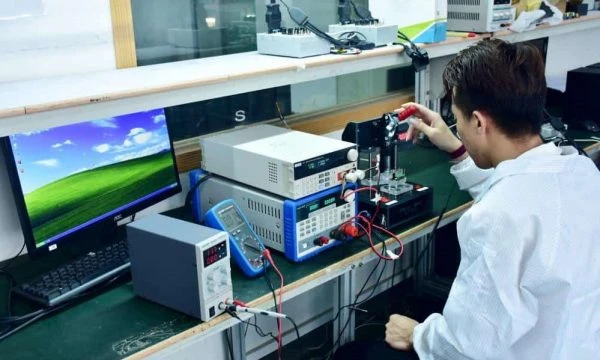
Once the strategy is selected, the actual engineering begins. At APTPCB, we recommend a structured checkpoint system to move from a CAD model to a physical tool. This ensures the fixture design for EMC validation is manufacturable and functional.
Phase 1: Design & Material Sourcing
Checkpoint: Material Dielectric Verification
- Recommendation: Confirm the batch Dk of the plastic. Generic "Nylon" varies wildly.
- Risk: Detuning the DUT antenna.
- Acceptance: Supplier datasheet or sample test.
Checkpoint: 3D Modeling of Cable Paths
- Recommendation: Model the cable routing in CAD, not just the mechanical holder.
- Risk: Cables dangling in front of the antenna during the test.
- Acceptance: CAD review showing fixed routing channels.
Checkpoint: Metal Minimization Review
- Recommendation: Replace all non-essential metal screws with Nylon or PEEK fasteners.
- Risk: Metal fasteners acting as parasitic elements.
- Acceptance: BOM review (Bill of Materials).
Phase 2: Fabrication & Assembly
Checkpoint: PCB Interface Fabrication
- Recommendation: If the fixture uses a PCB, follow strict DFM guidelines for impedance control.
- Risk: Signal integrity loss on the monitoring lines.
- Acceptance: TDR (Time Domain Reflectometry) test on bare boards.
Checkpoint: Connector Selection
- Recommendation: Use shielded connectors (SMA, N-type) that are rated for the test frequency.
- Risk: Leakage at the connector interface.
- Acceptance: VSWR measurement of the connector assembly.
Checkpoint: Ferrite Bead Placement
- Recommendation: Place ferrites on auxiliary cables outside the measurement zone to absorb noise entering from the support equipment.
- Risk: Noise from the power supply invalidating the test.
- Acceptance: Visual inspection against schematic.
Checkpoint: Grounding Bond Integrity
- Recommendation: Ensure ground pads are gold-plated or conductive chromate, not painted.
- Risk: High resistance ground connection causing CE failures.
- Acceptance: Resistance measurement (< 2.5 milliohms).
Phase 3: Validation
Checkpoint: Empty Chamber Scan
- Recommendation: Run a full emission scan with the fixture installed but powered off (or powered without DUT).
- Risk: The fixture itself radiates noise.
- Acceptance: Noise floor must be >6dB below limits.
Checkpoint: Golden Unit Correlation
- Recommendation: Test a known "passing" unit and a known "failing" unit.
- Risk: The fixture masks failures or creates false failures.
- Acceptance: Data matches historical baselines.
Checkpoint: Mechanical Repeatability
- Recommendation: Remove and re-insert the DUT 10 times.
- Risk: Loose fit causes variable results.
- Acceptance: Variation in results < 2dB.
Common mistakes (and the correct approach)
Even experienced engineers make errors in fixture design for EMC validation. Avoiding these pitfalls saves time and money.
Using Standard FR4 for High-Frequency Fixtures
- Mistake: Using standard FR4 for the fixture's interface board in >5GHz tests. FR4 is lossy and inconsistent at these frequencies.
- Correction: Use specialized RF laminates like Rogers or Teflon-based substrates.
Ignoring the "Pigtail" Effect
- Mistake: Leaving long, unshielded wire tails when connecting cable shields to the ground.
- Correction: Use 360-degree backshells or keep ground connections extremely short (millimeters, not centimeters).
Over-Engineering the Structure
- Mistake: Building a massive, thick plastic block to hold a small PCB.
- Correction: Use a "skeleton" design. Remove as much material as possible to reduce dielectric loading. Air is the best dielectric.
Routing Cables Across the Antenna
- Mistake: Allowing power or data cables to cross the radiation pattern of the DUT's antenna.
- Correction: Route all cables directly away from the antenna, preferably along the ground plane or through the back of the fixture.
Using Ferrous Metals in Magnetic Fields
- Mistake: Using steel screws in a fixture for magnetic field testing.
- Correction: Use non-magnetic stainless steel (316 series), brass, or plastic.
Forgetting Thermal Expansion
- Mistake: Designing tight-tolerance fixtures for high-temp testing without accounting for expansion.
- Correction: Calculate the CTE (Coefficient of Thermal Expansion) mismatch between the DUT and the fixture.
Neglecting Impedance Matching
- Mistake: Using random wires for high-speed signals.
- Correction: Use an impedance calculator to design traces and select cables that match the source impedance (usually 50 ohms).
Assuming "Shielded" Means "Perfect"
- Mistake: Assuming a shielded cable blocks all noise.
- Correction: Shields only work if grounded correctly at both ends (or one end, depending on the frequency and loop issues). Verify shield termination.
FAQ
Q1: What is the best material for EMC test fixtures? For general purpose, Delrin (Acetal) is excellent due to its strength and machinability. For high-frequency or high-temperature applications, Teflon (PTFE) or PEEK are superior due to their low dielectric constant and thermal stability.
Q2: Can I use 3D printed parts for EMC fixtures? Yes, but be careful. Standard PLA or ABS can have variable dielectric properties and may absorb moisture. SLA resins are often better, but you must verify they don't contain conductive pigments (like carbon black).
Q3: How does the fixture affect Radiated Emissions results? The fixture can reflect waves, creating standing waves that artificially boost signal peaks. Conversely, it can absorb energy, making a failing device appear to pass.
Q4: Do I need a custom fixture for every product? Ideally, yes. However, modular fixtures with adjustable clamps can be used for development testing. For final compliance, a dedicated fixture ensures repeatability.
Q5: What is the difference between a test jig and an EMC fixture? A test jig often includes pogo pins, clamps, and toggle clamps for fast operator use. An EMC fixture minimizes metal and prioritizes RF transparency, often sacrificing "quick load" features for RF performance.
Q6: How do I route cables to avoid acting as antennas? Twist wires together to cancel magnetic fields, use shielded cables, and add ferrite beads. Route cables perpendicular to the electric field polarization if possible.
Q7: Why is grounding so critical in fixture design? If the fixture ground is floating relative to the chamber floor, the entire fixture becomes a radiating element. The fixture ground must be bonded to the chamber ground reference.
Q8: Can APTPCB help design the fixture? Yes, APTPCB assists with the PCB manufacturing aspect of the interface boards and can recommend partners or guidelines for the mechanical assembly.
Q9: How often should fixtures be validated? Fixtures should be visually inspected before every test campaign and electrically validated (S-parameters/loss) annually or if dropped/damaged.
Q10: What is a "Golden Unit"? A Golden Unit is a device that has previously passed testing and has known emission characteristics. It is used to verify that the fixture and chamber are reading correctly.
Related pages & tools
- Rogers PCB Materials: Explore low-loss materials essential for high-frequency fixture interface boards.
- DFM Guidelines: Ensure your fixture's PCB is manufacturable and reliable.
- Impedance Calculator: Calculate the correct trace width for 50-ohm matching on your test interface.
- Get a Quote: Ready to manufacture your fixture's interface PCB? Upload your files here.
Glossary (key terms)
| Term | Definition |
|---|---|
| DUT / EUT | Device Under Test / Equipment Under Test. The product being validated. |
| LISN | Line Impedance Stabilization Network. A device used to provide standardized impedance and isolate the DUT from power source noise. |
| Anechoic Chamber | A room designed to stop reflections of either sound or electromagnetic waves. |
| Dielectric Constant (Dk) | A measure of a material's ability to store electrical energy in an electric field. Lower is better for EMC fixtures. |
| S-Parameters | Scattering parameters. Mathematical descriptions of how RF energy behaves in a network (reflected vs. transmitted). |
| Ferrite Bead | A passive electric component that suppresses high-frequency noise in electronic circuits. |
| Common Mode Noise | Noise that flows in the same direction on both signal lines and returns via ground. |
| Differential Mode Noise | Noise that flows in opposite directions on signal and return lines. |
| Far-Field | The region where the electromagnetic field distribution is essentially independent of the distance from the antenna. |
| Near-Field | The region close to the antenna where the fields are reactive and complex. |
| VSWR | Voltage Standing Wave Ratio. A measure of how efficiently radio-frequency power is transmitted. |
| Ground Loop | An unwanted current path in a circuit caused by potential differences between ground points. |
| Permittivity | Another term for Dielectric Constant. |
Conclusion (next steps)
Successful fixture design for EMC validation is a balance of mechanical stability and electrical invisibility. It requires a shift in mindset from "holding the part" to "preserving the RF environment." By focusing on low-Dk materials, precise cable management, and rigorous validation checkpoints, you can eliminate false failures and accelerate your time to market.
When you are ready to move from concept to production, the quality of your interface PCB is paramount. Whether you need high-frequency Rogers laminates or complex rigid-flex structures for your test setup, APTPCB is ready to support your engineering needs.
Ready to build your validation fixture? When requesting a quote for your fixture's interface board, please provide:
- Gerber Files: The standard manufacturing data.
- Stackup Details: Crucial for impedance control.
- Material Specs: Specify if you need Rogers, Teflon, or standard FR4.
- Test Frequency: Helps us suggest the right surface finish and tolerance.
Visit our Quote Page to get started today.