
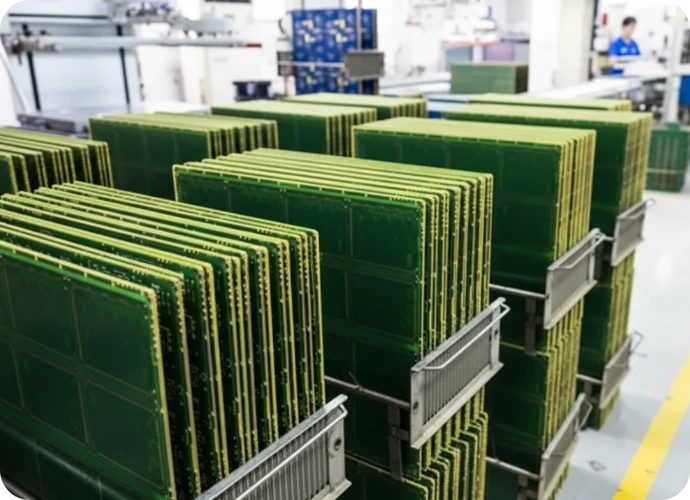
Heavy PCB assemblies require more than standard conveyor support. Large backplanes, thick-copper power boards, ceramic modules, and assemblies with heavy components can lose flatness during reflow because the laminate softens near its Glass Transition Temperature (Tg) while gravity continues pulling unsupported areas downward.
A correctly engineered fixture design for heavy boards maintains mechanical support, protects fragile substrates, preserves thermal uniformity, and reduces defects such as warpage, solder cracking, ceramic fracture, and conveyor handling failures.
This guide explains when a heavy-board fixture is required, how to select the correct material and structure, and which specifications should be included before releasing a fixture for production.
Quick answer: when does a heavy PCB need a dedicated fixture?
A dedicated fixture is normally required when one or more of these conditions apply:
- Board thickness exceeds approximately 3.2mm.
- Assembly weight exceeds approximately 1kg.
- Board dimensions create long unsupported spans.
- Heavy copper layers add significant mass.
- Ceramic substrates require controlled handling.
- Double-sided reflow places heavy components on the secondary side.
- The assembly experiences warpage after standard conveyor processing.
The core design targets are:
| Parameter | Recommended specification |
|---|---|
| Fixture material | CDM/Durostone composite or Titanium for demanding applications |
| Unsupported span | Keep below 150mm for heavy assemblies |
| Clearance from components | Minimum 3mm from fixture walls |
| Fixture flatness | Within ±0.1mm before production use |
| Hold-down force | Approximately 0.5kg–1.0kg force |
| Thermal validation | Verify actual profile with fixture installed |
| Production check | Confirm post-reflow warpage and board handling performance |
How do you choose the correct fixture material for heavy boards?
Material selection affects thermal behavior, stiffness, cycle life, and production cost.
| Material | Best application | Advantages | Limitations |
|---|---|---|---|
| CDM / Durostone composite | General heavy-board reflow fixtures | High temperature resistance, low thermal conductivity, good machinability | Gradual wear after repeated thermal cycling |
| Titanium | Extreme durability and high-cycle applications | High stiffness, thin structures possible, excellent mechanical strength | Higher cost |
| Aluminum | Cold operations or non-reflow support | Easy machining, high stiffness | Acts as a heat sink during reflow and can disturb thermal performance |
For most heavy PCB reflow applications, composite fixtures provide the best balance between thermal isolation and mechanical support. Titanium becomes attractive when fixture life, stiffness, or repeated cycling justify the additional cost.
What fixture design specifications should engineers provide?
A fixture supplier needs more than PCB dimensions. The following specifications define the mechanical and thermal requirements.
| Requirement | Recommended value | Verification method |
|---|---|---|
| Fixture wall thickness | Minimum 5mm composite construction | Caliper measurement |
| PCB pocket depth | PCB thickness + approximately 0.5mm | Depth gauge inspection |
| Support rib width | Minimum 3mm | Mechanical inspection |
| CTE compatibility | Below approximately 15 ppm/°C preferred | Material datasheet review |
| Airflow relief | Chamfered edges, typically 45° | Visual inspection |
| Corner radius | Minimum 2mm | Radius measurement |
| ESD resistance | 10⁵ to 10⁹ Ω/sq | Surface resistivity testing |
| Total fixture load | Typically below 5kg unless equipment supports more | Weight measurement |
| Tooling alignment | Two tooling holes recommended | Alignment check |
| Solder clearance | Approximately 2.5mm from pads | CAD/Gerber review |
Should a heavy board use perimeter support or center support?
Heavy assemblies usually require support across the board span, not only around the perimeter.
A perimeter-only fixture can allow the center of a large PCB to sag during reflow. Center ribs, support bars, or machined standoffs distribute the load while maintaining airflow.
Support placement should consider:
- Bottom-side component locations.
- Thermal airflow paths.
- Pick-and-place nozzle access.
- Solder pad clearance.
- Board center of gravity.
For assemblies with ceramic substrates or brittle components, support must prevent flexing during both heating and cooling cycles.
How should fixtures be designed for ceramic substrates and die attach?
Ceramic assemblies require special attention because the substrate is mechanically strong but brittle. Small amounts of bending stress can create hidden cracks that reduce reliability.
For die attach on ceramic substrates, fixture design should include:
- Low-force spring-loaded retention.
- Controlled expansion allowance.
- Support directly under rigid substrate areas.
- Careful CTE consideration between fixture and ceramic.
- Gentle handling during loading and unloading.
Rigid clamps that prevent expansion can transfer stress into the substrate during thermal cycling.
Fixture design decision matrix
Use this matrix when selecting a fixture approach.
| Application condition | Recommended fixture strategy |
|---|---|
| Large FR4 board with heavy components | Composite fixture with center supports |
| Thick copper power board | Low thermal mass composite fixture with reinforced ribs |
| Ceramic module | Precision support fixture with controlled hold-down force |
| Double-sided reflow | Dedicated carrier with underside protection |
| High-volume production | Fixed dedicated fixture |
| Multiple similar products | Adjustable fixture only if support requirements are similar |
How do you validate a heavy-board fixture before mass production?
A fixture should be qualified with the real PCB assembly, not only a mechanical drawing.
The validation sequence should include:
- Measure fixture flatness before use.
- Verify PCB fit and movement inside the pocket.
- Check component clearance using assembly data.
- Run a thermal profile with thermocouples attached to critical locations.
- Measure temperature difference across the board.
- Inspect board flatness after reflow.
- Confirm conveyor compatibility.
For heavy boards, the combined thermal mass of the PCB and fixture can significantly change the reflow profile. The fixture must be included during profiling.
What are the common heavy-board fixture failure modes?
| Failure | Primary cause | Corrective action |
|---|---|---|
| Board center sagging | Insufficient support ribs or excessive unsupported span | Add center supports or reduce span |
| Cold solder joints | Fixture blocks airflow or absorbs excessive heat | Reduce fixture mass and improve airflow paths |
| Ceramic cracking | Excessive restraint or thermal mismatch | Reduce hold-down force and allow expansion |
| Conveyor jams | Fixture distortion or incorrect dimensions | Inspect flatness and machining tolerance |
| Fixture discoloration | Flux attack or material aging | Replace fixture or select resistant material |
| Wave solder skips | Poor rib orientation or trapped air | Modify support geometry and flow direction |
How should a supplier receive a heavy-board fixture specification?
A complete supplier package should include:
- PCB mechanical drawing.
- Assembly drawing with component heights.
- Bottom-side component keep-out map.
- Gerber data.
- Weight and center-of-gravity information.
- Reflow temperature profile.
- Required material specification.
- Flatness tolerance.
- Pocket dimensions.
- Support locations.
- Expected production cycle count.
Providing these details reduces redesign cycles and prevents fixtures that mechanically fit but fail during production.
Fixed fixture vs adjustable fixture: which is better?
A fixed fixture provides the highest repeatability because the support structure is optimized for one assembly.
Advantages:
- Maximum rigidity.
- Better thermal consistency.
- Precise component clearance.
- Easier qualification.
Adjustable fixtures reduce tooling cost but may compromise support placement for very heavy boards. They are best suited for products with similar dimensions and support requirements.
For critical power electronics, aerospace, automotive, and ceramic assemblies, dedicated fixtures generally provide better production reliability.
FAQ
Can the same fixture be used for wave soldering and reflow?
Usually not. Reflow fixtures focus on flatness and thermal uniformity, while wave solder pallets control solder exposure and protect components. The two processes require different structures.
How does fixture thermal mass affect reflow?
The fixture absorbs heat during oven processing. Heavy composite structures can extend heating time and change the thermal profile. Always profile the complete PCB and fixture combination.
How often should heavy-board fixtures be cleaned?
High-use fixtures should typically be cleaned regularly, such as every 24 hours or around 50 production cycles, depending on flux chemistry and process conditions.
Can standard 3D printing be used for heavy PCB fixtures?
Standard PLA and ABS materials are not suitable for 260°C reflow environments. High-temperature engineering polymers may work for limited applications, but machined composite fixtures are usually preferred for production.
Why is a heavy board still warping after adding a fixture?
Possible causes include insufficient support coverage, fixture distortion, excessive clamp force, or incorrect thermal profiling. The fixture itself must be inspected after thermal cycling.
Related pages & tools
- PCB Manufacturing Capabilities – Review our capacity for handling thick copper and heavy substrates.
- PCB Materials – Select the right substrate material to minimize native warpage.
- Get a Quote – Request a DFM review and fixture quote for your heavy board assembly.
- DFM guidelines – Review design practices for manufacturability.
Glossary
| Term | Definition |
|---|---|
| CDM / Durostone | High-temperature composite material commonly used for PCB fixtures. |
| Tg | Temperature where PCB material properties change and sag risk increases. |
| CTE | Material expansion rate caused by temperature changes. |
| Thermal mass | The ability of a material to absorb and retain heat. |
| Hold-down | Spring, clip, or mechanism used to secure a PCB. |
| Warpage | Deviation from PCB flatness after mechanical or thermal stress. |
| Reflow soldering | Oven process where solder paste melts and forms joints. |
| Wave soldering | Process where molten solder contacts exposed joints. |
Conclusion
Heavy PCB assemblies require fixture designs that balance mechanical support, thermal performance, and production reliability. The correct combination of material, support geometry, clearance, and validation prevents warpage, solder defects, and substrate damage.
Whether the application involves thick copper power boards, large backplanes, or die attach on ceramic substrates, a properly engineered fixture is a critical part of handling and breakage prevention.
APTPCB integrates fixture design into the DFM process to help engineers move heavy assemblies from prototype validation to stable mass production.