
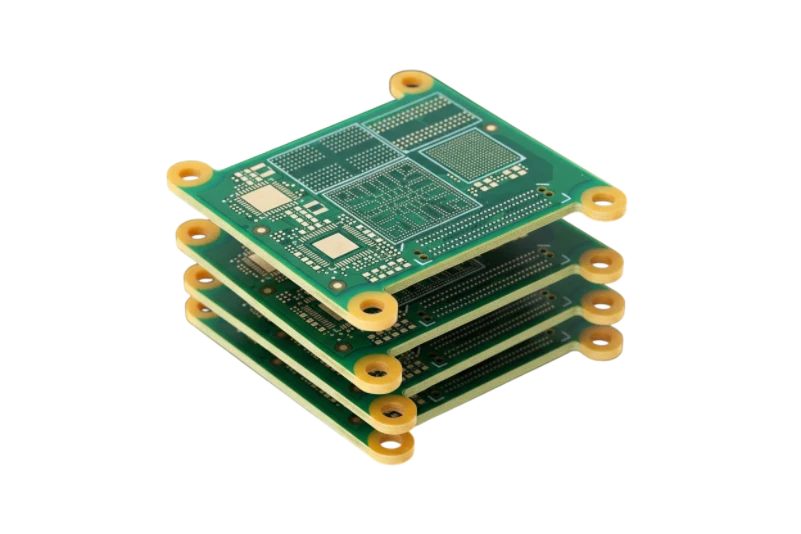
What should engineers consider when designing a Flame Detector PCB?
A Flame Detector PCB must process extremely sensitive optical signals while surviving industrial environments, electrical noise, temperature cycling, and moisture exposure. Unlike simple temperature or smoke sensing boards, flame detector designs often combine:
- UV sensor circuits requiring high-voltage bias generation.
- IR sensing paths requiring thermal stability.
- Analog front ends with high-impedance inputs.
- Microcontrollers running false-alarm rejection algorithms.
- Industrial communication interfaces such as RS-485.
The most important design decisions are made before routing begins:
| Design area | Typical requirement | Engineering reason |
|---|---|---|
| Sensor input routing | Short, guarded traces | Prevent leakage currents and noise pickup |
| UV tube drive | 300V+ circuits may be required | Prevent arcing and insulation breakdown |
| PCB material | High-Tg FR4 for industrial use | Improves thermal cycling reliability |
| Environmental protection | Silicone or acrylic conformal coating | Reduces humidity-related failures |
| Layer structure | 4+ layers for advanced designs | Enables ground shielding and controlled routing |
| Validation | Functional flame simulation | Confirms optical response, not only electrical continuity |
When does a Flame Detector PCB make sense?
A dedicated flame detector PCB is appropriate when the system must identify flame radiation rather than simply detect heat or smoke.
Typical applications include:
- Oil and gas processing equipment.
- Burner management systems.
- Turbine enclosures.
- Chemical processing areas.
- Industrial fire suppression systems.
A standard heat detector PCB may be sufficient when the objective is only temperature monitoring. A gas detector PCB or CO Detector PCB is more appropriate when the hazard is toxic gas accumulation rather than visible flame.
How do UV, IR, and UV/IR Flame Detector PCBs differ?
The PCB architecture depends heavily on the sensing technology.
| Detector type | PCB design priority | Main engineering challenge |
|---|---|---|
| UV flame detector | High-voltage isolation | Protect low-voltage circuits from HV leakage and arcing |
| IR flame detector | Thermal stability | Prevent PCB heat sources from affecting sensor accuracy |
| UV/IR dual sensor | Mixed-signal design | Combine HV isolation, analog precision, and digital processing |
| IR3 multi-spectrum detector | Signal processing capacity | Maintain sensor synchronization and noise immunity |
UV sensors often require specialized bias circuits. IR sensors depend on stable thermal conditions because nearby regulators, power devices, or LEDs can introduce measurement errors.
What PCB specifications are required for Flame Detector designs?
The following parameters should be defined during PCB design review and supplier quotation.
| Parameter | Recommended value/range | Verification method |
|---|---|---|
| Dielectric strength | >30 kV/mm for FR4 insulation material | Hi-Pot testing and material specification review |
| Power trace width | >20 mil (0.5mm) for higher-current paths | Current capacity calculation |
| Guard ring clearance | >10 mil (0.25mm) | PCB design rule check |
| Solder mask dam | >4 mil (0.1mm) | AOI inspection |
| Surface finish | ENIG for sensor contact reliability | Manufacturing inspection |
| Conformal coating | Silicone Type SR or acrylic Type AR | Coating inspection |
| Layer count | 4+ layers for complex industrial designs | Stackup review |
| Via protection | Tented or plugged vias where moisture exposure exists | Cross-section inspection |
| Component spacing | Based on voltage and environmental conditions | IPC-2221B review |
| Thermal relief | Spoke connections for large ground areas | Assembly inspection |
How should a Flame Detector PCB be laid out?
How do you separate high-voltage and sensor circuits?
High-voltage UV drive sections should be physically separated from low-voltage analog and digital sections.
A reliable layout approach includes:
- Place the UV high-voltage supply and switching components in a dedicated PCB region.
- Maintain appropriate creepage and clearance distances between HV and logic areas.
- Prevent HV return currents from sharing sensitive analog ground paths.
- Use PCB slots when additional isolation distance is required.
The exact spacing depends on voltage, pollution degree, altitude, coating, and applicable safety standards.
How do you protect sensitive flame sensor signals?
Flame sensor inputs often operate at high impedance, making them vulnerable to contamination and electromagnetic interference.
Recommended layout practices include:
- Keep sensor traces short.
- Surround sensitive nodes with guard rings.
- Keep digital clocks away from analog inputs.
- Use continuous ground planes.
- Separate switching regulators from sensor components.
What PCB stackup works best for Flame Detector PCBs?
A 4-layer stackup is common for industrial flame detection boards:
- Layer 1: Components and sensitive signal routing.
- Layer 2: Solid ground plane.
- Layer 3: Power distribution and secondary signals.
- Layer 4: Additional routing and communication interfaces.
A multilayer PCB provides better EMI control and reduces the risk of unstable sensor readings.
See our Multilayer PCB capabilities for advanced routing requirements.
What manufacturing process should be specified?
A Flame Detector PCB supplier should receive complete fabrication and assembly requirements.
The manufacturing package should include:
- Gerber files.
- PCB fabrication drawing.
- Stackup definition.
- Copper weight requirements.
- Surface finish specification.
- BOM with manufacturer part numbers.
- Pick-and-place files.
- Coating instructions.
- Test requirements.
For industrial safety applications, specify inspection requirements such as:
- Electrical testing.
- AOI inspection.
- X-ray inspection for hidden solder joints.
- Functional flame simulation testing.
See our Automated Optical Inspection (AOI) inspection guidance for assembly quality requirements.
What are the most common Flame Detector PCB failures?
| Failure symptom | Likely cause | Diagnostic method | Corrective action |
|---|---|---|---|
| False alarms | Leakage current from moisture, contamination, or flux residue | Measure insulation resistance around sensor inputs | Clean PCB, improve coating, add guarding |
| Sensitivity drift | Thermal changes near IR sensor | Thermal inspection and sensor calibration test | Move heat sources away, improve thermal isolation |
| No flame detection | Coating contamination on optical window | Visual inspection under magnification | Remove coating contamination or replace sensor assembly |
| Intermittent operation | Mechanical stress or solder cracking | Microscope inspection and vibration testing | Improve mechanical support and solder reliability |
| RF interference | Poor grounding or shielding | RF exposure testing | Improve ground stitching and filtering |
How do you choose materials for a Flame Detector PCB?
Material selection depends on operating environment.
Commercial environments
Standard FR4 may be acceptable for indoor installations with controlled temperature and humidity.
Industrial environments
High-Tg FR4 is preferred where boards experience:
- Elevated temperatures.
- Thermal cycling.
- Long operating periods.
- Mechanical stress.
For extreme applications, the PCB specification should include:
- Glass transition temperature.
- Thermal decomposition temperature.
- Moisture resistance.
- UL94 flame rating.
What should a Flame Detector PCB supplier provide before production?
A qualified supplier should confirm:
Design review checklist
- HV isolation requirements reviewed.
- Sensor footprints verified against manufacturer datasheets.
- Stackup approved.
- Material grade confirmed.
- Coating compatibility checked.
- Test requirements documented.
Manufacturing checklist
- Gerber review completed.
- DFM analysis completed.
- Component availability confirmed.
- Inspection standards defined.
- Functional testing method agreed.
For assembly support, see our Component Sourcing services.
Flame Detector PCB FAQ
What is the typical prototype lead time?
Bare PCB prototypes commonly require several days depending on layer count, materials, and special processes. Complete PCBA builds require additional time for component sourcing and assembly.
How much does a Flame Detector PCB cost?
Cost depends on:
- Layer count.
- Sensor complexity.
- High-voltage requirements.
- Surface finish.
- Testing requirements.
A simple industrial board may cost only a few dollars, while a complex UV/IR multilayer PCBA with specialized testing can cost significantly more.
Is conformal coating required?
For many industrial flame detector applications, conformal coating is strongly recommended because sensor circuits can be affected by humidity, contamination, and leakage currents.
See our PCB Conformal Coating service information.
What acceptance standard should be used?
Industrial boards commonly use IPC-A-600 and IPC-A-610 requirements. Safety-critical applications may require enhanced inspection levels depending on system certification requirements.
Flame Detector PCB glossary
| Term | Definition |
|---|---|
| UV Tron | Ultraviolet flame sensor using a gas discharge detection principle |
| Pyroelectric Sensor | Infrared sensor producing electrical output from radiation changes |
| Creepage | Distance along an insulating surface between conductors |
| Clearance | Air distance between conductive parts |
| Guard Ring | Conductive protection ring around sensitive nodes to reduce leakage |
| Conformal Coating | Protective coating applied over assembled PCB surfaces |
| False Alarm Rejection | Ability to distinguish flames from sunlight or welding sources |
| Spectral Response | Sensor sensitivity range across electromagnetic wavelengths |
| Intrinsically Safe | Design approach limiting energy in hazardous areas |
| Burn-in Test | Elevated stress testing used to detect early failures |
Request a quote for Flame Detector PCB manufacturing
APTPCB provides PCB fabrication and assembly support for safety electronics requiring controlled manufacturing processes.
Prepare these files for quotation:
- Gerber files with drill data.
- Fabrication drawing with material and thickness.
- BOM with manufacturer part numbers.
- Pick-and-place files for assembly.
- Coating and testing requirements.
Conclusion
A Flame Detector PCB combines high-sensitivity sensing, electrical isolation, environmental protection, and manufacturing precision. The best designs connect detector selection decisions with PCB architecture early in development.
By controlling sensor routing, high-voltage isolation, thermal behavior, materials, and validation testing, engineers can build flame detection systems that remain reliable in demanding industrial environments.
Resources
- Industrial Control PCB: Explore industrial automation PCB solutions.
- Security Equipment PCB: Learn about PCB manufacturing for security and monitoring equipment.
- PCB Quality System: Review PCB quality and certification processes.