
FAQ
What is flex-EMI shielding?
EMI shielding on flex pcb uses copper pour layers, conductive traces, and optional metal covers to block electromagnetic interference. Proper grounding via stitching along the shield perimeter is essential for effective shielding at high frequencies.
How do I ground a flex PCB properly?
Flex pcb grounding requires continuous ground traces on adjacent layers, stitch vias at regular intervals (typically every 3-5mm), and full coverage ground planes where space permits. Dynamic flex circuits need careful strain relief at flex-to-rigid transitions.
What causes EMI issues in flex circuits?
EMI in flex circuits commonly results from long signal traces without proper return paths, insufficient ground plane coverage, crosstalk between adjacent high-speed lines, and radiation from unshielded high-frequency signals traveling through the flex region.
How do I design EMI shielding for high-speed flex?
High-speed flex pcb shielding design involves assigning dedicated shield layers on both sides of signal layers, using cross-hatched ground mesh instead of solid copper to reduce stiffness, and maintaining shield continuity across all bend regions.
What is the difference between EMI shielding and ESD protection?
EMI shielding reduces electromagnetic radiation and susceptibility for signal integrity. ESD protection uses transient voltage suppressors (TVS diodes), guard rings, and spark gaps to protect circuits from electrostatic discharge events.
Flex PCB EMI shielding usually means a thin conductive film (or printed silver ink) laminated over the coverlay and tied to ground through coverlay windows, so the flex tail stops radiating and picking up noise without losing its ability to bend. Effective flex EMI shielding and grounding is critical for maintaining signal integrity in flexible printed circuits (FPCs) and rigid-flex designs. For rigid-flex PCB manufacturing capabilities and how EMI shielding integrates into multilayer flex stackups, see our capabilities page. As electronic devices shrink and operating frequencies rise, standard rigid PCB shielding methods often fail due to mechanical constraints. Engineers must balance electromagnetic compatibility (EMC) with the dynamic flexibility required by the application.
At APTPCB (APTPCB PCB Factory), we see many designs fail not because of poor logic, but because the shielding layer cracks during bending or the grounding scheme creates an impedance mismatch. This guide covers the specific rules, material choices, and validation steps required to implement robust shielding in flexible environments.
Flex PCB EMI shielding quick answer (30 seconds)
- Shielding Material: Use specialized EMI shielding films (silver paste or conductive polymer) for dynamic applications; solid copper pours often crack under repeated stress.
- Grounding Strategy: Connect shielding films to the ground net using exposed coverlay openings (windows) and conductive adhesive, not direct soldering.
- Impedance Control: Shielding films affect characteristic impedance. Adjust trace width/spacing to account for the shield's proximity (usually reduces impedance by 10–20%).
- Mechanical Constraint: Avoid placing grounding vias or stiffeners in the dynamic bend area; this concentrates stress and leads to fractures.
- Coverage: Ensure 360-degree termination where possible, or use stitch vias along the edge of the flex region to prevent edge radiation.
- Validation: Perform an FPC dynamic bend reliability test on the shielded prototype to ensure the conductive layer does not degrade after 100,000+ cycles.
When flex EMI shielding and grounding applies (and when it doesn’t)
Understanding the operational environment determines the complexity of your shielding strategy.
When to apply strict shielding and grounding:
- High-Speed Data Lines: MIPI, USB 3.0, or HDMI signals running over flex cables require shielding to prevent crosstalk and external interference.
- Sensitive Analog Signals: Medical sensors or audio lines where noise floor requirements are stringent.
- RF Applications: Connecting antennas or RF modules where impedance matching and emission containment are mandatory.
- Dynamic Bending: Applications like flip phones or printer heads where the shield must flex without cracking.
- Compact Assemblies: When the FPC runs directly over a noisy switching power supply or battery management system.
When standard methods suffice (or shielding is unnecessary):
- Static DC Power: Simple power distribution flexes often do not require expensive EMI films.
- Low-Speed Control Signals: GPIOs or simple LED connections usually tolerate ambient noise.
- Single-Layer Flex: Adding shielding to a single-layer flex significantly increases cost and stiffness; often, a twisted pair wire harness is a better alternative if space permits.
- Cost-Sensitive Consumer Toys: If regulatory compliance (FCC/CE) is not required, full EMI shielding may be over-engineering.
Flex EMI shielding and grounding rules and specifications (key parameters and limits)
Proper specifications prevent manufacturing delays and field failures. Use this table to define your requirements.
| Rule | Recommended Value/Range | Why it matters | How to verify | If ignored |
|---|---|---|---|---|
| Shield Resistance | < 0.5 Ω (end-to-end) | Ensures effective return path and noise draining. | 4-wire resistance measurement. | Poor shielding effectiveness; ground loops. |
| Shield Thickness | 10µm – 18µm (typical film) | Balances flexibility with shielding effectiveness. | Cross-section analysis (microsection). | Too thick = cracks; Too thin = poor attenuation. |
| Ground Window Size | > 0.5mm diameter | Ensures reliable contact between shield and ground net. | Visual inspection / Gerber check. | High contact resistance; intermittent grounding. |
| Bend Radius Ratio | > 10x thickness (dynamic) | Prevents work hardening and cracking of the shield. | FPC dynamic bend reliability test. | Shield cracks; open circuits after use. |
| Impedance Impact | -10% to -20% adjustment | Shield proximity increases capacitance, lowering impedance. | TDR (Time Domain Reflectometry). | Signal reflection; data errors. |
| Stitch Via Pitch | < λ/20 of highest freq | Creates a "Faraday cage" effect along edges. | DRC (Design Rule Check). | Edge radiation; EMI test failure. |
| Coverlay Overlap | 0.2mm – 0.5mm | Prevents exposed copper or shorting at shield edges. | AOI (Automated Optical Inspection). | Short circuits; corrosion risk. |
| Adhesive Type | Conductive (Anisotropic/Isotropic) | Connects shield to ground pads through coverlay. | Material datasheet review. | No ground connection; floating shield. |
| Trace to Shield Gap | > 50µm (dielectric) | Maintains isolation voltage and impedance. | Stackup verification. | Hi-Pot failure; shorting. |
| Strain Relief | 1mm – 2mm extension | Folded rigid-flex strain mitigation prevents tearing. | Mechanical drawing review. | Flex tears at the rigid interface. |
Flex EMI shielding and grounding implementation steps (process checkpoints)
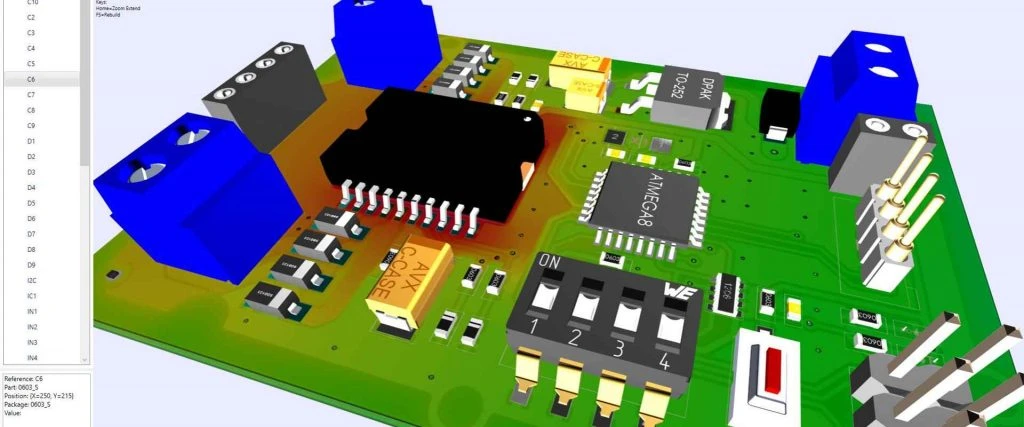
Follow these steps to integrate shielding into your flex PCB manufacturing process.
Define the Stackup: Determine if you need shielding on one side or both. Account for the dielectric thickness (coverlay) between the signal layer and the EMI shield.
- Check: Does the stackup meet the total thickness constraint for the bend radius?
Design the Ground Network: Create a robust ground plane on the copper layer. For dynamic regions, use a cross-hatched copper pattern (e.g., 45-degree hatch) to retain flexibility, or rely entirely on the external EMI film for grounding if copper is not feasible.
- Check: Are there continuous return paths for high-speed signals?
Place Grounding Access Points: Open windows in the coverlay (solder mask) to expose the ground copper. The EMI shielding film will bond to these points using conductive adhesive. Size and tolerance these windows with the same rules as other openings; see coverlay opening design rules.
- Check: Are access points distributed evenly to minimize loop inductance?
Select the Shielding Material: Choose between Silver Ink (cheaper, printed) or EMI Shielding Film (better performance, laminated). Films like Tatsuta or Toyo are industry standards for high-speed flex.
- Check: Does the material datasheet support the required bend cycles?
Route Signals with Shielding in Mind: Adjust trace widths. Since the shield acts as a reference plane, the characteristic impedance calculation must include the shield layer.
- Check: Run an impedance simulation with the shield present.
Apply Strain Mitigation: Implement folded rigid-flex strain mitigation techniques. Ensure the shielding film does not terminate exactly at the rigid-flex transition line, as this creates a stress concentration point. Overlap slightly or stop short depending on the stiffener design.
- Check: Is the transition area reinforced?
Final Verification: Generate manufacturing files (Gerbers) that clearly define the shielding layer area. It is usually a separate mask layer.
- Check: Do the drawings specify the grounding locations clearly?
Flex EMI shielding and grounding troubleshooting (failure modes and fixes)
When shielding fails, it usually manifests as EMI leaks or mechanical breakage.
Symptom: Intermittent Signal Loss during Bending
- Cause: The shielding film or the underlying copper trace has cracked due to stress.
- Check: Perform continuity tests while flexing the cable. Inspect for "swimming" (delamination).
- Fix: Increase bend radius or switch to a rolled annealed (RA) copper and a more elastic shielding film.
- Prevention: Review flex PCB bend radius rules for the dynamic zone, including the added shield thickness.
Symptom: High Radiated Emissions (EMI Failure)
- Cause: Floating shield. The conductive adhesive is not making good contact with the ground pads.
- Check: Measure resistance between the shield surface and the board ground. It should be near zero.
- Fix: Increase the size or number of coverlay openings for grounding. Apply higher pressure during lamination.
- Prevention: Specify grounding points every 5-10mm along the length.
Symptom: Impedance Mismatch (Signal Reflection)
- Cause: The shield was applied closer to the traces than calculated, increasing capacitance.
- Check: TDR measurement on the finished flex.
- Fix: Thicken the coverlay or reduce trace width in future revisions.
- Prevention: Consult APTPCB's DFM guidelines for stackup verification before fabrication.
Symptom: Shield Peeling
- Cause: Poor adhesion to the coverlay or contamination during assembly.
- Check: Visual inspection of edges.
- Fix: Use an edge-sealing process or wider coverlay margins.
- Prevention: Ensure surface cleaning steps are strictly followed in production.
Symptom: Short Circuits to Components
- Cause: Shielding film extends too close to component pads on the rigid section.
- Check: Inspect the interface between the flex tail and the rigid connector.
- Fix: Pull back the shielding film design 0.5mm from solderable pads.
- Prevention: Add keep-out zones for shielding layers in the CAD tool.
Symptom: Thermal Damage during Reflow
- Cause: Shielding film is not rated for lead-free reflow temperatures.
- Check: Review material Tg and decomposition temperature.
- Fix: Apply shielding film after reflow (cold press) or use high-temp rated films.
- Prevention: Verify process compatibility (Pre-lamination vs. Post-lamination).
How to choose a flex PCB EMI shielding method (design decisions and trade-offs)
Selecting the right method depends on the balance between flexibility, cost, and shielding effectiveness (SE).
1. Copper Layers (Internal) vs. EMI Films (External)
- Copper Layers: Using internal ground planes (stripline configuration) offers the best SE and impedance control. However, it significantly increases stiffness and thickness, making it poor for dynamic applications.
- EMI Films: Lightweight, thin (10-20µm), and highly flexible. They are ideal for dynamic flex but offer slightly less attenuation at very high frequencies (>10 GHz) compared to solid copper.
For flex PCB manufacturing including EMI shielding options and material selection, and multilayer PCB fabrication when internal copper ground planes are needed, see those pages.
2. Silver Ink vs. Conductive Film
- Silver Ink: Screen printed. Lower cost for high volume. Good for static applications or mild flexing. Can crack under tight bends. Variable thickness.
- Conductive Film (e.g., PC1000): Laminated. Uniform thickness, excellent flexibility, and consistent electrical properties. Higher material cost but better reliability for FPC dynamic bend reliability test requirements.
3. Grounding Method: Stitching Vias vs. Edge Plating
- Stitching Vias: Standard method. Connects top/bottom shields. Reliable but consumes routing space.
- Silver Epoxy Bonding: Used to connect the shield to the connector shell. Good for grounding the cable ends but manual and costly.
Decision Matrix:
- Dynamic Flex + High Speed: Use EMI Shielding Film + Cross-hatched Copper Ground.
- Static Flex + Low Cost: Use Silver Ink or simple Copper Pour.
- Rigid-Flex: Combine internal planes in the rigid section with EMI film in the flex section.
| Method | Shielding effectiveness | Flexibility | Cost | Best fit |
|---|---|---|---|---|
| Internal copper ground plane | Highest | Lowest (stiff) | Adds a layer | Static flex, rigid-flex rigid zones |
| Cross-hatched copper | Medium | Medium | Adds a layer | Flex that bends occasionally |
| EMI shielding film | Good | High | Higher material cost | Dynamic flex, high-speed flex tails |
| Printed silver ink | Fair to good | Medium (can crack in tight bends) | Lower in volume | Static or mildly flexed tails |
| Metal shield can on rigid area | High, local | Not flexible | Part + assembly | Components on the rigid section; see RF shield can design |
Flex PCB EMI shielding and grounding FAQ
Q: How much does adding EMI shielding film increase the cost? A: Typically, adding a specialized EMI film increases the flex PCB cost by 20% to 30% due to the expensive raw material and the extra lamination process steps.
Q: What is the lead time impact for shielded flex PCBs? A: It usually adds 1–2 days to the standard lead time. If the specific film (e.g., a specific Tatsuta part number) is not in stock, material procurement can take 1–2 weeks. APTPCB stocks common films to minimize this.
Q: How do I specify the shielding in my Gerber files? A: Create a separate layer (e.g., "F.Shield" or "User.1") indicating the area to be covered. Also, clearly mark the coverlay openings where the shield should contact the ground net.
Q: Can I reflow solder a flex PCB with EMI film attached? A: Yes, most modern EMI films are rated for lead-free reflow cycles. However, verify the datasheet. Some lower-cost silver pastes may require application after reflow.
Q: What are the acceptance criteria for shielding visual inspection? A: The shield must be free of bubbles, wrinkles, and peeling. The alignment with the coverlay openings must ensure at least 75% coverage of the ground pad.
Q: How does shielding affect the flexibility of the PCB? A: It adds stiffness. If your design is near the minimum bend radius limit, adding a shield might cause failure. Always recalculate the stackup thickness.
Q: What is the difference between "grounding" and "shielding" in flex? A: Shielding blocks external fields (Faraday cage). Grounding provides the path for those induced currents to drain away. Without proper grounding (low resistance connection), the shield becomes an antenna.
Q: Do I need shielding for a short flex cable (e.g., 20mm)? A: For very short lengths, the cable may not pick up significant noise unless it is near a strong emitter (like a switching regulator). Test without it first if cost is critical.
Q: How do I handle shielding in a rigid-flex PCB? A: The shielding film usually stops slightly before the rigid section to avoid stress concentration. The ground connection is handed off to internal planes within the rigid board.
Q: Can I attach an EMI shield with adhesive instead of mechanical clips and keep it grounded? A: Yes, if the adhesive path is conductive and verified. Test shield-to-ground resistance after lamination or cure, after thermal cycling, and after the bend or vibration profile the product sees, and check the edges for lift. A shield that loses its ground contact turns into an antenna, so define the resistance limit and the test sequence in the drawing.
Q: How do I place a shielded inductor near a flex tail in an EMI-aware layout? A: Keep the flex tail and its connector away from the switching node and the inductor's open sides, and route the flex return path over solid ground on the rigid board. Confirm the footprint and 3D model against the inductor datasheet (land pattern, height, and keep-out), because a shielded inductor only contains its field if it sits flat on the intended pads.
Q: What data is needed for a DFM review of shielded flex? A: Stackup diagram, impedance requirements, bend radius location, and the specific shielding material preference (or performance requirement).
Flex EMI shielding and grounding glossary (key terms)
| Term | Definition |
|---|---|
| EMI (Electromagnetic Interference) | Disturbance generated by an external source that affects an electrical circuit. |
| Coverlay | The insulating layer (usually Polyimide) on a flex PCB, similar to solder mask. |
| Shielding Film | A thin, conductive laminate applied to the outside of a flex circuit to block EMI. |
| Silver Paste | A conductive ink printed onto the flex to act as a shield; cheaper but less flexible than film. |
| Grounding Window | An opening in the coverlay allowing the shielding film to contact the copper ground net. |
| Cross-Hatching | A mesh pattern of copper used for ground planes to maintain flexibility. |
| Impedance Control | Managing trace dimensions to match the source and load resistance, affected by shield proximity. |
| Dynamic Flex | A flex circuit designed to bend repeatedly during operation (e.g., hinge). |
| Static Flex (Flex-to-Install) | A flex circuit bent only once during assembly. |
| Anisotropic Conductive Film (ACF) | Adhesive that conducts electricity only in the Z-axis (vertical), used to bond shields. |
Request a quote for shielded flex PCBs
For a precise quote and DFM review, please provide your Gerber files, stackup requirements, and estimated annual usage. APTPCB engineers will review your shielding strategy, impedance calculations, and material selection to ensure manufacturability.
Checklist for Quote Request:
- Gerber Files: Include a dedicated layer for the shielding area.
- Stackup: Specify total thickness constraints and coverlay type.
- Material: Indicate if you need specific brands (e.g., Tatsuta) or if "equivalent standard" is acceptable.
- Testing: Specify if TDR (Impedance) or specific resistance testing is required.
Conclusion (next steps)
Implementing successful flex EMI shielding and grounding requires more than just adding a conductive layer; it demands a holistic approach involving stackup design, impedance recalculation, and mechanical stress management. By following the rules for grounding windows, selecting the right film for dynamic bending, and validating with reliability tests, you can prevent signal integrity issues and mechanical failures. Whether you are designing a complex rigid-flex assembly or a simple flexible connector, proper shielding ensures your device meets EMC standards and performs reliably in the field.