
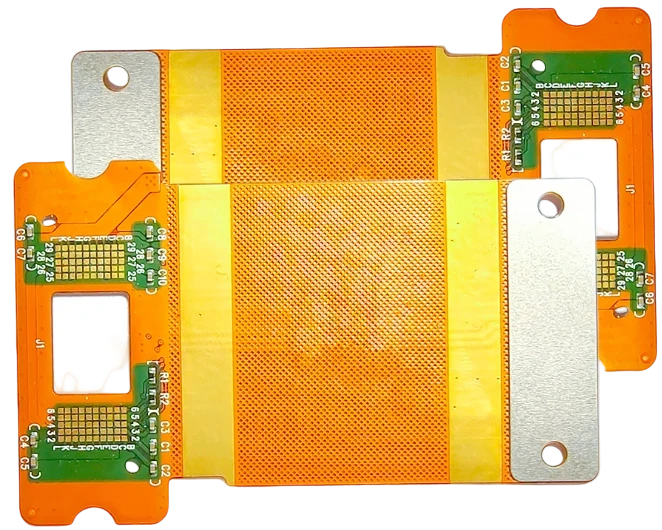
Designing flexible circuits for dynamic applications requires a fundamental shift from static interconnect logic to mechanical endurance engineering. For buyers and engineers, the decision is not just about connectivity, but about guaranteeing millions of flex cycles without work hardening or trace fracturing. This playbook provides the specific routing guidelines, material selections, and validation protocols necessary to procure reliable dynamic flex PCBs.
Highlights
- Mechanical Neutrality: Learn how to place conductors on the neutral axis to minimize stress during bending.
- Trace Geometry: Specific rules for avoiding I-beam effects and using curved routing to prevent stress concentration.
- Material Selection: The critical trade-offs between Rolled Annealed (RA) and Electro-Deposited (ED) copper.
- Validation: Acceptance criteria for IPC-TM-650 endurance testing.
Key Takeaways
- Mechanical Neutrality: Learn how to place conductors on the neutral axis to minimize stress during bending.
- Trace Geometry: Specific rules for avoiding I-beam effects and using curved routing to prevent stress concentration.
- Material Selection: The critical trade-offs between Rolled Annealed (RA) and Electro-Deposited (ED) copper.
- Validation: Acceptance criteria for IPC-TM-650 endurance testing.
- Scope, Decision Context, and Success Criteria
- Specifications to Define Upfront (Before You Commit)
- Key Risks (Root Causes, Early Detection, Prevention)
Contents
- Scope, Decision Context, and Success Criteria
- Specifications to Define Upfront (Before You Commit)
- Key Risks (Root Causes, Early Detection, Prevention)
- Validation & Acceptance (Tests and Pass Criteria)
- Supplier qualification checklist (RFQ, audit, traceability)
- How to Choose (Trade-Offs and Decision Rules)
- FAQ (cost, lead time, DFM files, materials, testing)
- Request a quote / DFM review
- Glossary (Key Terms)
- Conclusion (next steps)
Scope, Decision Context, and Success Criteria
Dynamic bending refers to applications where the flexible circuit is subjected to continuous or repetitive motion, such as in printer heads, disk drives, or hinge mechanisms. Unlike "flex-to-install" (static) designs, dynamic circuits must withstand fatigue. The primary goal is to maximize the fatigue life of the copper conductors.
Measurable Success Metrics
To ensure the design meets reliability standards, define these metrics early:
- Flex Cycle Count: The circuit must withstand a defined number of cycles (e.g., 100,000 to 10,000,000 cycles) at a specific bend radius without failure.
- Resistance Stability: The change in conductor resistance (Δ R) must remain below 10% throughout the lifecycle test.
- Dielectric Integrity: No visible cracking or delamination of the coverlay or insulation after the specified cycle count.
Boundary Cases
- Static vs. Dynamic: If the flex is bent only once during assembly (flex-to-install), standard ED copper and tighter bend radii (10x thickness) are acceptable. This guide focuses on dynamic use where RA copper and looser radii (20x-40x thickness) are required.
- Semi-Dynamic: Applications with infrequent bending (e.g., maintenance doors opened monthly) may use intermediate specs but should lean toward dynamic guidelines to ensure longevity.
Specifications to Define Upfront (Before You Commit)
The longevity of a dynamic flex PCB is determined by the geometry of the traces and the stackup. You must specify these parameters in your fabrication notes to prevent the flex pcb manufacturer from defaulting to standard, non-dynamic processes.
Critical Routing Guidelines
- Curved Traces: Avoid 45° or 90° corners in the flex area. Use large radius arcs. Sharp corners concentrate stress and initiate cracks.
- Perpendicular Routing: Traces must run perpendicular (90°) to the bend line. Traces running parallel to the bend axis will twist and delaminate.
- Staggered Conductors (No I-Beams): On double-sided flex, traces on the top layer must not be directly stacked over traces on the bottom layer. Stagger them to prevent the "I-Beam effect," which increases stiffness and stress.
- Neutral Axis Placement: The conductors should be located as close to the mechanical neutral axis (center of the stackup) as possible. For dynamic flexing, a single-layer flex with equal thickness coverlay on both sides is ideal.
- Teardrops: Add teardrops to all pads and vias, especially at the interface between rigid and flex areas, to prevent breakout during movement.
- Trace Width Consistency: Maintain constant trace width through the bend area. Necking down traces creates weak points.
- Solid Copper Planes: Avoid solid copper planes in dynamic regions. Use cross-hatched patterns (diamond or mesh) to retain flexibility, or remove planes entirely if EMI allows.
- Transition Zones: Do not place vias, components, or stiffener edges within 2.5 mm (100 mils) of the dynamic bend area.
- Solder Mask vs. Coverlay: Use flexible polyimide coverlay, not photoimageable solder mask, in dynamic areas. Solder mask is brittle and will crack.
- Conductor Thickness: Use thinner copper (e.g., 1/3 oz or 12 µm) for dynamic layers. Thinner copper experiences less strain during bending.
- Grain Direction: Orient the grain of the Rolled Annealed (RA) copper along the length of the traces (perpendicular to the bend).
- Bend Radius Ratio: Maintain a bend radius to thickness ratio of at least 20:1 for single-sided and 40:1 for double-sided dynamic flex.
Key Parameter Table
| Parameter | Standard (Static) | Dynamic Requirement | Why it Matters |
|---|---|---|---|
| Copper Type | Electro-Deposited (ED) | Rolled Annealed (RA) | RA has an elongated grain structure for higher fatigue resistance. |
| Copper Weight | 1 oz (35 µm) | 1/3 oz (12 µm) or 1/2 oz (18 µm) | Thinner copper reduces strain at the outer radius of the bend. |
| Bend Radius | 6x - 10x Thickness | 20x - 100x Thickness | Larger radius reduces mechanical stress per cycle. |
| Layer Count (Flex) | 1 - 6 Layers | 1 Layer (Preferred) or 2 Layers | Minimizes thickness; single layer places copper exactly on the neutral axis. |
| Insulation | Solder Mask or Coverlay | Polyimide Coverlay (Kapton) | Coverlay is ductile; solder mask is brittle and cracks under dynamic load. |
| Trace Routing | 45° corners allowed | Rounded Arcs Only | Eliminates stress concentration points where cracks initiate. |
| Plating | ENIG / HASL | Soft Gold / OSP (in flex area) | Hard plating can crack; keep plating out of the bend zone if possible. |
| Grain Direction | Any | Parallel to Trace / Perpendicular to Bend | Aligning grain with the bend direction causes immediate fracture. |
Key Risks (Root Causes, Early Detection, Prevention)
Dynamic flex failures are often catastrophic and latent, appearing only after the product is in the field. Managing these risks requires strict design controls.
1. Work Hardening and Cracking
- Root Cause: Repeated plastic deformation of the copper crystal structure due to tight bend radii or incorrect copper type (ED instead of RA).
- Early Detection: Resistance increases during cycle testing; micro-cracks visible under 20x magnification.
- Prevention: Enforce flex pcb bend radius rules (minimum 20x thickness) and specify RA copper in the fabrication notes.
2. The I-Beam Effect
- Root Cause: Traces on top and bottom layers are aligned directly on top of each other. This structure acts like a rigid I-beam, increasing stiffness and stress during bending.
- Early Detection: High stiffness felt during manual bending; rapid failure in double-sided flex testing.
- Prevention: Stagger traces on adjacent layers. If the top trace is at X position, the bottom trace should be shifted by at least the trace width + spacing.
3. Transition Zone Stress
- Root Cause: Stress concentrates where the flexible circuit meets the rigid stiffener or rigid PCB section.
- Early Detection: Coverlay delamination or trace breakage exactly at the stiffener edge.
- Prevention: Use a bead of epoxy (strain relief) at the interface. Ensure traces enter the rigid zone perpendicular to the edge. How to design stiffener for flex pcb: overlap the coverlay into the stiffener area by 0.5 mm to 1.0 mm to avoid a gap.
4. Coverlay Delamination
- Root Cause: Air gaps trapped between traces due to poor lamination pressure or insufficient adhesive flow.
- Early Detection: White spots (voids) visible in the coverlay after thermal shock or reflow.
- Prevention: Use "conformal" coverlay lamination processes. Ensure trace spacing allows adhesive to flow down to the base laminate (typically 5-10 mils minimum space).
5. Impedance Discontinuity
- Root Cause: Cross-hatched ground planes (used for flexibility) change the reference plane capacitance compared to solid copper.
- Early Detection: Signal integrity issues; TDR measurements showing impedance spikes in the flex region.
- Prevention: Model impedance using the specific hatch percentage (e.g., 50% copper). Confirm calculations with the flex pcb manufacturer during DFM.
6. Plating Cracks
- Root Cause: Electroless Nickel Immersion Gold (ENIG) or other hard platings extending into the bend area. Nickel is brittle.
- Early Detection: Intermittent open circuits that disappear when the flex is flattened.
- Prevention: Use "selective plating" or "button plating" so that only the pads are plated. Keep the dynamic bend area as bare copper covered by coverlay.
7. Solder Wicking
- Root Cause: Solder wicking down the trace under the coverlay, making the trace rigid and brittle.
- Early Detection: Visual inspection shows solder extending beyond the pad; stiff traces near pads.
- Prevention: Use "solder dams" (coverlay openings strictly defined) and restrict coverlay openings to the pad area only.
8. Dimensional Instability
- Root Cause: Polyimide materials shrink and expand during processing more than FR4.
- Early Detection: Misalignment of coverlay openings or drill holes relative to copper pads.
- Prevention: Use larger annular rings (+5 to +8 mils) and looser tolerances for coverlay alignment (±0.2 mm) compared to rigid boards.
Validation & Acceptance (Tests and Pass Criteria)
Validation for dynamic flex PCBs is destructive. You must allocate budget and samples for physical endurance testing.
Acceptance Criteria Table
| Test Item | Method | Acceptance Criteria | Sampling |
|---|---|---|---|
| Flexural Endurance | IPC-TM-650 2.4.3 (MIT Tester) | > 100,000 cycles (or custom spec) with Δ R < 10% | 5 coupons per lot |
| Peel Strength | IPC-TM-650 2.4.9 | > 0.8 N/mm (after thermal stress) | 2 coupons per lot |
| Visual Inspection | IPC-6013 Class 3 | No cracks, delamination, or blistering | 100% |
| Dimensional Stability | IPC-TM-650 2.2.4 | Change < 0.15% | 3 panels per lot |
| Impedance (if req) | TDR | ±10% of target value | 100% of signal lines |
| Solderability | J-STD-003 | 95% coverage, no dewetting | 2 coupons per lot |
Recommended Test Protocol
- Design a Test Coupon: Do not rely on the actual part for destructive testing if it is expensive. Create a "flex endurance coupon" that mimics the trace width, spacing, and stackup of the critical dynamic region.
- Daisy Chain Monitoring: Connect traces in a daisy chain pattern to monitor continuity continuously during the flex test.
- Glitch Detection: Use a high-speed event detector to catch micro-interruptions (duration > 1 µs) that might not register on a standard multimeter.
- Bend Radius Verification: Ensure the test fixture uses the exact bend radius specified in the design (e.g., 5mm mandrel).
- Directionality: Test bending in the actual direction of use. If the application involves twisting, use a torsion test instead of a simple mandrel bend.
- Post-Test Analysis: Cross-section failed samples to determine if failure was due to copper fatigue (ductile fracture) or brittle fracture (plating/work hardening).
Supplier Qualification Checklist (RFQ, Audit, Traceability)
Not all PCB manufacturers can handle dynamic flex requirements. Use this checklist to vet potential partners.
- Material Stock: Does the supplier stock Rolled Annealed (RA) copper foils and high-performance polyimide (e.g., DuPont Pyralux)?
- Coverlay Capability: Can they perform selective coverlay lamination with high registration accuracy (±0.15mm or better)?
- Laser Cutting: Do they use UV lasers for precise coverlay and outline cutting (essential for complex shapes and fine features)?
- Impedance Control: Do they have experience calculating and testing impedance on cross-hatched reference planes?
- Stiffener Attachment: Do they have automated or semi-automated processes for heat-bonding stiffeners (PSA or thermoset adhesive)?
- Testing Equipment: Do they have in-house flex endurance testers (MIT or similar) to validate the stackup?
- Traceability: Can they trace the grain direction of the copper foil from the raw material roll to the finished panel?
- DFM Support: Do they offer specific DFM feedback on bend radius ratios and trace routing geometry?
- Plating Control: Can they perform selective plating to keep the flex area free of brittle nickel/gold?
- Certification: Are they certified to IPC-6013 Class 3 for flexible printed boards?
- Handling: Do they use specialized trays and handling procedures to prevent kinking the flex circuits during production?
- Solder Mask vs Coverlay: Do they explicitly recommend coverlay over solder mask for dynamic regions? (If they suggest solder mask for dynamic flex, disqualify them).
How to Choose (Trade-Offs and Decision Rules)
This section helps you navigate the critical design and material trade-offs for dynamic flex PCBs.
Comparison: Rolled Annealed (Ra) vs. Electro-Deposited (Ed) Copper
| Factor | Rolled Annealed (RA) | Electro-Deposited (ED) | Best When | Trade-off |
|---|---|---|---|---|
| Grain Structure | Horizontal / Lamellar | Vertical / Columnar | RA: Dynamic flexing | RA is slightly more expensive and has lower peel strength. |
| Fatigue Life | High (Millions of cycles) | Low (Thousands of cycles) | ED: Static (Flex-to-install) | ED is better for fine line etching but fails in motion. |
| Surface Roughness | Smooth | Rougher (better adhesion) | RA: High-speed signals | RA requires special treatment for adhesion. |
| Cost | Premium | Standard | ED: Cost-sensitive static | RA availability can have longer lead times. |
| Availability | Specialized stock | Widely available | RA: Critical reliability | ED is standard for rigid PCBs. |
| Etch Factor | Good | Excellent | ED: Very fine pitch (<3 mil) | RA is harder to etch for ultra-fine lines. |
| Grain Direction | Critical (Must align) | Not critical | RA: Unidirectional bend | RA grain must be managed during panelization. |
| Elasticity | High | Low | RA: Tight bend radii | RA is softer and scratches more easily. |
Decision Matrix
| Priority | Best Choice | Why |
|---|---|---|
| Max Cycle Life | Single-Layer RA Copper | Places copper on neutral axis; RA resists fatigue. |
| High Density | Multi-layer with "Bikini" Coverlay | Keeps flex area thin (1-2 layers) while rigid areas handle density. |
| Cost | Standard ED Copper (Static only) | Only acceptable if the flex does not move after installation. |
| Impedance | Cross-hatched Ground | Maintains flexibility while providing reference plane. |
| Robustness | Polyimide Stiffeners | Adds thickness at connector ends without the weight of FR4. |
Decision Rules ("If... Choose...")
- If the application requires >10,000 flex cycles, choose Rolled Annealed (RA) copper; otherwise, standard ED copper may suffice for static install.
- If you need high-speed signals in the flex region, choose cross-hatched ground planes; otherwise, omit planes in the flex area to maximize flexibility.
- If the bend radius is tight (<10x thickness), choose a single-layer flex design; otherwise, a double-sided flex (staggered traces) is acceptable.
- If you are designing the transition zone, choose to overlap the coverlay into the stiffener by 0.5mm; otherwise, you risk trace breakage at the stress point.
- If you need to plate components near the flex, choose selective plating (pads only); otherwise, brittle plating may extend into the bend area.
- If you are routing traces through a bend, choose large radius arcs; otherwise, 45-degree corners will become stress concentrators.
- If you are specifying insulation, choose Polyimide Coverlay; otherwise, coverlay vs solder mask on flex pcb rules dictate that solder mask will crack in dynamic use.
- If you have traces on both sides, choose to stagger them; otherwise, the I-beam effect will increase stiffness and cause failure.
- If you need a stiffener for component support, choose FR4 or Stainless Steel; otherwise, use Polyimide stiffeners for thickness adjustment only (ZIF connectors).
- If cost is the primary driver and flexing is rare, choose "Semi-Flex" (thinned FR4); otherwise, stick to true Polyimide flex for reliability.
FAQ (Cost, Lead Time, DFM Files, Materials, Testing)
Q: How much more does RA copper cost compared to ED copper? RA copper typically adds 10-20% to the base material cost compared to ED copper. However, the total PCB cost increase is usually less than 5% because processing costs (drilling, plating, lamination) remain the dominant factors.
Q: What is the typical lead time for dynamic flex PCBs? Prototype lead times are typically 5-10 working days, while production volumes require 3-4 weeks. Lead times can extend if specialized RA copper weights (e.g., 1/3 oz) or non-standard polyimide thicknesses are not in stock.
Q: Do I need to send special files for the stiffener design? Yes, define the stiffener on a separate mechanical layer in your Gerber or ODB++ data. Clearly indicate the material (FR4, Polyimide, SS), thickness, and the adhesive type (PSA vs. Thermoset) in the fabrication notes.
Q: Can I use solder mask instead of coverlay to save money? Never use solder mask for dynamic flexing areas; it is too brittle and will crack, severing the traces underneath. Solder mask is only acceptable in static (rigid) areas of a rigid-flex board or for "flex-to-install" applications with very large bend radii.
Q: How do I specify the grain direction for RA copper? Include a note in your fabrication drawing: "Grain direction of RA copper to be parallel to the length of the circuit (perpendicular to the bend axis)." The manufacturer will orient the circuit on the panel to align with the roll direction.
Q: What is the "neutral axis" and why is it critical? The neutral axis is the plane within the stackup where there is zero tension and zero compression during bending. Placing conductors exactly on this axis (usually the center of a symmetrical stackup) minimizes mechanical stress and maximizes fatigue life.
Q: How do I test for "I-Beam" issues in my design? Review the CAM data or Gerber files by overlaying the top and bottom copper layers. If traces run directly on top of each other in the bend zone, shift them laterally to create a staggered structure.
Q: What is the minimum bend radius for dynamic flex? For high reliability, aim for a bend radius of 20x to 40x the total flex thickness. For example, a 100µm thick flex circuit should have a minimum bend radius of 2mm to 4mm.
Request a Quote / DFM Review for Flex PCB Trace Routing Guidelines for Dynamic Bending (What to Send)
When requesting a quote or DFM review for dynamic flex PCBs, providing complete data is essential to avoid delays and ensure reliability.
Capability Snapshot
| Parameter | Standard Capability | Advanced Capability | Notes |
|---|---|---|---|
| Flex Layers | 1-2 Layers | 3-6 Layers | Single layer best for dynamic. |
| Min Trace/Space | 4 mil / 4 mil | 3 mil / 3 mil | Wider traces preferred for flex. |
| Min Drill (Mech) | 0.2 mm (8 mil) | 0.15 mm (6 mil) | Laser drill available for microvias. |
| Copper Weight | 0.5 oz - 1 oz | 1/3 oz (12 µm) | Thinner is better for dynamic. |
| Coverlay Web | 10 mil (0.25 mm) | 4 mil (0 |
Glossary (Key Terms)
| Term | Meaning | Why it matters in practice |
|---|---|---|
| DFM | Design for Manufacturability: layout rules that reduce defects. | Prevents rework, delays, and hidden cost. |
| AOI | Automated Optical Inspection used to find solder/assembly defects. | Improves coverage and catches early escapes. |
| ICT | In-Circuit Test that probes nets to verify opens/shorts/values. | Fast structural test for volume builds. |
| FCT | Functional Circuit Test that powers the board and checks behavior. | Validates real function under load. |
| Flying Probe | Fixtureless electrical test using moving probes on pads. | Good for prototypes and low/medium volume. |
| Netlist | Connectivity definition used to compare design vs manufactured PCB. | Catches opens/shorts before assembly. |
| Stackup | Layer build with cores/prepreg, copper weights, and thickness. | Drives impedance, warpage, and reliability. |
| Impedance | Controlled trace behavior for high-speed/RF signals (e.g., 50Ω). | Avoids reflections and signal integrity failures. |
| ENIG | Electroless Nickel Immersion Gold surface finish. | Balances solderability and flatness; watch nickel thickness. |
| OSP | Organic Solderability Preservative surface finish. | Low cost; sensitive to handling and multiple reflows. |
Conclusion
flex pcb trace routing guidelines for dynamic bending is easiest to get right when you define the specifications and verification plan early, then confirm them through DFM and test coverage.
Use the rules, checkpoints, and troubleshooting patterns above to reduce iteration loops and protect yield as volumes increase.
If you’re unsure about a constraint, validate it with a small pilot build before locking the production release.