
Designing a Foldable OLED PCB requires navigating a narrow window between mechanical flexibility and electrical integrity. Unlike standard rigid boards, these circuits must withstand thousands of dynamic bending cycles while maintaining high-speed signal transmission for display drivers. APTPCB (APTPCB PCB Factory) specializes in fabricating these complex interconnects, ensuring that the transition from a static design to a moving component does not compromise reliability.
This guide covers the critical specifications, implementation steps, and troubleshooting protocols necessary for successful Foldable OLED PCB deployment.
Foldable OLED PCB quick answer (30 seconds)
- Bend Radius Rule: For dynamic applications, the bend radius should be at least 100x the thickness of the copper layer to prevent work hardening and cracking.
- Material Selection: Use Rolled Annealed (RA) copper rather than Electro-Deposited (ED) copper; RA copper has an elongated grain structure that withstands flexing better.
- Neutral Axis Placement: Design the stackup so that the conductor layer sits exactly in the center (neutral axis) of the material stack to minimize stress during bending.
- Trace Routing: Avoid 90-degree corners in bend areas; use curved traces or 45-degree angles to distribute mechanical stress evenly.
- Via Keep-Out: Never place vias or plated through-holes (PTH) within the dynamic bending zone; they will fracture under repeated stress.
- Adhesiveless Substrates: Prefer adhesiveless polyimide (PI) laminates for thinner profiles and better thermal performance compared to adhesive-based systems.
When Foldable OLED PCB applies (and when it doesn’t)
Use Foldable OLED PCB when:
- Dynamic Hinge Mechanisms: Devices like foldable smartphones or laptops where the screen and circuit must bend repeatedly during daily use.
- Space-Constrained Wearables: Smartwatches or health monitors where the PCB must conform to a curved housing or wrap around a battery.
- High-Density Interconnects: Applications requiring Chip-on-Flex (COF) for OLED Driver PCB integration to minimize bezel width.
- Weight Reduction: Aerospace or drone applications where replacing rigid wiring harnesses with flexible circuits significantly reduces payload.
- Vibration Resistance: Environments where rigid solder joints might fail due to constant vibration; flexible substrates absorb mechanical energy.
Do not use Foldable OLED PCB when:
- Load-Bearing Structural Support: Flexible PCBs cannot support heavy components or structural loads without additional stiffeners or rigid sections.
- Ultra-Low Cost Consumer Toys: If a simple wire harness or standard rigid board fits, the cost premium of flex materials and processing is unnecessary.
- High-Power Distribution: While possible, managing heat dissipation in thin flexible dielectrics is harder than in thick rigid boards with heavy copper.
- Simple Static Connections: If the board only bends once during installation (install-to-fit) and never moves again, a standard flexible PCB or semi-rigid board is sufficient, rather than a high-cycle dynamic foldable design.
Foldable OLED PCB rules and specifications (key parameters and limits)
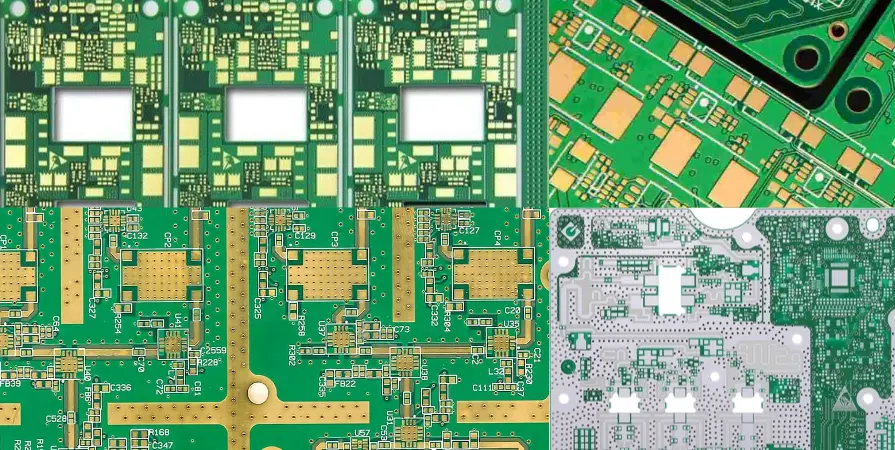
Adhering to strict design rules is critical for yield and longevity. The following table outlines the essential parameters for a robust Foldable OLED PCB.
| Rule | Recommended Value/Range | Why it matters | How to verify | If ignored |
|---|---|---|---|---|
| Copper Type | Rolled Annealed (RA) | Elongated grain structure allows for repeated bending without fatigue. | Material datasheet / Microsection analysis. | Conductors crack after few cycles. |
| Min Bend Radius (Dynamic) | 100x - 150x conductor thickness | Prevents plastic deformation of the copper. | Bend cycle testing (e.g., IPC-TM-650). | Early fatigue failure. |
| Min Bend Radius (Static) | 10x - 20x total thickness | Sufficient for one-time installation bends. | Visual inspection during assembly. | Dielectric cracking or delamination. |
| Trace Width in Bend Area | Uniform width, > 3 mil (0.075mm) | Variations in width create stress concentration points. | CAM review / DFM check. | Localized stress fractures. |
| I-Beam Construction | Avoid (stagger traces) | Traces on top and bottom layers directly over each other increase stiffness and stress. | Layer-to-layer registration check. | Increased stiffness, faster cracking. |
| Coverlay Thickness | 0.5 mil - 1 mil (12.5µm - 25µm) | Thinner coverlay reduces overall stackup thickness, improving flexibility. | Cross-section analysis. | Board becomes too rigid to fold. |
| Stiffener Termination | Overlap coverlay by 0.5mm - 1mm | Prevents a stress concentration point where the rigid stiffener meets the flex. | Design drawing review. | Trace breakage at the stiffener edge. |
| Impedance Control | ±10% (typically 50Ω/90Ω/100Ω) | Critical for high-speed MIPI/LVDS signals in OLED Interface PCB designs. | TDR (Time Domain Reflectometry). | Signal integrity loss, display artifacts. |
| Pad Plating | ENIG or Soft Gold | Hard gold is brittle; soft gold prevents cracking during component placement. | XRF measurement. | Solder joint embrittlement. |
| Tear Stops | Copper or slit restraints | Prevents slits or edges from tearing further under stress. | Visual inspection. | Mechanical failure of the substrate. |
| Via Placement | > 2mm away from bend zone | Plated barrels are rigid and will crack if bent. | DRC (Design Rule Check). | Open circuits in via barrels. |
Foldable OLED PCB implementation steps (process checkpoints)
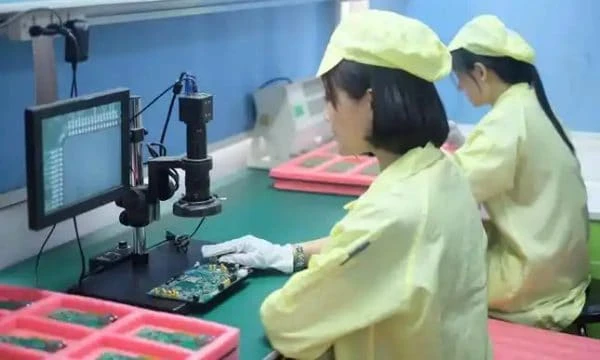
Implementing a Foldable OLED PCB involves more than just layout; it requires a manufacturing-aware approach.
Define Mechanical Constraints:
- Action: Determine the bend radius, fold angle (e.g., 180°), and cycle life requirement (e.g., 100,000 cycles).
- Check: Ensure the mechanical housing allows for the "service loop" (excess length) needed for the bend.
Select Material Stackup:
- Action: Choose adhesiveless Polyimide (PI) and RA copper. Calculate the stackup to place critical signal layers at the neutral axis.
- Check: Verify material availability with APTPCB to avoid lead time delays.
Circuit Layout & Routing:
- Action: Route traces perpendicular to the bend line. Use curved corners. Add "hatching" to ground planes in bend areas to maintain flexibility.
- Check: Run DRC specifically for flex rules (e.g., larger annular rings, teardrops on pads).
Signal Integrity Simulation:
- Action: Simulate high-speed lines (MIPI DSI, eDP) considering the cross-hatched ground reference, which affects impedance.
- Check: Confirm impedance matches the OLED Controller PCB requirements.
Stiffener & Component Placement:
- Action: Place components only in rigidized areas. Define stiffener materials (FR4 for support, PI for thickness, Steel for EMI/strength).
- Check: Ensure stiffener edges do not align perfectly with coverlay openings to avoid stress points.
Prototyping & DFM Review:
- Action: Submit Gerber files for DFM. Review "bikini" coverlay designs (coverlay only on flex, soldermask on rigid areas if using Rigid-Flex).
- Check: Validate the panelization to maximize material usage, as flex materials are costly.
Fabrication (Etching & Lamination):
- Action: Monitor etch factors closely for fine-pitch Micro OLED PCB traces.
- Check: Automated Optical Inspection (AOI) after etching is critical before lamination.
Surface Finish & Coverlay Application:
- Action: Apply coverlay using laser cutting or pre-drilled alignment. Apply surface finish (ENIG/ENEPIG).
- Check: Verify coverlay alignment to ensure pads are fully exposed but traces are covered.
Electrical & Mechanical Testing:
- Action: Perform Flying Probe Test (FPT) for continuity. Conduct bend cycle testing on test coupons.
- Check: No increase in resistance >10% after specified bend cycles.
Foldable OLED PCB troubleshooting (failure modes and fixes)
Even with good design, issues can arise. Here is how to troubleshoot common Foldable OLED PCB failures.
Symptom: Intermittent Open Circuits during Bending
- Cause: Work hardening of copper traces or cracks in the grain structure.
- Check: Microsection the failure area. Look for vertical cracks in the copper.
- Fix: Increase bend radius, switch to RA copper, or reduce copper thickness (e.g., from 1oz to 0.5oz).
Symptom: Coverlay Delamination / Bubbling
- Cause: Trapped moisture during lamination or excessive heat during reflow.
- Check: Inspect for blisters. Verify baking procedures before assembly.
- Fix: Bake PCBs to remove moisture before soldering. Optimize lamination pressure/temperature profile.
Symptom: Cracked Solder Joints near Stiffeners
- Cause: Stress concentration at the transition from rigid stiffener to flexible area.
- Check: Inspect the fillet of the stiffener adhesive.
- Fix: Use a bead of epoxy (strain relief) at the stiffener edge or overlap the coverlay under the stiffener.
Symptom: Impedance Mismatch on High-Speed Lines
- Cause: Cross-hatched ground planes provide inconsistent reference; variable dielectric thickness in bend areas.
- Check: TDR measurement. Compare straight vs. bent state.
- Fix: Use solid copper reference if flexibility permits, or tighten mesh density. Consult High Speed PCB design guidelines.
Symptom: Pad Lifting
- Cause: Excessive heat during rework or mechanical peeling force on non-anchored pads.
- Check: Visual inspection of lifted pads.
- Fix: Use "anchoring spurs" or "tie-downs" in the pad design. Increase annular ring size.
Symptom: Silver Migration (Dendrites)
- Cause: Moisture ingress combined with voltage bias on silver ink (if used for shielding).
- Check: Insulation resistance test under humidity.
- Fix: Use copper shielding layers instead of silver ink, or ensure hermetic sealing.
How to choose Foldable OLED PCB (design decisions and trade-offs)
Choosing the right architecture for your Foldable OLED PCB involves balancing cost, flexibility, and assembly complexity.
1. Rigid-Flex vs. Pure Flex with Stiffeners
- Rigid-Flex: Best for complex 3D assemblies where components are dense on both ends. Higher cost, higher reliability. See our Rigid-Flex PCB capabilities.
- Pure Flex + Stiffeners: Lower cost. Best when components are few or located on only one side. The stiffener provides mechanical support for connectors (ZIF) or components.
2. Active Matrix vs. Passive Matrix Support
- Active Matrix (AMOLED): Requires higher layer counts and finer pitch traces for the OLED Driver PCB signals. Often requires HDI technology.
- Passive Matrix (PMOLED): Simpler routing, fewer layers, lower cost. Suitable for smaller, lower-resolution displays.
3. Connector vs. Hot Bar Soldering
- ZIF Connectors: Allow for easy assembly and repair. Requires precise thickness control at the "fingers" (contact area).
- Hot Bar (Soldering): Permanent connection. Lower profile, more reliable vibration resistance, but harder to repair.
4. Shielding Options
- Copper Layers: Best shielding but increases stiffness.
- Silver Ink: Flexible and cheap, but lower shielding effectiveness.
- Shielding Films: Specialized EMI films (like Tatsuta) offer high shielding with minimal stiffness impact.
Foldable OLED PCB FAQ (cost, lead time, common defects, acceptance criteria, Design for Manufacturability (DFM) files)
Q: What is the typical cost driver for a Foldable OLED PCB? A: The primary cost drivers are the raw material (RA copper/PI laminate is expensive), the number of lamination cycles (especially for rigid-flex), and the yield loss associated with fine-pitch etching.
Q: How does lead time compare to standard rigid PCBs? A: Lead times are typically longer (10-15 days for prototypes, 3-4 weeks for production) due to complex processing steps like coverlay alignment, laser cutting, and baking.
Q: What are the acceptance criteria for coverlay alignment? A: Generally, IPC-6013 Class 2 or 3. Coverlay should not encroach on solderable lands, and adhesive squeeze-out should not exceed 0.2mm (depending on pitch).
Q: Can I use standard FR4 for the rigid part of a Foldable OLED PCB? A: Yes, in a Rigid-Flex construction, FR4 is used for the rigid sections to support components, while Polyimide is used for the flexible interconnects.
Q: How do I specify the "Neutral Axis" in my DFM files? A: You don't specify it in the Gerber, but you must design the stackup so the copper is centered. Provide a stackup drawing requesting the manufacturer to adjust dielectric thicknesses to achieve this balance.
Q: What testing is required for Micro OLED PCB applications? A: Beyond standard E-test, Micro OLED PCB designs often require high-resolution AOI, impedance testing, and sometimes cleanliness testing to prevent outgassing that could damage the OLED organic layers.
Q: Is impedance control possible on a hatched ground plane? A: Yes, but the calculation is complex. You must specify the hatch width and pitch. We recommend letting the Flex PCB engineering team calculate the trace width needed to hit the target impedance.
Q: What is the minimum trace width for a Flexible OLED PCB? A: We can achieve down to 2 mil (0.05mm) trace/space for high-density applications, but 3 mil (0.075mm) is recommended for better yield and lower cost.
Q: How do I prevent tears at the corners of the flex outline? A: Always use a radius (fillet) at internal corners. Never use sharp 90-degree internal corners. Adding a copper tear-stop feature near the corner also helps.
Q: Can I place vias in the flexible area if it doesn't bend dynamically? A: Yes, if the area is "static" (bent once), vias are permitted but should be kept away from the immediate bend line. For dynamic bending, vias are strictly prohibited in the flex arm.
Resources for Foldable OLED PCB (related pages and tools)
- Flex PCB Capabilities: Detailed specs on layer counts, materials, and tolerances.
- Rigid-Flex PCB Solutions: Combine the best of rigid and flexible technologies for complex OLED products.
- HDI PCB Technology: Essential for routing high-density signals in compact OLED drivers.
- Impedance Calculator: Estimate trace widths for your MIPI/LVDS lines.
Foldable OLED PCB glossary (key terms)
| Term | Definition |
|---|---|
| Neutral Axis | The plane within the stackup where neither compression nor tension occurs during bending. |
| RA Copper | Rolled Annealed Copper. Treated to have a horizontal grain structure for maximum flexibility. |
| Coverlay | A polyimide film with adhesive used to insulate and protect the outer layers of a flex circuit (replaces soldermask). |
| Bikini Coverlay | A technique in rigid-flex where coverlay is applied only to the flex section, and standard soldermask is used on rigid sections. |
| Stiffener | A rigid piece of material (FR4, PI, or Metal) bonded to the flex to support components or connectors. |
| Dynamic Flex | A circuit designed to be flexed repeatedly during the product's operation (e.g., flip phone hinge). |
| Static Flex | A circuit designed to be flexed only during installation (Flex-to-Install). |
| COF (Chip on Flex) | Mounting a die directly onto the flexible circuit, common in OLED Driver PCB assemblies. |
| Adhesiveless Laminate | Copper bonded directly to polyimide without acrylic adhesive; offers better thermal and electrical performance. |
| Service Loop | Extra length added to the flex circuit to accommodate the bend radius and assembly tolerances. |
| Tear Stop | A copper feature or slit termination designed to prevent a tear from propagating through the material. |
Request a quote for Foldable OLED PCB (Design for Manufacturability (DFM) review + pricing)
Ready to move your Foldable OLED PCB from concept to production? APTPCB provides comprehensive DFM reviews to catch flexibility issues before fabrication.
What to send for a quote:
- Gerber Files: RS-274X format preferred.
- Stackup Drawing: Indicate material types (RA Copper, Adhesiveless PI) and stiffener locations.
- Quantities: Prototype vs. Mass Production volumes.
- Special Requirements: Impedance control, bend cycle requirements, or specific surface finishes.
Conclusion (next steps)
Successfully deploying a Foldable OLED PCB requires strict adherence to mechanical design rules and careful material selection. By prioritizing the neutral axis, utilizing RA copper, and validating designs through rigorous DFM checks, engineers can ensure their flexible displays perform reliably over thousands of cycles. Whether you are building a Flexible OLED PCB for a wearable or a complex OLED Interface PCB for industrial controls, early collaboration with a capable manufacturer is the key to avoiding costly iterations.