
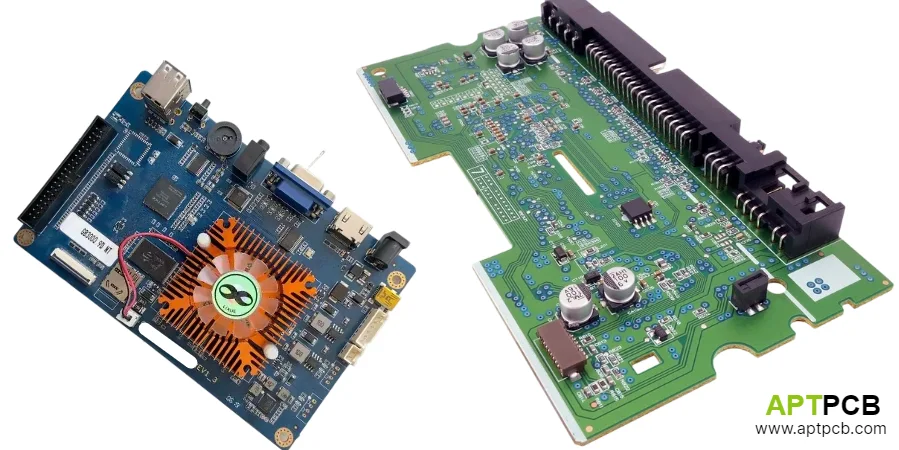
Game controllers demand exceptional design attention despite their apparent simplicity—competitive gamers notice single-millisecond latency differences, analog inputs require precision across millions of actuations, and wireless performance must remain reliable amidst interference from WiFi, Bluetooth, and other devices. The PCB design balances wireless connectivity, precise analog input sensing, advanced haptic feedback, and battery life optimization within ergonomic enclosures.
This guide examines controller-specific PCB challenges: implementing ultra-low-latency wireless connections, analog stick and trigger sensing circuits, haptic motor drivers for feedback, battery management for extended gaming sessions, and manufacturing considerations for high-volume gaming peripherals.
In This Guide
- Wireless Connectivity for Low-Latency Gaming
- Analog Input Sensing: Sticks and Triggers
- Haptic Feedback and Motor Driver Implementation
- Battery Management for Extended Gaming
- Button and Switch Matrix Design
- Manufacturing for Gaming Peripherals
Wireless Connectivity for Low-Latency Gaming
Wireless game controllers must achieve input latency comparable to wired connections—premium controllers target under 4ms total wireless latency from button press to console receipt. This requirement drives protocol selection, antenna optimization, and RF design decisions that differ from typical Bluetooth consumer devices.
Most major controllers use proprietary 2.4GHz protocols alongside Bluetooth, with proprietary links optimized for latency while Bluetooth provides compatibility with mobile devices and PCs. The PCB must support both protocols, often through a single radio with firmware-selectable modes.
Wireless Implementation
- Protocol Selection: Proprietary 2.4GHz for minimal latency to primary console; Bluetooth LE for mobile/PC compatibility—single-chip solutions support both.
- Antenna Design: PCB-printed antenna or FPC antenna positioned for clear radiation pattern despite metal buttons and battery proximity.
- Frequency Hopping: 2.4GHz band congested with WiFi and Bluetooth; adaptive frequency hopping essential for reliable connection.
- Polling Rate: High polling rates (1000Hz+) require fast wireless turnaround; protocol design and RF timing affect achievable rate.
- Range Optimization: Living room distances (3-5m typical) with margin for interference; antenna efficiency and transmit power trade battery life versus range.
- Coexistence: Controller must operate alongside WiFi router, other Bluetooth devices, and multiple controllers; protocol design handles interference.
Wireless latency perception varies by game type—fighting and rhythm games most sensitive; FPS and action games moderately sensitive; strategy games tolerant.
Analog Input Sensing: Sticks and Triggers
Analog sticks and triggers provide proportional input through potentiometers, Hall effect sensors, or optical encoders. The sensing circuit must achieve adequate resolution (typically 10-12 bits effective), linearity across the travel range, and stable readings despite temperature variation and component aging.
Hall effect sensing increasingly replaces potentiometers for reliability—potentiometer wipers degrade with use causing drift and dead zones, while Hall sensors provide contactless sensing with longer life. However, Hall sensor implementation requires more complex signal conditioning.
Analog Sensing Design
- Sensor Selection: Potentiometer simple but wear-prone; Hall effect sensors contactless with better longevity; optical encoding offers highest precision.
- ADC Requirements: 10-12 bit ADC provides adequate resolution; differential inputs reject common-mode noise; SAR ADCs provide fast conversion.
- Signal Conditioning: Analog filtering removes high-frequency noise; gain stages optimize signal range for ADC input.
- Calibration Storage: Individual stick calibration parameters stored in EEPROM; auto-calibration during startup centers neutral position.
- Temperature Stability: Hall sensors have temperature coefficients; compensation algorithm or low-TC sensor selection maintains accuracy.
- Noise Immunity: Stick signals vulnerable to wireless transmission coupling; filtering and shielded routing prevent interference.
Analog stick quality significantly impacts gaming experience—dead zones, drift, and non-linearity create frustration for users.
Haptic Feedback and Motor Driver Implementation
Modern controllers include sophisticated haptic feedback—from simple rumble motors to linear resonant actuators (LRAs) or voice coil actuators providing nuanced tactile sensations. The PCB motor driver must deliver controlled current waveforms while managing the inductive loads and preventing electrical noise from coupling into sensitive circuits.
Premium controllers like PlayStation DualSense use advanced haptics with wideband frequency response, requiring amplifier circuits capable of driving complex waveforms rather than simple on/off motor control. For designs that combine heat, tight tolerances, or RF stability needs, ceramic PCB options may be considered for specific submodules where appropriate.
Haptic Driver Design
- Motor Types: Eccentric rotating mass (ERM) for basic rumble; LRA for sharper feedback; voice coil for highest fidelity haptics.
- Driver Topology: H-bridge for ERM bidirectional speed control; Class-D amplifier for LRA drive; linear amplifier for precision voice coil waveforms.
- Power Handling: Haptic motors draw 100-500mA; driver thermal design and battery current capability must support sustained feedback.
- EMI Control: Motor switching creates EMI; careful layout, snubbing, and filtering prevent noise coupling to analog inputs and wireless radio.
- Freewheeling: Inductive motor loads require freewheeling paths during switching; integrated drivers include freewheeling diodes.
- Audio Integration: Advanced haptics synchronized with audio; audio codec or DSP generates haptic waveforms alongside sound.
Haptic quality increasingly differentiates controllers—premium products invest in sophisticated feedback systems.
Battery Management for Extended Gaming
Controller battery life directly affects user experience—session interruptions for charging frustrate gamers. Premium controllers target 20-40 hours of gameplay on single charge, requiring efficient power management across wireless radio, input sensing, haptics, and optional features like speakers or touchpads.
The power budget demands careful attention to standby modes, component selection for low quiescent current, and haptic power management that provides good feedback without excessive battery drain.
Battery System Design
- Cell Selection: 1000-2000mAh lithium polymer typical; cell size constrained by ergonomic requirements—balance capacity versus weight.
- Charging Interface: USB-C with PD or proprietary charging dock; target 2-3 hour charge time from depleted state.
- Power States: Active gaming, connected idle, sleep, and deep sleep states; aggressive state transitions preserve battery.
- Haptic Power Management: Haptic current dominates power budget during feedback; adaptive intensity based on battery state.
- Wireless Efficiency: Transmit power adaptation based on link quality; reduce power when signal strong to extend battery.
- Fuel Gauge Integration: Accurate remaining time estimation; coulomb counting with battery model for reliable predictions.
Battery management optimization enables power-efficient designs that meet extended gameplay expectations.
Button and Switch Matrix Design
Controllers include numerous digital inputs—face buttons, shoulder buttons, D-pad, menu buttons—typically implemented through switch matrices to minimize microcontroller I/O requirements. The matrix design must achieve reliable detection, minimal latency (single-scan latency under 1ms), and resistance to ghosting from multiple simultaneous presses.
Button quality perception includes both electrical response (debouncing, latency) and mechanical feel—the PCB design affects electrical characteristics while switch selection determines mechanical characteristics.
Button Matrix Implementation
- Matrix Organization: Rows and columns minimize I/O pin count; 4×4 matrix handles 16 buttons with 8 pins versus 16 pins for direct connection.
- Diode Protection: Anti-ghosting diodes allow accurate detection of any button combination; series diode per switch prevents false readings.
- Debouncing: Software debouncing typical; hardware RC debouncing if processor resources limited—target 2-5ms debounce time.
- Scan Rate: Matrix scanning at 1kHz or higher ensures sub-millisecond latency contribution; continuous scanning versus interrupt-driven trade-offs.
- Contact Materials: Gold-plated contacts prevent oxidation; carbon contacts adequate for cost-sensitive designs with appropriate contact pressure.
- Mechanical Integration: Button dome switches, membrane, or discrete switches each have different PCB interface requirements.
Button reliability over millions of actuations depends on both switch selection and PCB implementation—contact pad design affects long-term performance.
Manufacturing for Gaming Peripherals
Controller manufacturing combines standard SMT assembly with mechanical integration challenges—buttons, sticks, triggers, and haptic motors all require assembly steps beyond typical PCB production. Quality control must verify both electrical function and mechanical feel characteristics that affect user perception.
Volume production for major controller platforms reaches millions of units annually, justifying manufacturing optimization while maintaining the quality levels expected for gaming peripherals commanding premium prices.
Manufacturing Considerations
- Assembly Sequence: Electronics assembly followed by mechanical component integration; test coverage at each stage catches defects early.
- Flex Integration: Many controllers use flex circuits for trigger inputs or internal connections; flex-to-rigid connection reliability critical. This is where rigid-flex PCB manufacturing helps improve connector reliability and bend-life in compact enclosures.
- Calibration Process: Analog stick calibration during production; automated systems verify response curves meet specifications.
- Functional Testing: Button actuation, analog response, wireless connection, and haptic operation verification; comprehensive test coverage.
- Cosmetic Requirements: Visible PCB areas (some controllers have clear housings) require cosmetic quality attention.
- Reliability Testing: HALT testing for qualification; ongoing reliability monitoring through warranty returns analysis.
Controller manufacturing benefits from turnkey assembly services integrating PCB fabrication, assembly, and functional testing for gaming peripheral quality levels.
Technical Summary
Game controller PCB design balances multiple competing requirements: ultra-low-latency wireless for competitive gaming, precise analog sensing for reliable control, immersive haptic feedback, and battery efficiency for extended sessions. Each aspect demands careful engineering that contributes to the overall gaming experience.
Key design decisions include wireless protocol selection (latency versus compatibility), analog sensor technology (longevity versus cost), haptic implementation level (basic rumble versus advanced tactile feedback), and battery capacity (play time versus weight/ergonomics).
Manufacturing partnerships should demonstrate capability for both electronics assembly and the mechanical integration typical of gaming peripherals, with test systems capable of verifying the analog and haptic characteristics that determine product quality perception.
For product-page references and manufacturing options, start here: PCB Manufacturing.