
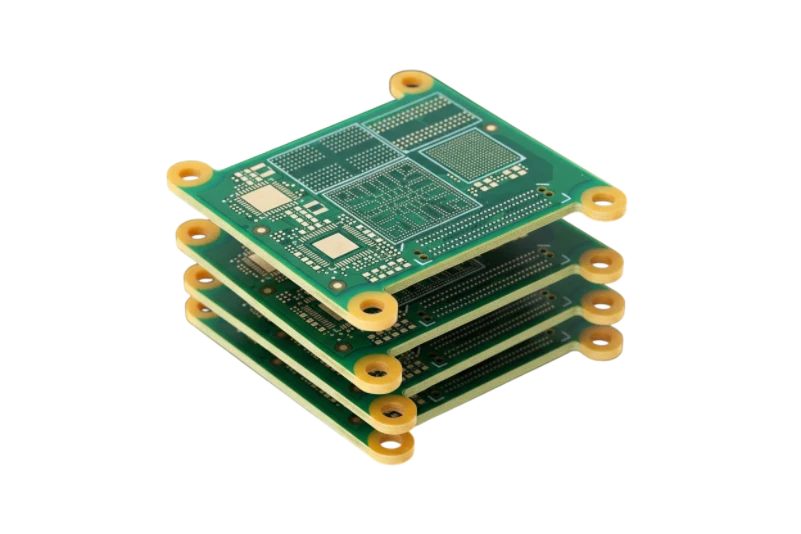
How can HBM3 interposer PCB cost be reduced without damaging signal integrity?
HBM3 packaging cost optimization is a balance between routing density, electrical performance, thermal reliability, and manufacturing yield. The lowest-cost design is rarely the design with the cheapest material. A lower unit price is usually achieved by selecting the correct substrate technology, reducing unnecessary process complexity, and validating manufacturability before production release.
The main cost drivers are:
- Interposer technology choice: silicon, organic, or hybrid.
- Build-up layer count and lamination cycles.
- Fine-line routing requirements.
- Microvia structure complexity.
- Low-loss material selection.
- Panel utilization and manufacturing yield.
- Assembly reliability requirements.
For high-volume AI accelerators, even small improvements in yield or substrate cost can significantly affect total package economics.
Which HBM3 interposer technology should be selected for cost optimization?
The first decision is whether the design requires silicon-level density or can move to an organic solution.
| Technology | Best fit | Cost impact | Main limitation |
|---|---|---|---|
| Silicon interposer (CoWoS-S) | Maximum I/O density and ultra-fine routing | Highest cost | Expensive semiconductor fabrication and yield sensitivity |
| Organic interposer (CoWoS-R style) | Cost-sensitive high-volume designs | Lower material and manufacturing cost | Lower routing density than silicon |
| Hybrid structure | Designs requiring localized high density | Balanced cost/performance | More complex supplier coordination |
Organic substrates can reduce interposer-related costs significantly when routing density allows. The design must still satisfy HBM3 electrical, thermal, and mechanical requirements.
What design parameters have the largest impact on HBM3 interposer PCB cost?
Small specification changes can create large manufacturing cost differences.
| Parameter | Recommended range | Cost impact | Verification |
|---|---|---|---|
| Line Width/Space (L/S) | 8µm/8µm organic target to 15µm depending on process | Tighter routing increases process cost | CAM review |
| Core material | Low-CTE core around 2-4 ppm/°C where required | Reduces warpage-related losses | Material datasheet/TMA |
| Dielectric loss | Df <0.002 @10GHz for demanding high-speed layers | Lower loss protects signal margin | VNA simulation/testing |
| Build-up layers | Approximately 4-6 layers where routing permits | Fewer layers reduce lamination cost | Stackup review |
| Microvia diameter | 50µm-75µm typical range | Smaller vias increase laser and plating complexity | Drill analysis |
| Impedance control | 45Ω/85Ω ±5% depending on design | Prevents signal reflection problems | TDR testing |
| Copper thickness | 1/3 oz or 1/2 oz base copper for fine routing | Supports finer features | Stackup validation |
| Panel utilization | >85% target | Reduces material waste | Panel drawing |
| Bump pitch | >130µm for PCB-oriented approaches | Smaller pitch may require semiconductor processes | Package drawing |
What is the best material strategy for HBM3 interposer PCB cost reduction?
Material selection should follow the signal path rather than applying premium materials everywhere.
A practical approach is:
- Use ultra-low-loss materials only on critical high-speed layers.
- Use appropriate lower-cost materials for power and mechanical layers where electrical performance allows.
- Match thermal expansion characteristics between silicon, substrate, and assembly materials.
Standard FR-4 is generally unsuitable for demanding HBM3 signal paths because loss characteristics are higher than advanced packaging materials require. High-speed PCB materials and organic build-up materials provide better control of insertion loss and impedance.
Related manufacturing capabilities:
Which HBM3 cost optimization choices create the highest risk?
Cost reductions must be evaluated against manufacturing yield.
| Design change | Possible saving | Main risk | Engineering check |
|---|---|---|---|
| Reduce layer count | Lower fabrication cost | Crosstalk and routing congestion | SI simulation |
| Replace stacked vias with staggered vias | Better yield and lower complexity | Routing limitations | Via structure review |
| Reduce material grade | Lower BOM cost | Higher insertion loss | VNA/TDR validation |
| Reduce core thickness | Lower material cost | Warpage during assembly | Warpage measurement |
| Increase panel density | Lower unit cost | Manufacturing constraints | Panel utilization study |
How should engineers choose between silicon and organic HBM3 interposers?
Use the routing requirement as the primary decision factor.
| Requirement | Recommended direction |
|---|---|
| Extremely high I/O density and minimum pitch | Silicon interposer |
| High-volume production with cost pressure | Organic interposer |
| Mixed density requirements | Hybrid architecture |
| Mature HBM3 design with stable routing | Optimize organic substrate process |
Organic solutions are attractive when the design can meet routing requirements without forcing semiconductor-level manufacturing complexity.
What HBM3 interposer PCB DFM checklist should suppliers receive?
A supplier review should begin before the design is frozen.
Provide:
- Gerber RS-274X or ODB++ files.
- Complete stackup drawing.
- Copper layer definitions.
- Drill chart.
- Controlled impedance requirements.
- Material preferences.
- Assembly temperature profile.
- Production quantity and lead-time requirements.
The supplier should review:
- Minimum trace width and spacing.
- Microvia reliability.
- Copper balance.
- Lamination sequence.
- Warpage risk.
- Panelization efficiency.
- Surface finish compatibility.
A complete DFM review prevents expensive redesign after tooling begins.
What are the most common HBM3 interposer PCB failures and fixes?
| Failure mode | Typical cause | Verification | Corrective action |
|---|---|---|---|
| Excessive warpage | CTE mismatch or unbalanced stackup | Shadow moiré measurement | Adjust core structure or copper balance |
| Closed eye diagram | Excessive dielectric loss or impedance mismatch | SI simulation/VNA testing | Upgrade critical signal materials |
| Microvia cracking | Excessive via stress or poor plating control | Cross-section analysis | Use more reliable via structures |
| Fine-line opens | Process capability mismatch | AOI inspection | Adjust L/S or manufacturing process |
| Underfill voids | Surface irregularity | C-SAM inspection | Improve planarization and surface control |
| Pad lifting | Material adhesion weakness | Peel testing | Select compatible materials |
How does the manufacturing process affect HBM3 interposer PCB pricing?
The production sequence directly affects yield and cost.
A cost-controlled workflow includes:
- Define the signal integrity budget.
- Select substrate technology.
- Create a balanced stackup.
- Optimize via architecture.
- Maximize panel utilization.
- Complete DFM review.
- Validate prototype yield before mass production.
A design that enters production with unresolved routing or material assumptions usually creates higher total cost through rework and low yield.
What should be included in an HBM3 interposer PCB supplier comparison?
Use this supplier checklist during qualification:
| Evaluation item | Supplier capability to confirm |
|---|---|
| Fine-line capability | Minimum production L/S and yield data |
| Material experience | Low-loss and ABF-compatible processes |
| Microvia capability | Laser drilling and reliability testing |
| Electrical testing | Netlist, impedance, and signal validation |
| Thermal reliability | Warpage and reflow data |
| Volume production | Proven panel yield and capacity |
HBM3 interposer PCB cost optimization FAQ
How much can switching from silicon to organic save?
Potential savings depend on routing requirements, package design, and yield. Organic approaches can reduce interposer-related costs when the density requirements are achievable with substrate processes.
Can HBM3 use standard FR-4?
For demanding high-speed HBM3 paths, standard FR-4 is generally not appropriate. Low-loss or ultra-low-loss materials are typically required.
Does reducing layer count always reduce cost?
No. Layer reduction helps only when signal integrity, power delivery, and manufacturability remain acceptable.
What testing should not be removed to reduce cost?
Critical electrical validation should remain. Typical requirements include netlist testing, impedance verification, and material/process validation.
What files are required for a DFM cost review?
Provide ODB++ or Gerber files, stackup information, drill data, material requirements, impedance specifications, and production targets.
Resources for HBM3 interposer PCB cost optimization
HBM3 interposer PCB cost optimization glossary
| Term | Definition |
|---|---|
| Interposer | High-density connection layer between logic and memory devices. |
| TSV | Through-silicon via used in silicon interposer structures. |
| RDL | Redistribution layer used for dense routing. |
| CTE | Material expansion coefficient affecting thermal reliability. |
| mSAP | Fine-line PCB manufacturing process for advanced substrates. |
| Bump Pitch | Distance between adjacent package connection points. |
| ABF | Ajinomoto Build-up Film used in advanced organic substrates. |
| Impedance Control | Maintaining controlled electrical characteristics for high-speed signals. |
Request a quote for HBM3 interposer PCB cost optimization (DFM review + pricing)
Ready to evaluate your HBM3 interposer design for cost reduction opportunities?
Provide:
- Gerber files or ODB++ package data.
- Stackup drawing.
- Material requirements.
- Volume forecast.
- Lead-time requirements.
- Controlled impedance specifications.
Conclusion: the lowest-cost HBM3 design is the one with the best manufacturing fit
HBM3 interposer PCB cost optimization requires engineering decisions across routing density, materials, stackup construction, and supplier capability. The strongest cost reductions come from removing unnecessary process complexity while preserving signal integrity and assembly reliability.
A validated organic or hybrid approach, supported by early DFM review, can reduce manufacturing risk and improve total package economics without sacrificing HBM3 performance.